 A finalist in the 2011/12 European Literary Awards, White Wahala is a modern tall tale with a dark South Africa twist. When Alasdair Nicholson, a spoilt young banker from a wealthy family, heads towards Soweto with his little sister to buy drugs, he sets in motion a chain of disastrous events which will put his entire family in grave danger, expose a long-buried secret, and end up in the headlines amidst an intrigue of national proportions.
White Wahala is populated by exaggerated characters whose outrageous actions and the dubious reasoning behind them take us to the heart of the misunderstandings and fears we encounter in everyday life as South Africans of all backgrounds. Ekow Duker’s take on the present state of the country has the potential to generate a lot of debate. It is impossible to remain neutral towards the story. My own personal response was a mix of incredulity and anger.
White Wahala
by Ekow Duker
Picador Africa, 2014
First published in the Cape Times on 26 September 2014.
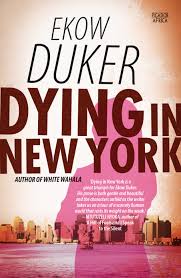
 It is difficult to write about Ekow Duker’s second novel, Dying in New York, without giving away the ending, an unexpected twist on which the entire narrative hinges. The book’s pre-teenage protagonist, Lerato Malema, suffers horrendous abuse at the hands of her father. Her mother, also a victim, unable to protect her daughter, stands by hopelessly. One day, the dynamics of the setup change with fatal consequences.
The only thing that keeps Lerato going is a vague fantasy about the city of New York which she shares with her mother. Propelled by her vivid imagination, she embarks on a roller-coaster ride through contemporary South Africa where she encounters the worst of what the country has to offer, with very little to relieve the alienation, horror and pain of her dark adventures. Reality and fantasy blur uncomfortably, revealing a highly unsettling picture of violence and insanity.
Dying in New York
by Ekow Duker
Picador Africa, 2014
First published in the Cape Times on 3 October 2014.
 For the past fifteen months the digital version of Aerodrome has been an exciting platform for all things literary. Immensely pleasing to the eye, it publishes fiction, poetry, reviews and a particular favourite of mine: author interviews. Freshly launched, the first paper issue of Aerodrome is an aesthetic gem and opens with several interviews with writers and artists such as Isobel Dixon, Zapiro, Mary Watson, Anton Kannemeyer, Conrad Botes and Zoë Wicomb. It also offers the best of the first year’s digital content and includes a few specials which will appear online later. A personal highlight is one of the exclusive features: an inspiring interview with Damon Galgut in which he states that you can recognise a real writer by the way they approach language. In this respect, Megan Ross’s short story “The Accidental Colour” and Jane McArthur’s poem “The Girl from Witwatersrand” delight.



 Karina Magdalena