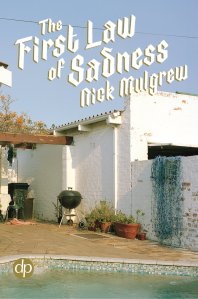
 The short story continues to fascinate me for two reasons: the precision of thought and execution it attracts as well as its unpredictability. If well done, it can surprise and satisfy like nothing else in literature. And Nick Mulgrew does the genre justice like few other contemporary South African writers. His work has been recognised with multiple awards and his vision and skill have been highly acclaimed by critics. Mulgrew is also an editor and the director of the flourishing poetry press, uHlanga, which published his debut poetry volume, the myth of this is that we’re all in this together, in 2015. In his many impressive literary incarnations, Mulgrew understands that short art forms require meticulous attention to language. He knows how to make words count.
Mulgrew’s debut collection of stories, Stations (2016), was a stunning accomplishment. His latest, The First Law of Sadness, expands on the predecessor’s sound foundations and takes us to the heart of sorrow: “There is the universe, I have come to know, and it is full of pain. This pain can neither be created nor destroyed: only transferred. For every pain healed in someone, a new one is felt in another.” This is the titular “first law of sadness”. Sadness in these pensive and beautifully crafted short stories comes in many guises, manifesting as loss, loneliness, melancholy or anguish. Each piece is accompanied by a colour photograph from the series “Robot Run” by Michael Tymbios, a Cape Town-based graphic designer. The images add a soulful dimension to the narrations.
The First Law of Sadness opens with a thought-provoking, and unsettling, epigraph by Genna Gardini: “Horror’s not the seedling. It’s the pot.” It is followed by an eerie prose passage in italics which includes this paragraph: “Your body, face-down. Ripples from the skin. Buoy at the edge of the world. Your body, it turns. Blue face, neoprene. A smile of teeth, beckoning. A hand of fingers, divining.”
Then a photograph and the title “Anew” announce the first story in the collection. The image is of skid marks on a road heading into an overpass tunnel on a clear, sunny day. Human presence is implied by its absence. There is a suspicion that despite appearances, something is out of control, that the calm of the surroundings is only an illusion. You never know what will shift a straightforward situation into a different gear or what will be needed to survive. The opening lines of “Anew” confirm the sense of instability and passing, setting the tone for the entire book: “Like water, it evaporates. Some small memory, in the sitting room, with the green damask carpet, the Lladros a silent audience. Sifting pictures on the floor, captured light, un-mounting paintings from the wall-paper. Last week’s newspaper, bubble wrap, boxes in the ruin. Strange how there is no memory now of what was living, but only the cleaning, the division of spoils.”
The First Law of Sadness includes ten other short stories, each introduced with a striking photograph by Tymbios. The images, ranging from an empty petrol station at night to a flower arrangement on display next to a car seem mundane at first glance, but closely observed, they can reveal moving stories in their own right and enrich the eerie atmosphere of the collection.
In “For Sale: Set of Secondhand Imported Momo Mags for Toyota Corolla (Mint Condition), Bargain”, an online sales ad for the item described in the title tells the tale of heart-breaking loss, reminiscent of the famous six-word story: “For sale: baby shoes, never worn.”
“Ever Elizabeth” captures the moment of return to a place of one’s past, when anything but escape felt like a trap. Elizabeth comes back to Port Elizabeth where, from the moment she lands at the airport, everything feels out of joint: “Everything built for a future that never became a present. An international airport with flights only as far as Johannesburg. An arrivals hall with one rotating carousel. Unused custom booths, filing cabinets gathering the receipts of years.”
In “Bootlegger”, Yerodin Fermin, a foreign student at Rhodes, runs over a duiker on his way to Grahamstown while under the influence of drugs. He comes up with a wild idea what to do with the carcass of the animal. In “Rise of the Shogunate”, the narrator tries to deal with the challenges of his post-divorce life with an interest in Japanese aesthetics. An encounter with an albino turtle exposes a heart-breaking vulnerability in “The Turtle-keeper”. A dog is killed by a bird of prey in “Smaller”; the incident brings the pet owner’s ugly emotions to the surface. Unwillingly, a man becomes an internet porn sensation in the sinister “Patron”. The removal of a man’s tattoos tells his story in “Therapist”. Seeing the Springboks after their World Cup win, Kip’s life takes a new turn in “Jumper”. Help arrives in an unexpected form after a freak plane accident in “A Descent”.
The last image in the book is of a dark ash-grey gargoyle statue with burning red eyes. But the gargoyle is not perched on a building as usual and is unable to fulfil its traditional architectural function (to convey water away from the structure it aims to protect). It just sits there panting on the ground in front of a dull brick wall. Another creature seems to be attached to the wall behind it, but it is impossible to discern what it is, as only a part of a curled tail is visible at the top of the picture. I wasn’t sure whether the image is meant to go along with the photographer’s biographical note on the next page, or whether it is a visual comment on the proceeding texts. If the latter, it is a brilliant conclusion to the collection: a displaced gargoyle and an unidentified tail are the perfect symbols for a book of stories in which everything and everyone seem lost in one way or another.
The First Law of Sadness
by Nick Mulgrew
David Philip, 2017
Review first published in the Cape Times on 23 February 2018.
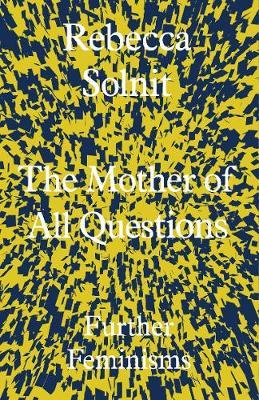 It was by pure chance that I discovered a recent online essay by Rebecca Solnit in which she was writing about women, art, motherhood and selfishness. As a creative woman who chose not to have children, I found it most affirming. After some research about the author, I could not believe that I had never encountered Solnit’s work before. But fortunately, the article led me to her impressive oeuvre and the latest piercing collection of essays, The Mother of All Questions: Further Feminisms. In the introduction, Solnit mentions “the rapid social changes of a revitalized feminist movement” and how it is “changing our understanding of consent, power, rights, gender, voice, and representation.” She speaks of the movement as being “gorgeously transformative”.
 A house robbery “gone bad” is sadly not an uncommon occurrence in South Africa, in reality or in fiction. The one with which NR Brodie’s debut thriller Knucklebone opens seems routine enough: two young men try to break into a home in Johannesburg; one escapes but is eventually caught, the other one is shot dead by the owner. But here, nothing is at it appears.
 I have been away.
 The occasion for trying to fly long distance again was of high importance: Miś, aka our mother, was celebrating her 70th birthday this month and all she wished for was to have both her children in the same room. For most mothers this is no problem whatsoever, but for our mother – with me living in South Africa and my brother’s itchy feet – the two of us in one room is a rare occurrence. She lives in Austria. The last time she was in the same room with both her children was in Cape Town three years ago when she was here to take care of me after André’s death. But she couldn’t stay here forever.
 And now, finally, we sat there all together as a family and ate the traditional Sacher Torte and celebrated Miś’s 70th birthday for an entire week. It snowed. There was water. And my favourite beer, Uttendorfer. To welcome me, Miś prepared the special dish I always ask for when I visit. We spent a few days around her birthday – one of them was the anniversary of André’s death – in Bad Ischl. Thermal springs, a hike on the Katrin, the Zauner restaurant, and the ghosts of the imperial past lingering everywhere. The birthday dinner was a Hauben-delight.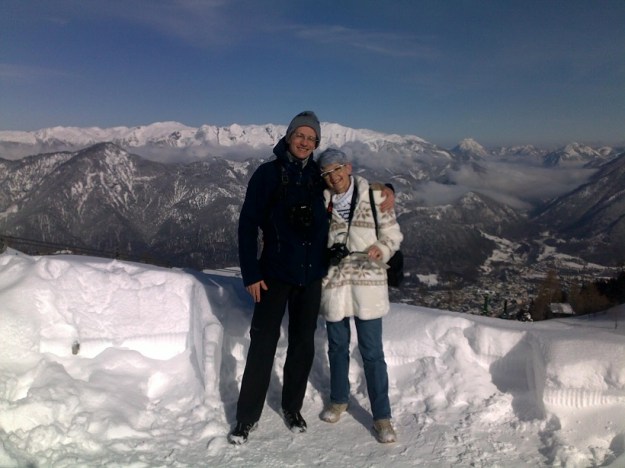
 During my visit, I had lots of coffee with Miś who is solely responsible for my addiction; had long chats with Krystian sitting next to him and not in front of a computer screen; saw old friends and knew exactly why they have always been so dear; in my mother’s attic, found the small green fork I used to eat with as a child; walked along my beloved Mattig; spoke German; sat quietly in my mother’s guest bed in the mornings when everyone else was still asleep and read Rehana Rossouw’s latest novel, New Times, set in Cape Town, in preparation for
  Like most readers across the world, I first became aware of the South Korean writer Han Kang when she won the Man Booker International Prize two years ago for her phenomenal novel, The Vegetarian. It was recommended to me by a friend who bought it because of the award. Since then, I have read Han’s other works translated into English: the harrowing Human Acts and her latest, The White Book.
 “The true character of a society is revealed in how it treats its children.” Nelson Mandela’s famous words echo the understanding that we can be judged by the way we treat the most vulnerable members of our communities, whether these are children, the elderly or the differently abled. Reading Valeria Luiselli’s Tell Me How It Ends: An Essay in Forty Questions, we are reminded how we fail to protect those who need our care. The story she outlines is set across the two Americas, but it resonates with so many other tales across all continents where displaced people are escaping horror or looking for decent opportunities to build their lives.
 Karina Magdalena