 It is heartening to see the proliferation of high quality poetry collections on the local literary scene, publishers like uHlanga Press, Modjaji Books, Protea Book House and Dryad Press leading the way. The history of intimacy by Gabeba Baderoon – “[a]n exquisite new collection from one of South Africa’s finest, most treasured poets”, according to Nadia Davids – is the only poetry volume published by Kwela Books this year, but one which is a most welcome addition to the plethora of distinguished South African poetic voices. It is Baderoon’s fourth after The dream in the next body (2005), The museum of ordinary life (2005) and A hundred silences (2006). She is also the author of the monograph Regarding Muslims: From slavery to post-apartheid (2014).
At the beginning of her literary career, Baderoon received the DaimlerChrysler Award for South African Poetry. The jury described her voice as being able to find “the poetic in the ordinary with a fine sense of locality and space”. They noted that Baderoon “weaves political and social issues into her poetry without sloganeering. Her work tackles a wide range of themes, astutely shifting the focus from the outside to the inside.” These remain her strengths as she takes us on a poetic journey of note in The history of intimacy.
The shift described above is beautifully captured in poems like “Axis and revolution” and “Stone skin”. In the former, we find the following lines: “In the door, I am a reflection/ on reflection, gleaming/ against the facing windows, seamless/ turning, turning// outside into inside, opening/ a dark glint of entry to your house./ Through glass skin,/ I am inside, invited in.” And in the latter: “In the castle the statues stiffen/ with perfection. Outside the stone walls/ the Senegalese immigrants hold out their hands/ full of roses and good fortune.” These “gestures”, we are told, “are not aesthetic, are not silent.” Only “the stone wall keeps in its place [at night]/ and outside, the silence, the growing silence”. Local history is encapsulated in the skin of stone, and the present moment of the foreign immigrants is alive in their skin and gestures of hope, commerce and exchange…
Continue reading: LitNet
The History of Intimacy: Poems
by Gabeba Baderoon
Kwela, 2018
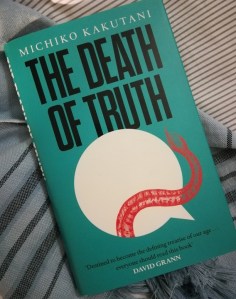 “For journalists everywhere working to report the news”, says Michiko Kakutani’s dedication in her latest book, The Death of Truth, published only a few weeks ago. The Pulitzer Prize-winning literary critic started her journalism career at The Washington Post, the newspaper that Jamal Khashoggi was writing for at the time of his brutal murder earlier this month.
 The city is Lviv. The house with the stained-glass window is an architectural treasure. The four generations of women living in it are steeped in the setting’s rich and deeply troubled history. And so begins Żanna Słoniowska’s magnetic debut novel. Ukrainian-born, Słoniowska has settled in Cracow, Poland, and published The House with the Stained-Glass Window in Polish. It won the esteemed Znak Publishers’ Literary Prize and the Conrad Prize for first novels. It was shortlisted for Poland’s most prestigious literary award, the Nike (not to be confused with the sports brand), a respected recognition. Translated seamlessly into English by Antonia Lloyd-Jones, the book is one of those historical novels that manages to encapsulate a century of socio-political hopes and upheavals in Ukraine’s most famous city by portraying the private and intimate lives of a single family, specifically the women who shaped its core.

 Karina Magdalena