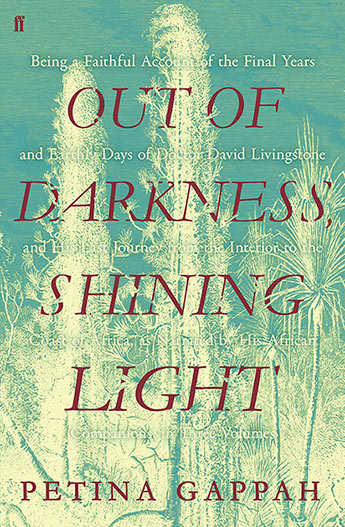
 “Whoever heard of a group of people marching from place to place with a dead body?” It is precisely such a journey that is at the centre of Petina Gappah’s latest novel, Out of Darkness, Shining Light. Two decades in the making, the book tells the story of the sixty-nine men and women who decided to carry the body of Bwana Daudi – the Scottish physician and explorer David Livingstone – across the African continent after his death, so that his remains could be interred in his own country.
“In the grave we dug for him under the shade of a mvula tree, his heart, and all the essential parts of him, are at one with the soil of his travels. The grave of his bones proclaims that he was brought over land and sea by our faithful hands.”
The novel has two primary narrators: the expedition’s cook, the slave woman from Zanzibar called Halima, who is freed by Livingstone’s death, and the aspiring missionary from the Nassick school in India, also a former slave, Jacob Wainwright. Their voices complement each other perfectly in this richly textured chronicle of loyalty and betrayal, ambition and resilience, placing the emphasis on the lives of people neglected by history, the true protagonists of this particular tale.
Gappah’s approach is stunningly encapsulated in the retelling of the famous encounter between Livingstone and Henry Morton Stanley, one of numerous highlights of this sumptuously imagined historical novel. It has been a long time since I have delighted in a book so much. Out of Darkness, Shining Light is Gappah’s third novel since the publication of her exquisite debut collection of short stories, An Elegy for Easterly, ten years ago. It takes you to the heart of the continent, illuminating it with the bright torch of African storytelling.
Out of Darkness, Shining Light
Petina Gappah
Faber & Faber, 2019
Review first published in the Cape Times on 25 October 2019.
 There is nothing to be done. We are coming too late to the party, allowing doom and gloom to persist. It’s easier to remain in a state of stupor than to take up the torch of an eco-warrior. Looking around, you will be forgiven for thinking that the war is already lost anyway. And there is no doubt about it: we are the bad guys on the wrong side of history. We are destroying our environments with ignorant dedication at a mind-boggling speed. The results are undeniable and crushing.
 “You learn to like the taste of sand out here … It gets to a point where you don’t feel quite right without a grain or two in your mouth. After all, it’s what the miners eat, isn’t it?” With these words the new magistrate of a mining town in Namaqualand is welcomed by his predecessor. It is winter of 1886, and after an arduous journey, William Hull arrives in Springbokfontein to guard the rule of law in the desolate place. Hull is well-meaning but obtuse and naïve; it takes him a while to grasp that there is only one real authority in town, the Cape Copper Mining Company, and that his attempts at justice are also being treacherously undermined in his own home, under his very nose. The battle of wills that ensues has tragic consequences.
 Karina Magdalena