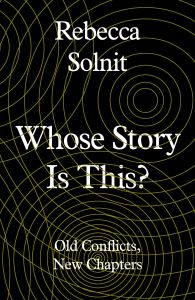
 There are numerous writers out there who understand the complexity of the present. Many can also clearly convey their insights. But few do it as strikingly as Rebecca Solnit. I have discovered her work only recently, but have read and loved all the books she has authored by now. Her latest is another intellectual delight.
Whose Story Is This? Old Conflicts, New Chapters is a collection of essays Solnit penned over the last three years. At the heart of the book is the ancient question of who and how is allowed to tell a story. It might seem simple at first glance, but there are no easy answers. And when one realises how many seminal stories are silenced and for which reasons, one can grow terrifyingly worried about the narratives that infiltrate our lives.
Storytelling and power are tensely interlinked. Credibility or lack thereof forms part of that connection. Having a voice doesn’t necessarily mean that it is your time to speak. Truth and accuracy are paramount. And perhaps most importantly for our strange times, the dominant story is often the one that is lethally misleading: “Gaslighting is a collective cultural phenomenon, too,” Solnit notes, “and it makes cultures feel crazy the way it does individual victims.” Whose Story Is This? is worth reading just for the explanation of this concept. But the book offers so much more.
Solnit’s intense clarity of thought and compassion allows us to follow her as she “maps or machetes” paths out of “this horrible tangle.” She says that it is all about the “active practice of paying attention to other people.” It is also about kindness. Our world can use a lot more of these vital skills, if we want to envisage a future that is meaningful to most, not only a few.
Whose Story Is This? Old Conflicts, New Chapters
Rebecca Solnit
Granta, 2019
Review first published in the Cape Times on 20 December 2019.
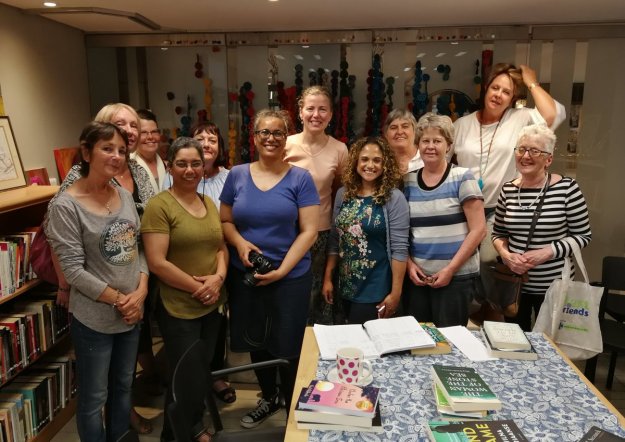
 For obvious reasons, I chose to speak about a few of the women in my life who shaped my creativity and were instrumental in paving my way towards a career in writing, editing and publishing. It was impossible to honour all of them in a short time, but these are the women who featured in my talk yesterday: my grandmother, Babcia Marysia, and my Mom, both of them nurtured my creativity in indirect but significant ways; Mrs Nellie Fahy, the librarian who awakened my passion for reading; Nadine Gordimer, whose writing brought me to South Africa for the first time; Maureen Isaacson, who first gave me the opportunity to hone my craft as a book reviewer when she was book page editor of the Sunday Independent; Lyndall Gordon, whose work and friendship showed me how to continue being a writer in the world when I was doubting that I could; Rachel Zadok, who believed in me as an editor and through work kept me sane when my world lost nearly all connection to sanity; and Joanne Hichens, who was a stranger when I asked her to visit me in an hour of utter despair nearly five years ago, but we became friends and are now co-editors of an anthology of short stories we published together: HAIR: Weaving and Unpicking Stories of Identity.


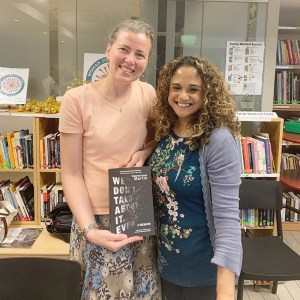 During the book club reviewing session, I also briefly spoke about the book I had finished reading that morning: Desiree-Anne Martin’s remarkable
  When a doctor pushed a shunt into her “unborn baby’s thorax to save his life from a deadly condition called hydrops”, Olivia Gordon and her husband had no way of knowing what other challenges would await them and their son before or after his birth.

 Karina Magdalena