Despite being able to transform into an object that exists in the world, in its essence, a book is a communion between an author and her readers. Unless you are writing a manual for wig making, the content of a book will hardly ever manifest as an artefact in reality. The kind of traces fiction or non-fiction leave behind are emotional and mental states, occasionally of life-changing consequences, but book content usually doesn’t metamorphose into material things.
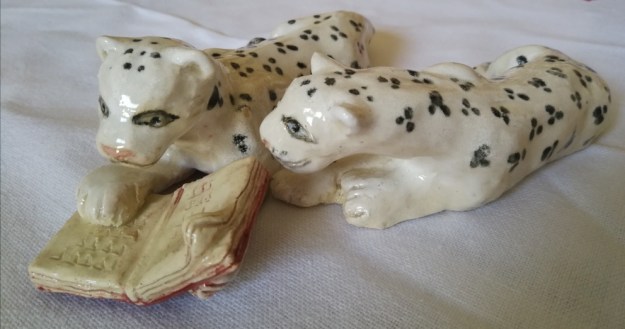
Imagine how moved I was when I pulled, out of a box, a longing which had only ever existed in my soul and as a phrase in my writing. And suddenly I held it – all real and beautiful – in my hands. It was a gift beyond imagination, a gift that only creativity can birth into the world. Pure magic: right there before my teary eyes, in my unbelieving hands. One of the most touching gifts I have ever received.
The power of storytelling.

Once upon a time, I compiled a collection of stories. Among them was Julia Smuts Louw’s “Paper House”. I have encountered Julia’s work when she was a creative writing student at UCT and I asked her to contribute to Touch: Stories of Contact. We didn’t particularly keep in touch after the project, but bumped into each other at literary events and, more recently, reconnected over our tasks of taking care of our loved ones’ literary legacies.
A while back, I got an inspiring and beautiful message from Julia about my memoir. She came to Karavan Press events. We went out to dinner. We have started thinking of working together on another literary project in the near future.
And then, a few days ago, she messaged me to say that she wanted to meet to give me something.
We had coffee. I opened the box containing my gift. A man observing the handover felt compelled to come over after we’d stopped hugging to say that it was wonderful to witness the exchange and the happiness it’d so obviously brought into the world.
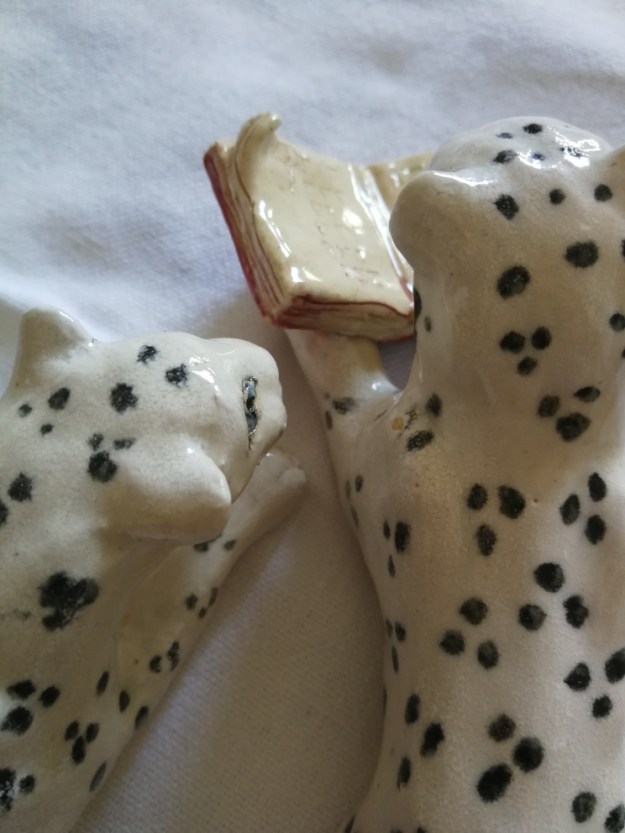
There they were: my snow leopards. Not only images in my head, but real creatures in the world that Julia had created herself after reading my memoir. The one phrase that encapsulates my being manifest in two clay statues – snow leopards reading a Karavan Press book to each other.

It is difficult to articulate magic, but here it is, sprung up among words and inspired fingertips.


Words can do this.
And all of it was happening while my dear friend, Erika Viljoen, was adding the final touches to her Afrikaans translation of The Fifth Mrs Brink, to be published by Protea Book House later this year. Another longing manifesting in the world in ways that are difficult to articulate, accompanied by a gratitude which knows no bounds. My memoir could never feel complete without an Afrikaans translation. Now it is almost here, and Die vyfde mev. Brink will have both of our names on the cover, Erika’s and mine. And we will be publishing another book together in 2020.
That’s the power of storytelling. And friendship that is like family, and more. And all those incredible journeys – new and old – that are still continuing …
… en net ’n handvol mense ken waarlik die Karina wat wild rondhol saam met sneeuluiperds.
Thank you.
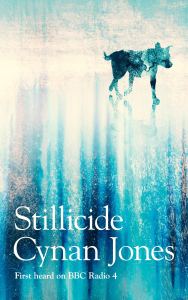 In his writing, Cynan Jones showcases the full potential of the short forms of prose – the novella and the short story. I have been a fan for years. The economy of his prose and the uncanny insight he offers into the human condition are a rare gift. Stillicide, his latest book, is a collection of short fictions which originated as a BBC Radio 4 series. The pieces are interlinked and centre around the theme of water, as the title suggests. “Stillicide” is defined as “a continual dropping of water” or “a right or duty relating to the collection of water from or onto adjacent land.”
 In his novels, Richard Zimler, who is best known for The Last Kabbalist of Lisbon, has been chronicling Jewish history throughout the ages and from all corners of the world for many years. His latest offering is an unusual, deeply touching retelling of the gospel. At its centre, Zimler places Lazarus and allows him to tell the story in a long letter to his grandson: “Picture me endeavouring to tell you matters that will never be able to fit easily or comfortably on a roll of papyrus.”
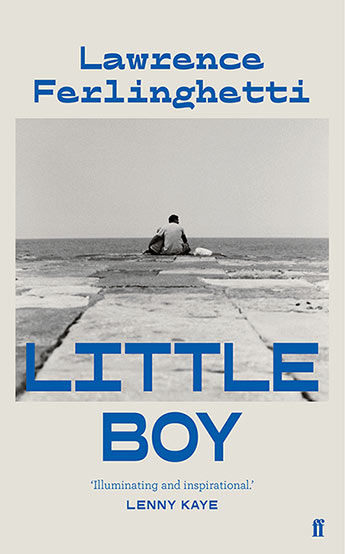 The versatile American artist Lawrence Ferlinghetti is a literary legend. For his hundredth birthday last year, Faber & Faber published a beautiful hardback edition of his latest work, a memoir in verse titled Little Boy. The cover and the first few pages lured me in at the bookshop; I couldn’t wait to take it home.
 Karina Magdalena