Please join us for a series of BOOK TALKS hosted by the FynArts Festival, taking place between 6 and 16 June 2025 in Hermanus.
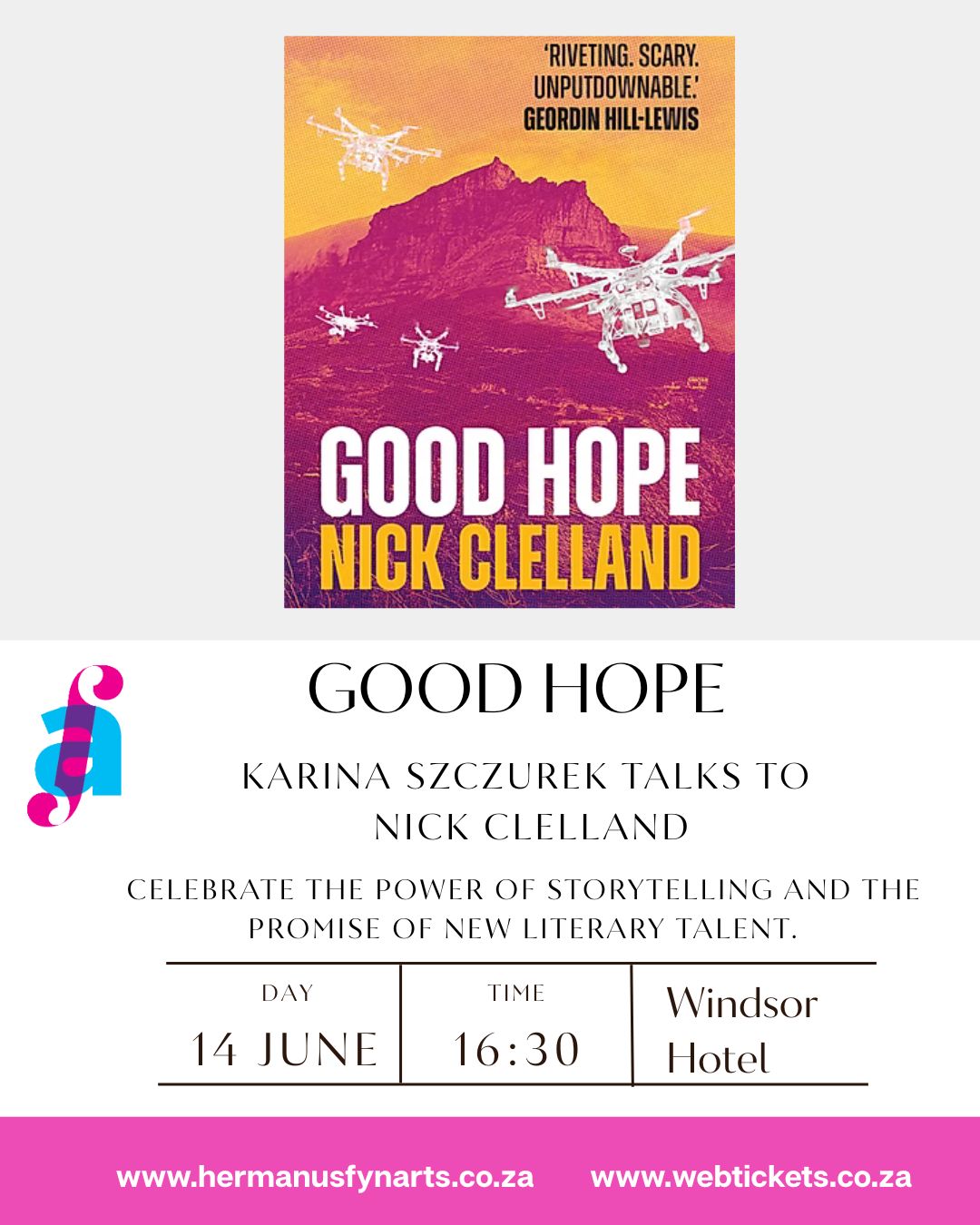
I will be talking to Nick Clelland about his debut novel, Good Hope
14 June 2025, 16:30, Windsor Hotel
Please join us for a series of BOOK TALKS hosted by the FynArts Festival, taking place between 6 and 16 June 2025 in Hermanus.
I will be talking to Nick Clelland about his debut novel, Good Hope
14 June 2025, 16:30, Windsor Hotel

Mary Douglas Leakey was a British paleoanthropologist who, among many other spectacular contributions, discovered the first fossilised Proconsul skull, an extinct ape which is now believed to be ancestral to humans. For most of her life, she worked along her husband, Louis Leakey, at Olduvai Gorge, an important paleoanthropological locality in East Africa. She was remarkable in many ways, and her legacy will inspire generations of paleoanthropologist to come. Her life, now beautifully reimagined in Penny Haw‘s latest biographical novel, Follow Me to Africa (Sourcebooks), will inspire women, especially scientists and self-taught geniuses, to follow in her determined footsteps on whichever career path they have chosen for themselves.
It is no secret that I have been a huge fan of Penny Haw’s writing for many years, and every new novel is a joy for me as a reader. What I have enjoyed most over the years, apart from the great women’s stories Penny captures between the pages of her books, is her unfolding as a writer, who – like her protagonists – is not afraid to dream big dreams and is always searching for new ways to excel at her craft. And she succeeds – she herself is a true inspiration for all of us.
Follow Me to Africa takes place across two continents and two points in time. We learn of the young Mary’s journey to becoming a world-famous paleoanthropologist, and the trials and tribulations of her love for Louis Leakey. At the same time, when she is wrapping up her successful career in the field, we witness Mary’s encounter with a young woman who reminds her very much of her younger self. And the two of them meet an extraordinary animal who changes the way they think about each other and the world around them.
Follow Me to Africa will officially reach our bookshops only in February 2025, and I cannot wait for other readers to enjoy this special novel. For more news about the publication, you can follow Penny here: pennyhaw.com
It’s 1983 and seventeen-year-old Grace Clark has just lost her mother when she begrudgingly accompanies her estranged father to an archeological dig at Olduvai Gorge on the Serengeti plains of Tanzania. Here, seventy-year-old Mary Leakey enlists Grace to sort and pack her fifty years of work and memories.
Their interaction reminds Mary how she pursued her ambitions of becoming an archeologist in the 1930s by sneaking into lectures and working on excavations. When well-known paleoanthropologist Louis Leakey commissions her to illustrate a book, she’s not at all expecting to fall in love with the older married man. Mary then follows Louis to East Africa, where she falls in love for a second time, this time with the Olduvai Gorge, where her work defines her as a great scientist and allows her to step out of Louis’s shadow.
In time, Mary and Grace learn they are more alike than they thought, which eventually leads them to the secret that connects them. They also discover a mutual deep love for animals, and when Lisa, an injured cheetah, appears at camp, Mary and Grace work together to save her. On the morning Grace is due to leave, the girl—and the cheetah—are nowhere to be found, and it becomes a race against time to rescue Grace before the African bush claims her.
From the acclaimed author of The Invincible Miss Cust and The Woman at Wheel comes an adventurous, dual timeline tale that explores the consequences of our choices, wisdom that comes with retrospection, and relationships that make us who we are, based on the extraordinary real life of Mary Leakey.
True greatness has the ability to inspire beyond its discipline. That is one of the reasons I have always loved watching sports. I grew up in a family where everything centered around cycling. When I cycled myself, between the ages of fourteen and nineteen, the most important lessons I learnt was how to push my physical and mental boundaries, and how to lose. During the five seasons I raced, I participated in two events almost every weekend (in those times not enough girls cycled, so the handful of us usually ended up in the boys’ categories – our races were anything between 30 to 100 km). I trained regularly, in all conditions. No weather was hot, cold or wet enough for me not to go out on my bike, whether alone or with the team. But I was not particularly good at cycling. I was nearly always among the last ten to finish a race, yet I finished every single one of those I entered in the five years. I remember that achievement as my greatest victory. I stopped cycling when I went to university. No regrets, just amazing memories – of perseverance and endurance. And being part of a team.
I continued watching sports, live and on TV. When I came to live in South Africa, I was immediately introduced to rugby. Initially, it did not feel like a sport I wanted to understand, but then I saw its poetry and fell in love. I can’t say I am a superfan, but give me biltong, a brandy with coke, and put me in front of a TV on a Saturday afternoon for a good game of rugby, and I will be a happy woman, win or lose.
Over the years, I have watched some incredible games, and witnessed rugby history unfolding. I also read the books, and always came away inspired.
When one of Nancy Richards’s sons, Tom Dawson-Squibb, contacted me to talk about a rugby book project he was considering, I was immediately intrigued. We met online earlier this year, had a chat about what he wanted to do and where he and his co-author – Nic Rosslee – were at, I read the first few chapters, and told him that they were on the right track – they had a great story and they knew how to tell it well. It was no surprise that a few months later, they contacted me to say: the book was at the printers and they would send a copy soon to say thank you for the conversations we had about the early stages of the project. I immediately pre-ordered a copy of the book for my love, too.
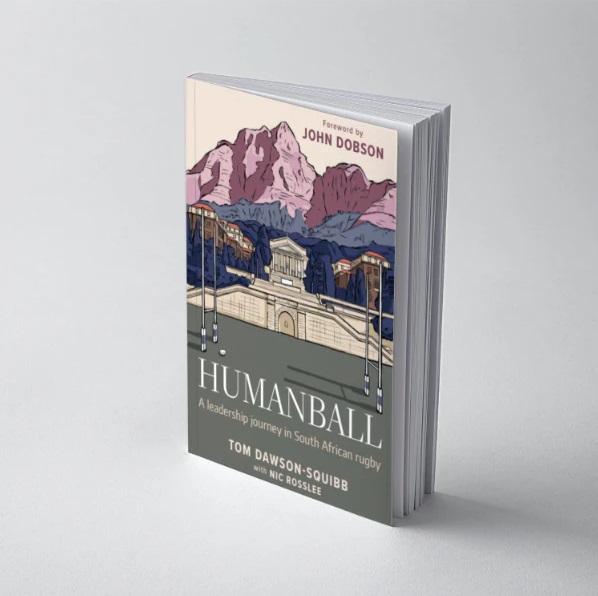
At the heart of Humanball lies the story of a team that is more than just the sum of its parts. It’s a story about getting the very best out of those around you. It’s a story about defying expectations—both those imposed by others and the ones we set for ourselves.
Performance coach Tom Dawson-Squibb tells the entertaining and inspiring story of his five years as the head coach of the University of Cape Town’s Ikey Tigers rugby team. Tom reveals how the most potent teams connect and inspire individuals to give effort far beyond what’s expected–and even what we believe to be possible at the time. He shows us how to find joy, meaning, and connection in our work and how to see much of what we call “work” as a serious form of play.
The books arrived on Friday – Humanball: A leadership journey in South African rugby. I finished reading my copy this morning. I could not put it down. It is a story to inspire beyond its own discipline. While reading, I was constantly reminded what made our team – the one called Karavan Press – special, and what I could still learn from Tom and his amazing experience with the Ikey Tigers rugby team. I feel empowered to continue building and strengthening the Karavan Press team, and inspired to continue dreaming our dreams. Like John Dobson, who wrote the foreword to the book, “I found myself reading and rereading segments and taking notes for instant application at the Stormers”. I will leave the Stormers in John Dobson’s capable hands, though, and apply what I have learnt to being a publisher.
Memorable quotes from Humanball: A leadership journey in South African rugby:
The currency of sport is trophies, and in that currency as a head coach, I am poor. But the real currency of life is found in your connections, and in that currency, I feel rich for my experience at UCT.
… I always say that the key is to surround yourself with people who are better than you. In many ways, your success is defined by the company you keep.
It’s about choosing not to play small.
… energy could be transferred through your words and your actions.
… I had an insatiable thirst for meaning and significance. I wanted to find purpose in what I did and feel a sense of significance and accomplishment.
If you make it [experience] bigger that it ordinarily would be, the players will feel special. If you make players feel special, they will behave in a way that is special. They will bring energy and performance.
… but I definitely gave a shit. I’ll never forget the importance of that.
The role of a performance coach is to help the players prepare mentally for their roles, advise and assist the coaching staff and facilitate leadership growth within the team’s structures.
To join a community where you don’t have to prove yourself as you walk through the door is a liberating thing.
… success isn’t just about personal achievements but about lifting others up along the way and making them feel great.
Every time the team stepped onto the field, the goal wasn’t just to win – it was to bring joy to the city. It reminded us that rugby was bigger than just the team; it was about the fans, the community, and the happiness we could spread.
The essence of sport is that you need to do the boring things well and often.
… we are more capable than we realise. You just need to keep being relentless in your pursuits.
And who doesn’t love a good story?
… consistently finding ways to inject joy into our environment was essential.
… it’s incredible how the losses along the way are crucial in your ability to grow as a team.
The primary focus should be on what we need from each other on and off the field to contribute to the collective effort.
I realised that collaboration isn’t just nice to have; it’s essential for navigating the inherent chaos of rugby.
If you’re feeling nervous or uncertain, judging yourself harshly only amplifies those feelings. But if you’re curious about why you feel that way, you open the door to understanding and growth.
… the best are always curious, always seeking to know more.
The same principles apply if you’re facing a personal challenge or struggling on the field. Acknowledge the issue, accept the reality, and then act decisively.
One person speaking from the heart can change the temperature of any room.
Confrontations can be awkward and unpleasant, but they are necessary. Importantly, there needs to be a strong relationship in place and the environment primed for them to have an effect. And they certainly need to come at the right time.
I’ve come to realise that the ability to get people to tell the truth to each other is crucial. When someone speaks from the heart, it can create massive shifts. But there needs to be a relationship at the foundation. Without the relationship, there ia a risk of the intended audience going into defence mode. If there’s trust and you value that person’s viewpoint, honest conversations make a real difference.
If your ‘honest feedback’ comes across as an assault on the individual’s character, you’re unlikely to get the desired effect and may find yourself short of friends. To inspire growth, you must reinforce the idea that improvement is always possible.
Being part of an environment where people contributed far more effort than was ever expected of them is something that I will forever be grateful for.
Part of what motivated me to write this book was that you can do deeply purposeful work away from the places that reward you with money or status.
Maybe the ‘how’ of making an impact isn’t so complicated. It’s about showing up with genuine passion and commitment, and as I’ve said before, giving a shit.
You can order your copy of Humanball here: humanball.co.za

Earlier this year, Debi Thomas Hawkins published her first book, Becoming a Mermaid Sister, a memoir about how the sea saved her at a time when she needed it the most. What she did not know at the time of the official publication of the book was that life was about to throw her a curveball that would take many months to recover from – but that is another story. When I saw Debi a few weeks ago, she shared what had happened to her with me, and told me how her memoir got lost in the chaos, how it never even had a proper launch. I was shocked that I did not even know it existed. But I knew how much Debi supports the literary community as a reader and a member of the Friends of the Fish Hoek Library who organise the fabulous Blown Away by Books, and I immediately thought that there was a simple way we could say ‘thank you’ for everything that she has done for all of us. So I bought a copy of Becoming a Mermaid Sister and asked Debi whether I could assist her to organise the launch of this beautiful, inspiring memoir. Luckily, she said yes.
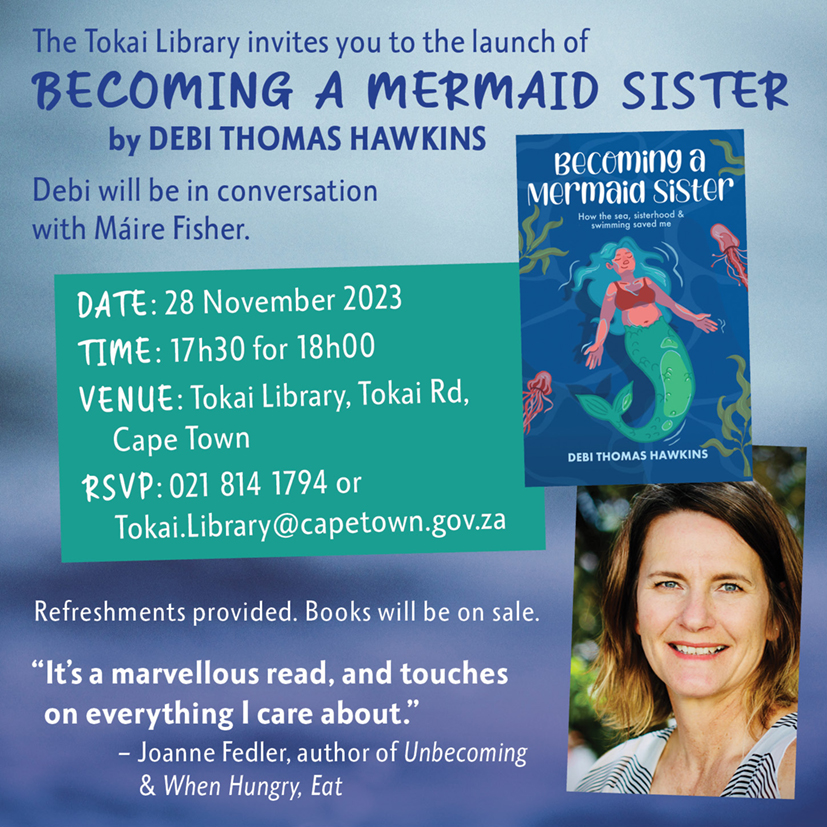
Unsurprisingly, after reading the book, I dreamt all night long about swimming in the sea, and I woke up feeling a longing to head to the nearest beach. I love the sea and I love swimming. Unlike Debi, who grew up in landlocked Zim, I grew up in a country with a magnificent sea and was introduced to its wonders as a small child. Debi moved to the Cape and the seaside only sixteen years ago, and found the courage to begin engaging with the sea only recently – when it was forbidden to do so during the deepest darkness of lockdown. It was a time in her life when she was experiencing the challenges of midlife as a woman and a mother, when she lost her job and income during the pandemic and tried to desperately reimagine herself in the new circumstances. In Becoming a Mermaid Sister, she recalls the disastrous first swim, when she and her husband Roger, aka The Pirate, decided to brave the lockdown regulations and found a secluded spot to go for a forbidden swim. They weren’t caught (not that time!), but Debi was left with “a love bite from the sea” after the adventure. Finding awe and solace in the sea, Debi and her “family bubble” found their Secret Beach and continued to swim. A traumatic arm fracture in her childhood and the resulting loss of full control over her arm made Debi fearful, and simple tasks that most of us take for granted became challenging in the everyday for her. Communing with the sea allowed her to face those fears and find a new side to her already amazing resilience. Meeting other women of the sea who practice cold-water immersion and paddling opened entirely new realms of possibility. They call themselves Mermaid Sisters. Their ethos is “kindness, support, and an unspoken trust circle.” Together, they create a space of safety that allows each member to thrive. Debi’s memoir tells the story of self-transformation that she calls “kick-in-the-butt-mation”. It is the story of how courage allowed her to discover the physical, psychological and emotional benefits of the sea, and it is a celebration of community.
“I am the champion of my life,” Debi says in Becoming a Mermaid Sister. And so she is, and she inspires all of us to become the champions of our lives.
Let’s celebrate this incredible woman and her wonderful book! See you at the Tokai Public Library on 28 November!

Unless we are suffering through a natural disaster, war, famine or pandemic, grief in the everyday is usually deeply personal. In the last three years, however, the world has been in the throes of grief on a global scale. COVID-19 and the resulting worldwide lockdowns initiated a process of communal mourning that is long from over. Many of us have turned to art for understanding and solace during this time. Art can provide both, on its creative and receiving ends. And perhaps no other art form can capture this wonder as succinctly as poetry.
The AVBOB Poetry Project began in 2017, and since then, in the words of AVBOB’s CEO, Carl van der Riet, “has expanded its reach as an essential archive representing our shared experience”. Many thousands of poems have been received since the inception. A significant number of these have found their way into the AVBOB Poetry Library, which is available online, and into the five volumes of poetry – I wish I’d said … – published as part of the endeavour. The first time I read one of these anthologies, I was surprised how much it meant to me. And now, engaging with the latest, the fifth volume in the series, gave me the renewed feeling of belonging that I’d sensed with the previous reading …
Continue reading: LitNet

“If Hell existed in the universe, it was right here,” Nellie Bly thinks to herself only a few days into her confinement on Blackwell’s Island. It is 1887, and the asylum, just off the coast of New York, is “a socially acceptable way of disposing with inconvenient women”. The difference between Nellie and the other women locked up in this hell on earth is that she is there of her own free will. Bly faked insanity to be admitted. She is one of the most dangerous of “inconvenient women” — one with a voice. Madwoman is her story.
Continue reading: Sunday Times
Madwoman ★★★★★
Louisa Treger
Bloomsbury, 2022

LitNet: You were a refugee, fleeing from an oppressive regime. Please share with us what those thousands of women and children who are now seeking refuge must feel like?
Karina Szczurek: I was a child when my parents decided to flee Poland in the 1980s. My brother was six and I was ten at the time. It was very difficult to comprehend what was happening to us, but at least we were secure in the knowledge that our parents were with us at all times and would take care of us, no matter what. Our lives were never in danger. Watching Ukrainian parents evacuate their children to safety while staying behind to fight for their future breaks my heart. I cannot imagine the levels of anxiety and distress this kind of separation causes for a family. These people will never fully recover from this, even if they survive.
LitNet: Do you know Ukraine at all?
Karina Szczurek: A little bit. I spent three weeks in the beautiful Lviv on a student exchange in 1997. We also travelled outside this historic city. It was a formative experience. During these three weeks, I experienced for the first time the real closeness of the two languages – Polish and Ukrainian – met Charlotte, who remains a very dear friend, and discovered my love for opera and ballet at the stunning Ivan Franko Lviv State Academic Theatre of Opera and Ballet (renamed since then). I specifically remember how friendly and welcoming everyone I met there was, and I will never forget their delicious black bread (I couldn’t get enough of it).
Continue reading: LitNet

Keith Gottschalk’s poem “As the sun sets” ends with the following lines: “as the sun sets/ the astronomers eat breakfast,/ set off, start work.” It is one of the first poems in his recent collection, Cosmonauts do it in heaven. The few simple phrases read like an invitation to follow not only the astronomers, but also the poet, into the night sky in order to accompany the author on his quest to honour the scientists who, throughout the ages, have observed and studied the stars above us, as well as to expose the challenges and prosecutions they have faced along their paths to understanding …
Continue reading: LitNet
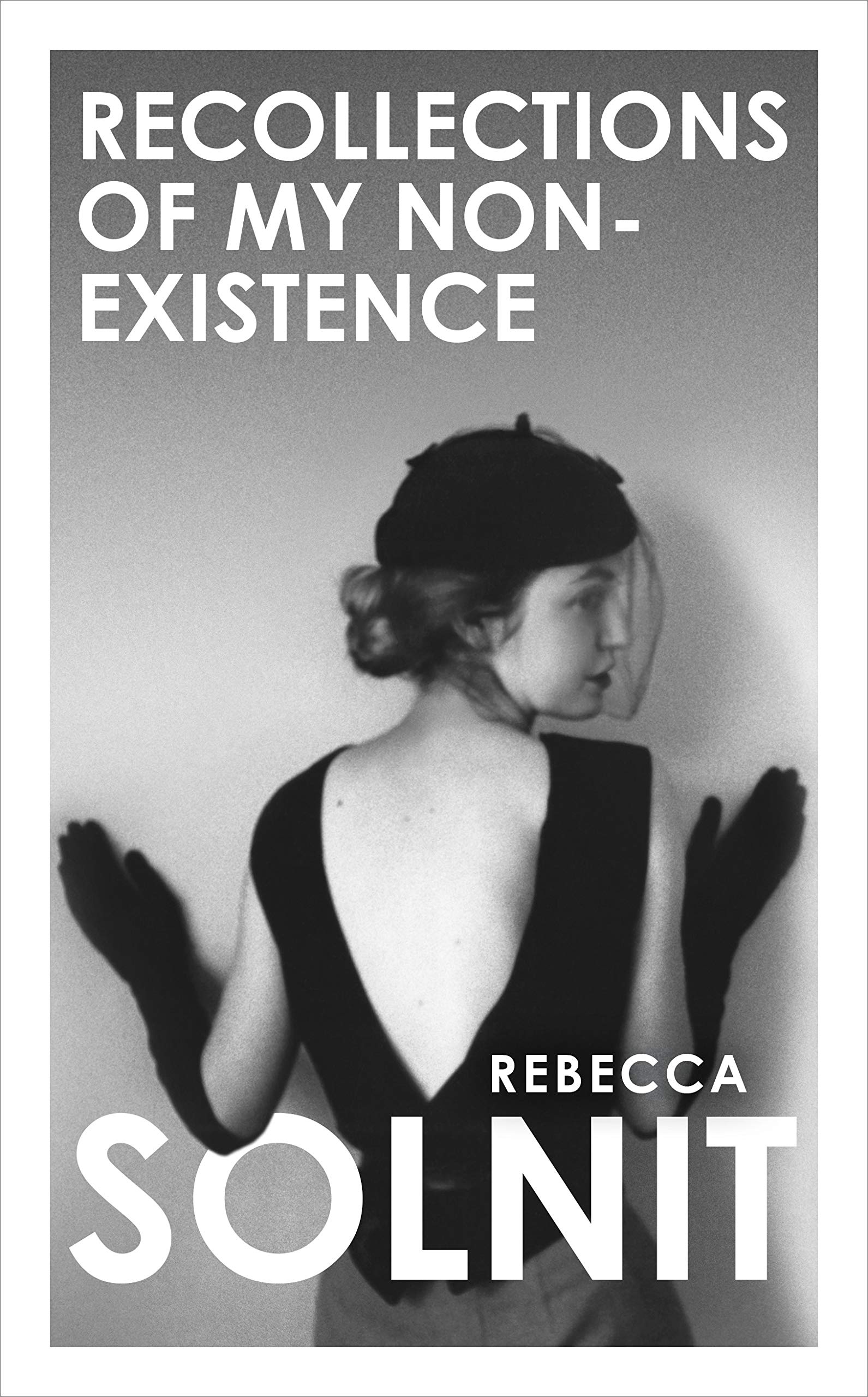
I cherish the day I discovered Rebecca Solnit’s voice. And so, as a woman and a writer, it was chilling for me to read the words that present her latest book, Recollections of My Non-Existence, to the reader as follows: “An electric portrait of the artist as a young woman that asks how a writer finds her voice in a society that prefers women to be silent.”
Solnit’s voice is a voice of reason, compassion and celebration. She could not be silenced. She is the author of over twenty titles, ranging from books about hope and walking to women’s rights and storytelling. Her oeuvre is a torch that lights the way through the darkness of this world.
Recollections of My Non-Existence tells Solnit’s personal story and weaves the history of feminism into it, empowering readers to follow in her extraordinary footsteps and yet find their own path. With every page you turn, you feel more inspired, and if you are a woman, you feel seen and recognised. The connection allows you to comprehend the ultimate need for “freedom, equality, confidence” that reality all too often denies us, but we must never abandon the desire to seek them out and make them our own.
Recollections of My Non-Existence
Rebecca Solnit
Granta, 2020
Review first published in the Cape Times on 24 December 2020.

My Mother’s Laughter: Selected Poems by Chris van Wyk, compiled and edited by Ivan Vladislavić and Robert Berold, is one of those literary gems that you will want to have on your bookshelf. Most readers will know Chris van Wyk as the author of Shirley, Goodness & Mercy and its sequel, Eggs to Lay, Chickens to Hatch, both memoirs published in the decade before Van Wyk’s untimely death of cancer in 2014.
He was a versatile writer of children’s books, autobiographical works and other non-fiction, as well as fiction. As editor of Staffrider, the literary and cultural magazine founded in the late 1970s (in existence until 1993), Van Wyk mentored a whole generation of emerging writers. In 1979, he published his only poetry collection, It Is Time to Go Home.
And now, My Mother’s Laughter brings together a selection from the debut volume, also the poems which appeared in Van Wyk’s memoirs, and includes previously unpublished work, showcasing the much-loved author’s poetic talent.
Inescapably, many of the poems from It Is Time to Go Home are set against the socio-political landscape of its time, but even decades later they radiate an energy of awareness and resistance that seems timeless and inspires to action against injustice. My Mother’s Laughter opens with “Metamorphosis”, a poem signalling transgenerational concerns about how historical events such as the Sharpeville massacre and the Soweto Uprising influenced and politicised whole generations of South Africans – a young son, “fidgeting around his [father’s] work-worn body / asking questions at his shaking head”, as a teenager trying to make sense of the world “after June 16”, ends up comprehending what was and is at stake: “I nod my head. / I understand.” Despite the horrors witnessed and the struggles which followed, the sense of hope for a better tomorrow does not abandon the poet. One day, he assures, hearts “will throb / to the rhythm of a drum / And all of Africa will dance”.
The political poems are interspersed with tender love poems, dedicated to Kathy, Van Wyk’s future wife. They were married in 1980 and had two sons. “I am happy here; / just being against your navel”, the poet declares in “You Must Never Know I’m Writing You a Love Poem”.
The previously uncollected poems evoke a strong sense of home and community, how the world infiltrates both with its deeply troubled realities, but also how family bonds and friendships as well as commitment can, if not shelter you from the worst, at least allow you to confront it. They are tributes to heroes of the struggle and heroes of the everyday alike. Van Wyk remembers his “ouma’s yard” and how the “black words / on the white sheets” of the books she bought for them were “like coal strewn across a field of snow.” Equally, his “mother’s laughter” sustained the family throughout the harsh winter of oppression.
My Mother’s Laughter: Selected Poems
Chris van Wyk
Deep South, 2020
Review first published in the Cape Times on 4 September 2020.
 Karina Magdalena