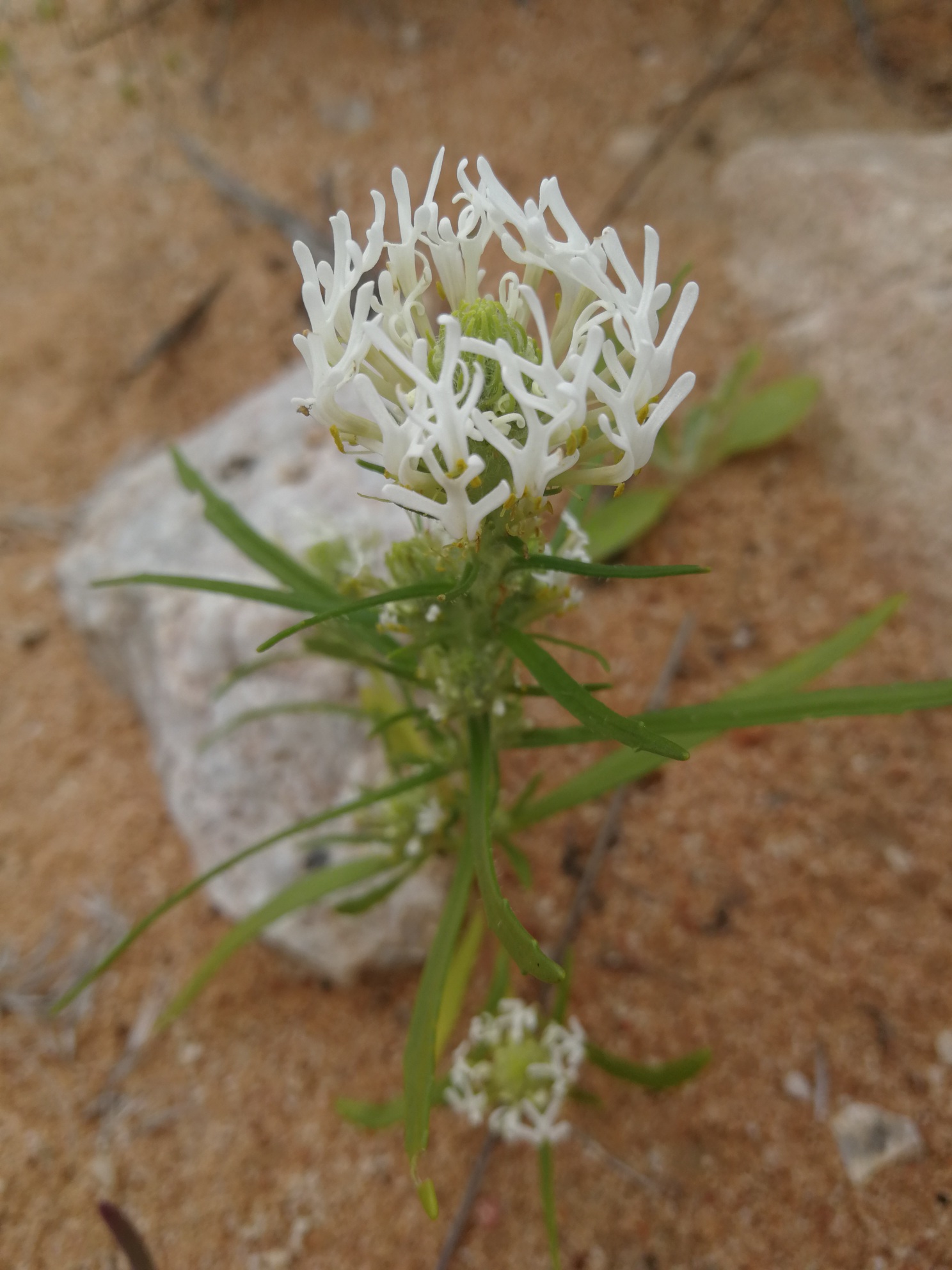
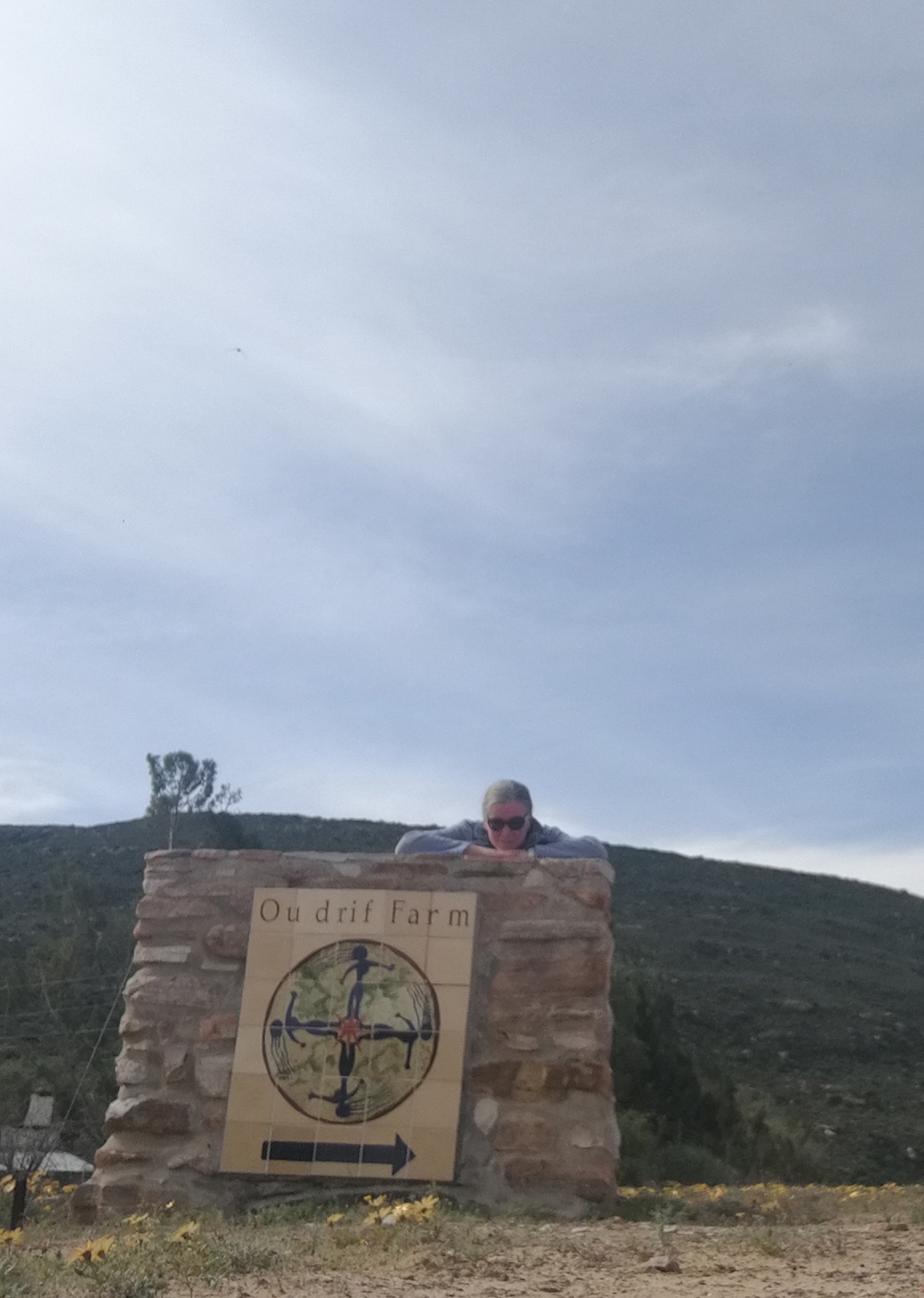
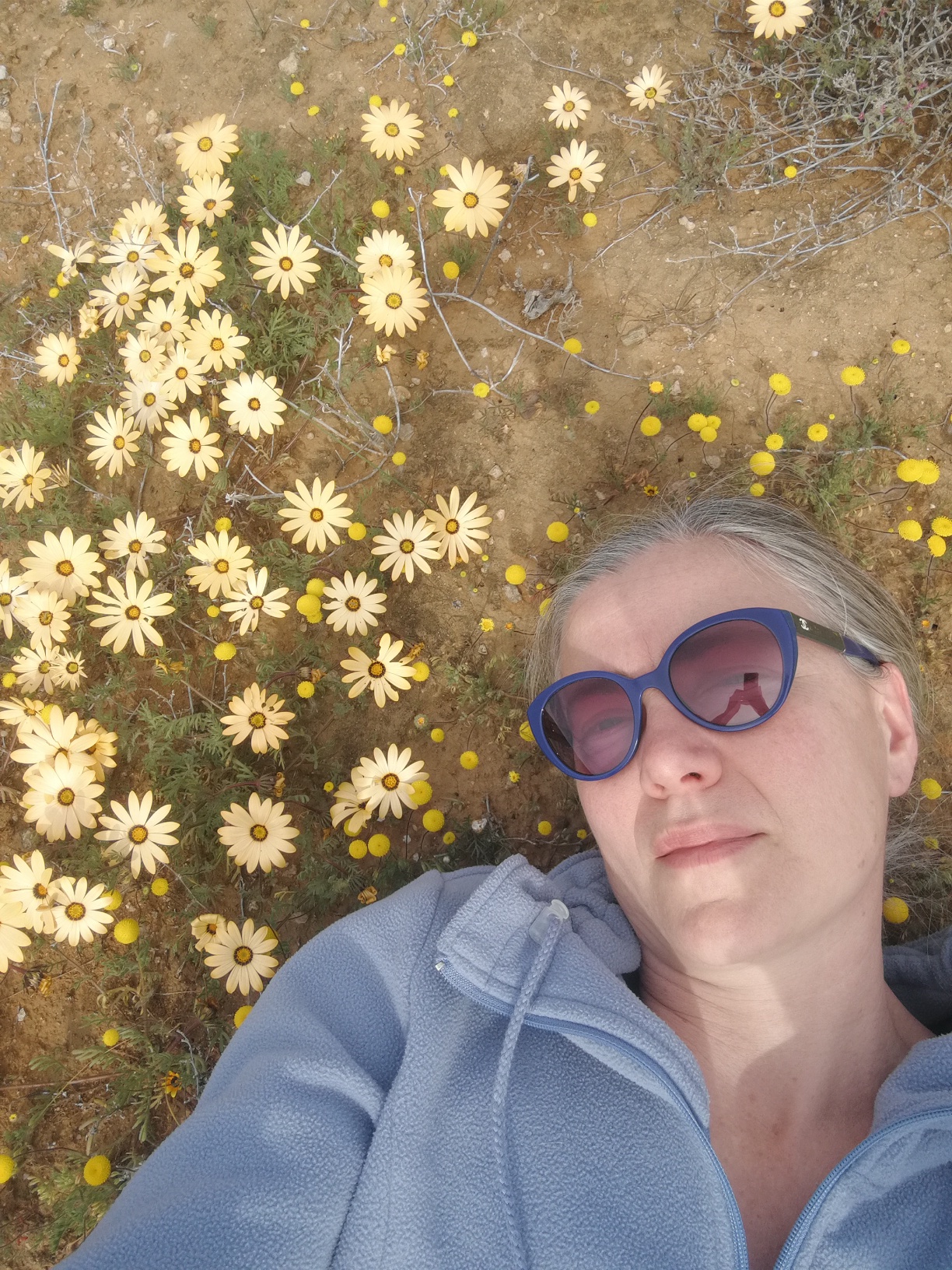
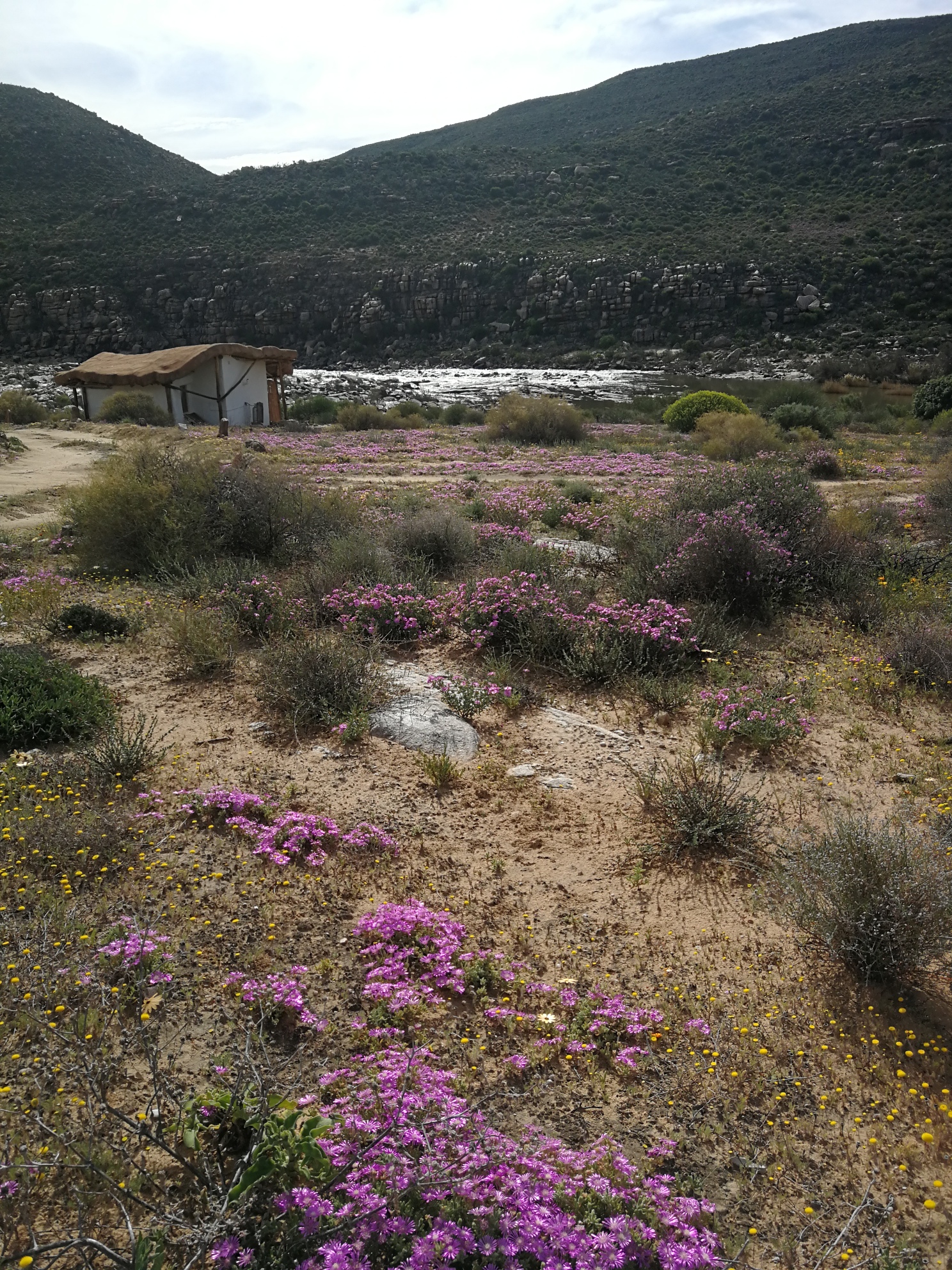
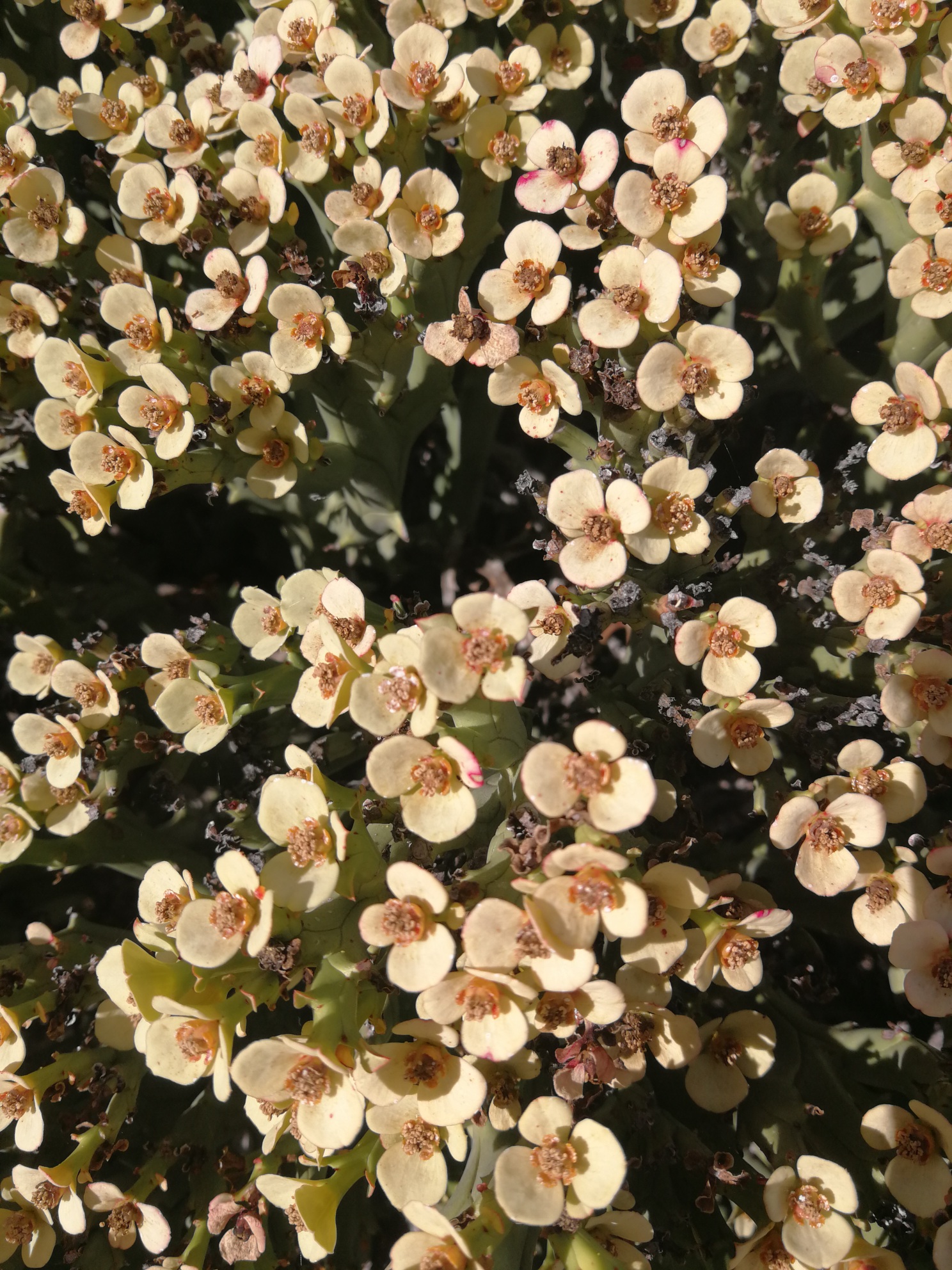
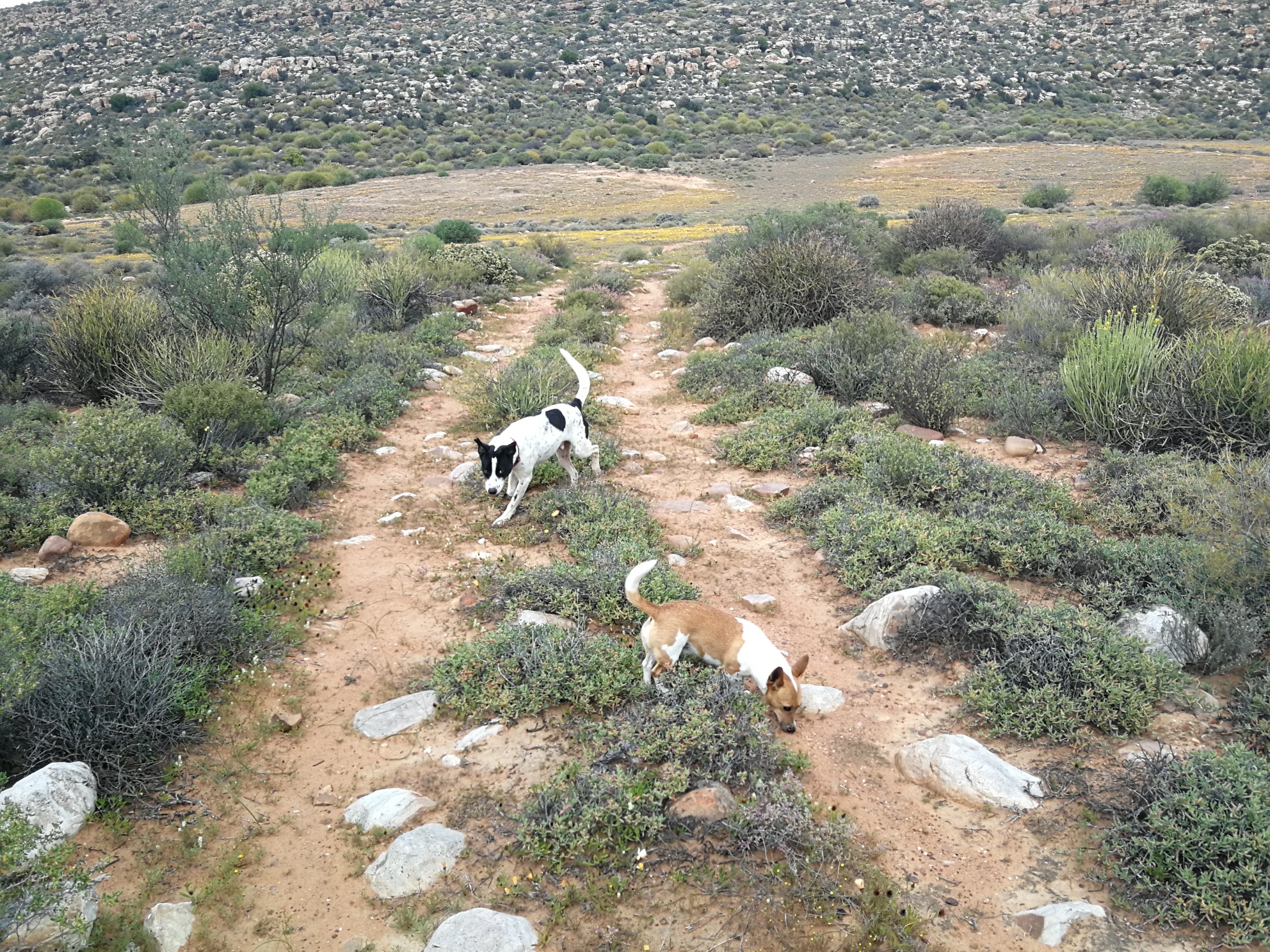
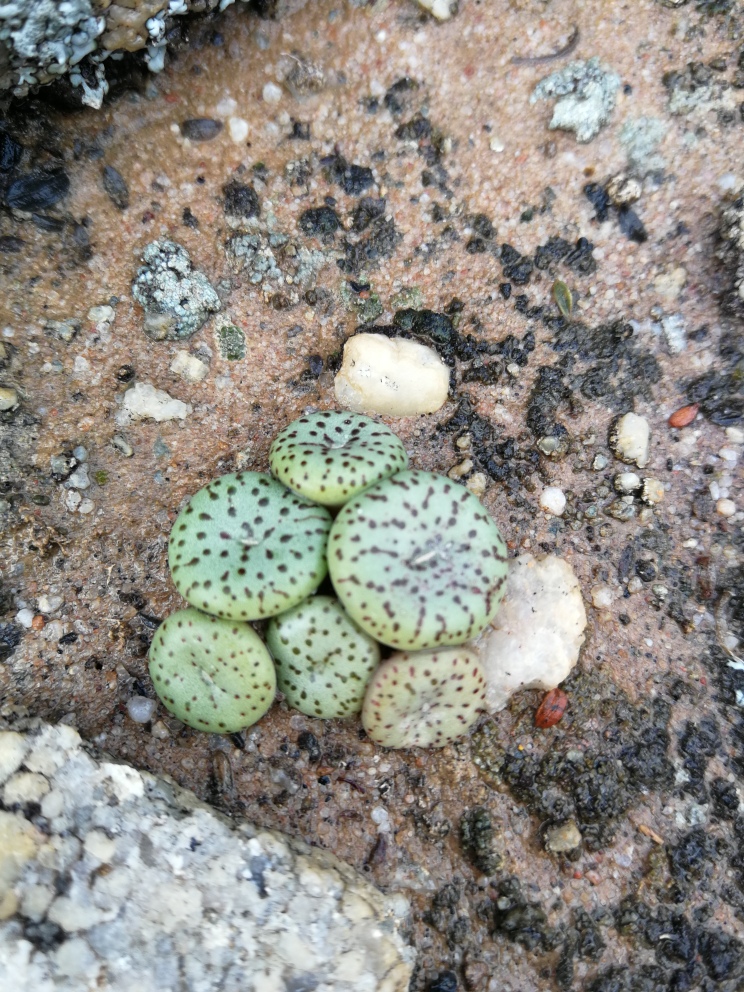
I arrived with a clenched jaw, a sore back and stomach cramps. In a few hours of welcoming hugs, delighted doggie barks, kitty purrs, gentle walking, blooming flowers, delighting in delicious food and many, many deep breaths, I began to feel human again, all the tensions and pains leaving my body, carried away by the honey-scented breeze and the rapids of the shimmering Doring River.
Oudrif, the place I always return to — my soul’s home.
Only three days at Oudrif restored me to myself. The last few weeks have been extremely stressful again — change is never easy, even if it is for the better — but a weekend in this blissful place in the Cederberg always inspires me and recharges my batteries, allowing me to face everyday life again. Many thrilling things are happening, and good news is coming in almost daily. A period of transition still lies ahead, but I feel ready. It’s time to bloom and celebrate, and to leave the stresses of the recent past behind me.
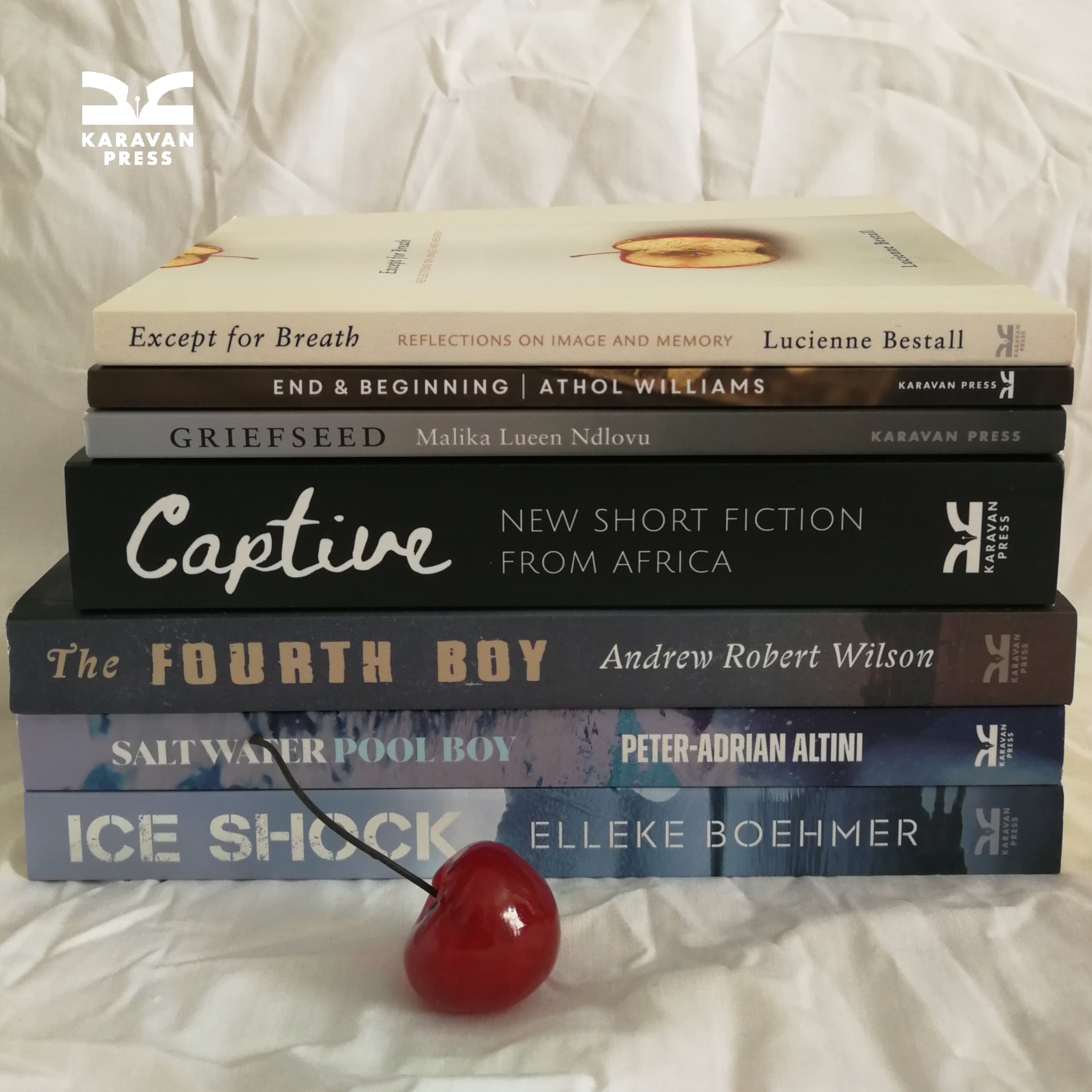
Oudrif is full of stunning nature, beauty and powerful stories. It attract visitors who are often avid readers — writers also visit, among them quite a few I have had the privilege of working with — and so I always make sure that Karavan Press books are available in the Oudrif library for eager hands. For the past few years, the sales of our books at Oudrif have also supported CLAWS (Clanwilliam Animal Welfare Society). And now, third time in a row, a Karavan Press book hamper is one of the prizes you can win when you enter the annual CLAWS Lucky Draw.
One of the CLAWS/Oudrif miracles I’ve witnessed over the years is Jack’s full recovery from near-death caused by terrifying neglect and cruelty. When Jeanine Mitchell of Oudrif rescued Jack, he was on the verge of starving to death and he could not walk. During my recent visit, Jack joined us on one of the walks. To see him bouncing around the Oudrif landscape, delighting in everyone and everything, was heart-warming beyond words.
By entering the CLAWS Lucky Draw, you can support CLAWS in helping, healing, nurturing animals in the Clanwilliam area, and making miracles like Jack’s recovery possible.
And you can win the following prizes:
OUDRIF ACCOMMODATION FOR TWO WORTH R7800
WINE FROM JOHN MAYTHAM’S COLLECTION WORTH R5000
KARAVAN PRESS BOOK HAMPER WORTH R2280
HOGHOUSE BREWING COMPANY CAFÉ VOUCHER WORTH R1000 & HOGHOUSE BREWING COMPANY BBQ VOUCHER WORTH R1000
GRAVITY ADVENTURES VOUCHER ADVENTURE FOR TWO WORTH R1100
DRIEHOEK AWARD-WINNING WINES WORTH R500
Entries close on 26 September. Draw will take place on 29 September. Winners will be announced on 30 September.
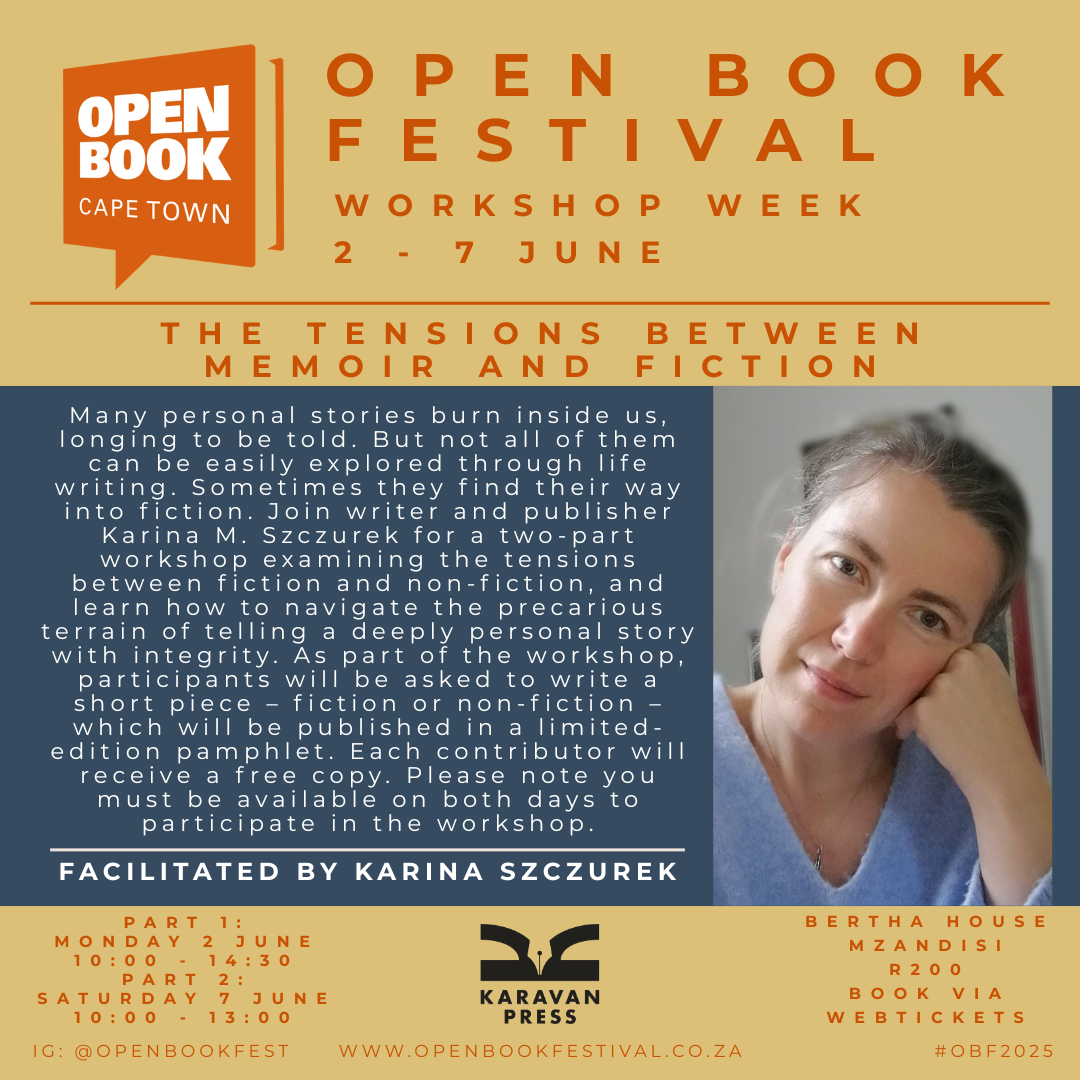
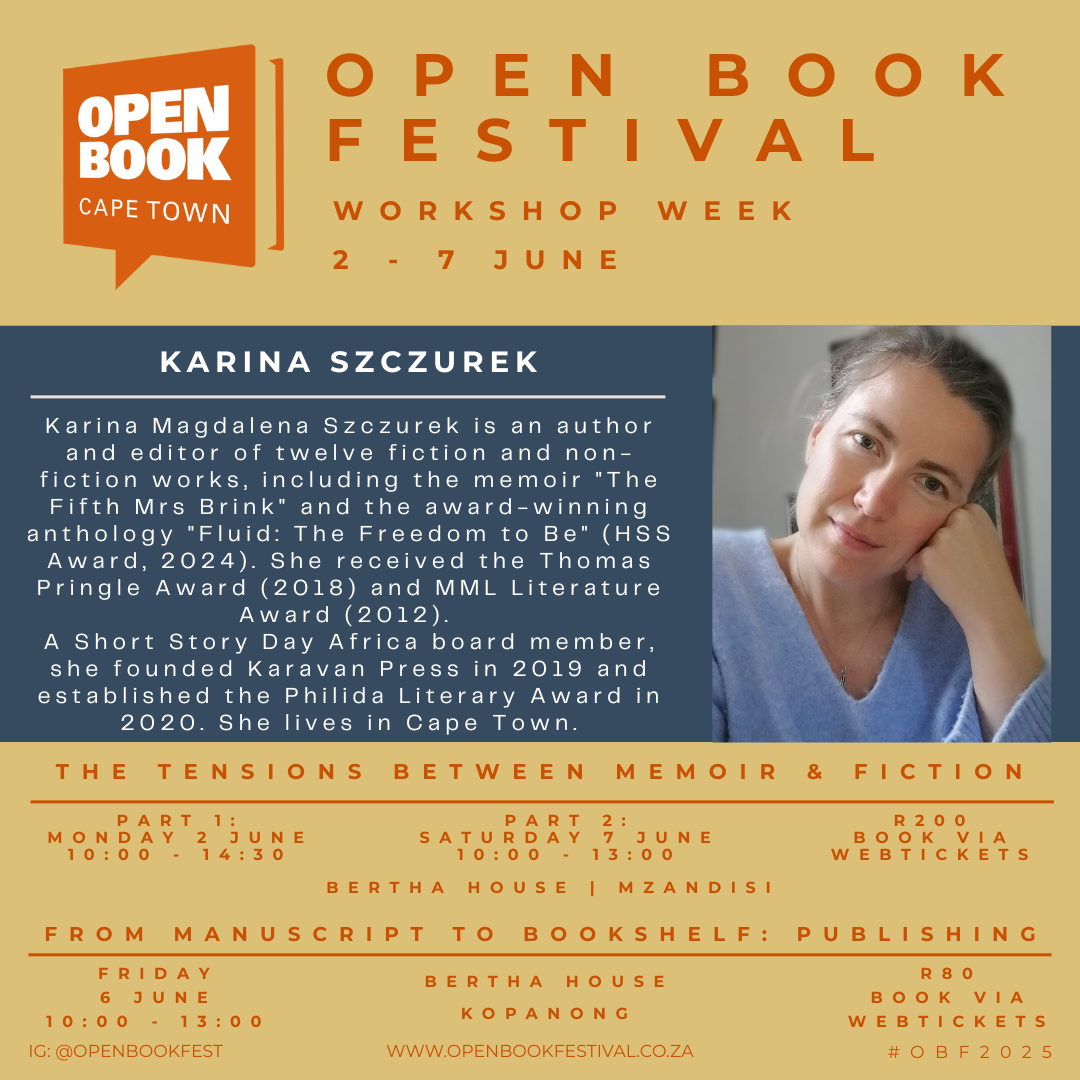
Explore the delicate balance between memoir and fiction with me, Karina Szczurek, in a two-part workshop. Your work could be published! Space is limited, so book now:
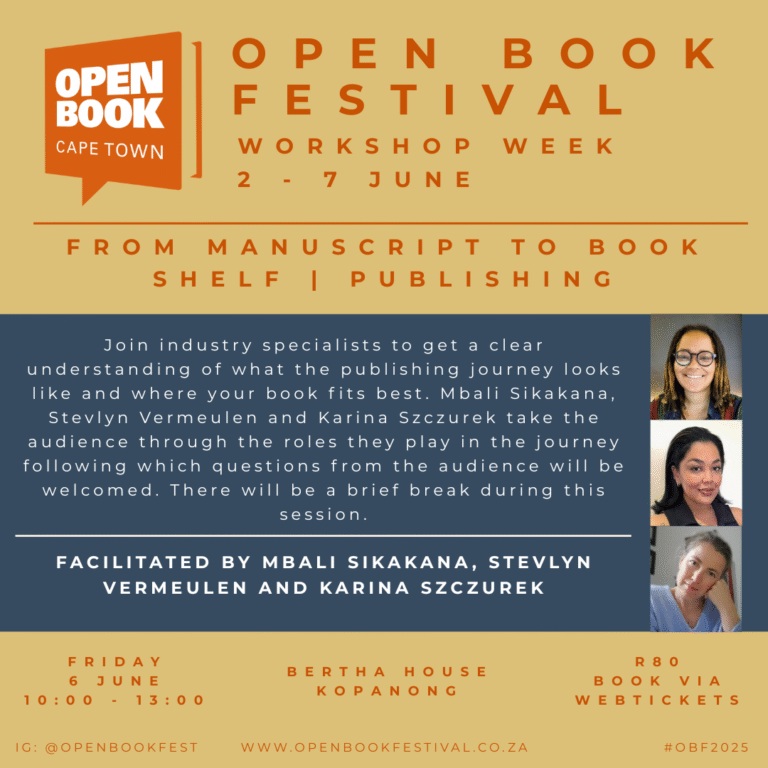
Join industry specialists to get a clear understanding of what the publishing journey looks like and where your book fits best. Mbali Sikakana, Stevlyn Vermeulen and Karina Szczurek take the audience through the roles they play in the journey following which questions from the audience will be welcomed.
There will be a brief break during this session. Book here:
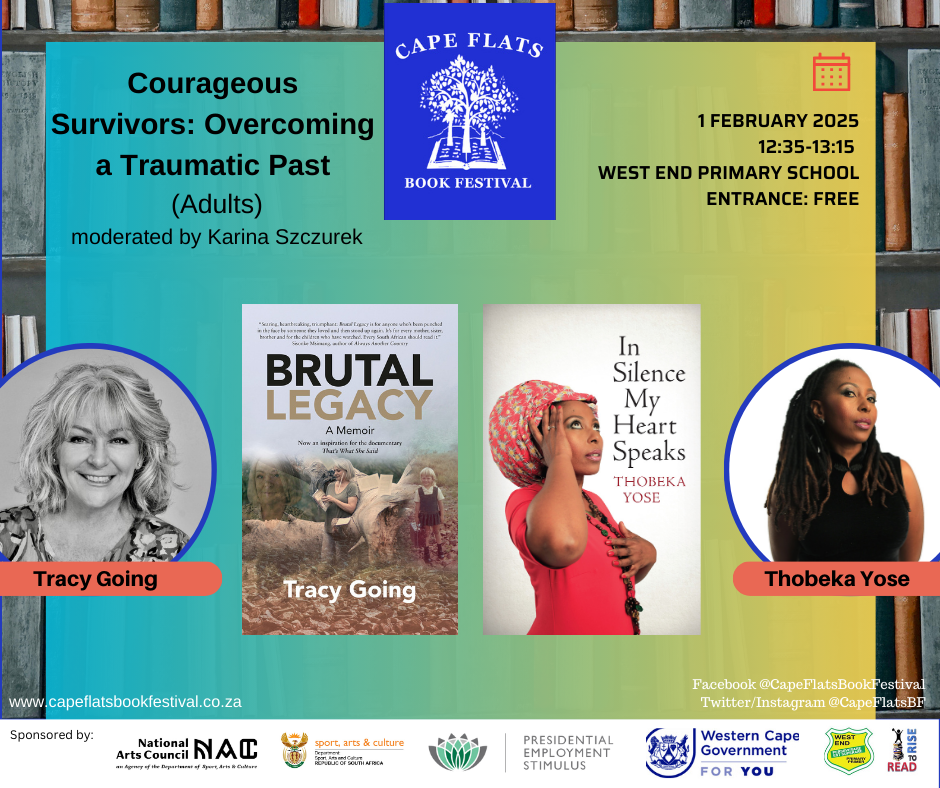
I absolutely love the Cape Flats Book Festival and look forward to attending every year. This year’s edition looks fantastic. If you are a book lover, this is the place to be on 1 and 2 February!
I have the enormous privilege of chairing a session with Thobeka Yose and Tracy Going, and being part of an event that pays tribute to Athol Williams.
Other Karavan Press authors will feature: CFBF 2025
All events are free, parking is available and, apart from all the amazing literary stuff, you will love the snacks being sold on the premises during the festival. I can’t wait and hope to see many readers and friends there! Don’t miss it :)
Mary Douglas Leakey was a British paleoanthropologist who, among many other spectacular contributions, discovered the first fossilised Proconsul skull, an extinct ape which is now believed to be ancestral to humans. For most of her life, she worked along her husband, Louis Leakey, at Olduvai Gorge, an important paleoanthropological locality in East Africa. She was remarkable in many ways, and her legacy will inspire generations of paleoanthropologist to come. Her life, now beautifully reimagined in Penny Haw‘s latest biographical novel, Follow Me to Africa (Sourcebooks), will inspire women, especially scientists and self-taught geniuses, to follow in her determined footsteps on whichever career path they have chosen for themselves.
It is no secret that I have been a huge fan of Penny Haw’s writing for many years, and every new novel is a joy for me as a reader. What I have enjoyed most over the years, apart from the great women’s stories Penny captures between the pages of her books, is her unfolding as a writer, who – like her protagonists – is not afraid to dream big dreams and is always searching for new ways to excel at her craft. And she succeeds – she herself is a true inspiration for all of us.
Follow Me to Africa takes place across two continents and two points in time. We learn of the young Mary’s journey to becoming a world-famous paleoanthropologist, and the trials and tribulations of her love for Louis Leakey. At the same time, when she is wrapping up her successful career in the field, we witness Mary’s encounter with a young woman who reminds her very much of her younger self. And the two of them meet an extraordinary animal who changes the way they think about each other and the world around them.
Follow Me to Africa will officially reach our bookshops only in February 2025, and I cannot wait for other readers to enjoy this special novel. For more news about the publication, you can follow Penny here: pennyhaw.com
It’s 1983 and seventeen-year-old Grace Clark has just lost her mother when she begrudgingly accompanies her estranged father to an archeological dig at Olduvai Gorge on the Serengeti plains of Tanzania. Here, seventy-year-old Mary Leakey enlists Grace to sort and pack her fifty years of work and memories.
Their interaction reminds Mary how she pursued her ambitions of becoming an archeologist in the 1930s by sneaking into lectures and working on excavations. When well-known paleoanthropologist Louis Leakey commissions her to illustrate a book, she’s not at all expecting to fall in love with the older married man. Mary then follows Louis to East Africa, where she falls in love for a second time, this time with the Olduvai Gorge, where her work defines her as a great scientist and allows her to step out of Louis’s shadow.
In time, Mary and Grace learn they are more alike than they thought, which eventually leads them to the secret that connects them. They also discover a mutual deep love for animals, and when Lisa, an injured cheetah, appears at camp, Mary and Grace work together to save her. On the morning Grace is due to leave, the girl—and the cheetah—are nowhere to be found, and it becomes a race against time to rescue Grace before the African bush claims her.
From the acclaimed author of The Invincible Miss Cust and The Woman at Wheel comes an adventurous, dual timeline tale that explores the consequences of our choices, wisdom that comes with retrospection, and relationships that make us who we are, based on the extraordinary real life of Mary Leakey.
True greatness has the ability to inspire beyond its discipline. That is one of the reasons I have always loved watching sports. I grew up in a family where everything centered around cycling. When I cycled myself, between the ages of fourteen and nineteen, the most important lessons I learnt was how to push my physical and mental boundaries, and how to lose. During the five seasons I raced, I participated in two events almost every weekend (in those times not enough girls cycled, so the handful of us usually ended up in the boys’ categories – our races were anything between 30 to 100 km). I trained regularly, in all conditions. No weather was hot, cold or wet enough for me not to go out on my bike, whether alone or with the team. But I was not particularly good at cycling. I was nearly always among the last ten to finish a race, yet I finished every single one of those I entered in the five years. I remember that achievement as my greatest victory. I stopped cycling when I went to university. No regrets, just amazing memories – of perseverance and endurance. And being part of a team.
I continued watching sports, live and on TV. When I came to live in South Africa, I was immediately introduced to rugby. Initially, it did not feel like a sport I wanted to understand, but then I saw its poetry and fell in love. I can’t say I am a superfan, but give me biltong, a brandy with coke, and put me in front of a TV on a Saturday afternoon for a good game of rugby, and I will be a happy woman, win or lose.
Over the years, I have watched some incredible games, and witnessed rugby history unfolding. I also read the books, and always came away inspired.
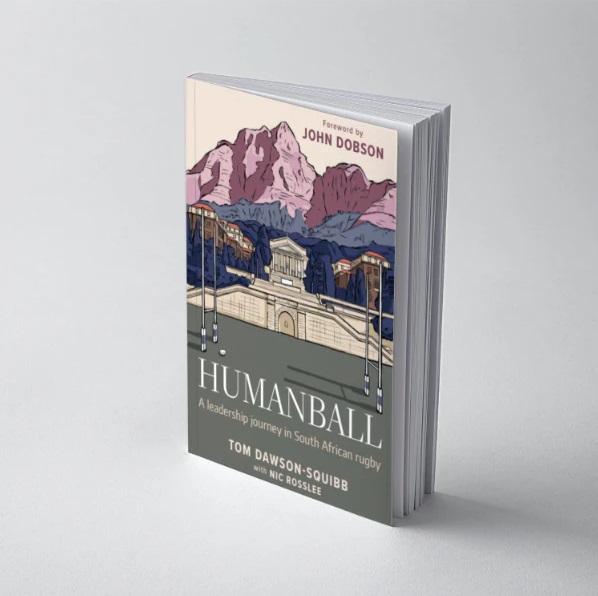
When one of Nancy Richards’s sons, Tom Dawson-Squibb, contacted me to talk about a rugby book project he was considering, I was immediately intrigued. We met online earlier this year, had a chat about what he wanted to do and where he and his co-author – Nic Rosslee – were at, I read the first few chapters, and told him that they were on the right track – they had a great story and they knew how to tell it well. It was no surprise that a few months later, they contacted me to say: the book was at the printers and they would send a copy soon to say thank you for the conversations we had about the early stages of the project. I immediately pre-ordered a copy of the book for my love, too.
At the heart of Humanball lies the story of a team that is more than just the sum of its parts. It’s a story about getting the very best out of those around you. It’s a story about defying expectations—both those imposed by others and the ones we set for ourselves.
Performance coach Tom Dawson-Squibb tells the entertaining and inspiring story of his five years as the head coach of the University of Cape Town’s Ikey Tigers rugby team. Tom reveals how the most potent teams connect and inspire individuals to give effort far beyond what’s expected–and even what we believe to be possible at the time. He shows us how to find joy, meaning, and connection in our work and how to see much of what we call “work” as a serious form of play.
The books arrived on Friday – Humanball: A leadership journey in South African rugby. I finished reading my copy this morning. I could not put it down. It is a story to inspire beyond its own discipline. While reading, I was constantly reminded what made our team – the one called Karavan Press – special, and what I could still learn from Tom and his amazing experience with the Ikey Tigers rugby team. I feel empowered to continue building and strengthening the Karavan Press team, and inspired to continue dreaming our dreams. Like John Dobson, who wrote the foreword to the book, “I found myself reading and rereading segments and taking notes for instant application at the Stormers”. I will leave the Stormers in John Dobson’s capable hands, though, and apply what I have learnt to being a publisher.
The currency of sport is trophies, and in that currency as a head coach, I am poor. But the real currency of life is found in your connections, and in that currency, I feel rich for my experience at UCT.
… I always say that the key is to surround yourself with people who are better than you. In many ways, your success is defined by the company you keep.
It’s about choosing not to play small.
… energy could be transferred through your words and your actions.
… I had an insatiable thirst for meaning and significance. I wanted to find purpose in what I did and feel a sense of significance and accomplishment.
If you make it [experience] bigger that it ordinarily would be, the players will feel special. If you make players feel special, they will behave in a way that is special. They will bring energy and performance.
… but I definitely gave a shit. I’ll never forget the importance of that.
The role of a performance coach is to help the players prepare mentally for their roles, advise and assist the coaching staff and facilitate leadership growth within the team’s structures.
To join a community where you don’t have to prove yourself as you walk through the door is a liberating thing.
… success isn’t just about personal achievements but about lifting others up along the way and making them feel great.
Every time the team stepped onto the field, the goal wasn’t just to win – it was to bring joy to the city. It reminded us that rugby was bigger than just the team; it was about the fans, the community, and the happiness we could spread.
The essence of sport is that you need to do the boring things well and often.
… we are more capable than we realise. You just need to keep being relentless in your pursuits.
And who doesn’t love a good story?
… consistently finding ways to inject joy into our environment was essential.
… it’s incredible how the losses along the way are crucial in your ability to grow as a team.
The primary focus should be on what we need from each other on and off the field to contribute to the collective effort.
I realised that collaboration isn’t just nice to have; it’s essential for navigating the inherent chaos of rugby.
If you’re feeling nervous or uncertain, judging yourself harshly only amplifies those feelings. But if you’re curious about why you feel that way, you open the door to understanding and growth.
… the best are always curious, always seeking to know more.
The same principles apply if you’re facing a personal challenge or struggling on the field. Acknowledge the issue, accept the reality, and then act decisively.
One person speaking from the heart can change the temperature of any room.
Confrontations can be awkward and unpleasant, but they are necessary. Importantly, there needs to be a strong relationship in place and the environment primed for them to have an effect. And they certainly need to come at the right time.
I’ve come to realise that the ability to get people to tell the truth to each other is crucial. When someone speaks from the heart, it can create massive shifts. But there needs to be a relationship at the foundation. Without the relationship, there ia a risk of the intended audience going into defence mode. If there’s trust and you value that person’s viewpoint, honest conversations make a real difference.
If your ‘honest feedback’ comes across as an assault on the individual’s character, you’re unlikely to get the desired effect and may find yourself short of friends. To inspire growth, you must reinforce the idea that improvement is always possible.
Being part of an environment where people contributed far more effort than was ever expected of them is something that I will forever be grateful for.
Part of what motivated me to write this book was that you can do deeply purposeful work away from the places that reward you with money or status.
Maybe the ‘how’ of making an impact isn’t so complicated. It’s about showing up with genuine passion and commitment, and as I’ve said before, giving a shit.
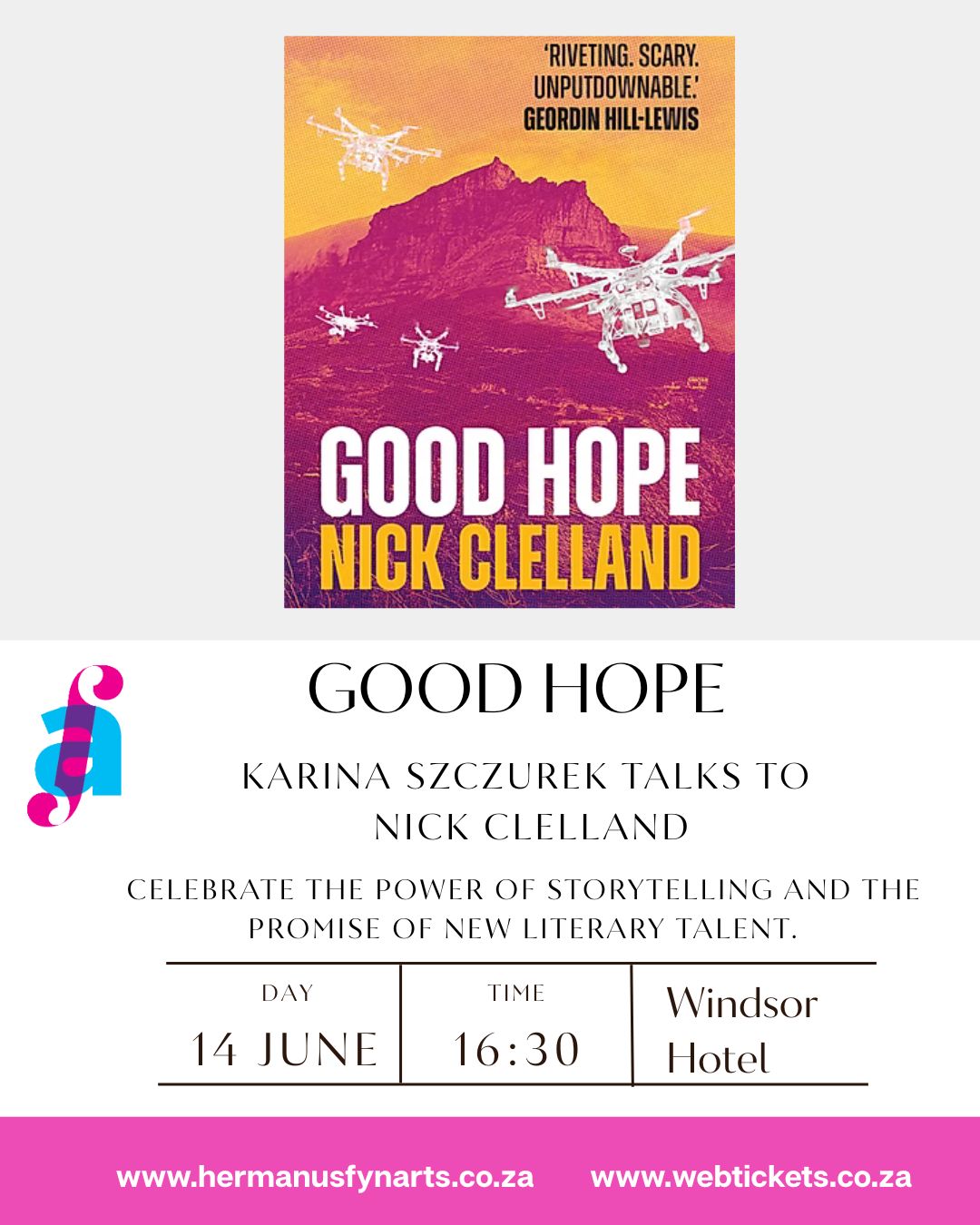
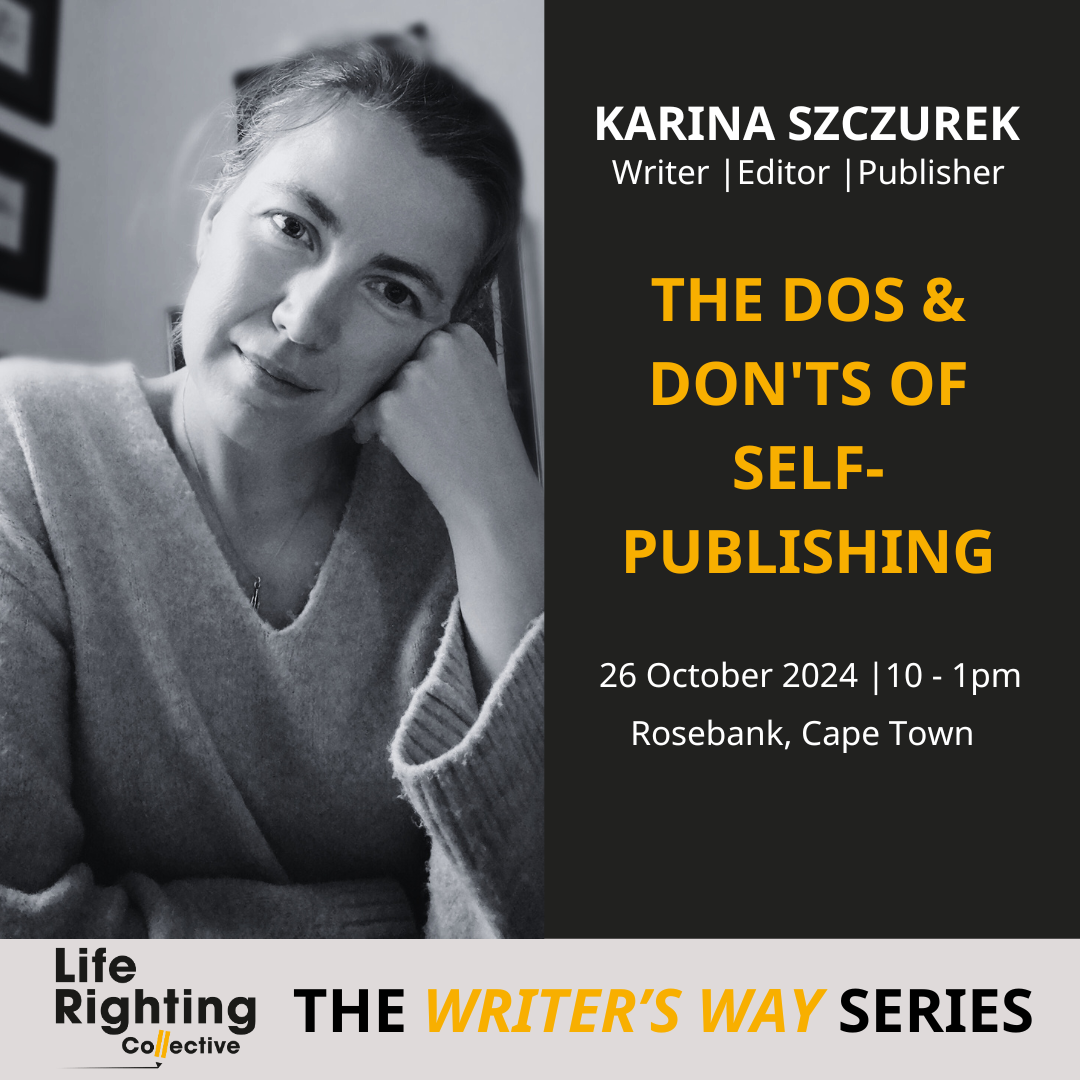
The Life Righting Collective is running a series of workshops to raise funds and to offer writers new platforms to thrive. Please join me for the first workshop in the series:
… discussing the daunting journey from manuscript to self-published book that will look and feel like a professionally published title.
“The Writer’s Way is a brand new writing series of exciting workshops and talks designed to offer aspiring and experienced writers from diverse backgrounds the opportunity to enhance their skills. The online and in-person workshops will feature diverse guest facilitators—accomplished writers and industry professionals—covering fiction, non-fiction, poetry, screenwriting, editing and more.”
“Words don’t help with grief, but presence does,” said Alex Latimer, author of the short story “Death and rooibos”, included in his collection Love stories for ghosts. In the story, Death takes a young boy’s mother away and remains behind in the child’s life well into his adulthood – a strange, friendly, comforting presence having a cup of rooibos whenever he visits. Alex was one of the well over 100 authors speaking at this year’s Open Book Festival, which took place last weekend between 6 and 8 September at the Homecoming Centre in Cape Town. The session he was part of, “Love and other toxins”, also featured Shubnum Khan and Sven Axelrad, and was expertly chaired by Dela Gwala. I have loved all three of these authors for a long time, but collectively they stole my heart during that afternoon …
I recently had the great pleasure of spending another weekend at Oudrif. We went to see the flowers, but ever since I first heard that locals had seen aardvarks in the area, I have been dreaming of a sighting myself … And every time on the way there, I would say, “This time!” But for seven years, the aardvarks had ignored my wishes. Until now! Once again, I said, “THIS time.” And just before arriving at Oudrif, right in front of us, like a mythical creature imagining itself into being, there she (or he) was: an aardvark! Pure wonder!
Needless to say, I am in love!
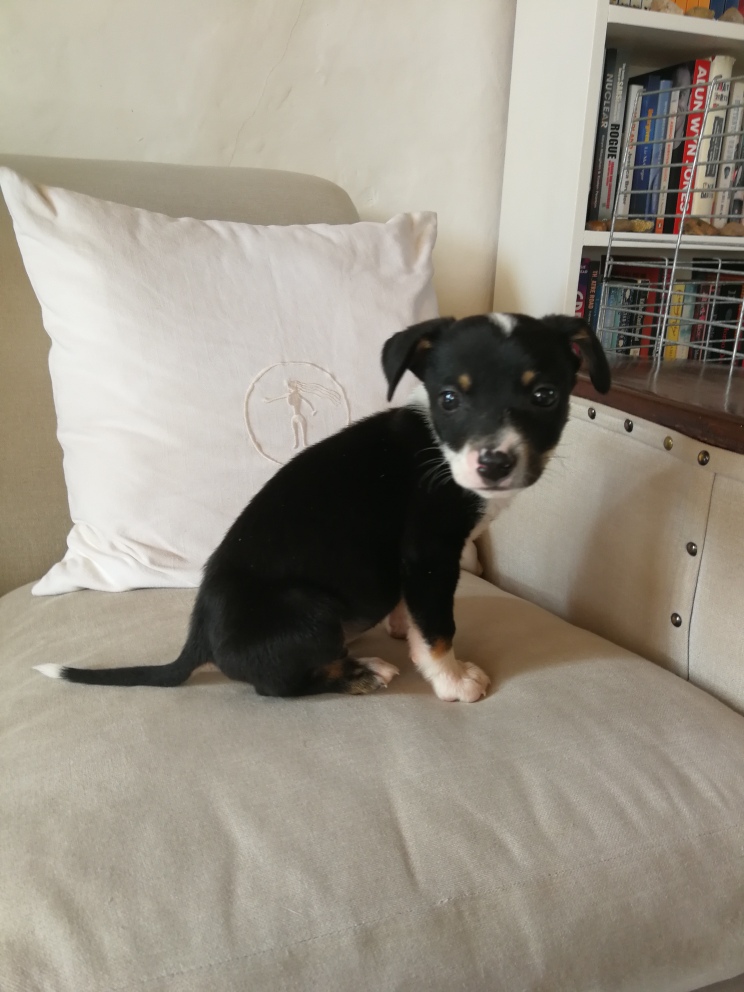
As I am in love with this little one, who is the latest CLAWS (Clanwilliam Animal Welfare Society) rescue puppy staying at Oudrif before finding his forever home:
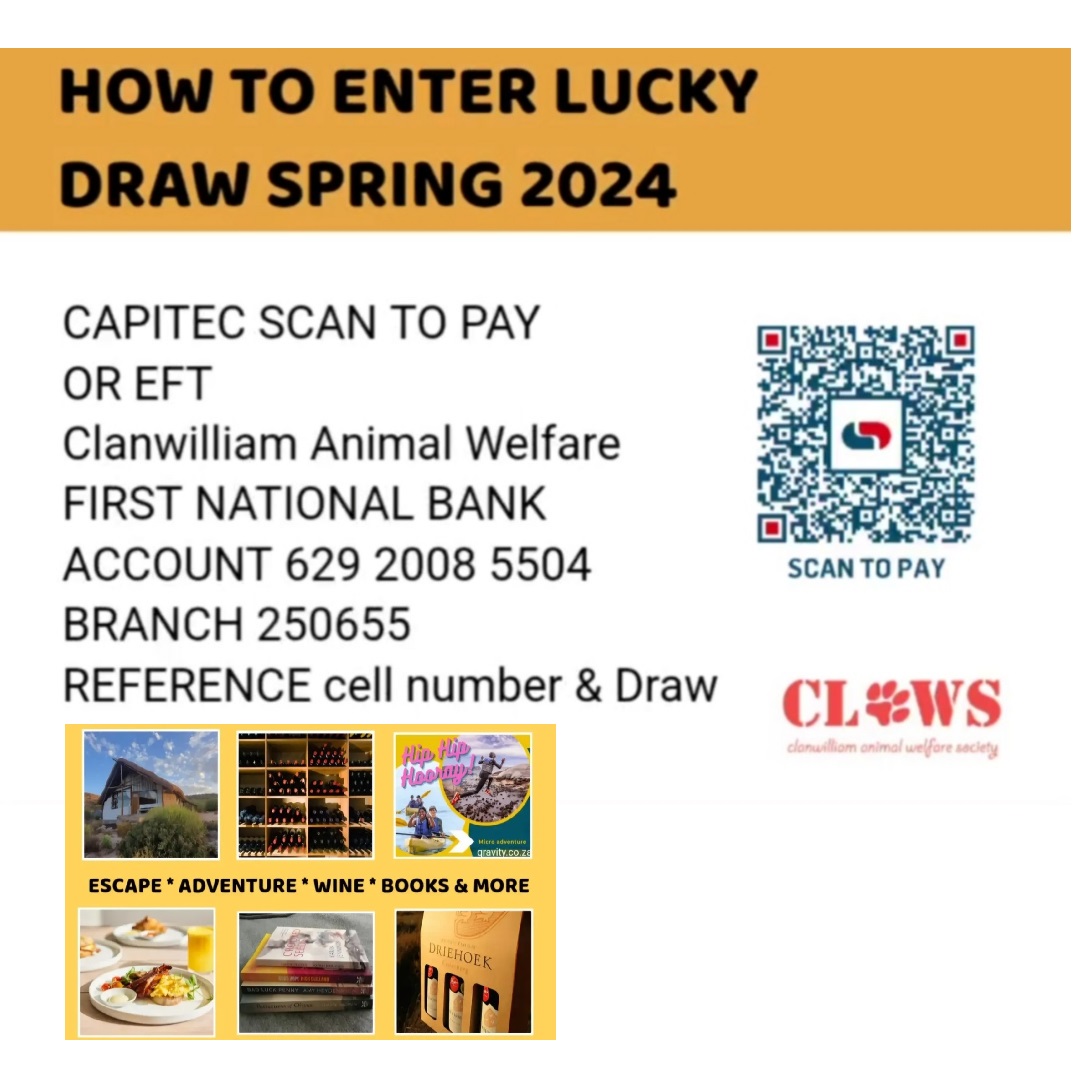
Every year, CLAWS fundraises through a Lucky Draw Raffle. This year, you can win a Karavan Press book hamper – among many other fantastic prizes – and support CLAWS.
CLANWILLIAM ANIMAL WELFARE NPO 262-101
Entries close on 26 October 2024
Draw will be on 28 October 2024
Prize not redeemable for cash
Winners will be announced on social media and contacted directly