
I’d never thought that a radio show about business news could be of personal interest to me, but I have been enjoying Bruce Whitfield’s clear and accessible Money Show for a few years now. Whitfield’s The Upside of Down is the last book I bought at a bookshop before the lockdown, but it is also available as an ebook. Although written just before the pandemic hit South Africa’s shores, it is an astoundingly fitting and inspiring read for our terrifying times.
The title alone already feels like a reassurance. The same clarity with which Whitfield presents his show can be found in his writing. One doesn’t have to be an economic and political fundi to follow the arguments presented in The Upside of Down. And after failing miserably at the quiz included in the first chapter of the book, I happily absorbed the knowledge and ideas that followed.
There is no way of assessing our current economic situation without wanting to weep, and Whitfield presents us with a sober picture after the looting of the Zuma decade, but he steers his readers towards the positive stories of entrepreneurs, big and small, succeeding against all odds. These are extremely empowering. He also outlines the basic traits that visionaries and companies require to thrive in an unstable environment as well as what socio-economic factors could contribute to stabilising it in order for the desperately-needed growth to follow and employment figures to increase.
Opportunities arrive all the time but, because of a persistent atmosphere of doom and gloom, not enough of us dare to dream. Whitfield understand the power of storytelling in channelling positive energies towards turning those visions into reality: “It’s in the very crisis in which South Africa finds itself today that there lies an enormous opportunity for renewal, growth and optimism.”
The Upside of Down: How Chaos and Uncertainty Breed Opportunity in South Africa
Bruce Whitfield
Macmillan, 2020
First published in the Cape Times on 24 April 2020.
PS This is Salieri, taking the title seriously and seeing the world from a different perspective.

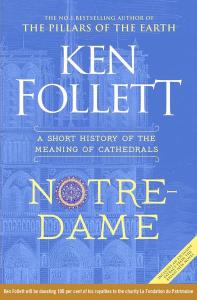 “Something priceless was dying in front of our eyes. The feeling was bewildering, as if the earth was shaking”, writes Ken Follett about watching the Notre-Dame Cathedral burning on 15 April last year. Not an expert on cathedrals, but known across the world for his The Pillars of the Earth, a novel about the construction of a cathedral for which he did an enormous amount of research, he became the media’s go-to person for commentary about the Notre-Dame fire and, together with his French publisher, decided to write Notre-Dame: A Short History of the Meaning of Cathedrals to support the reconstruction efforts of the architectural treasure after the catastrophe. All the royalties generated by the book go to the charity La Fondation du Patrimoine.
 Karina Magdalena