OYSTERHOOD is reclusiveness or solitude, or an overwhelming desire to stay at home.

A day of mixed news.
My own screams woke me up in the middle of the night. Nightmares I don’t remember. I slept again. Woke up early to take out the bin again and wave at the street (no garbage collection yet, the bin is back in). The clouds curdling on the horizon, bees humming like crazy in one of my trees. Away from them, silence.
Coffee. Twitter: the dancing friars (#friarswhodance)!, goats, squirrels. We are all trying to survive, not only physically, but especially in our heads. I have two left feet, but I am seriously considering doing a video of myself dancing to that same energising tune. If the friars can do it, so can I! Everything about it would be a challenge, including the video making. But this is the time for reinvention of the self. Maybe.
Reading until my Mom phoned and we had another good, supportive conversation. She is fit and healthy and coping well, but I fear for her. A lot. She has dug up her sewing machine and I have placed an order for two skirts. To be picked up when I see her again. Soon, I hope.

Then the great literary news of today: the cover of the Afrikaans translation of my memoir has been finalised. A dream come true. This book could have never felt complete without an Afrikaans translation, and the fact that it was done by my dear, dear friend Erika and will be published by my wonderful publishers, Protea Book House, is sheer perfection.
 The cover photograph is by Philip de Vos (among his many amazing achievements is the translation of The Gruffalo into Afrikaans: Die Goorgomgaai – one of the BEST WORDS EVER). The cover image has always reminded me of a very famous painting… Yeah, that one! Can’t help it. The photograph in which André and I look like two poor, but very happy, orphans is one of my favourite ones of all the ones that were ever taken of the two of us, and I am infinitely grateful that it finally found its proper place. The cover design and typography is by Hanli Deysel and this is the fourth book we have worked on together. May there be many more.
After the delightful news, there was only one thing to be done… Toilet cleaning. My eyes hurt after a lot of reading, so I decided to focus on the house today, starting with the bathroom and bedroom. All the cats assisted diligently by staying away from all the hard work…

Can you blame them? But strangely enough, they were very eager to share in my lunch treat today…

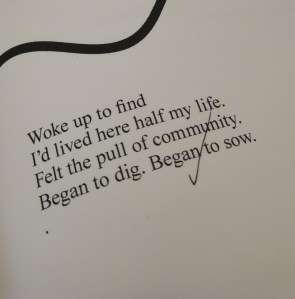
After lunch, I was waiting for a Skype chat with my brother, when another of those chain mails popped into my inbox, asking you to send a poem or something to the first person on the list and then do other things with the second name on the list and involve twenty of your friends and and and. I know these are meant well (or are they?), but I just can’t right now. Especially since I hardly know the person who sent the email and they did not even include a poem for me, just the instructions. When I complained about it on Twitter (sorry!), a poet from London responded with similar feelings. So in a way, the chain mail did something good in the end. I connected with someone who has given me enormous poetic pleasure by publishing the book London Undercurrents. And the exchange reminded me of this beautiful quote from the book, so fitting for our times:
Began to sew. Began to write. The pull of community.

A year ago my Mom bought me a 1kg-Lindt chocolate bunny for Easter. When I visited her shortly afterwards, the bunny looked threatening, especially to my fully packed suitcase. With a heavy heart, I had to leave the bunny behind. At Christmas time, when I visited again, we thought that we might manage to eat the bunny, but there was simply too much other food (Polish Christmas in Austria and my Mom CANNOT cook for just a few, she always cooks for an army). Eventually, my brother brought the bunny to Cape Town when he was visiting this February. The bunny did not survive the journey in its original form and was finally butchered. Talking to Krystian on Skype today after lunch, I was munching away on the remaining pieces (it looked like the bum) and still laughing.
These are the before and after photographs:


As you can see, my Mom does not do small measures. But boy! am I glad to have around 0,5kg bunny chocolate left right now. Especially just before Easter. My Mom had the right idea, she just got the year wrong.
After all that chocolate, it was time for another garden loop walk. This time, I marked each loop counterclockwise with a glass pebble and then clockwise again (I only have twenty-seven glass pebbles). Half an hour, fifty-four loops.


Then I listened to story-time on CapeTalk at 15:50 (absolutely delightful!) and sat in the sun with Mozart, continuing with A Poor Season for Whales.


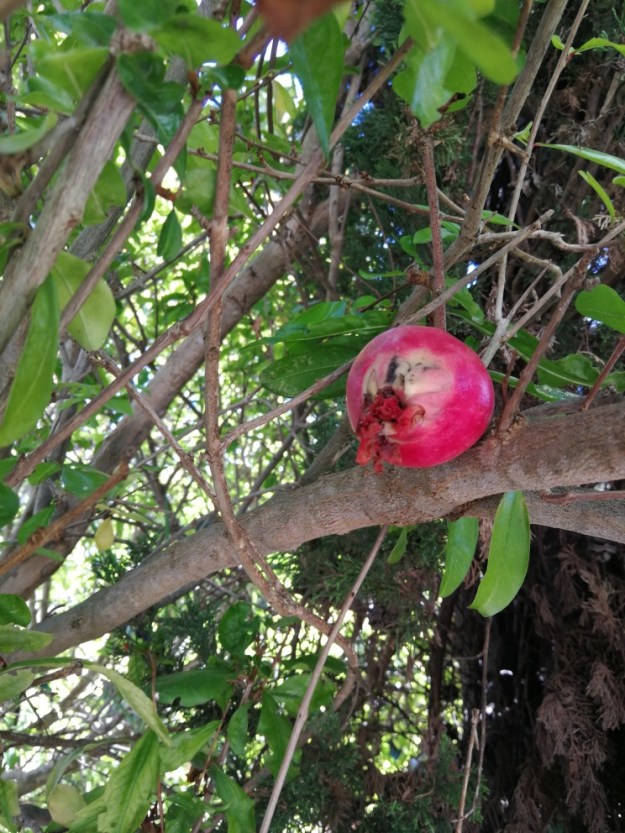
I haven’t noticed before my cuddle with Mozart that my poor pomegranate tree, which has never given me more than one fruit a year, has done it again. We have one small pomegranate!
I cleaned the kitchen before cooking dinner, another simple pasta affair.
Emails, a bit of admin, blog writing, and now time to sleep. Not to scream.
The day has also brought news of two fights, one for justice, one against illness. Both have begun quite a while ago and will continue for a long time to come. Both have to be won, but the strength and courage needed are gigantic. At a time like ours, even bigger. In my own non-religious way, I pray that The Good and Kind prevail.
A poor season for gentle dreaming, and yet: Good night!
Be kind to yourself. Be kind to others. Stay at home.












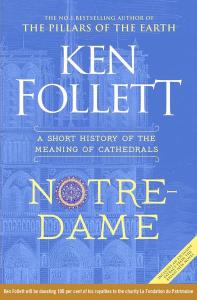 “Something priceless was dying in front of our eyes. The feeling was bewildering, as if the earth was shaking”, writes Ken Follett about watching the Notre-Dame Cathedral burning on 15 April last year. Not an expert on cathedrals, but known across the world for his The Pillars of the Earth, a novel about the construction of a cathedral for which he did an enormous amount of research, he became the media’s go-to person for commentary about the Notre-Dame fire and, together with his French publisher, decided to write Notre-Dame: A Short History of the Meaning of Cathedrals to support the reconstruction efforts of the architectural treasure after the catastrophe. All the royalties generated by the book go to the charity La Fondation du Patrimoine.


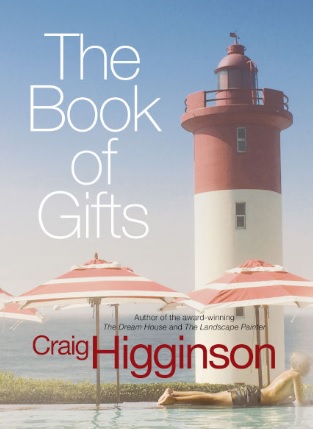 As readers, we turn to specific authors when we don’t want to be disappointed. The internationally acclaimed writer, Craig Higginson, has become one of these for me. His latest novel, The Book of Gifts, is another gem in his impressive oeuvre. It begins with a family trip to uMhlanga Rocks and radiates from this particular moment into the past and the future, gradually piecing together the puzzle of the intricate – often toxic – relationships that play out during the holiday in KwaZulu-Natal. At the centre of the unfolding story and the complex familial constellation are the two half-sisters, Emma and Jennifer. Emma is a successful sculptor and mother to Julian, at the time of the holiday an eleven-year-old boy who falls in love for the first time with an enthralling, slightly older Clare. Jennifer is a teacher at Julian’s school back in Johannesburg where they all live, and wife to Andrew, a psychologist struggling to find his professional and personal bearing.
 The internationally acclaimed, Durban-born writer, Elleke Boehmer, has a second short story collection out: To the Volcano, and Other Stories. Set mostly in the southern hemisphere and illuminated by the legendary southern light artists and tourists travel the world to experience, the twelve stories in this collection explore the tenuous and tenacious relationships people have with the South.
 Adamastor City is a first in all kinds of fascinating ways: for the author, Jaco Adriaanse, it is a debut novel and the first book in The Metronome Trilogy, and it is the first title for the new, independent publisher on the block, Burnt Toast Books, established this year by Robert Volker, who wants to focus on shorter forms and allow authors more freedom to experiment.
 We have entered an era when biographers and literary scholars bemoan the fact that most of us have stopped writing letters, the ones composed with a pen on paper, folded into an envelope and posted to be received and perhaps kept under a pillow or in a jacket’s pocket because of the precious content they contain. For centuries, such letters were frequently lifelines to others and bore testimonies to our lives in ways that our modern world, despite all our inventions and our seeming connectedness, is no longer capable of reproducing.
 Karina Magdalena