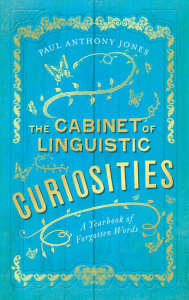
 Languages are living, breathing, mutating creatures. The English language of today is not the one of 1602 when, according to Paul Anthony Jones in The Cabinet of Linguistic Curiosities: A Yearbook of Forgotten Words, “the Elizabethan playwright Thomas Dekker coined the word love-libel – literally, ‘a handwritten admission of someone’s love’”. Or the English of the early 1400s when the striking word “recumbentibus” (which, like so many of the words Jones collected in his remarkable book, the spellcheck on my computer does not recognise!) was adopted into the language from Latin: “In its native Latin recumbentibus was used merely of the act of lounging or reclining, but when the word was adopted into English it was given a twist: English writers…began to use it to refer to forceful, knockout or knockdown blows”.
Despite linguistic evolution, many obscure words remain in the language, if not in everyday use then at least in Jones’s quirky bookish cabinet, home to such delightful words as “fedifragous” (an adjective describing a break of promise or a violation of oath), “spike-bozzle” (a verb meaning “to sabotage; to ruin or render ineffective”), “miraculate” (“to produce by a miracle”) or “eucatastrophe” (a noun for “a sudden and unexpected fortuitous event”).
The book comprises of 366 entries for every day of the calendar year, each with a tale attached to a particular date in history. The author traces each word’s etymology and tells a story illustrating its use. For 1 January, Jones chose the delightful word “quaaltagh”: “Proving there really is a word for everything, your quaaltagh is the first person you meet on New Year’s Day morning.” The noun was borrowed from Manx, “the Celtic language of the Isle of Man, in the early nineteenth century.” With its roots in the verb “quaail, meaning ‘to meet’ or ‘to assemble’, as it originally referred to a group of festive entertainers who would come together to gambol from door to door at Christmas or New Year singing songs and reciting poems”, a quaaltagh soon became a symbol for what the new year was about to bring: “dark-haired men were said to bring good luck, while fair-haired or fair-complexioned men (or, worst of all, fair-haired women) were said to bring bad luck – a curious superstition said to have its origins in the damage once wreaked by fair-haired Viking invaders.”
The words contained in Jones’s The Cabinet of Linguistic Curiosities are as fascinating as the stories accompanying them. Incidentally, the entry for 27 April, a date engraved on South African hearts, is “cosmonogy”, meaning “the creation of the universe”. The word was coined in the seventeenth century when thinkers of the time were beginning to reimagine and understand the nature of our solar system. In 1619, for example, the German astronomer Johannes Kepler postulated that “the universe…had come into existence on 27 April 4977 BC.” He was off by a few billion years for the universe, but I like the idea that he chose 27 April for a new beginning.
The Cabinet of Linguistic Curiosities: A Yearbook of Forgotten Words
by Paul Anthony Jones
Elliott and Thompson, 2017
Review first published in the Cape Times on 9 March 2018.
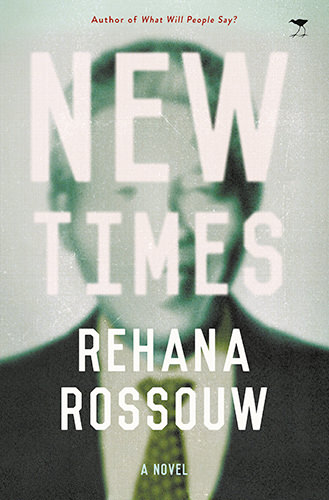 Rehana Rossouw’s debut novel, What Will People Say? (2015), was already on its seventh impression when I was reading it earlier this year. Being reprinted so often within a relatively short period of time is no small feat for a local novel. Even though I came late to the party, I immediately understood why it was so popular. Rossouw, a veteran journalist, succinctly captured an era and a community – the Cape Flats of the late eighties and early nineties – and made them come alive through a handful of characters belonging to the Fourie family. This was the time of volatile politics, raging gang wars and impossible choices. Decency and family values did not protect you from the evil of the system and the cruelties of the streets. Only the toughest survived to thrive.
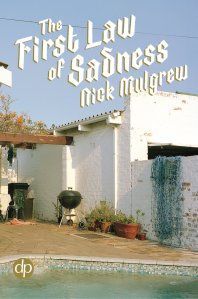 The short story continues to fascinate me for two reasons: the precision of thought and execution it attracts as well as its unpredictability. If well done, it can surprise and satisfy like nothing else in literature. And Nick Mulgrew does the genre justice like few other contemporary South African writers. His work has been recognised with multiple awards and his vision and skill have been highly acclaimed by critics. Mulgrew is also an editor and the director of the flourishing poetry press, uHlanga, which published his debut poetry volume, the myth of this is that we’re all in this together, in 2015. In his many impressive literary incarnations, Mulgrew understands that short art forms require meticulous attention to language. He knows how to make words count.
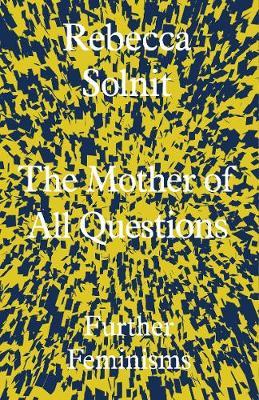 It was by pure chance that I discovered a recent online essay by Rebecca Solnit in which she was writing about women, art, motherhood and selfishness. As a creative woman who chose not to have children, I found it most affirming. After some research about the author, I could not believe that I had never encountered Solnit’s work before. But fortunately, the article led me to her impressive oeuvre and the latest piercing collection of essays, The Mother of All Questions: Further Feminisms. In the introduction, Solnit mentions “the rapid social changes of a revitalized feminist movement” and how it is “changing our understanding of consent, power, rights, gender, voice, and representation.” She speaks of the movement as being “gorgeously transformative”.
 A house robbery “gone bad” is sadly not an uncommon occurrence in South Africa, in reality or in fiction. The one with which NR Brodie’s debut thriller Knucklebone opens seems routine enough: two young men try to break into a home in Johannesburg; one escapes but is eventually caught, the other one is shot dead by the owner. But here, nothing is at it appears.

 I have been away.
 The occasion for trying to fly long distance again was of high importance: Miś, aka our mother, was celebrating her 70th birthday this month and all she wished for was to have both her children in the same room. For most mothers this is no problem whatsoever, but for our mother – with me living in South Africa and my brother’s itchy feet – the two of us in one room is a rare occurrence. She lives in Austria. The last time she was in the same room with both her children was in Cape Town three years ago when she was here to take care of me after André’s death. But she couldn’t stay here forever.
 And now, finally, we sat there all together as a family and ate the traditional Sacher Torte and celebrated Miś’s 70th birthday for an entire week. It snowed. There was water. And my favourite beer, Uttendorfer. To welcome me, Miś prepared the special dish I always ask for when I visit. We spent a few days around her birthday – one of them was the anniversary of André’s death – in Bad Ischl. Thermal springs, a hike on the Katrin, the Zauner restaurant, and the ghosts of the imperial past lingering everywhere. The birthday dinner was a Hauben-delight.
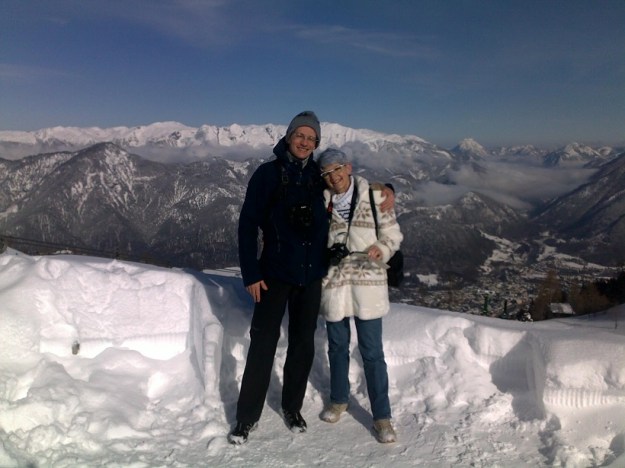
 During my visit, I had lots of coffee with Miś who is solely responsible for my addiction; had long chats with Krystian sitting next to him and not in front of a computer screen; saw old friends and knew exactly why they have always been so dear; in my mother’s attic, found the small green fork I used to eat with as a child; walked along my beloved Mattig; spoke German; sat quietly in my mother’s guest bed in the mornings when everyone else was still asleep and read Rehana Rossouw’s latest novel, New Times, set in Cape Town, in preparation for
 Like most readers across the world, I first became aware of the South Korean writer Han Kang when she won the Man Booker International Prize two years ago for her phenomenal novel, The Vegetarian. It was recommended to me by a friend who bought it because of the award. Since then, I have read Han’s other works translated into English: the harrowing Human Acts and her latest, The White Book.
 “The true character of a society is revealed in how it treats its children.” Nelson Mandela’s famous words echo the understanding that we can be judged by the way we treat the most vulnerable members of our communities, whether these are children, the elderly or the differently abled. Reading Valeria Luiselli’s Tell Me How It Ends: An Essay in Forty Questions, we are reminded how we fail to protect those who need our care. The story she outlines is set across the two Americas, but it resonates with so many other tales across all continents where displaced people are escaping horror or looking for decent opportunities to build their lives.
 Despite her impressive résumé, I had not heard of Jesmyn Ward before her latest novel, Sing, Unburied, Sing, was recommended to me by two local booksellers in the beginning of December. But I am thrilled that I finally came across her work. Ward is an American novelist and the first woman to win the prestigious National Book Award twice. This is no small feat, as she has only turned forty and Sing, Unburied, Sing is only her third novel. She received the National Book Award for it and its predecessor, Salvage the Bones (2011), but already her debut, Where the Lines Bleed (2008), was highly acclaimed. Ward is also the author of a memoir, Men We Reaped (2013), and the editor of an essay and poetry collection, The Fire This Time: A New Generation Speaks about Race (2016). Her potential has been recognised with the famous MacArthur Fellowship, better known as the “Genius Grant” ($625,000 – allow a moment for this number to sink in) given to individuals residing in the United States who exemplify “extraordinary originality and dedication in their creative pursuits and a marked capacity for self-direction”. I look forward to exploring more of her work, past and future.

