 Not all is well with the world. In moments of dark disillusionment, it is easy to give in to despair and just do nothing. But it is worthwhile to remember that if all of us, or at least most of us, institute even the tiniest of changes in our lives, we can make these lives better and we can make the world a better place, for ourselves and others.
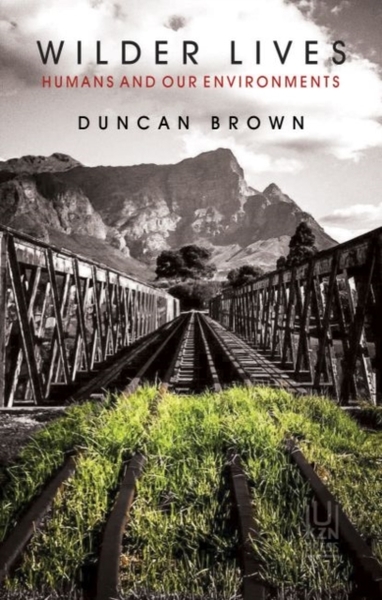
Duncan Brown will be known to readers as the author of Are Trout South African?, which partly informs his latest book Wilder Lives: Humans and Our Environments. It is difficult for me to pinpoint why this book made me feel happy, but it did. Perhaps it was because Brown does not preach. He is a generous writer who shares his observations and research in a way that is empowering. The fact that his book made me feel better about my completely wild (or “neglected”, as many visitors seem to think) garden might be another reason.
Divided into ten highly accessible chapters, Wilder Lives focuses on ways we can “re-wild” our lives, whether through conservation, language, or in re-examining ethics. The concept of “rewilding” looks for definitions of “wild” that have “positive value (self-propagating, growing sustainably, self-reliant, independent, and so on)”. In this sense, rewilding champions a nourishing of the self-sustaining ecological process.
Brown also examines our misconceptions about “wildness” and what we often think are its opposites: culture, civilisation, or simply us, humans. The belief that wildness can only exist “where humans are absent” is still prevalent but, as Brown explains, it is rendered “questionable as a concept in which human influence is omnipresent”. What is definitely of essence is that we realise we are not as important as we want to believe. Humility might be the trait that could perhaps save us from ourselves. Brown makes it clear that rewilding is, in the words of George Monbiot, “not about abandoning civilization but enhancing it.”
Deeply aware of the “contradiction, ambiguity and paradox, especially in their entanglement in South Africa with colonial and apartheid histories”, Brown presents us with ideas about wildness and our role in it that are balanced and not intimidating. In the chapter on wildness and language, he shows what a difference just paying attention and being able to name and describe the environments we engage with – “a place literacy”, in Robert Macfarlane’s words – can help us live more rewarding lives. It reminded me of the joy I experience when watching and naming the birds visiting my ecologically uncontrolled garden.
We can all profit in the end, and in ways that we don’t necessarily immediately recognise as profitable. What is it that makes our modern lives so rough to process? Maybe a more conscious, re-evaluated way of existing within our environments can lead to simpler and much more fulfilling journeys. Wilder Lives assuredly offers one of “possibility, affirmation and excitement.”
Wilder Lives: Humans and Our Environments
by Duncan Brown
UKZN Press, 2019
Review first published in the Cape Times on 30 August 2019.


 The other sessions were Finuala Dowling reading from her latest poetry volume, Pretend You Do Not Know Me, a ‘best of’ collection which also includes stunning new work; followed by John Maytham performing “Being Human”, a poetry script compiled by Finuala; Wilhelm Verwoerd talking about “that last name”; and Duncan Brown encouraging us to “rewild” our lives. While John was still in the audience, listening to Finuala, I was reaching for a tissue to deal with the emotions her poetry was evoking in me and glanced at him wiping away his own tears. We were both incredibly moved. And then, John made us laugh and cry with his exquisite reading of the poetry Finuala prepared for him. There was one particular poem that made us all crave chocolate cake so much that some delicious sinning was happily indulged in at lunchtime.


 Karina Magdalena