Missing Person, the latest thriller from the author of The Three, Day Four and The White Road, Sarah Lotz, was my companion on a recent overseas flight and kept me so entertained that I hardly noticed the long hours flying by.
Lotz is one of those versatile storytellers whose imagination knows no bounds. She addresses themes that are topical, but is never predictable or didactic and is not afraid to push the boundaries of genres. Despite part one opening “in a cemetery on a damp October evening”, unlike her previous three novels, Missing Person does not include the supernatural. Instead, it ventures into a space that is just as inscrutable: the internet.
An online platform specialising in identifying victims of unresolved crimes in the States goes on a mission to find the person behind the corpse knows as the Boy in the Dress, suspected to be Teddy Ryan. Unbeknownst to them, the group of hobby detectives involved are joined in their search by the killer responsible for the young man’s death. They are also assisted by Teddy’s nephew, Shaun, who’d been made to believe by his family that his uncle had died in a car accident years ago in Ireland. Determined to understand what led to Teddy’s demise, Shaun travels from Wales to the States and meets with the amateur sleuths of Missing-linc.com, none of them suspecting that he might be on direct collision course with his uncle’s murderer and that a single wrong gesture can have lethal consequences.
“If he doesn’t approach me, I’ll leave him alone”, the killer remembers first seeing his victim at a bar. The young man approached, sealing his fate. But was he the only one? Is this crime connected to another unsolved case?
The attempt to piece together the puzzle of Teddy’s mysterious disappearance is a way for Shaun of trying to cope with his life after the loss of his mother to cancer. His relationship with the rest of the family is strained. The affair he is having with a married man is burdened by too many lies. It’s hard to trust others when so much of your experience is steeped in deceit. Shaun likes his work at a bookshop, but questions whether there isn’t more to life than that.
Lotz’s other characters – the cyber detectives with their own fascinating stories and motives as well as the people in Shaun’s everyday life – are movingly drawn, believable and thus highly relatable. The murderer’s back story and his present life are chilling in their calculated simplicity. Missing Person is well-paced and, even though you know from almost the start who the killer is, the novel has great twist and turns that I did not see coming. Dialogue is another aspect of the book that Lotz does extremely well. No wonder that the thriller comes with endorsements from the master himself, Stephen King, and our own queen of the genre, Lauren Beukes.
Missing Person
Sarah Lotz
Hodder & Stoughton, 2019
Review first published in the Cape Times, 28 February 2020.







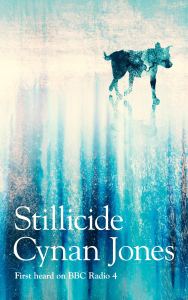 In his writing, Cynan Jones showcases the full potential of the short forms of prose – the novella and the short story. I have been a fan for years. The economy of his prose and the uncanny insight he offers into the human condition are a rare gift. Stillicide, his latest book, is a collection of short fictions which originated as a BBC Radio 4 series. The pieces are interlinked and centre around the theme of water, as the title suggests. “Stillicide” is defined as “a continual dropping of water” or “a right or duty relating to the collection of water from or onto adjacent land.”
 In his novels, Richard Zimler, who is best known for The Last Kabbalist of Lisbon, has been chronicling Jewish history throughout the ages and from all corners of the world for many years. His latest offering is an unusual, deeply touching retelling of the gospel. At its centre, Zimler places Lazarus and allows him to tell the story in a long letter to his grandson: “Picture me endeavouring to tell you matters that will never be able to fit easily or comfortably on a roll of papyrus.”
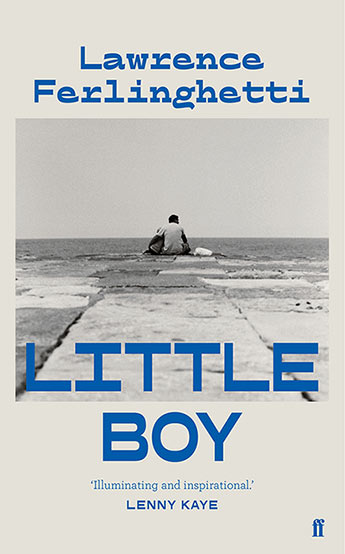 The versatile American artist Lawrence Ferlinghetti is a literary legend. For his hundredth birthday last year, Faber & Faber published a beautiful hardback edition of his latest work, a memoir in verse titled Little Boy. The cover and the first few pages lured me in at the bookshop; I couldn’t wait to take it home.
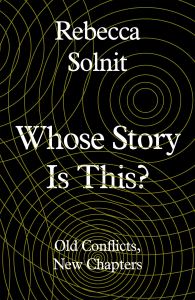 There are numerous writers out there who understand the complexity of the present. Many can also clearly convey their insights. But few do it as strikingly as Rebecca Solnit. I have discovered her work only recently, but have read and loved all the books she has authored by now. Her latest is another intellectual delight.
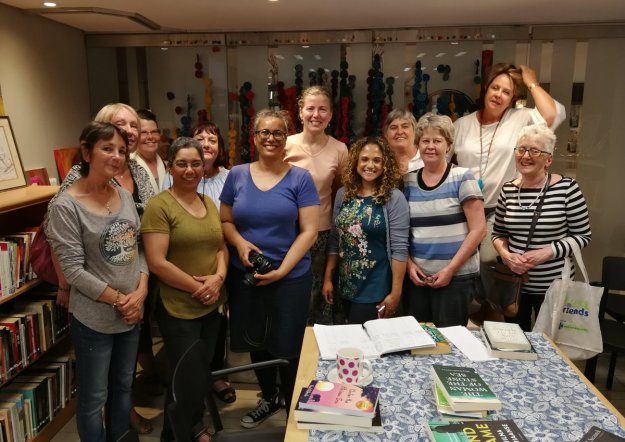
 For obvious reasons, I chose to speak about a few of the women in my life who shaped my creativity and were instrumental in paving my way towards a career in writing, editing and publishing. It was impossible to honour all of them in a short time, but these are the women who featured in my talk yesterday: my grandmother, Babcia Marysia, and my Mom, both of them nurtured my creativity in indirect but significant ways; Mrs Nellie Fahy, the librarian who awakened my passion for reading; Nadine Gordimer, whose writing brought me to South Africa for the first time; Maureen Isaacson, who first gave me the opportunity to hone my craft as a book reviewer when she was book page editor of the Sunday Independent; Lyndall Gordon, whose work and friendship showed me how to continue being a writer in the world when I was doubting that I could; Rachel Zadok, who believed in me as an editor and through work kept me sane when my world lost nearly all connection to sanity; and Joanne Hichens, who was a stranger when I asked her to visit me in an hour of utter despair nearly five years ago, but we became friends and are now co-editors of an anthology of short stories we published together: HAIR: Weaving and Unpicking Stories of Identity.


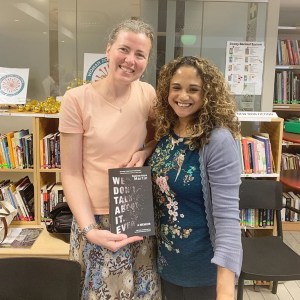 During the book club reviewing session, I also briefly spoke about the book I had finished reading that morning: Desiree-Anne Martin’s remarkable
 When a doctor pushed a shunt into her “unborn baby’s thorax to save his life from a deadly condition called hydrops”, Olivia Gordon and her husband had no way of knowing what other challenges would await them and their son before or after his birth.