Category Archives: What I’ve Read

Review: The Blazing World by Siri Hustvedt

the-blazing-worldThe Blazing World_HustvedtReading Siri Hustvedt’s work is always a stimulating treat. She is the author of six internationally acclaimed novels and the recipient of the International Gabarron Award for Thought and Humanities.

I first fell in love with her essays on art and psychology of which the most recent collection, Living, Thinking, Looking (2012), is a wonderful example. The clarity and beauty of her novelistic and essayistic vision is matched by her stylistic virtuosity. The result is a deceptively effortless execution that leaves the reader completely fulfilled.

The Blazing World, Hustvedt’s latest novel, is perhaps her best to date. Similarly to her other masterpiece, What I Loved (2003), it ventures into the treacherous world of art, greed and fame. The novel’s unusual format imitates an anthology composed of various pieces – interviews, letters, statements, notes, reviews, editorial comments, and diary entries – all of which centre on the life and art of Harriet Burden. Tellingly referred to as Harry by her family and friends, Burden feels that her artistic talents have been eclipsed by three unavoidable facts of her circumstances: her gender, age, and marital status. Hardly anybody wants to take her or her art seriously because she is a woman, she is middle-aged, and she is the rich widow of the famous art dealer, Felix Lord. A lethal combination for any artist trying to make her way in today’s world.

Her whole life Burden searches for a way to dodge misogyny. She grows up with a father who wishes she were a boy. Tall and curvaceous, she feels unattractive. Her intelligence and intellectual pursuits don’t help and turn her into an outsider. Feelings of inadequacy follow her into her marriage to Lord, a philanderer with many secrets. As a mother she finds how hard it is not to repeat the mistakes of our parents.

The art she creates is highly sophisticated, but largely ignored. She wants “to blaze and rumble and roar”, but something that is nearly impossible to articulate, “something horrible”, weighs her down and then rises like bile to her lips.

She wants revenge. She wants to have the last word. After Lord’s death, Burden employs three male artists to exhibit her artwork as their own: “There will be three, just as in the fairy tales… And the story will have bloody teeth.” One after the other, the exhibitions garner the recognition and success Burden had been craving for, but instead of proving a point, they cause a great deal of turmoil in the lives of people directly or indirectly involved in the project Burden aptly calls Maskings.

The novel cuts close to the bone. As a woman artist, I also found myself reading with this huge indigestible lump of “something horrible”, “fat, leaden, hideous”, stuck at the bottom of my intellectual and emotional stomach, and I knew exactly what Burden was experiencing when attempting to break down the prejudices she encounters in her life. However, Hustvedt’s rumbling and roaring is reassuring.

Her The Blazing World shines as brightly as Sirius.

Review first published in the Cape Times on 20 June 2014, p. 31.

Book mark: DF Malan and the Rise of Afrikaner Nationalism by Lindie Koorts

MalanFor somebody acquainted with only a broad outline of South Africa’s turbulent past, this blow by blow account of DF Malan’s life, told against the background of the crystallisation of Afrikaner nationalism and its most lethal exponent apartheid, was a real eye-opener. Deeply religious and driven by a strong sense of duty towards his people, Malan was prepared to make great sacrifices to achieve what he believed in: a South African republic where the Afrikaans-speaking community leads economically and culturally viable lives. He navigated the minefields of the country’s volatile political landscape in the first half of the twentieth century with determination that nearly obscures the warped racial ideology which drove him. Although this is Koorts’ first biography, she weaves the individual life story into the larger socio-political context with meticulous skill. At times her narrative reads like a political thriller where the villain is indistinguishable from a hero.

An edited version of this book mark was first published in the Cape Times today, 13 May 2014, p. 32.

DF Malan and the Rise of Afrikaner Nationalism
by Lindie Koorts
Tafelberg, 2014

Review: Chatsworth – The Making of a South African Township edited by Ashwin Desai and Goolam Vahed

ChatsworthThe forty contributions to this voluminous collection give a remarkable insight into the trials and tribulations of a South African township. Comprising academic studies, personal essays, and eye-witness reports on Chatsworth and its residents, the richly illustrated volume spans large chunks of the history of the township and its multitude of residents since its inception in the early 1960s.

Purely factual accounts are interspersed with vibrant narratives, like the one offered by the playwright Ronnie Govender who captures the spirit of the entire book by writing that a “ghetto is designed to kill the spirit of its hapless denizens … Chatsworth is one of those ghettos that refused to buckle.” Nearly all pieces in the book convey this message of survival against all odds.

Each of the local and international contributors approaches the township from a different angle. Many pieces centre on historical events and socio-political processes which shaped the area, first and foremost the initial forced resettlements around which all other memories evolve. One report examines the protests which dominated the early 1970s against plans to ban private bus companies from Chatsworth. Others write about specific individuals and entire movements which have been combating the appalling living conditions in the township. They zoom in on the daily struggles of ordinary people facing displacement, dire poverty, unemployment, gang culture, drug abuse, or different forms of exploitation.

There is an account of the horrific incident which shook Chatsworth on 24 March 2000 when thirteen teenagers were killed in a stamped at a nightclub. The tragedy was a wake-up call for the community to rethink the infrastructures available to young people in the township. Such reports are contrasted with stories about people hailing from Chatsworth who have made a great success of their lives, like Kumi Naidoo, the present International Executive Director of international environmentalist group Greenpeace, or Kerishnie Naiker, Miss Africa of 1997, who through her Welfare Initiative has initiated and facilitated the building of the Chatsworth Youth Centre.

Reading about the uplifting role cricket and football played in the lives of Chatsworth’s players, their teams, and the communities which supported them makes one furious about the carelessness with which sports at school level have been dealt with by the post-apartheid dispensation. More inspiring is the story of the Denny Veeran Music Academy where legions of musicians are being taught to reach for their dreams.

The book includes a captivating photo essay by Jenny Gordon which focuses on the centres of worship in Chatsworth. It is a welcome companion to the few contributions which describe the religious make-up of the township and the challenges the various groups of worshippers encounter in their quest for spiritual guidance.

Chatsworth: The Making of a South African Township is not exactly a leisurely read and will not be of much interest to a general reader. For anybody wanting to look into the inner workings of a township, it will be a treasure trove of information and impressions. In this respect, I felt highly enriched by the book.

Review first published in the Cape Times on 2 May 2014.

Book mark: The Last Man in Russia and the Struggle to Save a Dying Nation by Oliver Bullough

Book mark_Last Man in RussiaIn this enthralling but heart-breaking book the historian and journalist Oliver Bullough tries to find answers to a fundamental question about Russia: Why does a people turn to vodka for solace and what consequences does mass alcoholism have for a country? Bullough travels through Russia in the footsteps of Father Dmitry Dudko to trace how a fearless priest, who had brought hope and unity to his people, succumbed to the KGB. He exposes the ruthless finesse of the KGB’s enterprise in the former Soviet Union, the greed which has replaced ideology after the transition, and the continuing drinking problem of an entire nation. Despite inklings of optimism, it’s difficult to take heart for the future of Russia from his insightful report.

Book mark first published in the Cape Times, 25 April 2014, p. 12.

The Last Man in Russia and the Struggle to Save a Dying Nation
by Oliver Bullough
Allen Lane, 2013
Penguin, 2014

Review: Barracuda by Christos Tsiolkas

Barracuda by Christos TsiolkasReaders familiar with Christos Tsiolkas’ previous four novels, especially the widely acclaimed The Slap (2008), might approach his latest, Barracuda, with great anticipation. Not having read any of the others, I did not know what to expect and even after finishing Barracuda, I am still not sure what to feel about this complex, but disappointing novel.

Set for the greater part in Australia, it tells the story of Daniel Kelly who goes by the nickname of the title. A highly talented swimmer, Daniel receives a scholarship to a prestigious private school. Coming from a Greek-immigrant, working-class background, he has a great chip on his shoulder and feels like a complete outsider among the rich and spoilt beautiful kids.

With the support of his coach Frank Torma, he begins to prove himself in the water, and following the coach’s advice to “always answer back when you receive an insult”, he gains respect from some of the boys on the squad. But when all his dreams are crushed and he fails to deliver on his promise to become a great champion, Daniel’s world spirals horrifically out of control.

Told alternatively in the first and third person with Daniel as the focaliser, and jumping to and fro between different periods and events in his life, Barracuda examines the lethal whirlpool Daniel finds himself in after his failure and the reasons leading up to it.

As the narrative zooms in and out of the collage of Daniel’s life, one has the uncomfortable impression that the author is trying too hard to make Daniel’s breakdown and its consequences believable. Throughout the novel, I questioned his motives and actions and could never really grasp either, thus it was nearly impossible to identify or empathise with him.

The fact that it occasionally took quite a while to find one’s feet and connect the dots because of the non-chronological storytelling technique did not help in the matter either. Stylistically, there is a certain irritating, breathless repetitiveness in the novel, which awakens a longing in one to edit the text instead of getting lost in it.

Tsiolkas also has a tendency to describe bodily functions with a frankness and attention to detail that goes beyond challenging accepted norms. One scene in particular is not only disturbing, but also alienating. One wonders what the author wanted to achieve with it.

Thematically, Barracuda is a mixed bag. The novel focuses on the different relationships Daniel forms with his family members, friends and lovers, but also takes up issues of class, sexuality, identity, migration, religion, same-sex parenting and xenophobia. The characters have a tendency of discussing these topics at length, mostly without convincing arguments. They are not integrated well enough into the narrative not to appear didactic.

The novel has been received to enthusiastic critical and popular acclaim, but at more than 500 pages, Barracuda is one of only a few novels I’ve truly struggled to finish.

Review first published in the Cape Times on 11 April 2014, p. 28.

Review: Arctic Summer by Damon Galgut

Arctic Summer coverThe publication of every new book by Damon Galgut is a literary event par excellence. Two of his latest three novels were shortlisted for the prestigious Man Booker Prize. He is the recipient of many other accolades, including the local CNA Prize for The Beautiful Screaming of Pigs (1991) and the Commonwealth Writers Prize for Best Book from the Africa Region for The Good Doctor (2003). Galgut’s beautifully supple prose, his mastery of narrative forms, and his feel for characterisation always offer a rewarding literary experience. Arctic Summer is no different.

Like Galgut’s last novel, In a Strange Room (2010), Arctic Summer is partly set in India. Galgut’s descriptions of the places his astutely drawn characters traverse are as always a feast for all senses. In many other respects, however, it is a great departure from Galgut’s previous work. Evoking the early life of the British novelist E.M. Forster (1879-1970), Arctic Summer is a biographical novel, focused on its protagonist’s travels to India and Egypt as well as the relationships he shared with his mother and the few men who stirred his love and desire.

It is the time after Oscar Wilde’s trial and exercising caution in the display of one’s sexual longings is paramount to one’s survival. For most of the novel, Forster’s yearnings remain unfulfilled. The struggle to articulate what is one of the greatest taboos of his time and to put his desire into practice – whether in life or his work – takes centre stage in the novel.

Arctic Summer opens in 1912 with Forster on board a ship heading for India where he intends to visit Syed Ross Masood, a young Muslim man to whom he had been a tutor in England. The two men developed a deep, yet often unsatisfying, relationship, which is clouded by Forster’s love for Masood and his heterosexual friend’s inability to respond to his unwanted advances. The trip unfolds in unexpected ways. But it is Masood and the stay in his native country that eventually will inspire Forster’s masterpiece, A Passage to India (1924).

It is only in Egypt during the First World War when Forster volunteers to work for the Red Cross that at the age of thirty-seven he is seduced by a recuperating soldier. Then he meets and falls in love with Mohammed el-Adl, a tram conductor, who despite being also heterosexual and later happily married, allows Forster certain sexual liberties and appears to share his affections.

During Forster’s later sojourn in India he becomes embroiled in a relationship with Kanaya, a barber at the court of the Maharajah Bapu Sahib to whom Forster becomes Private Secretary. Devoid of feelings which he so desperately craves and blackmailed by Kanaya, Forster feels lonelier than ever.

Galgut brilliantly describes not only the precarious situation in which gays, or “minorities” in Forster’s terminology, found themselves at the beginning of the twentieth century, but also the pitfalls of power relations across race and class that accompany Forster’s ventures into the land of mostly unreciprocated love. The subtlety with which Galgut imagines the shifts in Forster’s psyche and the way his discoveries impact on his work, especially A Passage to India, the posthumously published Maurice and the unfinished Arctic Summer from which Galgut’s own title derives, is remarkable.

Even though with this novel Galgut enters the well-established field of fictional author biographies (locally, Michiel Heyns’s The Typewriter’s Tale or J.M. Coetzee’s Foe spring to mind), there is a great risk with imagining the lives of real people, especially well-known historical figures. Reading Arctic Summer, I often had the feeling that it is a novel where it should have been a biography and a biography where it should have been an autobiography. It is specifically Galgut’s dedication of his novel which echoes Forster’s original dedication of A Passage to India to Masood that makes one question the real inspiration and background of Arctic Summer. The parallel suggests that at least some of the emotional and psychological texture which Galgut ascribes to Forster’s and Masood’s relationship in Arctic Summer might have an autobiographical source.

Judging from the acknowledgements, Galgut’s research into E.M. Forster’s life must have been extensive. But like most readers, I’m neither a Galgut nor a Forster scholar, so it is impossible for me to judge where and to what extent the lines between Forster’s life and Galgut’s imagination and own experiences blur. Even more difficult is to define why such “untidy borders”, in the words of critic Ellen Rees, trigger occasional twinges of unease when reading the novel.

And yet, there is no doubt that this meticulously crafted book is a tribute to an intriguing man and his work. A deeply felt, melancholic novel which charts the subliminal links between creativity and desire and brings to life a fascinating literary figure, it is another bright feather in Galgut’s literary cap.

Review first published in the Cape Times on 28 March 2014, p. 32.

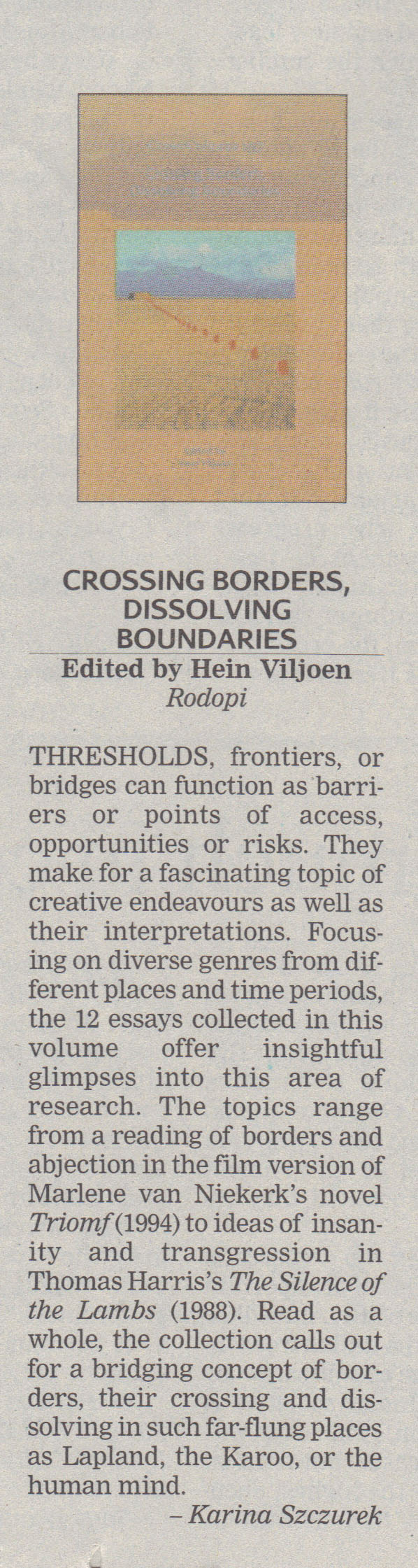
Book mark: Crossing Borders, Dissolving Boundaries edited by Hein Viljoen

Book mark_Crossing Borders_small copyThresholds, frontiers, or bridges can function as barriers or points of access, and they can represent opportunities or risks. They are indispensable in our way of perceiving and categorising the world, and make for a fascinating topic of creative endeavours as well as their interpretations. Focusing on diverse genres from different places and time periods, the twelve essays collected in this volume offer insightful glimpse into this area of research. The topics range from a reading of borders and abjection in the film version of Marlene van Niekerk’s novel Triomf (1994) to ideas of insanity and transgression in Thomas Harris’s thriller The Silence of the Lamb (1988). Read as a whole, the collection calls out for a bridging concept of borders, their crossing and dissolving in such farflug places as Lappland, the Karoo, or the human mind.

Book mark first published in the Cape Times, 21 March 2014, p. 10.

Crossing Borders, Dissolving Boundaries
Ed. Hein Viljoen
Rodopi, 2013

“Solve problems, make art, think deeply.”

What I have learned from and liked about Susan Cain’s Quiet – The Power of Introverts in a World That Can’t Stop Talking, a highly rewarding read:

~ It is fine to just be, you don’t have to act all the time.
~ Being an introvert does not make public speaking an easy experience.
~ “…how did we go from Character to Personality without realizing that we had sacrificed something meaningful along the way?”
~ Substance and thought are much more important than presentation.
~ Solitude and creativity are happy bedfellows.
~ Open-plan offices and brainstorming are not as great as some make them out to be.
~ Patience and persistence are underrated.
~ “We fail to realize that participating in an online working group is a form of solitude all of its own.”
~ Sensitivity to novelty can tell you a lot about yourself.
~ We are becoming less empathetic – some suggest that “social media, reality TV, and ‘hyper-competitiveness'” might be responsible.
~ Without sensitive people “we will, quite literally, drown”.
~ “The trick for introverts is to honor their own styles instead of allowing themselves to be swept up by prevailing norms.”
~ Conviction and caring might be more powerful than dynamism and charisma.
~ Acting out of character can pay off, if done for the right reasons.
~ Ask yourself what was important to you when you were a child, what kind of activities do you perform with a passion, what do you envy, and you might recognise the right reasons for you.
~ Good ideas don’t always come in eloquent packages.