
 The Finnish writer and documentary filmmaker, Elina Hirvonen, was one of the international guests attending the Open Book Festival last year in September. During the festival, she spoke about her novel, When I Forgot, originally published in Finnish in 2005. Two years later, it was translated into English and followed by Farthest from Death in 2010. Hirvonen’s third novel, When Time Runs Out (2015), was published to great critical acclaim in Finland. The English translation became available soon after Hirvonen’s visit in South Africa and is as relevant to our contemporary reality as it was at the time of its inception. Wherever we are in the world, news of mass shooting reach us on a regular basis and the intensely polarised opinions about the motivations, circumstances and the consequences of such actions continue to dominate global discussions.
Hirvonen’s fictional take on such horrendous acts is deeply insightful. The book was written and published in the aftermath of the Norwegian Anders Behring Breivik committing the horrific attacks in Oslo and on the island of Utøya in which 77 people died. There is a time-shifting reference to the event in the book: “Almost twenty years ago a Norwegian man killed dozens of young people on an island where they had gathered to talk about politics.” Hirvonen sets her story in Finland, in downtown Helsinki. Aslak, a young man, climbs to the roof of a building, aims his weapon at two unsuspecting women below, and fires: “They may be mother and daughter, he thinks, as he sets the rifle down for a moment, shaking his arms and taking a deep breath as if after a long dive. Then he raises the rifle again and takes aim at the woman, who is holding her hat as she runs for safety.” Within moments other passers-by become his victims.
It is one thing when you face an enemy you are aware of. Falling victim to a random act of violence is something none of us can guard against, which makes the possibility so much more frightening. Additionally to the loss of a loved one, the families and friends of mass shooting victims have to deal with this cruel unpredictability. And it is all around us: “In some extraordinary way we have grown used to killing. We have grown used to the feeling of insecurity caused by violence, to the grief which everyone wants to share, to the huddles of candles in the streets and in the school playgrounds, to the hearts and cloying ballads of social media which people try to share after such events. We have learned to deal with death and a daily insecurity, but not with the silence of a killer.”
Hirvonen’s When Time Runs Out looks at that silence and a different kind of suffering involved in such a situation – that of the family of the perpetrator: “When a quiet pupil comes to school with a weapon under his long coat and shoots ten of his classmates, everyone is supposed to think about the victim’s parents. How awful it would be to be one of them… You can talk about fear and anxiety to others because everyone recognises this. Parents who forget to breathe when reading such news because they know that the shooter could be their child bear their horror alone.”
When Time Runs Out is mainly told from the perspectives of Aslak’s mother, Laura, and his older sister, Aava. Their relationships with Aslak are complicated in diverse ways. Laura finds it extremely difficult to find a sense of connection to her son. Aava, who is a doctor working in conflict zones around the globe, has a closer relationship with her brother, but struggles to reach him when it matters the most. The family, including the father, battles to understand the troubled, impenetrable young man growing up among them.
When Time Runs Out is divided in five parts and each is preceded by a fascinating epigraph. The one which opens the novel comes from Susan Sontag’s seminal work, Regarding the Pain of Others: “Compassion is an unstable emotion. It needs to be translated into action, or it withers.” It pinpoints the nearly impossible task of the characters face, given the situation they find themselves in. With the fourth epigraph and what it stands for, Hirvonen adds a complex dimension not only to Aslak’s motives, but his mother’s vocation in the context of their story. The quote comes from a scientific paper by Craig A. Anderson and Matt Delisi: “However, no country will be immune to the violent consequences of global change.”
Laura works for an environmental organisation, specialising in climate politics. When Aslak is younger, he hears her lecture on the topic of climate change. It is a rare moment of sharing between them, but whereas Laura thrives on the passion for her vocation and her professional support of policy change, her son’s solution to the problem is driven by a sickening logic and inspired by a need to belong to something seemingly meaningful, no matter how cruel or misguided.
Hirvonen never excuses any of Aslak’s crimes, but offers us a credible story of what makes a person turn to absolutely senseless violence. What is most impressive about Hirvonen’s novel is that she does not let his family off the hook either. The author never lectures or points careless fingers. She makes the reader stare into the barrel of that rifle with which Aslak is about to shoot innocent people. She shows us what it means to stand there along with his helpless mother when the police come to tell her the news. We witness his sister trying to breathe through the night on the other side of the globe when she intuitively feels that something horrible is unfolding, but is paralysed by her brother’s last messages and the silence which follows.
Hirvonen’s storytelling is a fine act of balance between compassion, responsibility and blame. When Time Runs Out will make you reconsider your assumptions about this terrifying topic.
When Time Runs Out
by Elina Hirvonen
Manilla, 2017
Review first published in the Cape Times on 20 April 2018.
 “Not for the first time, I cursed my name… It was the only thing my mother had given me before she ran off with a man from God knows where when I was a few days old”, the narrator of Mary Watson’s The Wren Hunt tells us in the first pages of this beautifully crafted novel. Her name is Wren. The novel opens on Saint Stephen’s Day, or the Day of the Wren, as the public holiday is also known in Ireland. It takes place on 26 December and commemorates the Christian martyr who according to some legends was betrayed to his enemies by a wren. Other tales record an occasion when the presence of Irish soldiers was revealed to the Vikings by a wren on Saint Stephen’s Day, and until about a century ago, boys traditionally hunted wrens on that day, displaying the dead birds and collecting money for celebrations of the occasion. Today, live birds or model wrens still form part of the observance.
 Oudrif. Oudrif. Oudrif. A spell. A promise. We kept repeating the word to each other with longing, desperate to get away from the perils of our everyday. Our cosy straw bale cottage in
 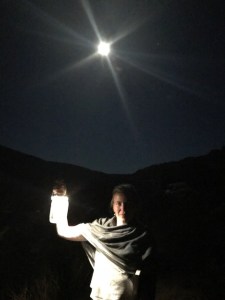 Oudrif. Oudrif. Oudrif. In Polish, we speak of such secluded spots as the places where the Devil says good night. But Oudrif is paradise on earth, day and night. Solar-powered angel lights guide you through the darkness before the stars light up the night. The place is totally independent of the municipal electricity and water grids. Any negative environmental impact is kept to a minimum.
 All around is rooibos country, every breath infused with the typical, soothing scent of the tea bush. But it was a mug of freshly brewed coffee on the stoep of our cottage that got us going every morning. In the afternoons, dry heat lured us back to bed and the setting sun invited for a swim in the rock pools of the Doring still full of balmy waters. The laziness of those tipsy hours of sleep, lounging about and playing cribbage… And the full moon dinner stories in the company of fascinating, like-minded, isolation-seeking guests from around the world… Let us return soon and sink into the loving arms of happily exhausted days at Oudrif. Oudrif. Oudrif.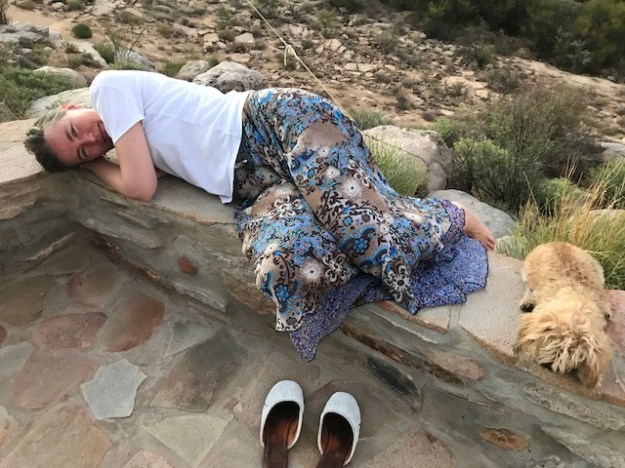
 Anyone who has read Karin Schimke’s Bare & Breaking, for which she won the prestigious Ingrid Jonker Award in 2014, will be delighted to know that her second collection of poems is now available from Modjaji Books. Navigate is sublime. Schimke’s poems steer between memory and loss, beauty and hurt, while forging a path to understanding, joy, holding on.
 At first glance, it looks like a typical boy meets girl story. However, Sally Partridge’s latest novel, Mine, is so much more. The book’s stunning cover illustration by Astrid Blumer introduces us to Kayla and Finlay (or Fin), the protagonists of the novel: we don’t see their faces, but we know that Kayla’s hair is in part strikingly blue, Fin is wearing a hoodie with a thunderbolt on his back. They are sitting on bench. One of them must have arrived to the meeting on a skateboard. Someone carved their initials into the back of the bench. Next to “K+F” is a broken heart. A squirrel watches on.
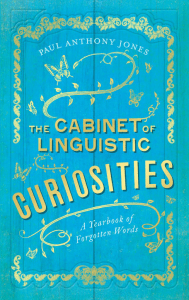 Languages are living, breathing, mutating creatures. The English language of today is not the one of 1602 when, according to Paul Anthony Jones in The Cabinet of Linguistic Curiosities: A Yearbook of Forgotten Words, “the Elizabethan playwright Thomas Dekker coined the word love-libel – literally, ‘a handwritten admission of someone’s love’”. Or the English of the early 1400s when the striking word “recumbentibus” (which, like so many of the words Jones collected in his remarkable book, the spellcheck on my computer does not recognise!) was adopted into the language from Latin: “In its native Latin recumbentibus was used merely of the act of lounging or reclining, but when the word was adopted into English it was given a twist: English writers…began to use it to refer to forceful, knockout or knockdown blows”.
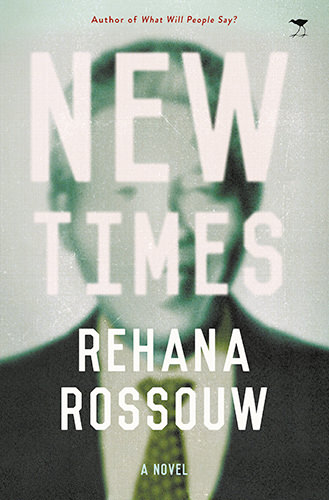 Rehana Rossouw’s debut novel, What Will People Say? (2015), was already on its seventh impression when I was reading it earlier this year. Being reprinted so often within a relatively short period of time is no small feat for a local novel. Even though I came late to the party, I immediately understood why it was so popular. Rossouw, a veteran journalist, succinctly captured an era and a community – the Cape Flats of the late eighties and early nineties – and made them come alive through a handful of characters belonging to the Fourie family. This was the time of volatile politics, raging gang wars and impossible choices. Decency and family values did not protect you from the evil of the system and the cruelties of the streets. Only the toughest survived to thrive.
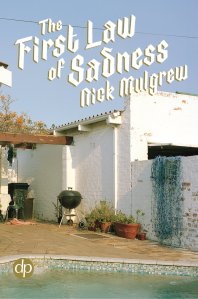 The short story continues to fascinate me for two reasons: the precision of thought and execution it attracts as well as its unpredictability. If well done, it can surprise and satisfy like nothing else in literature. And Nick Mulgrew does the genre justice like few other contemporary South African writers. His work has been recognised with multiple awards and his vision and skill have been highly acclaimed by critics. Mulgrew is also an editor and the director of the flourishing poetry press, uHlanga, which published his debut poetry volume, the myth of this is that we’re all in this together, in 2015. In his many impressive literary incarnations, Mulgrew understands that short art forms require meticulous attention to language. He knows how to make words count.
 It was by pure chance that I discovered a recent online essay by Rebecca Solnit in which she was writing about women, art, motherhood and selfishness. As a creative woman who chose not to have children, I found it most affirming. After some research about the author, I could not believe that I had never encountered Solnit’s work before. But fortunately, the article led me to her impressive oeuvre and the latest piercing collection of essays, The Mother of All Questions: Further Feminisms. In the introduction, Solnit mentions “the rapid social changes of a revitalized feminist movement” and how it is “changing our understanding of consent, power, rights, gender, voice, and representation.” She speaks of the movement as being “gorgeously transformative”.
 Karina Magdalena