
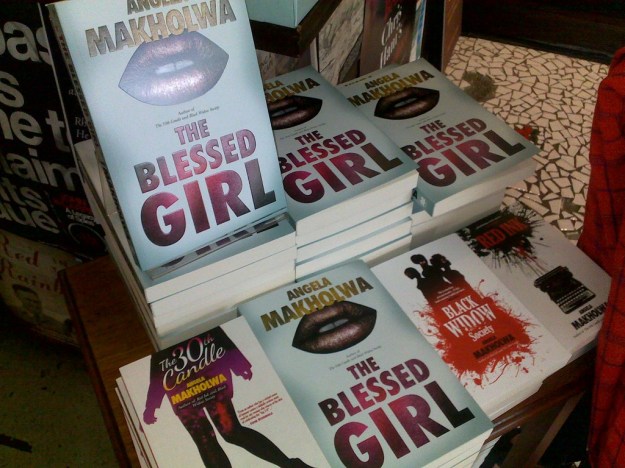
 The Blessed Girl is Angela Makholwa’s fourth novel. Although it was published only a few weeks ago, it has already gone into its second print run and I have an idea it is not going to be its last. The book sheds light on a phenomenon which has moved into the public eye in the last couple of years: the life of a blessee (usually a woman “who lives a luxurious lifestyle funded by an older, sometimes married partner in return for sexual favours” and who flashes that lifestyle on social media) and her blessers (the sponsors of that lifestyle and recipients of the sexual favours).
In interviews, Makholwa has stated that she did a lot of research into these opulent lifestyles and has spoken to people involved first-hand, even registering for a website which connects potential blessees with their blessers. The outcome is an authentic portrayal of the scene. Makholwa’s wit will make you laugh but while entertaining, she incisively delves into the much darker aspects of her story than the glitter lives of her characters would suggest on the surface. The Blessed Girl reads like chick-lit and does what the best of its kind achieve: for all its humour and light touches, it is a very serious analysis of the topic at hand.
Bontle Tau is the narrator of the novel and the blessee who seems to have it all: she is not even thirty, has the looks of a supermodel, owns her own penthouse apartment, drives a luxury car, throws money around on fancy restaurants, beauty treatments and designer goods like there is no tomorrow. She is offered business opportunities most of us can only dream of. It all comes at a price, of course. She is at the beck and call of her three main blessers who are all older, married, more or less affluent, and use her as they please. But she wants us to believe that it is all worth it, that she is the one exploiting others, not the other way around.
Bontle is not the kind of woman you would necessarily want to be friends with, and Makholwa makes sure that we know not to trust all that her protagonist is trying to sell to us, but she gives Bontle a voice that is genuine and thus allows us to care for her in a manner which surprised me. As the story progresses and Bontle’s seemingly charmed life unravels on the pages in front of us, it is nearly impossible not to feel empathy for the young woman as she makes her choices and deals with the ones forced on her. Makholwa paints a credible, moving backstory for her which explains Bontle’s position in life. It fills you with sorrow and anger. The ending of The Blessed Girl looked predictable at times, but Makholwa managed to surprise and I appreciated the unusual way Bontle’s fate unfolded. A book of our times; not to be missed.
The Blessed Girl
Angela Makholwa
Pan Macmillan, 2017
Review first published in the Cape Times, 10 November 2017.
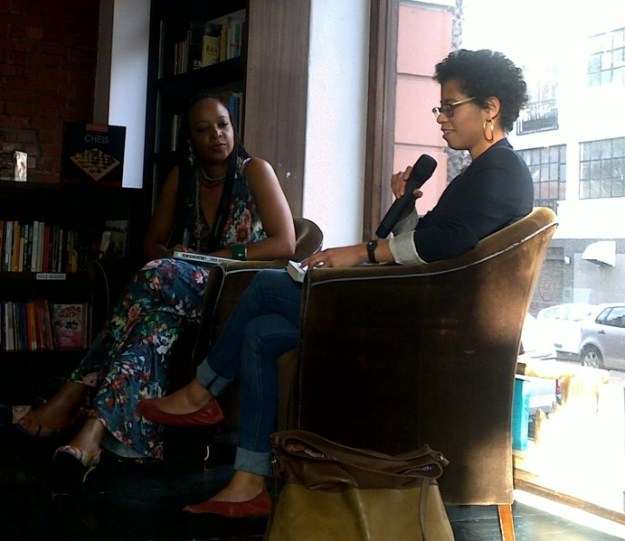
Angela Makholwa and Lauren Smith at the launch of The Blessed Girl at the Book Lounge.
 Traumatic events in your life have a tendency of distorting your perception of time. Accumulated layers of distress and pain can be paralysing. One of the saddest consequences of trauma is that it often becomes extremely difficult to live beyond the present moment, to imagine a future, especially a future that is kinder, filled with light. Survival mode takes a lot out of you. You have to be careful with your limited resources to simply take the next breath, to move one step forward. Just keeping still requires enormous effort.
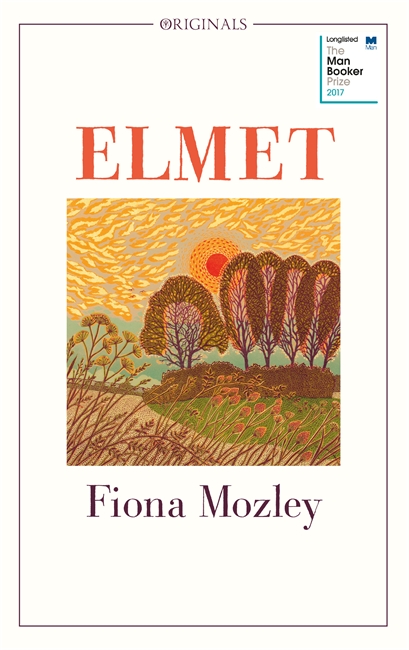 Every year, I try to pick at least one of the titles shortlisted for the prestigious Man Booker Prize and read it before the winner is announced in mid-October. This time, the novel which intrigued me the most on the list was Fiona Mozley’s debut, Elmet. The narrative draws you in from the first sentence: “I cast no shadow”, it begins, and continues in Mozley’s beautifully balanced prose that is balm for the aesthetic soul: “Smoke rests behind me and daylight is stifled. I count sleepers and the numbers rush. I count rivets and bolts. I walk north. My first two steps are slow, languid.” This kind of writing is difficult to resist.
 Opening Dark Chapter, Winnie M Li’s debut novel, you will find out the following: it is a work of fiction, but the book is “inspired by the author’s own rape in similar circumstances”. Dedicated to “all the victims and all the survivors – and most of us, who are somewhere in between”, the narrative plays out in that “in between” space and is a harrowing account of a woman’s attempt to come to terms with her new frightening reality after being raped. The circumstances Li describes are somehow unusual, the telling perhaps even more so.


 “What is it about our society that excuses these monsters? Why are we not holding people accountable on all levels?” Redi Tlhabi asked at the recent Cape Town launch of her latest book, Khwezi: The remarkable story of Fezekile Ntsukela Kuzwayo. She was referring to the horrifying prevalence of sexual violence in South Africa and our inability to prevent it as well as to offer justice to its victims. In Khwezi, Tlhabi demonstrates how the legal system and we, as society, have failed the victims of sexual violence in general, and one person in particular: Fezekile Ntsukela Kuzwayo, for over a decade known to most of us only as Khwezi – the woman who decided to fight for her right to safety and dignity and accused Jacob Zuma of rape when he ignored both by having sex with her without her consent on 2 November 2005. Zuma was acquitted of the rape charge in May 2006. Kuzwayo, vilified and violated by his supporters, had to flee the country.
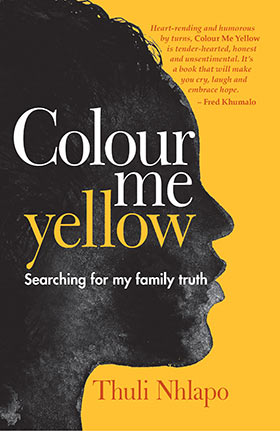 Reading Thuli Nhlapo’s powerful memoir, Colour Me Yellow, two thoughts dominated my mind. The book reminded me of a Polish saying that “families are best in photographs”. It also made me think of what Mphuthumi Ntabeni said at the recent Open Book Festival: “We need to address the failures of our traditions.” At the same time, I was overcome by an array of emotions. I was seething at the injustice of what happened to Nhlapo throughout her life, while simultaneously being filled with incredible sorrow for the child she once was and the deepest admiration for the woman she became.


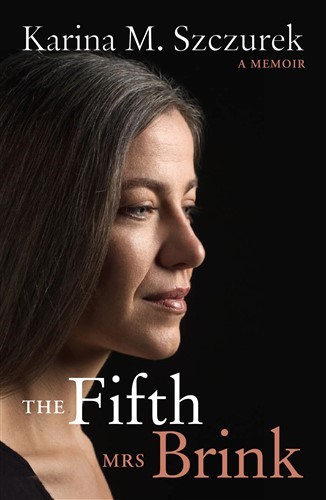
 Karina Magdalena