
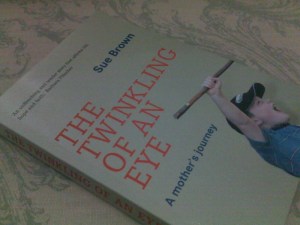
 How do you cope with the death of your child? How do you capture the ungraspable in words? I can hardly imagine either, but reading Sue Brown’s account of the life and death of her son Craig, I felt that every single word she put down on the page was an act of heroism.
The Twinkling of an Eye chronicles the years that Craig’s family shared with the boy, focusing on the last months of his life when he was diagnosed with a brain tumour which eventually caused his death just after his thirteenth birthday in 2011. With this book, Craig’s mother faces the events of this excruciatingly painful time with unflinching honesty. She pays tribute to a life cut short, but lived passionately, and admits: “I have found myself recalling times in my personal life – and career as a physiotherapist – of which I am not proud.”
Each chapter of The Twinkling of an Eye is preceded by an epigraph from different works of literature. The one which struck me is a quote from Tolkien’s The Hobbit: “It does not do to leave a live dragon out of your calculations, if you live near him.” Indeed, but none of us is ready for the moment the “beast” moves into our vicinity.
When Craig’s health began deteriorating, all the worrying symptoms could be easily explained by non-life-threatening conditions. Most alarming was the boy’s changing personality. When school friends started to complain about his uncharacteristically bullying behaviour, the family was worried that they had a “delinquent teenager in the making” on their hands. Distressed about her son’s – and her own – lack of empathy in the situation at the time, Brown writes: “Later I will ache at my son’s confusion and hurt, and my total lack of understanding as his mother.”
The first brain scans reveal the real reason for all of Craig’s strange symptoms. The wish is to “buttress the horror from spilling into what could be the last day of pretend normality.” The reality of the situation begins to sink in as the doctor “mentions two possible names, both of which my own brain stubbornly refuses to register. It hears, clings to, only the ‘hopefully benign’ bit at the end.” An operation is inevitable. Another follows. Craig and his family battle and endure, but their world becomes completely unrecognisable to them all. Everything changes and there is no way back “to a time when I could worry within safe limits, or resume the life that we knew.” There is hope and despair, agony and fury, desolation and exhaustion, frustration and bravery. And the moment when Craig says out loud, “I think I am dying.”
Understandably, Brown is confronted with a spiritual challenge: “My faith is thin ice that might crack beneath the weight of my fear for my child”, she confesses, but finds a way to carry on. A friend suggests that Craig and the family “did not deserve this”, but Brown wonders whether anyone ever does.
This is not an easy read. It is impossible to witness the soul-crushing experiences Brown describes with dry eyes. Just as it is impossible to remain untouched by the acts of tenderness and kindness she remembers. Many people do not know how to react to the news which becomes more terrifying with nearly every visit to the doctor, but those who find a soothing word or gesture at the right time become invaluable. Brown is “surprised at the comfort that the presence of all these people, with all the love they hold for Craig and for us, brings” and feels “gently held”.
No matter how many books are written, how much wisdom gathered in them, there are no manuals on how to deal with these most intimate and personal losses in life. Each path is individual, even if many of us recognise the occasional signpost along the way. Nothing can prepare you before you embark on this journey. But books written by others who had suffered loss bring relief to Brown in her hour of need and she finds her own writing “profoundly healing”. I can imagine that readers will recognise many of their own truths in her book.
Craig was a boy full of energy, ideas, dreams and ambitions. Those who knew him felt that he was destined for a special life. Nobody could have predicted that he would have to face the most outrageous odds: “A one-in-a-billion, sick kind of fame so unlike the types he had fancied for himself. Still, I have the sense that walking this unchosen path with his courage and humour has perhaps been the greatest achievement imaginable.”
The Twinkling of an Eye ends with a deeply moving tribute to Craig by his older sister Meg. She writes about the “Craig-shaped hole by which our family feels different.” That hole can never be filled, but through the book Craig’s memory will not only be kept alive by those who knew and loved him, but also by the many readers who will allow the boy’s recorded effervescence and bravery to settle in their hearts.
The Twinkling of an Eye: A mother’s journey
by Sue Brown
Human & Rousseau, 2017
First published in the Cape Times on 28 July 2017.
 A cup of tea contains many stories. There is one on the intriguing cover of Francine Simon’s debut poetry collection, Thungachi. Simon hails from Durban where she was born into an Indian Catholic family, a heritage that infuses her poems about myths, family, language and religion.
 There is something about a debut novel that excites beyond the ordinary experience of opening a new book by a familiar author. You have no way of knowing what to expect. When starting Marcus Low’s Asylum, I certainly did not anticipate that the novel would hold me captive for several hours. I read it in one go, even though I only intended to dip into it on the morning before its launch at the Book Lounge last month. A friend of mine was interviewing the author at the event and I meant to go to support my friend. By the time I arrived at the bookshop, however, I was there to cheer on everybody involved. Marcus Low has got himself a fan.
 A few years ago when I read Donvé Lee’s illuminating debut novel An Intimate War (2010), I promised myself that I would read anything this author writes. I doubt I would have picked up Syd Kitchen’s biography otherwise. Kitchen’s name meant nothing to me before I read the book. An acoustic folk musician who came into prominence in South Africa in the 1970s, Syd Kitchen was not the kind of person I enjoy reading about: an addict and a gambler who “didn’t so much as burn the candle at both ends as apply a blowtorch to the middle” (according to Michael Cross). But there is no doubt that he had a unique talent and a charisma which touched many people’s lives, and Lee’s compassionate portrayal of the man made me curious about his music.

 In 2013, South African-born author Deborah Levy published Things I don’t want to know, a response to George Orwell’s 1946 essay “Why I write”. The Notting Hill Editions version of this exquisite book flourishes two quotes on the cover. On the front: “To become a writer, I had to learn to interrupt, to speak up, to speak up a little louder, and then louder, and then to just speak in my own voice which is not loud at all.” On the back: “Perhaps when Orwell described sheer egoism as a necessary quality for a writer, he was not thinking about sheer egoism of a female writer. Even the most arrogant female writer has to work over time to build an ego that is robust enough to get her through January, never mind all the way to December.”
 Levy’s incisive essay was very much on my mind when I was reading two recent titles published by Modjaji Books: the poetry volume How to open the door by Marike Beyers, and the memoir Flame and song by Philippa Namutebi Kabali-Kagwa. But it took me a while to figure out what the connection my intuition had been suggesting was, and then it hit me: since its inception, Modjaji Books has been offering a publishing platform for loud books by authors with soft voices – the kind of soft which utters the most powerful messages. No shouting necessary, please; we are getting all the way to the end of the year here.
 “Winterbach is the kind of writer any literature could be envious of” – Marlene van Niekerk is quoted on the cover of The Shallows, Ingrid Winterbach’s latest novel translated from the Afrikaans into English. The original, Vlakwater, was published in 2015. One of South Africa’s most distinguished novelists, Winterbach is the author of ten other highly acclaimed novels, five of which are also obtainable in English. Anyone who has engaged with her work will understand what a privilege it is to have it available in translation. She is a quintessentially Afrikaans, South African, writer; her narratives are deeply rooted in the local consciousness. However, their appeal is truly universal. The stories she tells, the way she tells them, remind me of authors like the American Siri Hustvedt, or the Pole Olga Tokarczuk, or the Israeli Etgar Keret. They come up more easily for comparison than other compatriots. In fact, the only writer I can think of locally whose work displays a similar storytelling intuition is the translator of The Shallows, Michiel Heyns. The supple prose of his translation testifies to the perfect match.
 A while back, I spoke to a friend about the phrases ‘to handle something’ or ‘to have a grip on something’ in connection with the physical ability to hold, handle, or have a grip on something as a manifestation of an emotional and psychological capability.
 I had this grand plan of learning how to quilt while resting (I always find it reassuring, comforting, to see something come into being in my hands – activities like crocheting, knitting, or ironing soothe me). But now, not only has my plan of a self-imposed sabbatical been delayed because of work-related commitments I simply cannot get out of (I know, I know!) by two to three weeks, I actually cannot quilt, at least not until my arm recovers.
 Karina Magdalena