Category Archives: Uncategorized

Die vyfde en laaste mevrou Brink

MaanKind's avatarMaanKind

Waarom vind ‘n mens sekere mense se lewensverhale meer aangrypend as ander?

Vir solank ek kan onthou, was André P Brink die hoogste op my lys van gunstelingskrywers. Toe Nicolette saam met Die Ambassadeur oorsee gerinkink het, was ek maar self ‘n blote kind en het glad nie Ingrid Jonker in verband gebring met die karakter Nicolette nie. Waarom sou ek? Dis tog ‘n verhaal wat stelselmatig oor die dekades bekend geword het aan ons gewone lesers. In elkeen van sy boeke wat daar altyd iets universeel aan sy vroulike hoofkarakter, in so ‘n mate dat ek my eenmaal lank gelede vererg het en gedink het Brink kyk eensydig na vroue, dat hy ‘n illusie najaag en dat hy nooit die ideale vrou of vrouekarakter sou kry nie. Dit het eers later aan die lig gekom dat die vrouekarakters geskoei was op die beeld wat hy van Ingrid Jonker in…

View original post 629 more words

Review: Falling Creatures by Katherine Stansfield

Falling CreaturesThe British author Katherine Stansfield has a mesmerising novel (The Visitor, 2013) and an exquisite poetry collection (Playing House, 2014) to her name. Falling Creatures is her second novel. Set on the Bodmin Moor in Cornwall where Stansfield grew up, it tells the story of an actual murder which occurred in 1844. A young woman’s throat was slashed; a man who lived on the same farm as her was hanged for her brutal murder. A memorial commemorating the gruesome event still stands on the spot where the woman died and continues to haunt locals and visitors alike. The records of the real story are inconclusive as to what might have truly happened. But where the historian’s hands are tied, a novelist can step in and imagine a plausible scenario. This is precisely what Stansfield did for Charlotte Dymond and Matthew Weeks of Penhale Farm.

The story begins with a chance encounter between the narrator, whom we eventually get to know by the name of Shilly, and Charlotte. After her mother’s death, Shilly is left by her father at the All Drunkard pub where she and Charlotte are hired by the widow Mrs Peter to help on her farm. A special bond develops between the two young women when Charlotte gifts Shilly “blood-heat” on the day they meet. She gathers the body heat of a horse in her hands to warm Shilly with. From that moment on, it is clear that Charlotte has mysterious talents and communes with powers the other inhabitants of Penhale Farm and the surroundings are weary of, but Shilly also finds enthralling.

Charlotte’s beauty and skills cast spells over the people who cross paths with her. Mrs Peter’s son John and farmhand Matthew are drawn by her magnetism, as is Shilly. She feels very protective of her new friend, who reads nature and human deeds for signs and predicts that “terrible things will happen”. When Charlotte is found dead on the moor soon after her arrival at Penhale Farm and Matthew is apprehended as a suspect for her murder, a charismatic stranger arrives on the scene to investigate the horrific deed and requests Shilly’s assistance in his quest. The devastated Shilly obliges, but also has her own demons to confront as the tantalising story unfolds: “I had loved her, though she was cruel, though she was sly. She was my girl, and after all, anyone who claimed to have no badness in them was shown to be bad by the lie. She and I were just as the rest of the world – creatures falling, creatures failing.”

Stansfield’s take on the historic events of 1844 is as bewitching as her protagonist. If you are a fan of historical fiction, Falling Creatures has all the ingredients that will keep you hooked. Stansfield weaves together a fascinating plot, charismatic characters – real and imagined – and atmospheric prose to delight the aesthete. The sequel to Falling Creatures, The Magpie Tree, is to be published early next year, and it will be eagerly awaited.

Falling Creatures

by Katherine Stansfield

Allison & Busby, 2017

Review first published in the Cape Times, 18 August 2017.

Review: Firepool by Hedley Twidle

FirepoolIn the Afterword of At Risk: Writing On and Over the Edge of South Africa, a collection of personal narratives edited by Liz McGregor and Sarah Nuttall, Njabulo S. Ndebele writes about the book taking “us closer to the notion of ‘making public spaces intimate’ by infusing into the public domain, not gossip, but genuine, reflective, if sometimes agonised, personal testimony. Self-exposure of this kind is harder than the act of unmasking others. It allows for the public sharing of vulnerabilities as the basis for the restoration of public trust (against public hypocrisy) and makes possible a world of new, interpersonal solidarities that extend into broader, more affirming social solidarities.”

Narratives of this kind are not only fascinating but, in a world of lethal lies, increasingly essential. Hedley Twidle’s excellent Firepool allows the form to shine. The book contains nine essays on topics as diverse as skin, democracy, literature, Mandela, Verwoerd’s assassin, music, nuclear power, racism, the N2, universities and that swimming pool. Here is an incisive mind at work, writing about relevant issues, but not from a purely intellectual perspective of a distant observer, but from within the personal experience. The “vulnerabilities” Ndebele mentions in the above quote are on full display and allow for a deeply intimate engagement with each text – for the writer and, crucially, for the reader.

When Twidle says “I want to write about skin”, you would be forgiven in the present climate to expect that he will be writing about race. And in a sense he does, but not in any obvious way. Twidle recalls his school years and the intricacies of power one face as a young adult. He talks about transformation (from childhood to adolescence and then adulthood, but also in socio-political terms) and “troubled skin”, skin suffering from the most horrifying acne: “These registers of experience are revolting, and seldom written about – or, at least, were very hard to find in print during the pre-Google era.” There is a reason why Twidle goes where only Google does not fear to tread, why he is probing “the limit zones of disgust: political disgust, but also the intimate and democratic rankness of bodily disgust – in the belief that such an investigation might be a prelude to true metamorphosis, acceptance, love.”

“Twenty-Seven Years” is a tribute and a meditation on the remarkable life of musician Moses Taiwa Molelekwa. He was a child prodigy who died much too young at the age of twenty-seven, but who was not afraid “to risk being naive, and to begin at the beginning.” Twidle records his own music history with the awareness that “the challenge for all writing about anything that moves us, is to carry within the writing a memory of that initial ignorance, of the silence before the music started.” He structures the essay in narrative loops which manage to create that sense of innocence, eschewing the usual “scholarly mode” of linear developments and imitating an improvisation, as if on a musical theme.

In “Getting Past Coetzee” we are referred to the hermit crab of the book’s wonderful, but initially mysterious, cover (the illustration makes perfect sense once you reach the last page). I doubt there are any students of English literature anywhere in the world who have not come across JM Coetzee. Twidle is a great admirer, but not an uncritical one. Contrary to his literary hero, he acknowledges a South Africa that is a “generous one, where things are thrashed out in dialogue with others, rather than selves.”

The essays which gripped me the most were “A Useless Life”, “Thirteen Ways of Looking at the N2” and “Nuclear Summer”. The former two tackle unusual topics: Demitrios Tsafendas and the N2. The latter reverts to an all familiar consideration, but with refreshing urgency: nuclear energy.

Tsafendas is the man who murdered Verwoerd, but his existence has been nearly erased from public consciousness. He later testified he had acted “on instructions from a tapeworm inside his gut.” Twidle recounts his story in vivid details and reclaims it for “our national narrative”, showing what consequences suppression of truth and diverse definitions of and approaches to madness can have. It is an intriguing story if there ever was one. In “Thirteen Ways of Looking at the N2”, Twidle takes us on a walk along the N2 from the city centre to the airport – “a space where we are all in it together (though not, of course, all in the same way).”

“Nuclear Summer” exposes a peril that is common to us all and is a stark reminder that silence is “indefensible” in cases of life and death. No matter how tired we might feel because of the endless debates about nuclear power, Twidle returns us to basic truths: the anti-democratic nature of nuclear power and the fatal failure of our imaginations in connection to the environmental impact this form of energy production has. We know “that knowledge and authoritarianism can go very well together; that facts now live alongside alternative facts, that truths can coexist perfectly happily with lies.” And because we know, there is no excuse for silence.

The essays in Firepool are an intellectual and emotional feat, calling for understanding as well as compassion. The need for both cannot be underestimated.

Firepool: Experiences in an Abnormal World

by Hedley Twidle

Kwela, 2017

Review first published in the Cape Times, 18 August 2017.

The Fifth Mrs Brink

mztiahmarie's avatarTiah Marie Beautement

35080452.jpg– Fiction is the most dangerous place in the world; that’s where truth lives. –
– There is no peace in fear for a loved one. No place to hide in the face of death. I read and wrote through the nights, stared into darkness. –

– Water tells my story. –

– Languages come to me. There is no other way of describing it. After an initial intimidating few months of frustration, they seep into me. It is a process I can think of only as osmosis. The moment I find myself surrounded by a language, it enters through my mind’s pores into my consciousness. I think, dream and live it. –

– Memoir is as close to a recollected truth as I dare to come, and there is no one to protect me. It is selective, structured, but no less sensitive. –

– It moves in with you…

View original post 46 more words

Review: The Twinkling of an Eye – A mother’s journey by Sue Brown

TwinklingHow do you cope with the death of your child? How do you capture the ungraspable in words? I can hardly imagine either, but reading Sue Brown’s account of the life and death of her son Craig, I felt that every single word she put down on the page was an act of heroism.
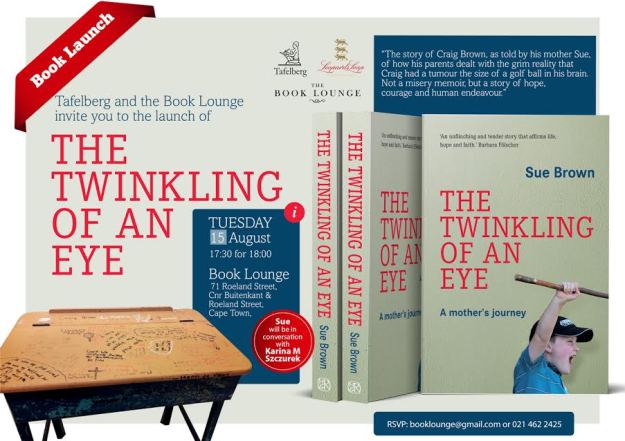
The Twinkling of an Eye chronicles the years that Craig’s family shared with the boy, focusing on the last months of his life when he was diagnosed with a brain tumour which eventually caused his death just after his thirteenth birthday in 2011. With this book, Craig’s mother faces the events of this excruciatingly painful time with unflinching honesty. She pays tribute to a life cut short, but lived passionately, and admits: “I have found myself recalling times in my personal life – and career as a physiotherapist – of which I am not proud.”

Each chapter of The Twinkling of an Eye is preceded by an epigraph from different works of literature. The one which struck me is a quote from Tolkien’s The Hobbit: “It does not do to leave a live dragon out of your calculations, if you live near him.” Indeed, but none of us is ready for the moment the “beast” moves into our vicinity.

When Craig’s health began deteriorating, all the worrying symptoms could be easily explained by non-life-threatening conditions. Most alarming was the boy’s changing personality. When school friends started to complain about his uncharacteristically bullying behaviour, the family was worried that they had a “delinquent teenager in the making” on their hands. Distressed about her son’s – and her own – lack of empathy in the situation at the time, Brown writes: “Later I will ache at my son’s confusion and hurt, and my total lack of understanding as his mother.”

The first brain scans reveal the real reason for all of Craig’s strange symptoms. The wish is to “buttress the horror from spilling into what could be the last day of pretend normality.” The reality of the situation begins to sink in as the doctor “mentions two possible names, both of which my own brain stubbornly refuses to register. It hears, clings to, only the ‘hopefully benign’ bit at the end.” An operation is inevitable. Another follows. Craig and his family battle and endure, but their world becomes completely unrecognisable to them all. Everything changes and there is no way back “to a time when I could worry within safe limits, or resume the life that we knew.” There is hope and despair, agony and fury, desolation and exhaustion, frustration and bravery. And the moment when Craig says out loud, “I think I am dying.”

Understandably, Brown is confronted with a spiritual challenge: “My faith is thin ice that might crack beneath the weight of my fear for my child”, she confesses, but finds a way to carry on. A friend suggests that Craig and the family “did not deserve this”, but Brown wonders whether anyone ever does.

This is not an easy read. It is impossible to witness the soul-crushing experiences Brown describes with dry eyes. Just as it is impossible to remain untouched by the acts of tenderness and kindness she remembers. Many people do not know how to react to the news which becomes more terrifying with nearly every visit to the doctor, but those who find a soothing word or gesture at the right time become invaluable. Brown is “surprised at the comfort that the presence of all these people, with all the love they hold for Craig and for us, brings” and feels “gently held”.

No matter how many books are written, how much wisdom gathered in them, there are no manuals on how to deal with these most intimate and personal losses in life. Each path is individual, even if many of us recognise the occasional signpost along the way. Nothing can prepare you before you embark on this journey. But books written by others who had suffered loss bring relief to Brown in her hour of need and she finds her own writing “profoundly healing”. I can imagine that readers will recognise many of their own truths in her book.

Craig was a boy full of energy, ideas, dreams and ambitions. Those who knew him felt that he was destined for a special life. Nobody could have predicted that he would have to face the most outrageous odds: “A one-in-a-billion, sick kind of fame so unlike the types he had fancied for himself. Still, I have the sense that walking this unchosen path with his courage and humour has perhaps been the greatest achievement imaginable.”

The Twinkling of an Eye ends with a deeply moving tribute to Craig by his older sister Meg. She writes about the “Craig-shaped hole by which our family feels different.” That hole can never be filled, but through the book Craig’s memory will not only be kept alive by those who knew and loved him, but also by the many readers who will allow the boy’s recorded effervescence and bravery to settle in their hearts.

The Twinkling of an Eye: A mother’s journey

by Sue Brown

Human & Rousseau, 2017

First published in the Cape Times on 28 July 2017.

Sue-Brown invite

Review: Thungachi by Francine Simon

ThungachiA cup of tea contains many stories. There is one on the intriguing cover of Francine Simon’s debut poetry collection, Thungachi. Simon hails from Durban where she was born into an Indian Catholic family, a heritage that infuses her poems about myths, family, language and religion.
The collection opens with “Naming Places” in which the poet recalls the distant past, the time “they came on the boats”, and explains that “since we don’t know / my father’s family / we are the last of the Simons. // Nothing left for his daughters / but to be girls.” But like the biblical Adam, Simon is claiming and naming her domain, as poet and woman. Deeply embedded in the culture of her community, the poetic persona of poems like “Tamil Familiars” evokes her grandmother’s and mother’s superstitions only to ignore them: the curry-leaf tree which is supposed to die when picked from at “that time of the month” is standing as strong as the “I” of the poem who eats straight out of a pot even if it might bring rain to her wedding day: “I never give a thought / to my wedding.” (In a note on the poem, Simon comments that it is most likely to rain in Durban that day anyway.)

“I”, with only a dash to follow, also emerges at the end of the poem “Rati”, in which the mythical story is retold as a background against which to define oneself. In “Tea”, the ways of serving tea at home are described in detail: “Tea is my job. I know it well.” But once again the “I” sets herself apart from her family’s traditions: “I take tea but never drink it. / You can always find a cold cup / and know it’s me.”

In “Gathering”, there is a sense of the past being put to rest: “All are broken clocks / and candle stumps. / Dust, watching / in a settlement.” These images contrast with the exuberance of “Nanni-ma”, which opens with the lines “I think of sex and only / sex since he / became my neighbour” and ends with “in my doorway at night / asking to eat from / my chilli tree.” Or the devotion of “Vetala-pachisi”: “and when you lit that candle / it was hard enough to ask so instead you burned // Hail Marys into your hands.”

Simon is not afraid to push the boundaries of poetic forms. She experiments with abandon and takes the reader into unfamiliar territories. In this respect, not all of the poems in Thungachi were my cup of tea, but they fascinate and force one to engage with more care, refining one’s palate. The Notes at the end of Thungachi are a wonderfully inventive part of the collection and should not be skipped. They add texture and spice to the poems they comment on. And thus the ending of “Little House” encapsulates Simon’s deft, purifying touch: “Nothing here, / only dust // on our words in want of a wiping hand.”

Thungachi

by Francine Simon

uHlanga, 2017

Review first published in the Cape Times, 21 July 2017.


Review: Asylum by Marcus Low

AsylumThere is something about a debut novel that excites beyond the ordinary experience of opening a new book by a familiar author. You have no way of knowing what to expect. When starting Marcus Low’s Asylum, I certainly did not anticipate that the novel would hold me captive for several hours. I read it in one go, even though I only intended to dip into it on the morning before its launch at the Book Lounge last month. A friend of mine was interviewing the author at the event and I meant to go to support my friend. By the time I arrived at the bookshop, however, I was there to cheer on everybody involved. Marcus Low has got himself a fan.

Asylum tells the story of Barry Wilbert James. He is locked up under quarantine in the titular asylum. The facility is located in the unforgiving nothingness of the Karoo. The time is the not too distant future (the twenties of our present century) after pulmonary nodulosis – a lethal illness – had affected vast numbers of the population: “We are sick and therefore we are isolated, locked up. We must wait out our days here, and then die – so that the healthy ones, the ones we have forgotten about, may live.”

There is no cure. Admitted to the asylum a couple of years ago in 2019, Barry spends most of his time contemplating his lot and dreaming of distant, frozen landscapes. He avoids other detainees – a “flock of coughing corpses”. To deal with their suffering, they are mostly drugged. Remembering loved ones is devastating. Thinking of the outside world is torture, especially since its state is uncertain. Violence erupts in the midst of the hopelessness the men face. Dreams “are the only way out of here – in those dreams anything is possible, any horror, any one, any thing, even snow.” In Barry’s dreams, some people speak Polish, men in tuxedos dance at masked balls, and there is a threatening presence, but also a white pill which promises relief. And there is consolation: “For it seems to me that even in the most bleak of worlds we’ll find something to hold on to…even if that is something as impossible as snow in this godforsaken landscape.”

After a suicide attempt, a psychologist is assigned to Barry to help him cope with his situation. She advises that he keep a journal. His notebooks form the core of Asylum. It is after they are discovered and stored in the Museum of the Plague in Beaufort West in 2026 that we learn about Barry’s life in the asylum and what led him to implicate himself in some of the other patients’ plans to escape. The eight recovered notebooks – incomplete and intriguingly unreliable – are accompanied by varied notes trying to make sense of the entries and to establish a “plausible chronology”.

Low’s handling of the narrative technique is extremely deft. The lyrical meditative passages of the notebooks are interspersed with fragments, marginalia, poems, and terse academic commentary, which offers factual, but not always enlightening data. The effect is striking. What we get is a version of the story, which might or might not be true, and it is up to the readers to piece it all together in their heads. We know about the documents. We are told that they were found by one of the asylum’s doctors and passed on to the psychologist, who, in turn, donated them to the museum. We are also informed that the body of another inmate, Jonathan Fox, “was found in a shallow grave” near the asylum and that the find corresponds with Barry’s account of the man’s death.

Marcus Low used to be the policy director of the Treatment Action Campaign. At the launch of the book, he mentioned that he is gradually losing his eyesight. Both of these real-life experiences allow him a unique insight into the reality of illness and what it takes to lead a fulfilled life beyond frightening medical diagnoses. His portrayals of Barry’s daily struggles with depression, delusions and his inevitably impending death are heart-wrenching. They provide not only an incisive take on incurable illnesses, but also policymaking in such institutions as health-care facilities or old-age homes.

Asylum explores how one can deviate from a predestined plot by dreaming, or telling stories. The strategy not only applies to fiction, but also life. In the novel, an academic studying Barry’s journals in the museum suggests that the texts show Barry “preoccupied with colour and light.” Barry realises: “I started imagining that someone would one day read all this…That is why I could keep on with it, why it became an obsession, why I’m sitting here now, months later, filling page after page of this notebook.”

Speculative, post-apocalyptic fiction has now firmly established itself in contemporary South African literature. Marcus Low’s Asylum is a remarkable addition to the genre. I am not the only one who found it unputdownable. Friends report similar experiences. Thought-provoking, alluring and sensitively written, it is a mesmerising novel which announces a new thrilling talent on the local literary scene.

Asylum

by Marcus Low

Picador Africa, 2017

Review first published in the Cape Times on 12 May 2017.

Book review: Syd Kitchen – Scars that Shine by Donvé Lee

Syd-Kitchen-Cover-3D-199x300A few years ago when I read Donvé Lee’s illuminating debut novel An Intimate War (2010), I promised myself that I would read anything this author writes. I doubt I would have picked up Syd Kitchen’s biography otherwise. Kitchen’s name meant nothing to me before I read the book. An acoustic folk musician who came into prominence in South Africa in the 1970s, Syd Kitchen was not the kind of person I enjoy reading about: an addict and a gambler who “didn’t so much as burn the candle at both ends as apply a blowtorch to the middle” (according to Michael Cross). But there is no doubt that he had a unique talent and a charisma which touched many people’s lives, and Lee’s compassionate portrayal of the man made me curious about his music.

Born in Durban on Valentine’s Day in 1951, Syd Kitchen led a life marred by substance abuse and resulting poverty. A self-taught guitarists, songwriter and performer, he just about tried everything apart from conformity. His rebellious nature often brought him in conflict with other musicians and the record companies. A victim of sexual abuse, he found it difficult to find healing and stability in his life. But all his life he was surrounded by adoring fans, especially women, and friends who carried him through until self-neglect eventually killed him much too early, at the young age of sixty.

He became an iconic figure in the music circles around South Africa. The title of his fourth album – Africa’s Not for Sissies (2001) – became a well-known catchphrase. His international breakthrough arrived late in his life, and although it was relatively small, it was significant. Several documentaries record his life. Lee’s is the first biography.

I love the scene with which Lee opens the book: Sev Kitchen, one of Syd’s two daughters, once asked her father why he wasn’t “as big” as other musicians in the country. He explained that he was “like a special braai marinade…tangy mango orange chutney with a bit of chocolate in it. Very few people might like it but the ones that do will only eat that.” Sev goes on to observe that her father was “not just going to go and be sticky barbecue for everyone.” Nor will Lee’s book be, but Scars that Shine is a fascinating biography even if you do not know the subject.

Lee writes the biography in the guise of an autobiography, allowing Kitchen to tell his own story in the first person. It is no mean feat. Her own voice only surfaces distinctly in the Foreword where she recalls how the idea for the book came about and tells us: “The more I delved into Syd Kitchen’s extraordinary life, the more Syds I uncovered. I found a saint, a scholar, and a skollie. I found an insufferable narcissist, a profoundly lovable but troubled human being, and a man who planted fertile seeds as he danced through the lives of others.” Lee’s biography can be counted among them.

Syd Kitchen: Scars that Shine

by Donvé Lee

Tracey McDonald Publishers, 2017

An edited version of this review appeared in the Cape Times on 5 May 2017.

Book review: Invisible Others by Karina M. Szczurek

NatashaKlebAlexander's avatarNatashaKlebAlexander

“And your work – is it inspired by soul or conscience?”

“Damage.”

A writer from South Africa, Cara meets a Polish historian, Konrad in Paris, both trying to deal with scars of their complex pasts. Cara recovering from an affair with a famous painter, Lucas that ended tragically; Konrad still grieving over the death of the women he loved. There’s also Lucas and his wife Dagmar who have their own ghosts to deal with. All these characters’ journeys are touching and exquisitely written.

“Be kind, for everyone you meet is fighting a battle you know nothing about.”  This book, although fiction, makes you hang on to that saying and you realise again how much truth there is to it.

Thank you to my friend Louis Wiid (Author of Submerged) for suggesting this book. I cannot remember when last I was moved this deeply by a book. The story evokes…

View original post 96 more words