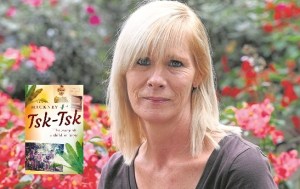
 It is painful to think and write about Suzan Hackney’s courageous memoir, Tsk-Tsk: The story of a child at large, around Mother’s Day when many of us celebrate our fabulous mothers or are cherished as such by our kids. The relationship between a child and a mother is not always one of joy, and Hackney’s story is mostly one of unimaginable heartbreak. She was given up for adoption as a baby by her biological parents. Still in the hospital, the moment she found herself in the arms of the woman who was to become her mother, she started screaming her lungs out. The scream was a foreboding. Her memoir reads like a reckoning with that primal anguish she experienced as an infant and the torment which followed. It is also a story of survival in the face of impossible odds, and of laying ghosts to rest.
“I was made in Coffee Bay. Right there on the beach, in the sand. To this day I despise coffee and adore the sea in equal measures”, Hackney begins her life story. Most of it will be characterised by the tension between loving and hating which she captures in these first few sentences. Her adoptive parents call her Susan – which she insists on changing to Suzan as an act of self-reclamation later on – and take her home to Pietermaritzburg, were everything is “extremely civilised here, and structured, organised, pristine, well-modulated, painfully polite and prim. This clashes somehow with my wild tantrums as it does with my poo-smearing pastime… Not even my dad is impressed with these early display of artistic genius and none of this is helping my mother’s nervous condition.”
What is described by the family as her mother’s “nervous condition” results in horrifying abuse. Instead of experiencing tenderness and care as a child, Suzan is constantly exposed to her mother’s rage. And from the moment she can, she fights back. Her father attempts to mitigate the torture, but one does not have to be a psychologist to understand how power dynamics in dysfunctional families go horribly wrong. Everyone suffers. The only stable source of kindness and love little Suzan experiences is her older brother Jonathan, who is also adopted. She smiles for the first time when she sees him: “Jonathan becomes my favourite person in the whole world and he happily takes on this role, as he does everything, in his caring, little boy’s stride.” But Jonathan is also only a child who is as much ensnared in the toxicity of the family relationships as everyone else involved, and there is only so much that can be endured. When their mother actually gives birth to a third child, the fault lines intensify.
Growing up, Suzan and her mother clash over everything: “Right from that first fateful encounter in the hospital, this mother and I are sworn enemies and no matter how hard I try to change it or how much I don’t want it to be like this between us, I’m incapable of doing anything about it. I love her with all my childish heart even though I am still small enough to fear her. Sometimes I also hate her.” The psychological and physical violence the little girl encounters is narrated in a seemingly casual and controlled way which makes it all the more shocking, and powerful. Cutting down to the bones of the story and revealing them in their most vulnerable nakedness, Hackney relates what happened but mostly refrains from commenting on the situation as an adult.
This is Hackney’s first book and, because of its intimate and deeply personal nature, probably the most difficult she will ever have to write on all kinds of levels if she pursues this career, and so the consummate skill she already shows in Tsk-Tsk is highly admirable.
Hackney continues her story until she is in her late teens. “I really am a dreadful child”, she writes about the internalised suffering, “I am defiant and cheeky, I speak way too loud, I shout at the slightest thing. I have wild and violent temper tantrums for apparently no reason at all and I can keep screaming for hours and hours… I’m smacked. I make fires, sometimes inside the house and sometimes in the garden.” At times, the book reads like a continuation of that screaming and setting things alight. The sorrow becomes otherwise too great to hold.
It gets worse; the accumulated misery persistently seeks a way out. As a thirteen year old Suzan is sent to a reformatory, the first of many, and eventually declared a ward of the state. A different kind of battle for survival begins for her. And it is not one she fights only on her own behalf; on her path, she encounters others she feels she needs to protect. And those who cannot be saved: “Kim also has to keep a suicide watch on Kerry 24/7. From very early childhood, Kerry’s father beat and raped her. When she was twelve, she fell pregnant and gave birth to a dying baby boy with no brain; Kerry’s intention is to kill herself, to be with her baby again.”
Suzan repeatedly runs away, living rough and getting involved with people who definitely do not have her best interests at heart. No matter where she turns, violence is lurking and pounces without mercy. The places where she is supposed to be kept safe turn out to be the most lethal. Hackney exposes how horribly the systems – our homes and the state – that are supposed to protect the most vulnerable members of society fail. There were moments when it was difficult for me to continue reading, and Hackney lived through it all.
Tsk-Tsk will make you seethe with anger, and it will make you cry. It is the kind of book that scars one’s soul, but should be read anyway. No child should be allowed to ever suffer like this.
Review first published in the Cape Times, 25 May 2018.
 The Finnish writer and documentary filmmaker, Elina Hirvonen, was one of the international guests attending the Open Book Festival last year in September. During the festival, she spoke about her novel, When I Forgot, originally published in Finnish in 2005. Two years later, it was translated into English and followed by Farthest from Death in 2010. Hirvonen’s third novel, When Time Runs Out (2015), was published to great critical acclaim in Finland. The English translation became available soon after Hirvonen’s visit in South Africa and is as relevant to our contemporary reality as it was at the time of its inception. Wherever we are in the world, news of mass shooting reach us on a regular basis and the intensely polarised opinions about the motivations, circumstances and the consequences of such actions continue to dominate global discussions.
 “Not for the first time, I cursed my name… It was the only thing my mother had given me before she ran off with a man from God knows where when I was a few days old”, the narrator of Mary Watson’s The Wren Hunt tells us in the first pages of this beautifully crafted novel. Her name is Wren. The novel opens on Saint Stephen’s Day, or the Day of the Wren, as the public holiday is also known in Ireland. It takes place on 26 December and commemorates the Christian martyr who according to some legends was betrayed to his enemies by a wren. Other tales record an occasion when the presence of Irish soldiers was revealed to the Vikings by a wren on Saint Stephen’s Day, and until about a century ago, boys traditionally hunted wrens on that day, displaying the dead birds and collecting money for celebrations of the occasion. Today, live birds or model wrens still form part of the observance.
 Oudrif. Oudrif. Oudrif. A spell. A promise. We kept repeating the word to each other with longing, desperate to get away from the perils of our everyday. Our cosy straw bale cottage in
 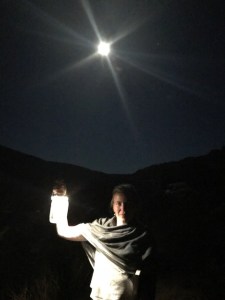 Oudrif. Oudrif. Oudrif. In Polish, we speak of such secluded spots as the places where the Devil says good night. But Oudrif is paradise on earth, day and night. Solar-powered angel lights guide you through the darkness before the stars light up the night. The place is totally independent of the municipal electricity and water grids. Any negative environmental impact is kept to a minimum.
 All around is rooibos country, every breath infused with the typical, soothing scent of the tea bush. But it was a mug of freshly brewed coffee on the stoep of our cottage that got us going every morning. In the afternoons, dry heat lured us back to bed and the setting sun invited for a swim in the rock pools of the Doring still full of balmy waters. The laziness of those tipsy hours of sleep, lounging about and playing cribbage… And the full moon dinner stories in the company of fascinating, like-minded, isolation-seeking guests from around the world… Let us return soon and sink into the loving arms of happily exhausted days at Oudrif. Oudrif. Oudrif.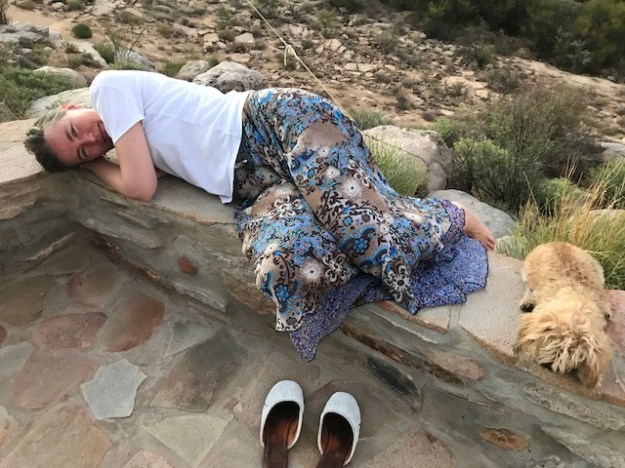
 Anyone who has read Karin Schimke’s Bare & Breaking, for which she won the prestigious Ingrid Jonker Award in 2014, will be delighted to know that her second collection of poems is now available from Modjaji Books. Navigate is sublime. Schimke’s poems steer between memory and loss, beauty and hurt, while forging a path to understanding, joy, holding on.
 At first glance, it looks like a typical boy meets girl story. However, Sally Partridge’s latest novel, Mine, is so much more. The book’s stunning cover illustration by Astrid Blumer introduces us to Kayla and Finlay (or Fin), the protagonists of the novel: we don’t see their faces, but we know that Kayla’s hair is in part strikingly blue, Fin is wearing a hoodie with a thunderbolt on his back. They are sitting on bench. One of them must have arrived to the meeting on a skateboard. Someone carved their initials into the back of the bench. Next to “K+F” is a broken heart. A squirrel watches on.
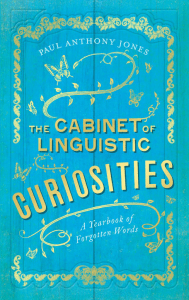 Languages are living, breathing, mutating creatures. The English language of today is not the one of 1602 when, according to Paul Anthony Jones in The Cabinet of Linguistic Curiosities: A Yearbook of Forgotten Words, “the Elizabethan playwright Thomas Dekker coined the word love-libel – literally, ‘a handwritten admission of someone’s love’”. Or the English of the early 1400s when the striking word “recumbentibus” (which, like so many of the words Jones collected in his remarkable book, the spellcheck on my computer does not recognise!) was adopted into the language from Latin: “In its native Latin recumbentibus was used merely of the act of lounging or reclining, but when the word was adopted into English it was given a twist: English writers…began to use it to refer to forceful, knockout or knockdown blows”.
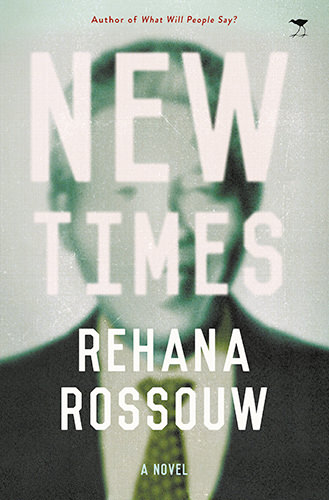 Rehana Rossouw’s debut novel, What Will People Say? (2015), was already on its seventh impression when I was reading it earlier this year. Being reprinted so often within a relatively short period of time is no small feat for a local novel. Even though I came late to the party, I immediately understood why it was so popular. Rossouw, a veteran journalist, succinctly captured an era and a community – the Cape Flats of the late eighties and early nineties – and made them come alive through a handful of characters belonging to the Fourie family. This was the time of volatile politics, raging gang wars and impossible choices. Decency and family values did not protect you from the evil of the system and the cruelties of the streets. Only the toughest survived to thrive.
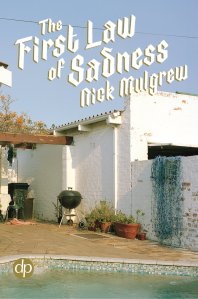 The short story continues to fascinate me for two reasons: the precision of thought and execution it attracts as well as its unpredictability. If well done, it can surprise and satisfy like nothing else in literature. And Nick Mulgrew does the genre justice like few other contemporary South African writers. His work has been recognised with multiple awards and his vision and skill have been highly acclaimed by critics. Mulgrew is also an editor and the director of the flourishing poetry press, uHlanga, which published his debut poetry volume, the myth of this is that we’re all in this together, in 2015. In his many impressive literary incarnations, Mulgrew understands that short art forms require meticulous attention to language. He knows how to make words count.
 Karina Magdalena