Category Archives: Uncategorized

Review: Self-Portrait with Dogwood by Christopher Merrill

Self-portrait with Doogwood review

“Trees and words branch into memoir”

Christopher Merrill is a highly acclaimed American poet, translator and editor. He is also the author of several books of nonfiction, including The Grass of Another Country: A Journey Through the World of Soccer and Only the Nails Remain: Scenes from the Balkan Wars. He recently visited Durban for the Articulate Africa Art and Book Fair where he spoke about his latest work, a memoir with the irresistible title Self-Portrait with Dogwood. Published earlier this year, the book is a series of vignettes about central episodes in Merrill’s life, all involving varieties of the dogwood tree. It might sound peculiar, but it is a delightful way of presenting a life.

“The average lifespan of a flowering dogwood is eighty years, and at the approach of my sixtieth birthday it occurred to me that I might create a self-portrait in relation to a tree that from an early age I have regarded as a talisman. Not a memoir, strictly speaking, but a literary exploration of certain events through the lens of nature”, Merrill writes in the prologue. His approach to the project and his elegant prose are reminiscent of the work of the great American essayist Anne Fadiman, whose own memoir, The Wine Lover’s Daughter, is to be published next month.

The individual chapters of Self-Portrait with Dogwood loosely follow the chronology of Merrill’s life, but never in the way you would expect. The structure challenges our “way of thinking about the tradition of writing memoirs.” Merrill begins with a seemingly typical childhood story of building “a fort under the dogwood tree” near the border of the neighbour’s property, but weaves the military history and legendary heroism of the region into his narrative. Mr Wright, their neighbour, was a Native American and the young Christopher played war with his son Michael, their childhoods infiltrated by the reality of the Cuban missile crisis and the Vietnam War. Mr Wright was responsible for conscientising Merrill by challenging his family’s political allegiances and making him aware about the destruction of the environment and the need to protect it.

Upon revisiting his early home as an adult, the absence of his dogwood tree prompts Merrill to note “that in addition to our inordinate fondness for shaping history by military means we are also adept at waging war on nature.” In his life, Merrill has been entangled in both styles of warfare and, as a passionate conservationist and cultural diplomat, has tried to steer the global consciousness towards better understanding of the perils involved.

Wars lurk behind many of Merrill’s enquiries and memories, but none as vividly as the one he finds himself in the middle of in the early 1990s in the former Yugoslavia. The memoir also includes outlandish stories about dogwoods. Experts have suggested that the trees might have been used in the Trojan War, perhaps even to build the infamous horse. A popular poem claims that the cross Jesus was crucified on was made of dogwood. “The dogwood, then, as metaphor – of the march of civilization, the Passion, growth and decline, love and war.” Merill writes about “dogwood diplomacy”, which was “the nickname bestowed upon a State Department initiative to promote friendship with Japan” and about why he was not allowed to visit the only two places in Russia where dogwood trees can be found.

He calls dogwood his “totem tree” and describes the role it played as witness to all crucial events of his life. In one of the most touching stories, Merrill recalls the pair of kousa dogwoods at the entrance to a park in Iowa City where he now lives with his family. The health of one of his daughters began deteriorating rapidly without apparent medical cause. The dogwoods in the park were in full bloom when she was at her lowest, but “acquired talismanic significance” during their visit and allowed Merrill to hope for her recovery. When they visited at the end of the season, and the trees were heavy with fruit, she was properly diagnosed and improving.

In his memoir, Merrill pays tribute to a few remarkable people who shaped him: a friend who became increasingly delusional at the same time as attempting to discuss the meaning of life via the literary greats with him; Charlie Ed, an African American who taught him what true disenfranchisement was and with whom Merrill worked in a lumberyard after getting in trouble with the police for drug possession; Jerry Munro, the owner of the nursery in which he worked for many years; and the poet Agha Shahid Ali, his dearest friend who died of brain cancer.

The words and wisdoms of writers like Herman Hesse, Walt Whitman, Emily Dickinson, Rachel Carson, and Henry David Thoreau dapple the narrative like light through a tree canopy. We turn to them for guidance and solace, especially in brutal times. Merrill describes his own experience of the post-9/11 era and trying to make sense of the layers of trauma surrounding the event.

As a wordsmith himself, Merrill acknowledges the fascinating idea that there might be a connection between trees and language as their branches attract birds and thus perhaps they inspire music: “Linguists posit that sometime in the last hundred thousand years our ancestors began to imitate birdsong and monkey alarm calls in delight, boredom, or terror, depending on the circumstances; the fusion of these two finite systems of communication from the animal world produced a third system, seemingly infinite, capable of conveying holistic messages. The integration hypothesis of human language evolution proposes that the combination of avian music and primate warning, the expressive and lexical layers of meaning, gave rise to grammar, and the rest in history – which is to say, the history of speech.” It is a marvellous way of looking at how one of our greatest feats – language – can be traced back to trees.

“In the nursery trade, dogwoods are called ornamentals, their flowering a highlight of spring.” Merrill’s writing feels like that kind of flowering: gentle, beautiful, full of life.

Self-Portrait with Dogwood


Self-Portrait with Dogwood

by Christopher Merrill

Trinity University Press, 2017


An edited version of this review was first published in the Cape Times, 13 October 2017.


Review: Khwezi – The remarkable story of Fezekile Ntsukela Kuzwayo by Redi Tlhabi

Khwezi“What is it about our society that excuses these monsters? Why are we not holding people accountable on all levels?” Redi Tlhabi asked at the recent Cape Town launch of her latest book, Khwezi: The remarkable story of Fezekile Ntsukela Kuzwayo. She was referring to the horrifying prevalence of sexual violence in South Africa and our inability to prevent it as well as to offer justice to its victims. In Khwezi, Tlhabi demonstrates how the legal system and we, as society, have failed the victims of sexual violence in general, and one person in particular: Fezekile Ntsukela Kuzwayo, for over a decade known to most of us only as Khwezi – the woman who decided to fight for her right to safety and dignity and accused Jacob Zuma of rape when he ignored both by having sex with her without her consent on 2 November 2005. Zuma was acquitted of the rape charge in May 2006. Kuzwayo, vilified and violated by his supporters, had to flee the country.
“We managed to carry on,” Tlhabi reminded us at the launch. “This should have been a turning point for South Africa, but it wasn’t.” Perhaps the publication of this brave and incisive book is giving us another chance a decade later. It is compulsory reading for anyone wanting to understand where we are as a country, as a people.

After years in exile, Kuzwayo returned to South Africa and agreed to work with Tlhabi to reclaim her name and life, but while we all now can read her story and know her by her real name, her life was tragically cut short when she died of AIDS-related causes a year ago.

“Here I am, attending a funeral instead of a triumphant book launch”, Tlhabi writes, continuing: “She was adamant – she would attend the launch and I was to introduce her by her real name.” But on 15 October 2016, Tlhabi, along other women, carried Kuzwayo’s casket at her funeral: “I was convinced that the book had died with her, that I could claim no moral authority for writing her story now that she was no longer here to vouch for it, but being in Durban that day gave me courage to carry on… This is her story.”

In an interview, Kuzwayo tells Tlhabi: “It was important for me to say to him, you cannot come onto my body and just do what you want to do. And soil me like that.” She adds: “I never saw myself as Zuma’s accuser, Zuma’s victim, or Zuma’s anything. I do not want any attachment to that man.”

In the book, Tlhabi gives us an insight into Kuzwayo’s restless and intricate life. Growing up in exile, the daughter of Mandla Judson Kuzwayo, a Umkhonto we Sizwe hero who died in a car accident when she was a child, and Beauty Kuzwayo, an actress who struggled to take care of her family after her husband’s death, the young Fezekile had to face displacement, loss and insecurity and survived three rapes before she turned fourteen. Repeatedly traumatised, she suffered from depression and anxiety. But her hunger for life and her irrevocable trust in the goodwill of people shine through. A trust that often exasperated those who loved her, also the author of her memoir. Tlhabi portrays Kuzwayo in all her beauty and troubled complexity and does not gloss over the tangled aspects of her personality.

Kuzwayo emerges from the pages a woman who had been asked to negotiate unbearable pain and yet retained her integrity throughout, even when an entire mob of manipulators, crooks, and seemingly well-meaning people was set to prove otherwise. Tlhabi recalls several episodes from the Zuma’s rape trial which are shocking, but we allowed them to happen on our watch. The most sickening is Adv Kemp trying to imply that Kuzwayo as a child gave consent to have sex with adult men. Judge van der Merwe did not stop this line of questioning, nor did he protest the invasive, unforgiveable questioning about her sexuality. They showed no understanding of trauma, nor the cultural traditions Kuzwayo grew up with.

“There are times when the legal, ethical and moral truths come together,” Tlhabi said this week at the Book Lounge, “but this was not one of those times.” However, she states unequivocally: “I believe her.”

Khwezi is Fezekile Ntsukela Kuzwayo. Khwezi is many women. Tlhabi relates Zuma’s inappropriate behaviour towards her and tells the story of one of her colleagues who had a similar experience. The memoir is “about every woman in South Africa,” she said. Khwezi is also I. Anyone affected by sexual predation knows how convoluted the issues of complicity, consent and shame we deal with are. “Not all men, but all women,” my psychologist told me at the time when I struggled to articulate my feelings when I was violated a year ago. “Not all men are monsters,” she said, “but all women experience forms of violation in their lives.” Terrifying but true. Patriarchy, entitlement, violence, denialism – past and present – have to be challenged and exposed. Breaking the silence is extremely difficult: “I could not imagine any woman coming forward to accuse a powerful man of rape after how Khwezi had been treated”, Tlhabi writes. But Kuzwayo and Tlhabi encourage victims and survivors of sexual violence and predatory behaviour to speak out and to fight for our integrity, safety and dignity. Tlhabi once told Kuzwayo: “even when justice is denied, withheld, perpetrators must know that we know who they are and how they operate. At least some of these horrible experiences must be written about. If not to document personal pain and loss, perhaps provide teachable moments for future generations?” More than ever we need “to have a meaningful and transformative conversation about sexual violence and the language of power.” As Tlhabi states: “If we are to declare ‘Remember Khwezi’, then we must do so boldly, courageously, honestly.” As she does in her ground-breaking book.

Khwezi: The remarkable story of Fezekile Ntsukela Kuzwayo

by Redi Tlhabi

Jonathan Ball Publishers, 2017

First published in the Cape Times on 6 October 2017.

Review: Colour Me Yellow – Searching for my family truth by Thuli Nhlapo

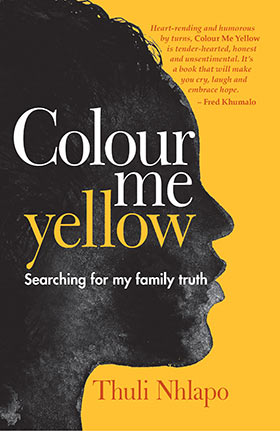
Colour-Me-YellowReading Thuli Nhlapo’s powerful memoir, Colour Me Yellow, two thoughts dominated my mind. The book reminded me of a Polish saying that “families are best in photographs”. It also made me think of what Mphuthumi Ntabeni said at the recent Open Book Festival: “We need to address the failures of our traditions.” At the same time, I was overcome by an array of emotions. I was seething at the injustice of what happened to Nhlapo throughout her life, while simultaneously being filled with incredible sorrow for the child she once was and the deepest admiration for the woman she became.

Colour Me Yellow tells one of the most heart-wrenching stories I’ve ever read. Nhlapo grows up with her mother telling her: “I hated being pregnant with you. I used to cry the whole day. I hated carrying you in my stomach. It was such an embarrassment for me and my family.” Wherever she turns, she meets with abuse, neglect and lies. No one wants to tell her the truth about why she is treated differently to her siblings, other family members, and the rest of the community. She feels alienated and scared. “What’s it like to be a normal child?” she wonders. She realises that she is never called by her name. To survive these ordeals, she develops two strategies, to become as invisible as possible so as not to attract any attention and the accompanying inexplicable brutality, and to excel at everything that she does to prove her worth.

“Since all my attempts to be accepted were unsuccessful, I gave up. It was useless to try to smile when I knew I was not wanted.” She reads and watches Bruce Lee films to escape reality. She does extremely well at school and despite all the adversity she experiences, begins to study, eventually graduating and entering the professional world on a high. She also gives birth to two sons and navigates the challenges of motherhood and work as well as the demands her family makes on her as a provider.

But years of denial and dishonesty take their toll: “My only quest was to find the truth”, she writes. She embarks on a mission to find the reason for all the hostility she encountered from her family and beyond. She wants to understand why she was never wanted. Eventually, a family member tells her to go to an address where she will find out everything about her real roots. The people she faces there shock her, but although, at last, they are willing to claim her as their own, she continues feeling that she does not belong. She persists and finally uncovers the truth about her origins. The revelation will have you reeling.

Today, Nhlapo is an acclaimed journalist and television producer. Colour Me Yellow is a portrayal of endurance and courage in the face of true evil. It is also a stark reminder of the ability of truth to set us free and the resilience of the human spirit.

Colour Me Yellow: Searching for my family truth

by Thuli Nhlapo

Kwela, 2017

Review first published in the Cape Times on 29 September 2017.

Topolino, book-spine blue

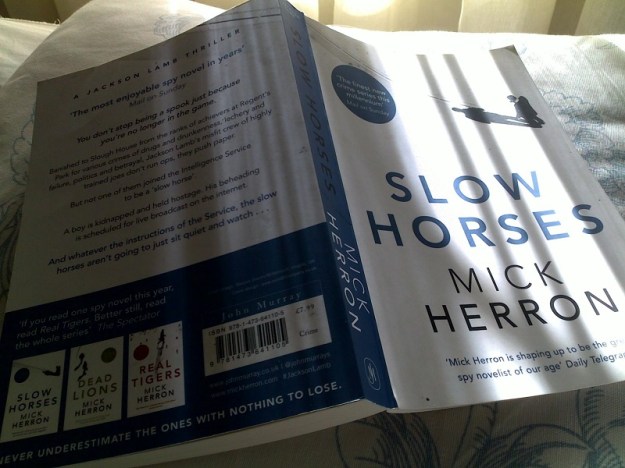
‘If you want a really good thriller,’ Geoff said, ‘try Mick Herron.’ I trust Geoff’s literary taste, so unsurprisingly, soon after our conversation, I got Slow Horses, the first in Herron’s Jackson Lamb series, at the Book Lounge. But it had to wait its turn, no matter how promising it looked on the to-read pile in my bedroom.

Around this time, I was also making one of the most important decisions of my life: a new car. I caused a terrible car accident almost two years ago: fortunately, I was the only one hurt, but the car was a write-off. It was an old, heavy, safe car – it probably saved my life.

Buying a new car, I was looking for three things: it had to be safe, small, and affordable. I wanted a new car with a warranty and no worries. I never had one before. I wanted to know what it’s like to drive and not worry about the condition of your car, to have other people take care of everything for a few years. I wanted to feel safe.

My heart whispered Fiat 500. I had driven two of them across France and Germany as rentals and loved both times – think Normandy to Paris and Görlitz to München (there are no speed limits on some stretches of the Autobahn; the little Fiat is quite comfortable with 160km/h). It is definitely small. I checked the safety ratings. They were perfect: seven airbags, standard. The affordability surprised me, although I had to think carefully how to go about financing it. Finally, end of July, I was ready.

Tyler of William Simpson in Cape Town assisted with the purchase. We went for a test drive and the car felt as good as I’d remembered it. Tyler was very patient in explaining everything; he answered all my weird questions and understood my quirks. My decision was made. Blue is my favourite colour, so I was set on getting the Fiat 500 in the available Azzuro Cappelini and placed the order. A few days later, Tyler informed me that he was terribly sorry, but they would not be able to provide the model I wanted in the colour I desired. They were all gone and the availability in the next shipment was also uncertain. We spoke. ‘I will probably live with this car for the next decade or beyond,’ I explained why I wanted it to be perfect. He promised to see what he could do. In the meantime, to my utter delight, I found out that, in Italy, the Fiat 500 is often referred to as “Topolino”. So Szczurek (little rat) would drive a Topolino (little mouse). We were meant for each other!

The solution Tyler came up with for the body of the car was a colour wrapping that is usually used for higher price range cars. But what is good enough for an Alfa Romeo is good enough for a Topolino. Tyler promised me a Fiat 500 in Azzuro Cappelini and that is what he would deliver – the car would be colour-wrapped for me in the desired blue. Once I heard about this option, I asked whether, in this case, I could perhaps have my absolutely favourite blue…? ‘Sure,’ Tyler said, ‘just please bring me something that is exactly the shade of blue you want.’

I put down the phone and glanced around me. The first thing I found sporting my favourite blue was the spine of Mick Herron’s Slow Horses

The next day in his office, Tyler had a look at the book spine and said, ‘It will be done. Do you also want it matt, like the book?’

‘Is that possible?’

‘Anything is possible.’

‘Then yes! A resounding yes!’

He had a closer look at the novel in his hands. ‘Do you mind if I read it while it is in my possession?’

‘Of course not! Enjoy. I hope it is really good. I haven’t read it yet, but it was recommended to me by people I trust.’

A few days later, Tyler sent me a note, saying that he was enjoying Slow Horses very much.

Trust me to find a reader to sell me a car.

Trust me to buy a car the colour of a book spine…

When Topolino arrived, it was love at first sight.

Topolino1

That day, I wrote the following message to Tyler:

‘My life in the last two-and-a-half years has been tough, to say the least. My husband died in February 2015 and I have been through hell and back since then. There haven’t been many opportunities for joy or laughter, but today I am happy – truly happy. It is a good feeling to experience. Thank you for my perfect Mick-Herron-book-spine blue Fiat 500. I am thrilled to have it and I am looking forward to driving it across South Africa, my home. Thank you for making the entire process of acquiring a new car so easy and pleasant.’

My first trip was to the Book Lounge – obviously! – where I had to pick up some books in preparation for the Open Book Festival. It rained that day. A blessing.

Topolino2

The first time I filled up Topolino, I overheard the following exchange between the two attendants helping me:

‘Nice colour.’

‘Nice blue.’

Indeed.

Book-spine blue.

Topolino3

I have now read Mick Herron’s Slow Horses. Sheer brilliance. I can’t wait to read the other books in the Jackson Lamb series and everything else Herron has written.

Topolino4

Thank you, Geoff, Tyler and Mick Herron from Topolino and Szczurek!

Review: The Life of Worm & Other Misconceptions by Ken Barris

Life of Worm

I cannot remember when last I took so much pleasure from a short-story collection. Expect the unexpected: flying rooms, mustard reviews, book timeshare plans, the sense of beauty, or a talking baboon.

The life of Worm & other misconceptions by Ken Barris offers a beautiful range of tone. Readers might be relieved to learn that “there are many ways to cook a pterodactyl”, even if you find yourself in a flying room like the narrator of Atmosphere. Two long-term friends hike the Klipspringer Trail in Puff adder. Although there is nothing funny about the outcome of the story, I loved the dry humour of its unfolding. In the allegorical Cat got your tongue, guilt and unspeakable acts are articulated in silence and gestures.

The collection opens with a piece about writing itself. The narrator of To see the mountain attends a writing workshop. He is struggling to write. Patience, one of the other workshop participants, tackles the serious issue of patriarchy in her work. They both attempt to see the mist-veiled mountain from the place where they are staying. Each writer has a unique strategy for how to accomplish the task. For the narrator, the act of imaging the local geography and a hike up the mountain are enough to unlock his creativity. Patience channels her energies differently…

Continue reading: LitNet

Review: Encircling 2 by Carl Frode Tiller

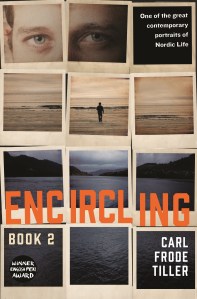
Encircling 2The second instalment in Carl Frode Tiller’s Encircling trilogy, this novel follows the predecessor’s structure by allowing three different narrators to tell us about their lives around the month of July 2006 in the small Norwegian town of Namsos. While they relate their present-day stories in occasionally minutiae detail, they also reveal more or less relevant facts about themselves through the letters they write during this time to David, a man they all knew at some stage in their lives. They respond to a newspaper article in which David, supposedly suffering from amnesia, asks those who knew him to help him regain his memory.

In the first of the three books, his two teenage friends and his step-father contact him. In the second, it is Ole, a farmer from the same municipality; Tom, another close friend from his childhood; and Paula, who lives in an old-age home and used to be friends with David’s mother. Paula is assisted by Harald, who has his own reasons for wanting to write to David. The individual narrators assemble a collage of partly overlapping, but also partly conflicting stories, and the enigmatic young man they all refer to moves in and out of our focus. It gradually transpires that not only are the memories and motives of the storytellers unreliable, but perhaps a lot more is at stake and not entirely as it seems.

The first part of the trilogy was published in Norway a decade ago and has garnered much acclaim. Carl Frode Tiller has been compared to the likes of Karl Ove Knausgaard. His descriptions of contemporary life in Norway intrigue, but it is the depiction of universally recognisable everyday misunderstandings and cruelties between people that I found most gripping. Although at times over-written for my liking, some of the situations narrated were stunning in their portrayal of how we fail at communicating our intimate, crucial truths. The last of the books is supposed to be published next year and I am most curious to find out how the trilogy will end and what it will reveal about David and the people who address him.

Encircling 2

by Carl Frode Tiller

Sort of Books, 2017

Review first published in the Cape Times on 22 September 2017.

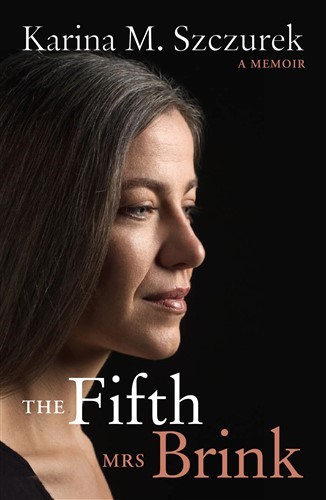
Book Review – The Fifth Mrs Brink

Bookruse's avatarbookruse

Karina M. Szczurek

The Fifth Mrs Brink is a memoir of grief, love, life and loss.

Karina Szczurek’s story begins with diary entries immediately after the death of her husband André P Brink. The grief is raw, taking its toll on her physically and emotionally. The memoir is a searingly honest account of life before André, during her marriage and after his death.

The love which they shared is something many of us dream of. I would not have guessed that André had such a soft and caring side. His immediate search for Rudolf the Bear in the wee hours of the morning brought tears to my eyes. His caring for Karina during bouts of pain, a testament to a love that ran deep.

They also shared a passion for tennis, rugby and chocolate, which is a running theme throughout the memoir (as are the trio Mozart, Salieri and Glinka!)…

View original post 186 more words

Review: Killing Karoline by Sara-Jayne King

Killing Karoline“What happens when the baby they buried comes back?” The question is asked on the cover of Sara-Jayne King’s stunning memoir, Killing Karoline. The story King relates is simultaneously heart-breaking and inspiring. A child is conceived during an illicit relationship in apartheid South Africa. Named Karoline, she is “born with a large, black question mark over my head”. Her biological parents – a white woman and a black man – are forbidden by law and custom to be together. Her official parents – both white – decide to hide the mother’s “indiscretion” with her black lover and smuggle her to the UK under false medical pretences. They proceed to give her up for adoption and return to South Africa, lying to all concerned that Karoline had died.
The image on the cover of King’s book – of the young Karoline, renamed Sarah Jane by her adoptive parents – spreading her arms in joy, as if to embrace the universe with her gorgeous smile – says everything about this incredibly resilient person, who refused to be killed by the “deception and denial” of the people who brought her into this world and the inhuman system that governed their decisions and fears.

Sarah Jane is adopted by a couple who were unable to have biological children. Earlier they also adopted a boy, Adam. No other book on adoption I have read made the complicated dynamics involved in this kind of family structure as tangible to me as King’s memoir. She confesses what it means to be a “consolation prize” to her adoptive mother: “Not just enough, but that our becoming her kids was actually sufficient to eradicate, or at least usurp her own disappointment at not being able to have her own biological children.” Feelings of insecurity persist. They are complicated by her parents’ inadequate handling of a vital side of their adopted children’s reality: “And so while we knew we were loved, my parents’ ignorance and inability to acknowledge our skin colour as being crucial to our identities ultimately led to both Adam and I navigating, in isolation and confusion, a painful and self-destructive path to make sense of who we were as individuals and in the world at large.” For Adam, the journey ends in tragedy.

When the ground beneath your feet keeps shifting, it is impossibly hard to keep stable, to know who you are. King is constantly faced with the necessity of reframing her beliefs. It can be something as obvious as finding out that when you are born in August in South Africa, you are not a summer baby. Or it can be as soul-crushing as your biological mother’s refusal to give you the answers you crave. Adoption, King writes, “creates gaps of assumption, false imaginings and, ultimately, disappointments.” It confronts King with the fact that for her biological mother “saving face held greater importance…than hearing me say my first word, or watching as I gingerly took my first step.”

She clings desperately to things that give her comfort like her childhood blanket. To escape reality, she flees into books, her “first addiction”; then others follow. She struggles to maintain a healthy relationship with food, drinks excessively, tries other substances and starts self-harming. Feeling inadequate and ashamed, she becomes a “people pleaser”. She enters toxic relationships. Around her families fall apart. Her adoptive parents separate. As she finds out while trying to trace her biological parents, the woman who gave birth to her goes on to have another child. Establishing contact with her siblings and her and their extended families proves to be extremely difficult, as one can imagine. But there are moments of joy. If anything, King’s story proves the adage that friends are the family we choose.

King is honest and extremely generous about sharing her experience of adoption, loss and addiction. It is humbling to follow her life as it unfolds through the stories she chooses to tell. She is not sentimental, which could have easily been the case. Above all, she narrates a story of great courage in standing up for oneself. Exceptionally talented, she completes her university studies, begins working, and when everything goes haywire, she is brave enough to accept the help she needs to recover. This comes with challenges of its own, but seeking treatment brings her back to the country of her birth where she eventually settles and where she finally claims for herself the name she’d always wanted to be known by: Sara-Jayne.

“I just want someone to see me”, she writes. Sara-Jayne refuses to disappear. She gradually surfaces into acceptance and acknowledgement. She realises that it is her biological mother’s loss for not wanting to know her. It is our gain that she allows her readers to see her extraordinary strength and beauty.

King is now based in Cape Town and shares her life with another adoptee, her dog Siza. She is a journalist and broadcaster, hosting her own show on CapeTalk.

Killing Karoline is not just a powerful story which could have been told in almost any fashion to thrive, it is a well-crafted text which testifies to the love of literature and the remarkable skill of this emerging creative writer.

Killing Karoline

by Sara-Jayne King

MFBooks, 2017

Review first appeared in the Cape Times on 15 September 2017.

A Conversation with Frankie Murrey

Sarafina Magazine's avatarSarafina Magazine

Frankie Murrey worked in the book trade for a number of years before becoming the Festival Coordinator of Open Book Festival, which runs from September 6th until the 10th right in the heart of Cape Town. In addition to working on the core festival programme, she works closely with others on CocreatePoetica, Comics Fest and the Youth Fest. She is the facilitator of the Mentoring Programme and the Open Book School Library Project. In 2015, she was awarded the Chevalier de l’Ordre des Arts et des Lettres.

View original post 2,120 more words