 I’m a dreamer. I dream with abandon, remembering up to four dreams a night, all vivid as if seen on a silver screen just moments before. Some of these dreams end up as my stories. Others I keep in my diary. As a child, I had a recurring dream about an island surrounded by dark waters. Many of my dreams are linked to the sea. In the last few weeks I’ve been through some rough waters. Under pressure, I stop eating, sleeping, and, worst of all, dreaming. The last dream I remember before last night is the one I wrote about in my Nadine Gordimer tribute. And now, over a month later, I’m surfacing and this morning I woke up remembering two dreams! One is for the diary. The other one for sharing.
But first a few memories. Many years ago I saw a movie which made a deep impression on my young mind; the most striking image from the movie involved women clad in crimson. Much later, at university in Austria, I read my first Margaret Atwood novel: Cat’s Eye. It triggered my fascination with Atwood’s work. I read a few other of her titles. Then, while doing research at the university library in Aberystwyth, Wales, I was passing a row of books when a red smudge on a book spine caught my eye: the crimson women. I think I read The Handmaid’s Tale in one sitting through the following night.
A few years ago, I had the remarkable honour of sitting at the same table as Margaret Atwood at a gala dinner in New York. We did not talk much, mostly because the Oscar-winning composer right next to me wanted to touch my hair, which was luckily all braided and pinned and meant for another. So sadly, I remember only one exchange with Atwood that night. We discussed peanut butter sandwiches. Really!
Fast-forward to last year. Venice. Another gala dinner, Atwood at the same table, for most of it right next to me. And this time I felt like a woman in one of her stories, battling with her voice. I stopped speaking all together for a week after that evening (acute laryngitis). Atwood took over the conversation and the erudite editor on my other side was just as entertaining. But I can’t say that I was much of an articulate presence.

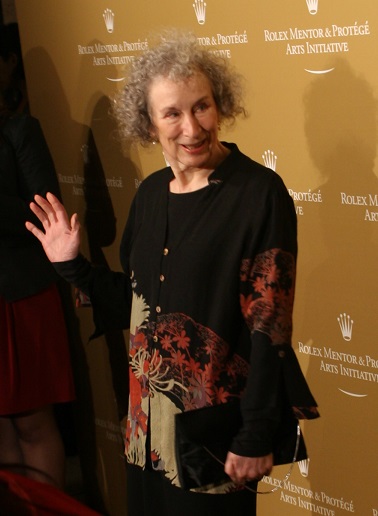
Photo: Krystian Szczurek, New York 2011
And then a few days ago, I saw the wonderful news that Atwood’s latest short-story collection is to be published before the month is over. I’m eagerly awaiting the day it reaches South African bookshops. So, I suppose, given all of the above, it is no surprise that one of my dreams last night was about Margaret Atwood. In the dream, I was living in a small town. I found myself sitting next to Atwood on a park bench and she was telling me about attending a literary festival nearby. ‘This morning just after 5am, they came into my hotel room, saying that I needed to go with them to sign books, and they brought me here, and now I’m stuck, because nobody wants to take me back,’ she said, but she did not seem concerned at all, just perplexed, and a bit amused. Naturally, I offered to drive her to her hotel. And then I woke up, delighted to be dreaming properly again, and remembering how generously Atwood had signed my books in New York and Venice.
What would Dr Freud say?
Dr Szczurek says: Get Stone Mattress!
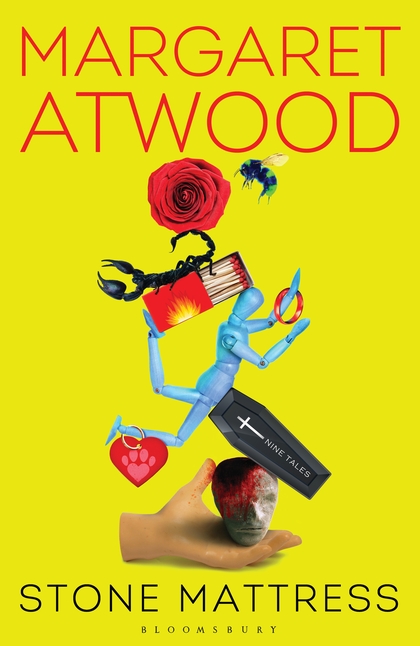
 About Stone Mattress:
“A recently widowed fantasy writer is guided through a stormy winter evening by the voice of her late husband. An elderly lady with Charles Bonnet’s syndrome comes to terms with the little people she keeps seeing, while a newly-formed populist group gathers to burn down her retirement residence. A woman born with a genetic abnormality is mistaken for a vampire. And a crime committed long-ago is revenged in the Arctic via a 1.9 billion year old stromatalite. In these nine tales, Margaret Atwood ventures into the shadowland earlier explored by fabulists and concoctors of dark yarns such as Robert Louis Stevenson, Daphne du Maurier and Arthur Conan Doyle – and also by herself, in her award-winning novel Alias Grace. In Stone Mattress, Margaret Atwood is at the top of her darkly humorous and seriously playful game.”
Over the years, I have reviewed a few of Atwood’s books:
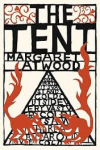 The Tent (2006)
Margaret Atwood’s latest collection of writing The Tent is a visual and intellectual delight. Provocative and full of wisdom it provides plenty of food for thought, not always readily digestible. A little book with big ideas. Beautifully designed and illustrated by the author, it has the feel and look of a private notebook one would want to carry around in one’s breast pocket at all times. One feels tempted to add personal comments on the few blank pages in-between the many voices of Atwood’s narrators, living and sharing their thoughts full of anxieties and hopes with the readers in a world which is hostile and frightening.
From the drawing of the cover to the last page of the book one image persists: a tent full of words, surrounded by beastly creatures. When the narrator of the title piece in the collection tells us “you’re in a tent”, we just have to take the book and put it up on its covers’ edges to realise how deliciously suggestive the image is in its multiple meanings. “It’s vast and cold outside, very vast, very cold. It’s a howling wilderness…But you have a small candle in your tent. You can keep warm…The trouble is, your tent is made of paper. Paper won’t keep anything out. You know you must write on the walls, on the paper walls, on the inside of your tent.” With your writing you must describe the howling and the truth, you must write about the ones you love and the things you love and try to protect them, even though your “obsession with calligraphy” is not always appreciated and understood. And your tent is fragile and endangered by the howlers sniffing around outside, “but you keep on writing anyway because what else can you do?”
Xenophobia, violence, despotism, gender inequality, terrorism, crime, environmental crisis, tyranny, war – our global society is drenched in conflict, “a howling wilderness” indeed. If anybody had any doubt about the role of the intellectual in these difficult times, Margaret Atwood’s gem of a collection shows the path to take. The title piece is probably the most honest, humble as well as forceful, statement on the precarious situation of the writer and the importance of writing in recent years. In another piece, “Voice” the situation is again exemplified. The first-person narrator tells us she has been “given a voice”. No matter what glory and adoration it gives her, she knows one day it will begin to shrivel. Until then it is “attached like an invisible vampire to my throat.”
The whole book is like a little tent written against the evils of the world. Balancing on the border of fiction and non-fiction, Atwood’s collection with its generic mixture of fables, essays, dreams, monologues, dialogues, rewritings of myths and legends, satires, allegories and poems, is a subtle and razor-sharp analysis of the world around us. No preaching, just small precise revelations on the madness of our global society.
“Thylacine Ragout” explores the follies of genetics and the power of money to buy anything it wants. “Plots for Exotics” deals with our prejudices and xenophobia. Pieces such as “Heritage House” and the magnificent poem “Bring Back Mom: An Invocation” take up gender issues.
“And there you’ll be, in your cotton housecoat,
holding a wooden peg
between your teeth, as the washing flaps
on the clothesline you once briefly considered
hanging yourself with –”
“Eating the Birds” tells us of complicity, choice and unrighteous wanting of something that does not belong to us: “We’re ankle-deep in blood, and all because we ate the birds, we ate them a long time ago, when we still had the power to say no.” When in “Chicken Little Goes too Far” the chicken finds out that “the sky is falling”, he has to pay a high price for wanting to save the world.
Although some of the other pieces are more introspective, quiet, even funny, there is little comfort in the volume. However it is a nourishing piece of work that goes straight to the heart and makes one want to take up the pen and write on the blank pages in-between. For what else can you do?
Bertolt Brecht once said that thinking is something that follows problems and precedes action. This is precisely where Atwood’s little big book stands. In the last piece of the collection “But it Could Still” the narrator begins by saying: “Things look bad: I admit it. They look worse than they’ve looked for years, for centuries. They look the worst ever. Perils loom on all sides. But it could still turn out all right.” There are many stories, winter’s tales, that keep up the faith. “We want to huddle round them, as if around a small but cheerful fire.” And there are the tulips you planted before the winter frost “in the brown earth” where “already hundreds of small green shoots…intending to grow despite everything” were waiting. The narrator contemplates in the end: “What would you call them if they were in a story? Would they be happy endings, or happy beginnings? But they aren’t in a story, and neither are you. You tucked them back under the mulch and the dead leaves, however. It was the right thing to do on the darkest day of the year.”
Atwood’s Tent is full of thoughts on humanity. Like the small green shoots intending to grow despite everything, they will survive the dark cold winter and blossom proudly in spring. Outside of a story I would call them hope.
First published in the Sunday Independent, 4 June 2006.
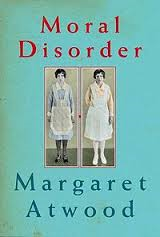
 Moral Disorder (2006)
Margaret Atwood, by now the author of over three dozen books, has always been a prolific writer. Last year, however, was a special treat for all the fans of her fiction. After the publication of The Penelopiad (one of a series of myth rewritings by internationally acclaimed authors) and The Tent (a collection of shorter miscellaneous pieces), the end of the year witnessed Atwood’s latest release, Moral Disorder. This intriguing book is yet another representative of a genre which is not exactly new, but is increasingly coming into its own on the international literary scene, and even more so on our local market. Moral Disorder could be termed a ‘short story novel’. It comprises a collection of interrelated short stories, which can be read separately as individual pieces in their own right, but which reveal the total scale of their meanings only within reference to each other, interacting in this way to form a whole which could be read as a novel.
In South African fiction, recent examples of this fascinating – at times also controversial (some of us will remember the debate surrounding the nomination of Ivan Vladislavić’s The Exploded View for the Sunday Times Fiction Award in 2005) – genre range from Mary Watson’s beautifully intricate Moss (2004) to Byron Loker’s freshly rewarding New Swell (2006). As Miki Flockemann pointed out in her review of Moss, it is not unexpected that this genre “has become a noticeable trend in recent South African writing on account of the simultaneous embrace of cohesion and fragmentation.” It fictionally embodies the instable and diverse nature of the reality around us.
The short story novel is not foreign to Canadian fiction either. Alice Munroe’s Runaway (2005) will ring a bell for many readers. Now, Atwood’s Moral Disorder, “a collection of eleven stories that is almost a novel…or a novel broken up into eleven stories”, as the inside cover suggests, embarks on a journey through time and space and reveals, in glimpses, the intertwined lives of its characters.
We are first introduced to the main protagonists, Nell and Tig, as an ageing couple in “The Bad News”. The bad news of the title arrives in the form of a newspaper headline Tig shows to Nell, who is not ready to receive it, “Not before breakfast…You know I can’t handle it this early in the day.” Nell knows that this sort of news – about explosions, oil spills, genocides, famines – will always be followed by others like it, and is unwilling to confront it unless it concerns them directly. Instead, she escapes into the distant past, remembering a holiday in France. The memory merges into a daydream, which makes her realise that bad news has always arrived at our doorstep and will always do so, until eventually it pounces and “you reach out in the night and there’s no more breathing.”
The second story, “The Art of Cooking and Serving”, takes us back in time to when Nell was eleven and her mother was expecting her second daughter. While Nell decides to knit a layette for her sibling, she is frightened of the “listless, bloated, version” of her mother, who by changing her own future also changes Nell’s “into something shadow-filled and uncertain.” After her sister is born, Nell suddenly finds herself taking over from her mother, baby-tending and doing the chores, until she rebels in order to lead the normal teenage life she witnesses other girls enjoying. We encounter her at that stage in “The Headless Horseman” and “My Last Duchess”.
In “The Other Place” Nell is a young adult on the run from herself and the world until she meets Tig, and later recalls: “then followed the cats and the dogs and children, and the baking, and even the frilly white window curtains, though they eventually vanished in their own turn”.
All stories are told in the first person, apart from the following four, “Monopoly”, the title story “Moral Disorder”, “White Horse”, and “The Entities”, which switch to the third person, allowing us a fuller perspective on the lives of the characters, and a different insight into Nell, who has been the storyteller until now.
The four third-person stories centre on the complex relationship between Nell and Tig, who brings into the equation two sons and Oona, his demanding first wife whom he is in the process of divorcing. We watch Nell navigate between the moods and wishes of the people in her life as well as trying to fulfil her own dreams and guard her own integrity in the process: “Nell felt intimidated by this marriage, and small and childish in comparison with it. It had a certain oversized and phosphorescent splendour about it, like a whale decaying on the beach. It made her seem pallid, at least to herself: pallid, banal, insipidly wholesome. She did not have nearly as much operatic and tenebrous and sanguinary melodrama to offer.”
Rich in memorable characters and evocative settings, Moral Disorder offers deeply moving reflections on all stages of life, including ageing and death, which feature strongly especially in the two last pieces: “The Labrador Fiasco” and “The Boys at the Lab”.
Atwood is one of the best storytellers alive. In all the stories of Moral Disorder the importance of literature in our lives as guide, companion, mirror, filters through, and because of the honesty and insight with which all of them are told, we find ourselves looking at our own lives reflected in them and, once again, begin to marvel at the miracle of it all.
First published in the Sunday Independent, 14 January 2007.
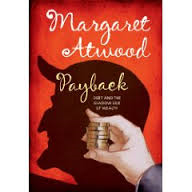
 Payback: Debt and the Shadow Side of Wealth (2008)
In this time of financial crisis, reading an entire book about the concept of debt is not an enticing idea. This is the reason why as a devoted fan of Margaret Atwood’s work I’ve eagerly picked up her latest publication, Payback: Debt and the Shadow Side of Wealth, in the bookshop, and then, upon finding out what it was about, returned it to its shelf with a deep sense of mistrust, almost fear. I resisted the thought of hearing any more about debt, even if it was from one of my favourite writers.
Then a copy of the book arrived in the post for reviewing, and in the end, I couldn’t be more grateful for it. But my intuition about Payback was right. It is a scary book, although it does not begin as such. Payback comprises of five chapters, each focusing on a different aspect of the debt concept, and the first four are rather funny and light-hearted. It is only the last one that brings all the entertaining insights together in a devastating conclusion about us and our future.
As Atwood explains in the opening chapter “Ancient Balances”, Payback is not about such things as debt management, national debt, or shopaholics; it’s about debt as a human “imaginative construct”. Atwood goes on to expound that such inner foundation stones of humanness as instant gratification and fairness underlie this construct, presenting many fascinating experiments to illustrate her point. She also examines the moral and economic concepts of debt through a mythological and religious lens and traces them back to the idea of logos: without the possibility of keeping track of debt, it ceases to exist.
The second chapter “Debt and Sin” explores the idea of debt as a fashion: “We seem to be entering a period in which debt has passed through its most recent harmless and fashionable period, and is reverting to being sinful.” A lot of us have lost the ability of living within our means when it became acceptable to take the easier path. There was a time when going to a pawnshop was considered a terrible disgrace, a sin. Today, we all live on credit, however unaffordable it has become.
In spiritual terms, as Atwood shows, there is a close link between a pawnshop and redemption. She tells intriguing stories of St. Nicolas, the patron saint of thieves; the Sin Eater, who for a reward symbolically consumes a deceased person’s sins (spiritual debts) at the funeral; or the Devil and his careful bookkeeping of who owes him what.
The next chapter “Debt as Plot” builds on such stories and investigates many literary classics and their famous characters, especially Christopher Marlow’s Doctor Faustus and Charles Dickens’s Scrooge, offering a fresh insight into the art of storytelling and our perception of the primary mechanisms on which literary plots rely.
As its title suggests the next chapter, “The Shadow Side”, turns to the dodgy side of debt and traces the historical and present consequences of what actually happens when individuals or nations fail to settle their financial or ethical dues, i.e. when “big debts can make history and rearrange the landscape.” Atwood gives many terrifying examples of how the strategy of getting rid of debt by killing or expelling creditors has survived successfully throughout the ages. “The Shadow Side” also includes a sober, or rather satirical, look on tax: “There are two kinds of taxation systems: ones that are resented, and ones that are really resented.”
Atwood writes about the symbiotic relationship between the debtor and the creditor in the light of the Jungian theory of the Shadow, “our dark side, the repository of everything in us we’re ashamed of and would rather not acknowledge”. From there she moves to the concept of forgiveness and presents no other than Nelson Mandela and the TRC as her examples of how moral debt does not have to be evened out by revenge, but by the one thing which can undermine an eye-for-an-eye approach: forgiveness. If for nothing else, Payback is worth reading for this rather short section and Atwood’s fascinating thought experiment of what would have happened, had the president of the United States sent a message of forgiveness instead of revenge to the people responsible for 9/11.
“Payback”, the final chapter of the book by the same title takes us on a journey through time with a 21st-century version of Scrooge and the Spirits of Christmas. What Scrooge “Nouveau” experiences is scary, but Atwood does not wag her forefinger, she just wants us to wake up to the reality round us. As a human species we have incurred a debt to the planet that will also have to be settled, rather sooner than later, and if we want to be around to see the thereafter, we have to act now by paying back what we owe.
Payback includes a thorough bibliography, a good index and above all some valuable notes which can help readers think about realistic solutions to the many problems we face today.
First published in the Sunday Independent, 8 March 2009.
 In Other Worlds: SF and the Human Imagination (2011)
Margaret Atwood opens her latest non-fiction offering with a clear declaration:
“In Other Worlds is not a catalogue of science fiction, a grand theory about it, or a literary history of it. It is not a treatise, it is not definitive, it is not exhaustive, it is not canonical. It is not the work of a practicing academic or an official guardian of a body of knowledge. Rather it is an exploration of my own lifelong relationship with a literary form, or forms, or subforms, both as reader and as writer.”
In short: In Other Worlds is a love song for a genre. Most importantly, precisely because it does not have any of the aspirations Atwood negates in the above statement, it will be appealing to many readers, of her own work and of science fiction (in all its manifestations).
The book is divided into four parts. The first includes the three Ellmann Lectures Atwood delivered at Emory in 2010. They constitute some general and theoretical deliberations on SF as well as on Atwood’s own full-length forays into what she calls “ustopia-writing”: The Handmaid’s Tale, Oryx and Crake, and The Year of the Flood. The second is a series of essays and reviews Atwood wrote on some classics of the genre, such as H. Rider Haggard’s She or Kazuo Ishiguro’s Never Let Me Go. The third is a tribute section for which Atwood selected some of her shorter ustopias. The final section, “Appendices”, features the open letter Atwood wrote to the Judson Independent School District which banned The Handmaid’s Tale (cautionary reading for our times in South Africa), and an article on Weird Tales covers of the 1930s, published recently in the US edition of Playboy.
It might seem like too much of a mixed bag, but the pieces are carefully chosen and well integrated into the whole. From the start, Atwood explains her understanding of the genre under discussion and the terminology she applies to its many subforms, introducing her own terms and clarifying where she differs from other practitioners. The most important to her is the umbrella term which she uses to refer to her own work: ustopia, a combination of utopia and dystopia – “the imagined perfect society and its opposite – because, in my view, each contains a latent version of the other.”
Atwood includes many stories about her “tangled personal history with SF, first as a child, then as an adolescent, then as a one-time student and academic, then as a reviewer and commentator, and then, finally, as a composer.” She also focuses on the literary and cultural context in which stories about alien invasions and possible futures have developed, offering a enticing overview of the field’s many fascinating aspects and paying homage to the path breakers like Swift or Verne. Atwood’s reading of well-known proponents of SF are highly enlightening and made me want to return to some of my favourites. But even if you are a LeGuin or Lem devotee, a staunch Trekkie, or a vampiramas addict, some of Atwood’s insights might add to your understanding and appreciation of the genre. And if you are one of those who’d rather stay away from SF altogether, even if it is offered by somebody of Atwood’s calibre, please remember that “in brilliant hands…the form can be brilliant”, in spite of its “downright sluttish reputation.”
In Other Worlds is also an astute analysis of SF’s function in our lives. As Atwood concludes one of her essays: “We are not only what we do, we are also what we imagine. Perhaps, by imagining mad scientists and then letting them do their worst within the boundaries of our fictions, we hope to keep the real ones sane.” There is little doubt that we are still very much on target towards one of Atwood’s own fictions: a brass cylinder with a rough outline of what humanity once was before eradicating itself. She ends the piece, “Time Capsule Found on the Dead Planet”, with the crushing line: “Pray for us, who once, too, thought we could fly.”
Informative, humorous and intriguing, In Other Worlds is dedicated Ursula K. LeGuin – a worthy tribute to the reigning queen of SF.
First published in ITCH e.10 (May 2012).
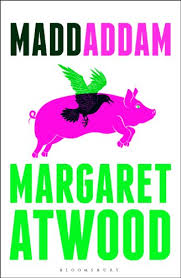
 MaddAddam (2013)
The day the Nobel Laureate for Literature was announced in October was a great day for the short story, for women writers, for Canadian literature, and for the remarkable Alice Munro. Yet, my heart bled for another Canadian writer: Margaret Atwood. The ways of the Nobel committee are unfathomable, but given the choice between a brilliant Canadian woman short-story writer, and a brilliant Canadian woman short-story writer, novelist, essayist and poet all in one, it’s hard not to wonder what went through their minds.
Undoubtedly, there is a prejudice against so-called genre writing, even when it transcends such reductionist labels with the impeccable quality of its offerings, as do most works stemming from Atwood’s pen. Her The Handmaid’s Tale (1985) is a classic. Not that Atwood’s work can be lumped into any category. In the last decade, Atwood has published extensively, but the emphasis has been on the speculative fiction trilogy which began with the Booker-shortlisted Oryx and Crake (2003) and now concludes with MaddAddam. Perhaps the genre has torpedoed Atwood’s chances with the committee? If so, it is regrettable. But having said so, this is not to take anything away from the recognition of Munro’s work of which I am an avid admirer.
Also, I hope the above will testify to my respect for Atwood’s prolific writing and put my disappointment in her latest novel into context.
Oryx and Crake blew me away. Set in a not too distant future, it tells the story of Jimmy, the seemingly last human survivor of an apocalyptic plague unleashed on the world by his best friend Crake. In Jimmy’s care are the Crakers, a genetically engineered, green-eyed, blue-penis-swinging, eerily singing and purring humanoid species – Crake’s idea of an improvement on depraved humanity. The novel ends when Jimmy, injured and hallucinating, encounters three other human beings.
The follow-up, The Year of the Flood (2009), recounts the same story from another perspective and also leads up to the charged encounter. The three people Jimmy sees are Amanda, previously of the God’s Gardeners, an eco-sect founded by Adam One and led by the street-wise Zeb, and her malevolent kidnappers who have raped and tortured her. As it turns out, two others are also watching the confrontation: Ren, Amanda’s best friend, and Toby, their erstwhile teacher at the God’s Gardeners, who have likewise survived the pandemic. They are the protagonists of The Year of the Flood.
Having loved the ingenious predecessors, I reread them before turning to the trilogy’s highly anticipated conclusion. The joy I got out of the rereading turned out to be the best part of the whole experience. MaddAddam aptly wraps up some of the loose ends of the other novels, but it far from delivers on their considerable promise.
How is the handful of remaining humans going to build up a new life from the ruins of the post-pandemic world where genetically spliced plant and animal species sprawl and roam free, dangerous pig-human hybrids among them? What role will women, previously mass exploited and brutalised, play in this newly-fledged society? What is their interaction with the naïve, peace-loving Crakers going to be like? How will Jimmy feature in the mix, especially since three of his ex-girlfriends are among the survivors, and two of them have been inadvertently raped and impregnated by the Crakers who still see Jimmy as their creator’s prophet? What will they all make of Crake’s brilliantly insane plan for humankind and their own involvement in its execution?
The potential conflicts appear ripe for the picking. But MaddAddam only skirts these issues. Instead, the novel focuses on the backstories of Zeb and Adam One, and the enfolding relationship between Toby and Zeb. The former dominate large chunks of the narrative and unnecessarily demystify two of the most intriguing characters of the trilogy. The latter descends into the ludicrous stuff that soap operas are made of.
The mutations the main characters undergo in MaddAddam are baffling. Top-notch scientists, hackers and revolutionaries turn into bitchy fashionistas. The strictly vegetarian God’s Gardeners tuck into juicy steaks and crisp bacon. The tough, mysterious Zeb transforms into a chauvinistic jerk – “beneath vulgar”, in the words of his brother. Most discouraging, the once resilient and wise Toby begins acting like a lovesick teenager. Jimmy is comatose for nearly the entire time and when he finally regains consciousness, most of his conflicted, poignant nature stays behind in the coma.
The tension and the emotional intelligence of the first two novels are irreparably compromised in MaddAddam. But not all is lost. Moments of dark humour, the homage to the power of storytelling, some twists in the inter-species relations, and above all Atwood’s powerful prose, provide some satisfaction. But compared to the first two incisive instalments of the trilogy which both ended with a bang, MaddAddam is a mere whimper.
First published in the Cape Times, 15 November 2013.











 Karina Magdalena