Please join us (Kerry Hammerton and me) for this special online event with Jen Thorpe.
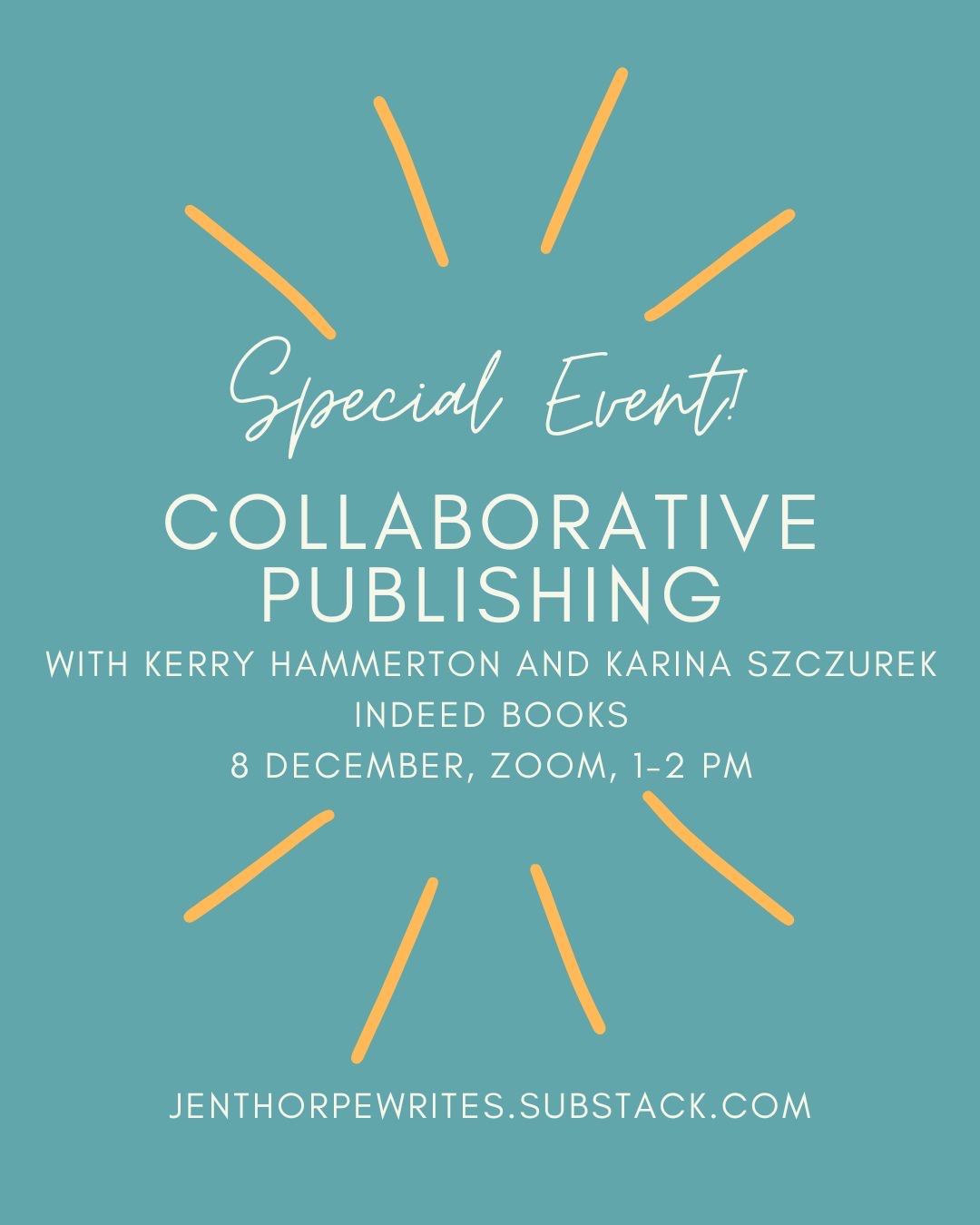
For more details, click here: Collaborative Publishing
Please join us (Kerry Hammerton and me) for this special online event with Jen Thorpe.
For more details, click here: Collaborative Publishing

Six years after publication, The Fifth Mrs Brink is making her last official appearance at a festival before going out of print. The Book Lounge will be selling the remaining copies of the original edition of my memoir.
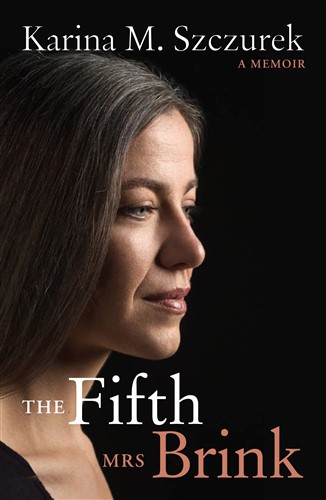
But no worries, Future Readers, Karavan Press is going to bring out a new edition of the book soon.
Karavan Press is “seriously punching above its weight” at this year’s festival. You can read about it here: Karavan Press and Friends at Open Book Festival.
I will be participating in two panels, one in which Mervyn Sloman of The Book Lounge will be chatting to Mbali Sikakana of NB, Eugene Ashton of JB, and me about the future of publishing. It will be fun!

And then, I will be chairing a session with Sue Nyamnjoy, Zibu Sithole and Diane Awerbuck and we will be talking about writing journeys.
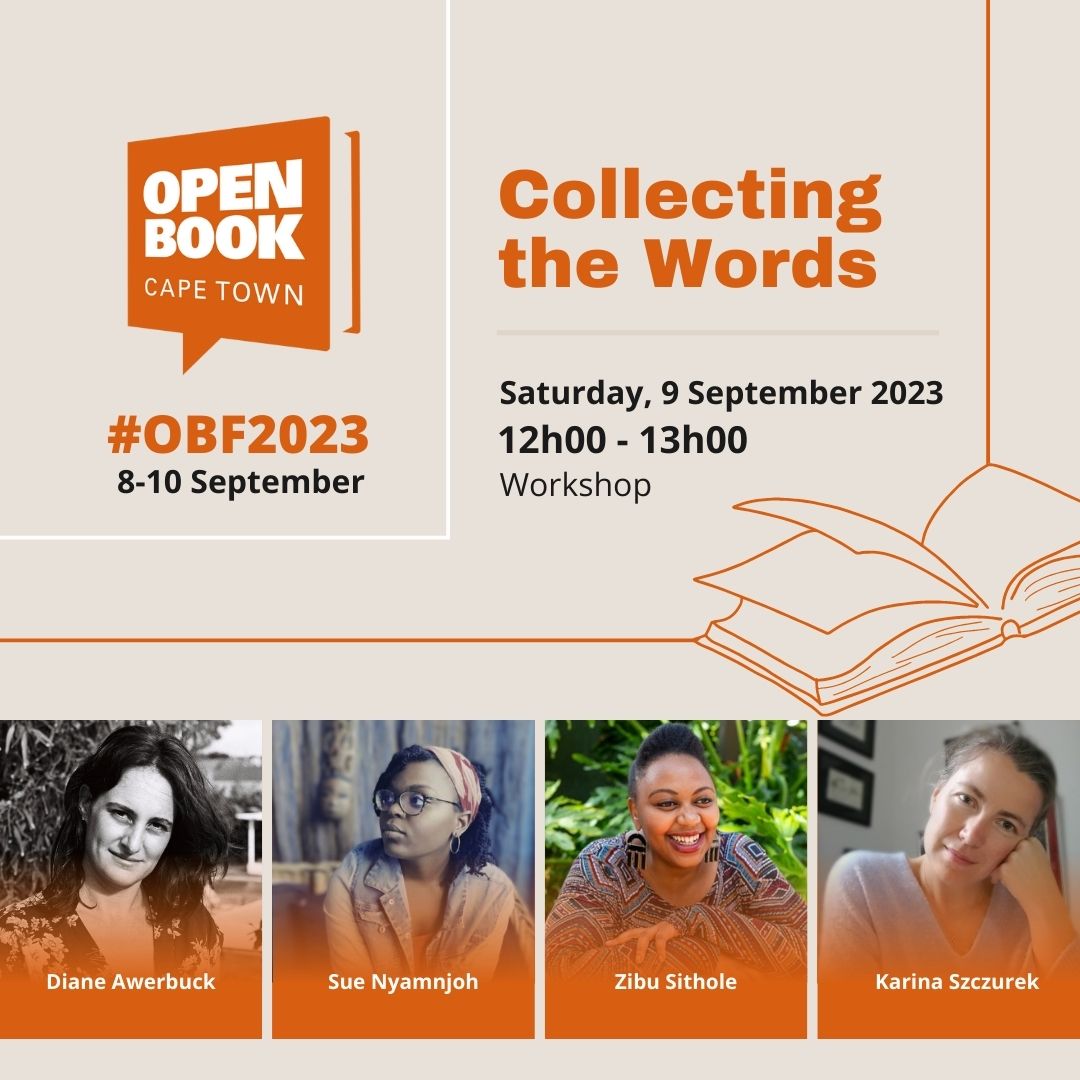
Diane Awerbuck is a prizewinning writer, reviewer, editor and teacher. She writes femme/goth thrillers (Home Remedies); memoirs (Gardening at Night); pandemic cowboy thrillers (South, as Frank Owen; North, as Frank Owen); doctorates on trauma (The Spirit and the Letter); holy-wholly poetry (As above, so below); and short story collections (Cabin Fever; Inside your body there are flowers). She hopes you are sitting comfortably.
Zibu Sithole lives in Johannesburg with her son. She is a journalist with more than 10 years of experience writing for television and radio as well as print and digital media. She is a published ghostwriter of mainly romance novels. The Thing with Zola is Zibu’s first novel published under her own name.
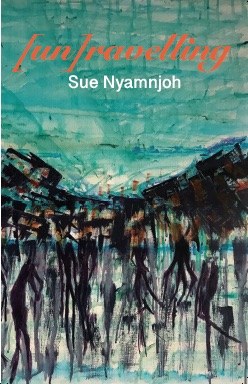
Sue Nyamnjoh is a Cameroonian-born creative currently residing in Cape Town. She has a background in media studies and languages and holds a BA(Hons) from the University of Cape Town. Earlier this year (2023), Sue released her debut poetry collection. The anthology, [un]ravelling, explores universal themes of love, grief, joy, and loneliness from a deeply personal lens. Beyond literary pursuits, Sue enjoys large doses of music, food, and people, in no particular order. She is mother to a feline named Shola and various plants in questionable states of existence.


You can book your tickets here:
 Every now and then, a book comes along which changes your life. For me, Roberto Calasso’s The Art of the Publisher is one of them. But you don’t have to be – or, like me, want to become – a book publisher to find this gem an inspiration.
For quite a while now, publishing has been steeped in a pervasive atmosphere of gloom and doom, especially in South Africa. The threat of the internet, the e-book, the retail giant Amazon, and the financial crisis have made life for the printed book difficult. Locally, a seemingly general disinterest in South African fiction and foolish political decisions have made survival tougher for our publishers, and consequently, of course, for us writers. Book sales are not encouraging. Publishers scaling down even less so. Yet, watching developments like the self-publication of Paige Nick’s latest novel, Death by Carbs, or new publishing ventures like uHlanga and Tattoo Press, I have a feeling that some creative and daring people in the country are on to something which gives me many reasons for optimism.
Roberto Calasso’s essays collected in The Art of Publishing attest to the fact that it all comes down to basics. And the basics are vision and quality. It is these two aspects of publishing that readers throughout centuries have best responded to with enthusiasm. These are no trade secrets, just simple rules which those who have been successful in publishing have always followed.
Critic, writer, and a publisher himself, Calasso has been at the forefront of Italian publishing for decades. His love for literature and the book shines through every single paragraph of The Art of Publishing. His passion is one of beauty. His insights are heartening to read.
When it matters, publishing is not about money, although, as with all art forms, moderate financial rewards cannot and should not be excluded. There are enough examples out there to prove the case. All aspects of the form play an integral part in its success: “choice and sequence of titles published…texts that accompany the books, as well as the way in which the books are presented as objects.” Calasso does not deny that this is “the most hazardous and ambitious goal for a publisher, and so it has remained for five hundred years”, but he also reminds that “literature loses all of its magic unless there’s an element of impossibility concealed deep within it.”
He goes into the fascinating history of publishing, asks what constitutes culture, celebrates the great publishers of our times, explores the relationship between the publisher and the writer, demonstrates how crucial the nourishment of writers and the care for the book as an object are to a thriving publishing environment, and most importantly, to our intellectual and emotional lives.
Calasso also shows that even if often unbeknownst to us why a particular publisher attracts our enthusiasm, as readers we understand the value of our “repeated experiences of not being disappointed.” And that is what only a publisher of vision and quality can offer.
The Art of the Publisher by Roberto Calasso
Translated from the Italian by Richard Dixon
Penguin Books, 2015
Review first published in the Cape Times, 22 January 2016.
Two comments:
When I truly enjoy a book I have the need to share it with others. I have already bought several copies of The Art of the Publisher for friends, two more today…
I was attracted to the book in the first place because it appealed to me as an object. I saw it displayed at the Book Lounge in Cape Town and could not walk away from it…
 As I see it, in publishing there is a significant difference between accidental and nurtured bestsellers. Nowadays, the market is dominated by the former. But every now and then you get a publisher who will understand the value of the latter.
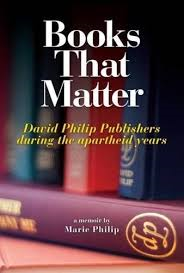
Reading Marie Philip’s memoir about the famous publishing house she and her husband established in South Africa during the dark years of apartheid, I was reminded of how precious such an approach is in the book world. It is even more precious and definitely rarer when it is combined with a moral and social conscience which Marie and David Philip and their team exemplified.
It is difficult to imagine the South African literary scene without David Philip Publishers (DPP). Over the years, they have launched or assisted the careers of such writers as Richard Rive, Nadine Gordimer, Mandla Langa, Stephen Watson, Alan Paton, Sindiwe Magona, Ivan Vladislavić and Lyndall Gordon. The list of their titles, which Marie Philip includes at the end of her incisive book, is astounding, to say the least. Just to give you a sample, among their seminal publications are: Don Foster’s Detention and Torture in South Africa, Mamphela Ramphele’s A Bed Called Home, Michael Fraser’s A Fynbos Year, The Essential Evita Bezuidenhout, Ellen Kuzwayo’s Sit Down and Listen, and Being Here: Modern Short Stories from Southern Africa (compiled by Robin Malan). Because of their independence the Philips “had the freedom to take risks and be bold, and even eccentric”, as well as to tune into their “own publishing instincts”. While it was important to survive, money was not their “main concern”. The combination of these factors turned out to be a recipe for great success in all respects.
And it all began with a penguin in the early 1970s…
Continue reading: Not Now Darling, I’m Reading
 Karina Magdalena