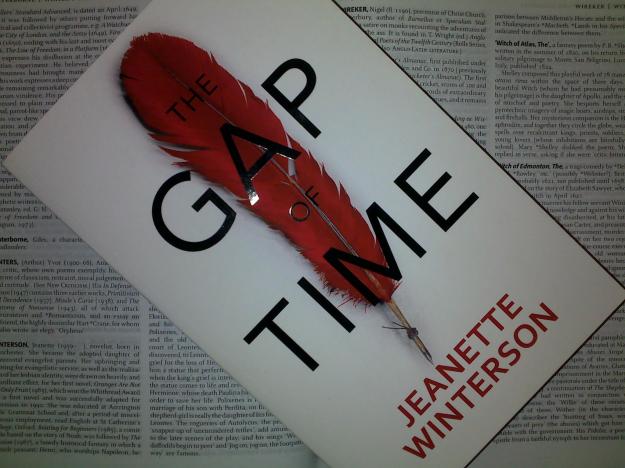
 Jeanette Winterson is one of my favourite writers of fiction and non-fiction. Her recent memoir Why Be Happy When You Could Be Normal (2011) was a revelation. I was introduced to her work at university with the by now classic novel Oranges Are Not the Only Fruit (1985). Her Lighthousekeeping (2004) is one of the most moving love stories I have ever read. Among many texts, it echoes Virginia Woolf’s To the Lighthouse. The main character Silver reappears in other Winterson novels. As does the line: “Tell me a story.” Winterson is known for her retellings of myths and legends, her writing is rich in intertextuality. I loved her modern rendering of the Atlas myth, Weight (2005).
The Gap of Time, Winterson’s latest novel, is also a cover version of a famous classic, no other than Shakespeare’s The Winter’s Tale. It is the first book in a series launched in October last year which aims to reimagine Shakespearean works for our generation. Howard Jacobson’s Shylock Is My Name was published last month. Upcoming titles include such promising treats as Hag-Seed, Margaret Atwood’s take on The Tempest, or Gillian Flynn’s version of Hamlet.
One does not have to be a Shakespeare buff to enjoy The Gap of Time. For those unfamiliar with The Winter’s Tale, the original is summarised in the beginning of the book. But Winterson’s brilliant interpretation is self-reliant and can be read independently.
“The story has to start somewhere”, but not necessarily at the beginning. The Gap of Time begins in the middle: Shep, a jazz bar owner, and his son Clo witness a murder. At the same time, they discover a little girl “as light as a star” in a baby hatch of a hospital nearby. Because the child reawakens Shep’s belief in love, which he lost when his beloved wife died of cancer, he decides to adopt her.
The story moves back in time to when the ruthless businessman Leo accuses his wife pregnant wife MiMi of having an affair with their best friend Xeno, and of carrying his child. Although both deny the accusation vehemently, Leo attempts to kill Xeno and refuses to acknowledge his daughter when she is born. His rampant jealousy results in a tragedy which leaves no one unscathed.
Years later, fate leads two young people to fall into love, but their respective family histories might ruin their chance at happiness. With great emotional and psychological depth, Winterson’s tale examines the notions of family and what it means to love, “to know something worth knowing, wild and unlikely and against every rote.” She exposes the foolishness of taking love for granted and allowing chances at redemption to slip us by.
As Winterson writes in the end, the reason Shakespeare endures is because stories of revenge, tragedy and forgiveness are universal. This superb twenty-first century retelling speaks straight to our contemporary, post-Freudian consciousness and touches our ancient hearts which continue longing for the recognition of the magic they are capable of.
The Gap of Time
by Jeanette Winterson
Hogarth Shakespeare, 2015
Review first published in the Cape Times, 1 April 2016.
 Melissa de Villiers was born in Grahamstown and educated at Rhodes, but she is a citizen of the world. She lives in Singapore, travels widely, and often returns to South Africa. The nine stories in her debut The Chameleon House are informed by migrations. The concept of home is interrogated, as is contemporary South Africa and its difficult past, “old ways unextinguished and forever edging forward, smudging boundaries”. A woman inherits her grandfather’s weekend house and with it the question of ownership. Another is the victim of sly abuse. An illicit couple is caught up in a blackout. Lust and power mingle with loneliness, an “emptiness – desolate and cold – that would claim her should her hold on him flicker and fail.” Loyalties are tested when four friends sharing a house in London unwittingly harbour a traitor among them. This is powerful storytelling from a writer to watch.
 The feeling one is left with after reading Sandra Hill’s debut story collection Unsettled is reflected in the title of the book. Hill paints vivid portraits of what it means to be a woman in different places and times. It is a finely layered picture of the everyday and the unusual. The mother of one of the characters insists that one should read poetry “slowly, expectantly, the way you eat oysters”, as the “magic…comes after you swallow.” Although every story is a fully contained piece, read together, they acquire that magic of swallowing oysters. Saturated with local flavours, settings, history, Unsettled offers evocative, intimate glimpses of women’s lives – their dreams, desires, worries and regrets – many readers will find uncannily familiar, sometimes perhaps difficult to acknowledge: “Life can take us away from where we belong, but we don’t lose the longing for it… If we are lucky we get to make our way back.”
 It’s difficult to believe that this is only
  There is nothing quite as satisfying as an excellent personal essay, and William Dicey’s Mongrel contains six gems of the genre. Dicey has been on my literary radar for a while now. In the past decade, whenever I found myself admiring a beautifully designed local book, Dicey’s name would often feature on the copyright page. His first book, Borderline (2004), a travel memoir about canoeing on the Orange River, is one of those titles readers remember fondly whenever mentioned, but apparently, it is out of print. Fortunately, I found a copy in our library. I have been meaning to read it for years, and Mongrel has finally made me realise that I need to succumb to the longing.
 Many of my friends will know
  Despite my irredeemable addiction to Lee Child’s Jack Reacher series, I do not often turn to thrillers or crime fiction for entertainment. But Night School, the next Reacher adventure, is coming out only in September, and since the nights are getting longer, it is nice to have a few good stand-ins in the meantime. Locally, I really enjoyed the recently published Sweet Paradise by Joanne Hichens: tight plotting, great writing, a scary villainess, and a heroine with balls. It surprised me, and that is a quality I truly appreciate in genre fiction.
 Reading about the Holocaust is never easy. Facing its terrible truths, especially when your own family is involved, is heroic.
 There are writers and then there are writers. Most of us can only dream of becoming the kind of writer Jacqui L’Ange already is, and the stunning The Seed Thief is only her debut novel. Her prose is luminous. It feels as if her words are caressing the pages they are printed on. Enthralled from the beginning, I was reading with bated breath, afraid that the author could not sustain such excellence through an entire novel, that she would take a false step, get lost along the way, and lose me as a reader. But The Seed Thief is one of those rare books which deliver on all fronts and leave you completely satisfied.
 The first one arrived in manuscript form for evaluation. I started reading it in bed in the morning and nearly didn’t get up until I was finished. The exhilaration of the encounter is still with me years later. I thought I was reading one of South Africa’s greats. Galgut or Coetzee came to mind – not a debut novelist.
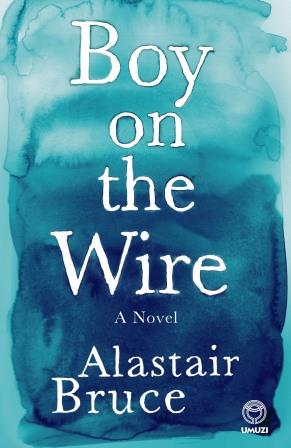 The narrative takes us back to a Sunday in the December of 1983 when John, his brothers Paul and Peter, and their parents travel to the mountains in the Karoo for a family holiday. But only four of them return home. And there are no real survivors. The tragedy literally plunges them all into an abyss.
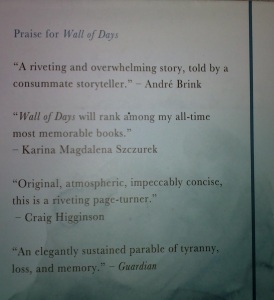 Whereas Wall of Days was as close to perfection as a novel can get, I had some difficulties with the characterisations in Boy on the Wire. The portrayal of John and Rachel’s relationship after his return to South Africa wasn’t convincing enough for me. I could not relate to Rachel’s responses to the unfolding of the events and found the explanations of her behaviour implausible in a few moments. Furthermore, I am not sure that readers who are unaware of the effects of trauma on the mind will find enough narrative guidance in the story to read John’s mental states as plausible. I also found my suspension of disbelief tested when it came to the simple day to day logistics of inhabiting an inherited house.
 Karina Magdalena