
In the Acknowledgements of my novel, Invisible Others, I wrote: ‘My furry family, Glinka, Salieri and Mozart, true experts at life, keep trying to teach me how to make the most of it; I hope they will succeed one day.’ It is four years later, but no matter how desirable, being a cat is not an easy task. I might, however, be closer than ever. ‘Your immediate goal is to be a cat’, writes Jaron Lanier in the introduction to his Ten Arguments for Deleting Your Social Media Accounts Right Now (2018), a book that is, despite its title, ‘about how to be a cat.’
‘Cats have done the seemingly impossible: They’ve integrated themselves into the modern high-tech world without giving themselves up. They are still in charge. There is no worry that some stealthy meme crafted by an algorithm and paid for by a creepy, hidden oligarch has taken over your cat. No one has taken over your cat; not you, not anyone… Cats on the internet are our hopes and dreams for the future of people on the internet’, says Lanier. And he should know, not only as a Silicon Valley insider, but as someone who shares his life with cats – Loof, Potato, Tuno and Starlight – who taught Lanier ‘how not to be domesticated’.
Books, like cats, have the ability to change lives. I read Ten Arguments for Deleting Your Social Media Accounts Right Now over the festive season and it did exactly that: changed my life. I haven’t deleted the only social media account I have (yet?); that, too, is ‘part of your prerogative, being a cat’, as Lanier emphasises. But I did decide to change the way I interact with social media.
The problem with social media that Lanier identifies – ‘relentless, robotic, ultimately meaningless behaviour modification in the service of unseen manipulators and uncaring algorithms’ – is, of course, something that many of us have been aware of for quite a while. But it was ultimately his book that encouraged me to do something against it in my own private capacity. I am tired of the exploitative, manipulative, addictive, artificial, often toxic and aggressive, nature of social media. It seems that no matter how much you try to curate your experience, there is no way of avoiding all the negative side effects of engaging with the diverse platforms. There are just so many accounts that you can block without feeling that you are totally wasting your time and could invest it in something much more creative and positive, something that perhaps you yourself – and not some ruthless, greedy company – can profit from, if not exactly financially, then definitely intellectually and emotionally. It’s time to ‘detach from the behaviour-modification empires for a while’, as Lanier says.
‘Go to where you are kindest,’ he suggests, and it resonates with me deeply. Kindness is essential to my survival. It is kindness that has carried me to safety across the roughest storms of my life, and there have been way too many in recent years. I want kindness and calm in my life, and cats and books. That is what makes me happy, what makes life worthwhile for me.
What has changed? Nothing drastic. I stopped tweeting on 31 December. Mid-January, I am still missing it sometimes (it is addictive, after all), especially the interaction with friends and followers I truly care about but, mostly, I feel a lot of relief. I still look at notifications every now and then and acknowledge the ones which I would have in the past, and I use DMs to communicate with a few people, but I completely ignore my timeline. Many social media accounts are of interest to me, but I look at them directly when I feel like it. Basically, I shifted from an active participant to a passive observer. I want to give it a few months to see how I will feel about it all later in the year.
It is amazing how much time I save every day by not engaging with social media. And I decided to use that time for creativity. As Lanier says, the internet is not the problem, the problem is how we use it and how it is being used against us. Producing and sharing creative content about topics I am passionate about, that I or others can also profit from – directly or indirectly (from the exchange of ideas or book sales, for example) – feels right. It is crucial to consider, in Lanier’s words, ‘sustainable, dignified business models’ where a transaction between two parties does not have to go through a third one ‘who is paying to manipulate them.’ Lanier asks for social media that he can pay for, and where he can ‘unambiguously own and set the price for using my data, and it’s easy and normal to earn money if my data is valuable.’ I like that idea very much.
Lanier asks, ‘What if listening to an inner voice or heeding a passion for ethics or beauty were to lead to more important work in the long term, even if it measured as less successful in the moment? What if deeply reaching a small number of people matters more than reaching everybody with nothing?’
What if? Indeed.
I upgraded my blog, so that it does not feature any ads I cannot control; I love the new, clean look which is focused on my – personally chosen – content. The costs involved were minimal in comparison to the benefits.
I decided to choose my online news and entertainment sources directly and to pay for content I find valuable. Well-researched, -considered, -written and -presented content costs money to produce and I want its creators to be well-paid for their intellectual and creative work. Quality, not quantity – that’s what I seek.
The word ‘content’ itself deserves more attention. I find it problematic, but that’s a thought that needs further consideration.
I love paper and never read e-books if I can help it. Reading print media of diverse nature during the festive season made me remember how good it feels to lie next to the pool and turn the pages of an informative, fun magazine. I want more of that in my life again, too.
There is a wonderful passage about writing in Ten Arguments for Deleting Your Social Media Accounts Right Now. It turns a premise writers live by on its head: ‘You can’t read well until you can write at least a little’, claims the author, and continues, ‘The reason we teach writing to students is not in the hopes that they’ll become professional writers… Instead, we hope they’ll learn what it means to write, and to think, which will make them more thoughtful when they read.’ And he adds, challenging us: ‘You can’t use the internet well until you’ve confronted it on your own terms, at least for a while. This is for your integrity, not just for saving the world.’
Integrity, like kindness, deserves to be cultivated with the utmost care.
Finally, I find Lanier’s description of certain questions as ‘tender’ beautiful. Let’s ask more of those ‘tender questions’ together.
‘Empathy is the fuel that runs a decent society.’
— Jaron Lanier
(PS I tweeted the link to this post and pinned it to my timeline as a way of explaining my disappearance from Twitter; my friends have been asking whether everything was all right. It is. Thank you for caring!)
 Written over many years, the short stories included in Ahmed Ismail Yusuf’s debut collection have a mythical quality to them and tell a tale of a people searching to find peace in a time of turmoil. Yusuf grew up as a nomad in his native Somalia and relocated to the United States where he still lives and where he discovered his love for books and storytelling.
 I have only done it once. On the Hurtigruten’s

 I recently read Graham Viney’s marvellous book, The Last Hurrah: The 1947 Royal Tour of Southern Africa and the End of Empire, and while boarding the ship named after one of the 1947 tour’s main royal guests, I recalled the evocative way Viney had described the approach of the ship that carried the royal family into Cape Town’s harbour in 1947.
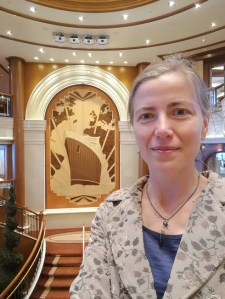 The ship named after now Queen Elizabeth impresses with its elegant interiors, an old-world charm that is irresistible to hopeless romantics like myself. You enter the main hall and cannot help thinking of similar scenes from the movie Titanic – the opulence and the beauty, the promise of an adventure (before the encounter with The Iceberg, of course). The live harp music started playing just after six pm, in time for dinner. Luckily, nobody was sinking. I did not count the restaurants and bars on board, but there seemed to be many, something for every taste.
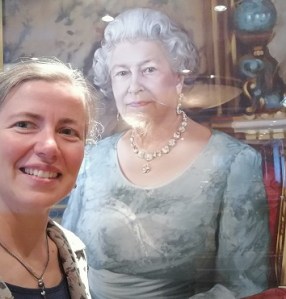 A selfie with the Queen seemed compulsory. She celebrated her twenty-first birthday during that famous tour of 1947. In a few days, I will be twice her age of the time. The average on board of the QEII is probably thrice as much or even more, so maybe a sea voyage like this should wait for a while yet. But ever since visiting the ship, I have been fantasising about sailing for two or three weeks, a stranger among strangers, and writing, writing, writing. With no everyday distractions, and only the sea as my companion, I could probably have a rough draft of a novel at the end of such an expedition. The mere possibility is incredibly tempting…


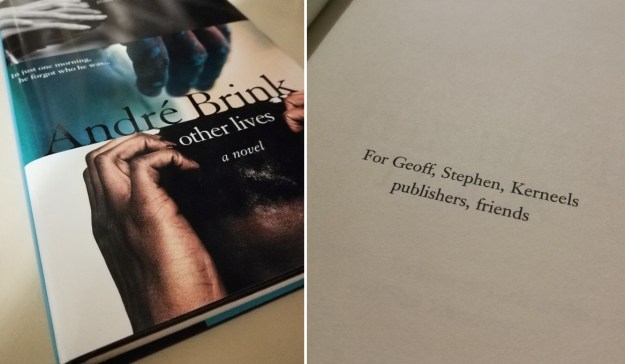


 The importance of truth and the careful use of language cannot be underestimated. “Precision, accuracy, and clarity matter, as gestures of respect toward those to whom you speak; toward the subject, whether it’s an individual or the earth itself; toward the historical record. It’s also a kind of self-respect”, writes the award-winning author and intellectual Rebecca Solnit in her latest collection of essays, Call Them by Their True Names. The individual pieces draw our attention to the roots of the present crises facing America and beyond: the infamous election of 2016, inequality, and climate change.
 “Loss helps you remember, and loss of a library helps you remember who you truly are”, writes the remarkable Argentine-Canadian wordsmith, Alberto Manguel. Nine years ago, I had the great fortune of spending an afternoon in his company. It was just after a visit to the special collection of a library in the French province of Champagne where I had seen manuscripts from the Middle Ages. The librarian responsible for them handled the treasures in white cotton gloves and, for understandable reasons, would not allow anyone else to touch them. Still spellbound, I told Mr Manguel of the encounter with the precious books and how much I had longed to touch their pages. That is when I found out about his own famous library, located in the home he shared with his partner near Paris, and containing thousands of books, some as ancient and unique as the ones I had seen. And in his kindness, he said that if I ever came to visit, he would allow me to hold these books in my hands.
 It is nearly impossible to know where to start when writing about postcolonial studies. This vast field of inquiry has influenced diverse schools of thought and disciplines all over the world. One of its leading scholars in the literature corner is Elleke Boehmer, the author of such seminal works as Colonial and postcolonial literature: Migrant metaphors (1995; expanded edition, 2005), Empire, the national, and the postcolonial, 1890–1920: Resistance in interaction (2002) and Stories of women: Gender and narrative in the postcolonial nation (2005). What sets Boehmer’s work apart from many other academic writers’ is its readability. She is also an acclaimed novelist and short story writer. These two facts are most likely related. They also allow the author to view the topic of her latest book, Postcolonial poetics: 21st-century critical readings, from a rare perspective, as a theorist and practitioner of the art of creative writing.
 Karina Magdalena