I was about to leave the house to go to the airport when my mom’s warning caught me in the doorway: ‘You can’t meet the man wearing that,’ she said, pointing at the Norwegian wool cap covering my ears.
‘Why not?’ I replied defiantly, but she only glanced at me over the rims of her glasses.
My compassion for an elderly man was taking me to Vienna International Airport. I was helping to organise a symposium on South African literature at my home university in Salzburg, and there’d been a terrible mix-up with the ticket we’d booked for one of our distinguished guests, André Brink. I felt so sorry for him that I suggested somebody should at least go to Vienna and accompany him on the train journey to Salzburg. I was delegated to do the job because of being most familiar with his work. I’d read several of André’s novels by then and loved all of them: the outrage of fantasy in The First Life of Adamastor; the exploration of responsibility and belonging in Imaginings of Sand; the aching eroticism in The Rights of Desire (which I read in a single sitting); the shocking reality of apartheid portrayed in A Dry White Season; the glimpse of possibility in An Instant in the Wind; or the brutality and humanity of Looking on Darkness. Naturally, I was honoured to be of service to the author of these magnificent novels, however intimidating the task felt all of a sudden.
I travelled to Vienna a day before André was due to arrive and used the opportunity to visit a friend, Charlotte Khan, with whose help I’d once survived three weeks in an Ukrainian student hostel but who now turned against me and backed Mom on the issue of the cap. Standing – bareheaded – in the airport’s arrivals hall that fateful Saturday morning in December 2004, my palms sweating, I told myself that it was silly to be nervous; even famous authors were ordinary human beings. Right?
Then the door to the baggage hall slid open and very casually André walked through. He was nothing like I’d imagined. I was expecting, at sixty-nine, an elderly, stooped gentleman in an outdated suit, exhausted and foul tempered after the horror flight. With his wavy brown hair, lively pale blue eyes behind elegant, light-framed glasses and a cautious smile on his lips, André walked, tall and straight, towards my extended hand. He shook it briefly while I recovered from my confusion. He was wearing a pair of well-worn jeans, an old leather jacket over a cotton shirt, and big black shoes. I couldn’t help being surprised, and impressed.
Our train trip from Vienna to Salzburg was full of conversation and laughter, at least until André fell asleep in his seat opposite me; the long trip taking its toll after all. I took out my copy of Looking on Darkness and continued reading, every now and then glancing up from the book to check whether he was real.
A few days on, we were slowly walking from the Max Gandolph Library in Salzburg, where the last symposium session of the day had just come to an end, to the taxi rank around the corner on the Residenzplatz next to the Cathedral. The other participants were still tying up loose ends of heated debates over a glass of red wine, but André had asked me to get him out of there. He was tired, he’d said, and wanted to get to his room.
When we reached the row of taxis, the traditional Christmas Market was in full swing around us, scents of gingerbread and hot mulled wine accenting the icy air. For a few moments the buzz of the market faded into the background as André turned to face me before getting into the car. We each removed one glove and shook hands again, but this time holding on much longer than necessary.
Our fate was sealed.
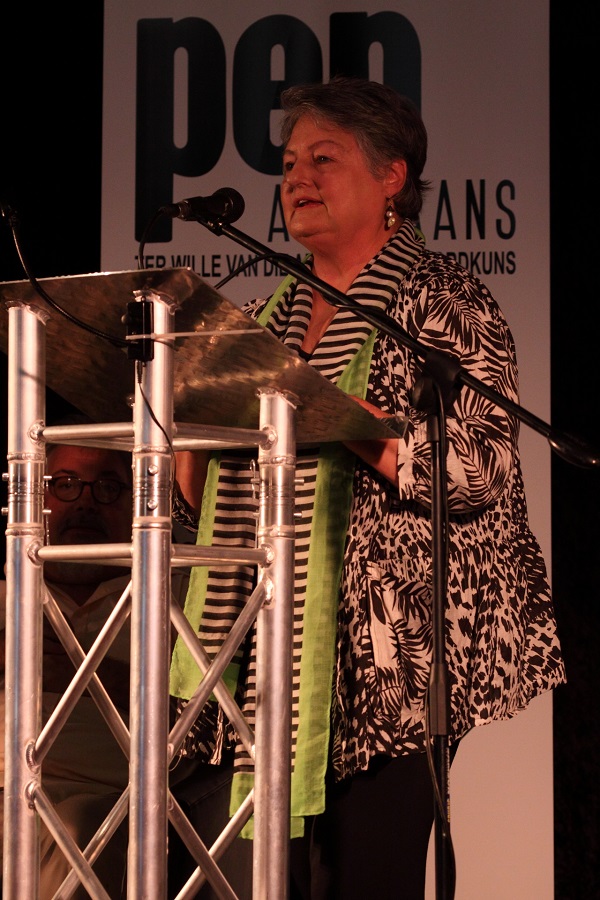
The night before he was to leave Salzburg, André gave a reading at Schloss Leopoldskron where he was staying for the duration of the symposium. I introduced him to the public and conducted the Q&A session during the event. Preparing for the evening, I’d washed and dried my long hair, letting it fall loose around my shoulders. As I sat next to André, I observed his hands for the first time.
When the applause died down, books had been signed, the last goodbyes exchanged and the lights dimmed, the atmosphere in the Schloss was full of magic. As one of the organisers I was the last person to leave. And there I stood with my hand on the front door knob, looking at the Christmas tree in the reception hall, listening to the engulfing silence and desperately trying to find a reason to go upstairs and knock on his door.
I didn’t that night, although, as we discovered later, he was leaning against the door in his room, just as desperately trying to find a reason to come down again. For a few seconds before our courage failed us, the night stood still in anticipation. Reason prevailed, but not in any conventional sense. There was no articulate decision taken or any logic involved. The subliminal stirrings of mutual attraction simply remained suppressed, not allowed to manifest themselves as real thoughts, or actions. I was married at the time. Unhappily, but that was and is beside the point. It was only much later that all of this became clear, was put into words and was recognised for what it was – an awakened possibility of something new, of being aware of somebody in that way again.
A vivid correspondence followed. Feeling understood, I shared freely. By then, my personal life lay in ruins around me, completely shattered. On crisp, stark-white pages with an old-fashioned fountain pen and no lines to guide me, André allowed me to write it into being all over again. Day after day, as I was trying to piece my life together, he read and wrote in support. He also spoiled me with moving gifts: a box of sea urchins from a snorkelling expedition with friends from Still Bay, Umberto Eco’s On Beauty and a delicate golden chain for my twenty-eight birthday, ten crimson velvety roses for Valentine’s Day. Yet, there was no room for real promises in this pristine universe built of words, although everything seemed possible. André’s epistolary presence gave me a new lease on life during and after a painful divorce.
It was during this period that I wrote a paper on An Instant in the Wind for a seminar I attended. Inevitably, it is my only extended piece of criticism on one of André’s books. I treasure it and the novel it analyses for the intellectual and emotional journey it allowed me to travel. The story of Elisabeth and Aob resonated deeply within me and if I had to choose (which fortunately I don’t), I would pick An Instant as my favourite among all André’s novels. In portraying the fundamental recognition between two people and juxtaposing it with the ultimate betrayal, he captured the essence of what it means to be human. Referring to a quote from the book – ‘all the impossible possibilities, everything which can be confirmed and petrified by a single gesture, created or destroyed by it’ – I wrote in my essay: ‘Whether something really happens or not is not the issue, what is most important is the possibility and the faith in the chance of its potential happening.’ Through his work and his letters, André restored this faith in me.
By the time we met in the physical world again – in the European spring of 2005 – we were both free to listen to our hearts, and it was André’s turn to meet me at an airport. He says he kissed me then and there when I arrived, but I don’t remember. What is vivid in my memory is the taxi ride from Charles de Gaulle Airport into the city. This time nobody was left behind in the cold. In the back of the car our hands touched, knowingly and purposefully, and I remember thinking that I had never seen more beautiful hands in my life.
It was spring, we were in Paris, there was also a conference about South African literature taking place at the Sorbonne, and we walked hand in hand around the city, discovering that what we’d brought into being through words was taking real physical shape in the world between us. I did not have to steal sneaking glances at André’s hands anymore or imagine their touch. I could caress, feel, rub lotion into them, place kisses on each individual finger tip. One day, when he was taking his usual afternoon nap, I took a series of photographs of them resting next to his face on the ornate duvet in the hotel we were staying at. I asked whether I could do a manicure for him and he readily agreed. Taking care of his hands has become one of the most pleasurable routines in my life.
On our last evening in Paris, I invited André to La table du Perigord, one of his favourite restaurants (sadly closed down afterwards), to a feast of pan-friend duck liver, a dish he had introduced me to there a few days before. Nothing can beat the taste of a baguette morsel dipped in the mixture of fried liver and pear juices, accompanied by a sip of a good Bordeaux and the promise a twinkle holds in the eyes of your lover.
A month later we met again in England at yet another conference and, once our literary duties were over, we travelled together to my beloved Wales where I’d spent a year studying and taming dragons. We stopped for tea at Tintern Abbey and read Wordsworth aloud to each other in the middle of the ruins. I took André to my favourite place on earth, the Elan Valley, where on a wind-still day the water surfaces of the reservoirs reflect the pastoral landscape around them, in photographs the mirror image impossible to distinguish from the real thing. In Aberystwyth, I showed André the house I’d lived in and we walked along the long promenade, watching the tide come in, and breathing in the heavy sea kelp smell. We spent a few days in Hay-on-Wye, rummaging through the second-hand bookshops and staying at an early seventeenth-century guesthouse in which the entrance to our room was barely a metre high, but the shower cubicle was big enough to accommodate us both. Knowing that we would be visiting this area, André’s friend and publisher, Geoff Mulligan, had booked us a table at the The Stagg Inn, in 2001 the first ever pub to be awarded a Michelin star.
I came to Cape Town for André’s seventieth birthday, then for the South African winter the same year. Late 2005 we travelled together on the magnificent Trollfjord of the Norwegian Hurtigruten fleet which sails along the fjord coast all the way between Oslo and Kirkenes. I wore the woollen cap I’d been forbidden to wear the previous year to the airport; André thought it lovely. The trip was organised by Wiggo Andersen and his then partner, now wife, Kristin Johansen. Over the past four years we have become close friends with this wonderful, enterprising Norwegian couple and their lovely Cape Town-born daughter Selma. Soon all of us will be embarking on another journey, fulfilling André’s life-long dream of experiencing the ancient splendour of the Machu Picchu ruins in Peru.
It was directly after the Trollfjord trip that I arrived on André’s doorstep with two large suitcases and an invitation to stay forever. I walked around his soulful Victorian house in the middle of Rosebank with its walls covered in paintings from around the world and the rooms beautifully furnished with antiques, and I immediately felt at home. We turned one of the guest bedrooms into a study for me and the adjoining little room into the biggest Brink library in the world. I became the proud custodian of this impressive collection of André’s author copies, translated into over thirty languages, Polish (my mother tongue) among them. When I sit at my desk and glance over at the rows of books, I’m awed and inspired. Since coming to live with André, I have witnessed the genesis of several recent Brinks, from the moment inspiration strikes, through the endless baths in which he mulls over plot and characters before returning to type and rewrite, to the sound of the doorbell announcing the arrival of the final product. In the beginning I’d feared the isolation which accompanies creativity, but in the meantime have discovered the generosity of sharing with which André approaches the task, and the respect and appreciation he shows for my own work. Somehow we have managed to synchronise our working schedules so that they do not encroach on our relationship time, so precious to us both.
On a warm summer evening in 2006, André returned home irritated and frustrated by the day’s many unexpected little vexing challenges. I was not to be deterred from my plans for this particular evening. There was only one solution to the tension: I ran him a bath. While he was floating, I set a small ancient cedarwood table for us in the lounge, let Mozart play in the background, lighted candles, prepared a light meal, and opened a bottle of champagne. As always, he emerged from the bathtub newborn, and I served the food. During dessert I let André read a letter I’d written for him.
Then I got on my knee and asked him to marry me.
‘Jou poephol,’ he exclaimed.
I swear.
But then he said a definite Yes with tears gathering in his eyes, and we both cried and laughed and hugged and kissed and, yes, were married a few months later, on 20.06.2006. The little cedarwood table served as our altar in the lounge. A close friend performed the official ceremony. Soon after, with a few months in between every arrival, three cats – Mozart (from Austria), Salieri (from a Capetonian sewage pipe) and Glinka (from the multi-pet household of André’s daughter) – moved in with us.
We are a family now. I became a stepmother to André’s four children, all older than me, and a step-grandmother to their six children, one of whom even teasingly calls me babcia, Polish for grandma. The entire Brink family and André’s many friends welcomed me with warmth and kindness. My own family was just as pleased about our relationship. When I told Dad about us for the first time, we were in his workshop and he was in the process of assembling a bicycle. I clumsily began explaining that the man I was in love with was twenty-two years older than him. There was a short silence, not because my father didn’t know how to respond, but because he was concentrating on setting the bike’s rear derailleur right. Once he was satisfied, he looked over his shoulder.
‘But he makes you happy, doesn’t he?’ he asked.
I nodded.
‘So, what’s the problem?’
He won’t admit it openly, but I think Dad misses me a lot now that I live so far away, but he and Mom are happy for us, and we do visit often, phoning each other regularly in between.
Dad calls André ‘my black son-in-law’. ‘He’s African, isn’t he?’ That settles it for him.
Mom, unable to communicate properly in a language André understands, has discovered his love for her pan-fried potatoes with garlic and a few other of her specialities, and she expresses her affection by cooking for him.
In spite of all the travelling we do, André and I love being at home. We spend almost every hour of every day in each other’s company. Even if we work in our separate studies, each is aware of the other’s presence across the passage, a few metres which we traverse back and forth many times a day to seek advice, exchange news, or offer one another a cup of tea. Often I find André in the bath, or run him one myself, when he writes himself into a corner. I don’t know whether he realises how much confidence he has given me by discussing his projects with me, by making my opinions count, by trusting my judgement, and most importantly, by believing in my own creativity. More than anyone else, he has inspired me to say, proudly and out loud: I am a writer.
When not at work, we enjoy life’s simple pleasures together. André will get out of bed, put on his clothes, grab the car keys and drive with me to the nearest open sushi place if I get a craving, even late in the evening. If we feel like it, we will run a bath at three a.m., or watch Fawlty Towers for the hundredth time. When André turned seventy-one and I twenty-nine, we threw a huge party to celebrate our hundredth birthday. For other birthdays, we always explore different means of transport – anything from donkey cart to helicopter. André awakened my passion for rugby and opera. I’m still trying to get him to read science-fiction. I love that he asks me to listen to the morning songs of birds outside our bedroom window, that he can’t say no to chocolate even though it often gives him stomach cramps, that he cries while listening to Rolando Villazón and Anna Netrebko, rereads Miguel de Cervantes Saavedra’s The History and Adventures of the Renowned Don Quixote de la Mancha at every opportunity, adores female toes beyond reason, and breathes art through his skin, unable to resist a new Georges Mazilu or a Jan Vermeiren or a statuette of a weeping woman in a Parisian gallery window. I love the fearlessness with which he encounters every windmill in his path and the eagerness with which he approaches every new adventure. To experience life with André is to enter a space where the boundaries between the everyday and the extraordinary blur, where duty merges with passion, and a mere possibility becomes intoxicating reality.
Sometimes I watch André peacefully asleep next to me and still marvel at how in spite of coming from two entirely different cultural backgrounds and of having forty-two years of age between us, we fit like a pair of long-lost shoes, totally out of fashion, but a perfect match. Usually the first one to wake up in the morning, I always turn to face him and know that I will be greeted by a smile the moment André opens his eyes, sometimes even beforehand. We often only murmur our good mornings and continue to hold entire conversations in this manner – about how we’d slept and whose turn it was to serve tea and rusks in bed. The moment she hears our voices, our youngest cat Glinka comes charging into the bedroom, chirping her own greetings and demanding her share of a rusk.
It hasn’t always been easy; nothing worthwhile ever is. From our individual pasts we’d brought a lot of baggage into our relationship that had to be examined, repacked and re-shelved, so as not to weigh us down on our continuing journey. We have always been able to talk to one another, to sit down at a table and explain where our feelings came from and what we expected from one another. It might sound simple, but I consider this space of honesty and trust between us as our greatest achievement. Through his love and patience, André has given me the most precious gift any person can give to another: the courage to be wholly and completely myself, to unabashedly stand naked in his presence.
Like Don Quixote his Dulcinea, André makes me possible.
First published in Encounters with André Brink (2010).
 Trying to describe it is like the task itself. Elusive, not part of your everyday vocabulary. You don’t really know how to begin until you hold the tools in your hands and rely on intuition and muscle memory to take over. I was thinking this while sewing the belt loop of my grey cardigan back on to its side. You take a needle and a thread, the cardigan and the loop. The scissors are on standby. You actually don’t know how it will work out until you proceed to pierce the wool with the needle. The loop is not only to be reattached. You do want it to look pretty.