Launch of Divided Lives by Lyndall Gordon at the Book Lounge

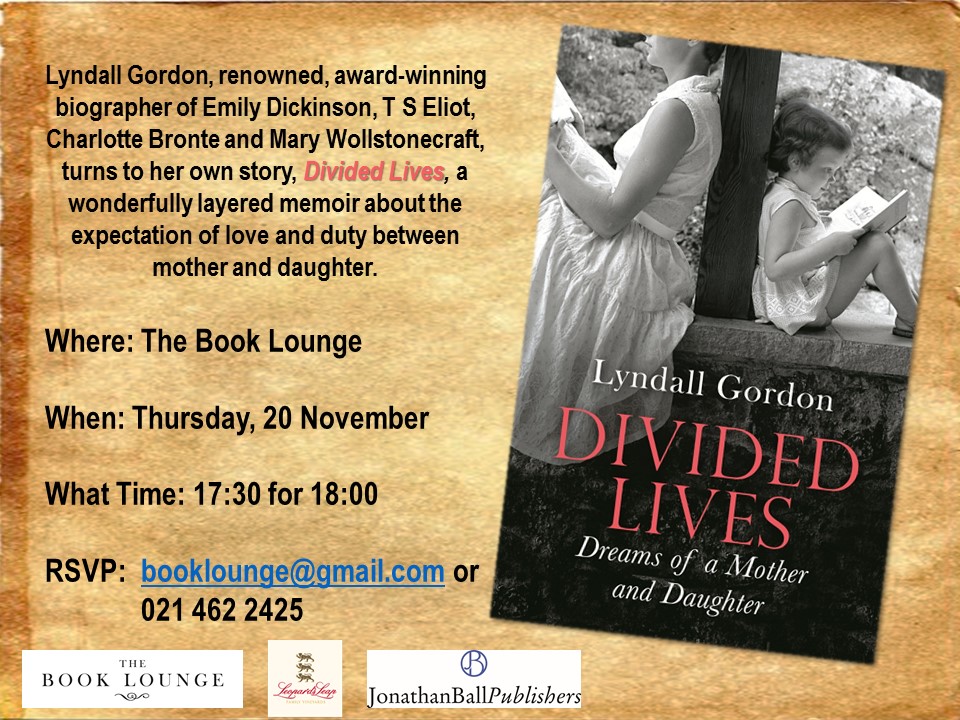
Next week, on Thursday, 20 November, it will be my pleasure to speak to Lyndall Gordon at the Book Lounge launch of her latest memoir, Divided Lives: Dreams of a Mother and Daughter.
lyndall-gordon-launch

lyndall-2-12“Lyndall Gordon grew up in Cape Town where she studied history and English, then nineteenth-century American literature at Columbia in New York. In 1973 she came to England through the Rhodes Trust. For many years she was a tutor and lecturer in English at Oxford where she is now Senior Research Fellow at St Hilda’s College.

Virago has published her six biographies and two memoirs. Lyndall is a Fellow of the Royal Society of Literature and member of PEN. She is married to Professor of Cellular Pathology, Siamon Gordon; they live in Oxford and have two grown-up daughters.”

SharedLivesTSVirginiaEmily

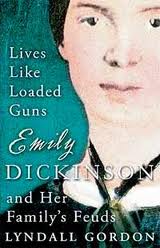
The first time I encountered Lyndall Gordon’s work was when her biography Lives Like Loaded Guns: Emily Dickinson and her Family’s Feuds was sent to me for for reviewing in 2010:

“In Lives Like Loaded Guns: Emily Dickinson and her Family’s Feuds, Lyndall Gordon considers the two unassailable facts of Emily Dickinson’s life: the family feud over the affair Emily’s brother, Austin Dickinson, had with Mabel Loomis Todd, and the poet’s letters and poems about her unnamed sickness. In the process Gordon debunks the many myths created around the unique woman who spent most of her time in her own home, writing, gardening and baking prize-winning bread for her family.

Through a meticulous reading of letters, court evidence, publishers’ papers, medical prescriptions and other archival records, as well as most importantly, the lines of her poems, Gordon distils the essence of Emily Dickinson and allows her to emerge in a completely different light. Not as an eccentric, disappointed, white-clad spinster, but a woman of genius who lived fully and loved passionately, while choosing a seemingly quiet ‘Existence’ – one she insisted on spelling with a capital E.”

For me, the review was the beginning of an enlightening journey. Gordon’s remarkable books arrived in my life when I most needed them. They sustained me through periods of doubt and gave me strength to continue on my own literary path.

For my review of Divided Lives see LitNet.

“The people Gordon portrays in her biographies glow with their inner lives, and our appreciation of their work also catches fire.”

Divided LivesCharlotteHenryMary

For Lyndall Gordon’s other events in South Africa see Blake Friedmann.

Review: Divided Lives – Dreams of a Mother and Daughter by Lyndall Gordon

Divided LivesOn 26 November 2012, Time published this tiny obituary: “DIED Valerie Eliot, 86, who married TS Eliot in the last years of the great poet’s life; she edited an edition of his epic The Waste Land that included annotations by Ezra Pound.” Not even three dozen words to sum up the life of a woman who was infinitely more than just an editor of her famous husband’s most famous work. When they married towards the end of his life, “Eliot at last found himself ready for forgiveness. Horror, gloom, and penitence came to an end with his discovery of the unconditional love of a young woman,” writes Lyndall Gordon in TS Eliot: An Imperfect Life (1998).

In her biography of Eliot, Gordon retraces the poet’s insatiable search for perfection and his troubled relationships with the women who accompanied him on his quest: “His passion for immortality was so commanding that it allowed him to reject each of these women with a firmness that shattered their lives.” The exception was his second wife, Valerie, who despite being his junior by nearly four decades was the one who bestowed grace upon the final years of his life. Gordon’s biography emphasises the profound change Valerie’s love brought to Eliot in the light of all his previous precarious commitments.

In her biography Henry James: His Women and His Art (1998, revised edition 2012), Gordon sums up the distinguished writer’s ability to explore “the inward life: the unvoiced exchange and the drama of hidden motives … his skills, as well as a power, beyond that of any other man, to plumb the unknown potentialities of women”. James never openly acknowledged the influence such strong, independent women as the American writer Constance Fenimore Woolson had on his writing life and his heroines, but it was immeasurable, as Gordon’s biography shows. While in Venice last year, I was reminded of a striking scene she describes in the book: Henry James helplessly trying to drown Fenimore’s black dresses in one of the lagoons a few weeks after her death. Like balloons the dresses kept surfacing…

Continue reading: Review of Divided Lives: Dreams of a Mother and Daughter by Lyndall Gordon

Published by Virago Press, 2014

Review: The Gonjon Pin and Other Stories – The Caine Prize for African Writing 2014

The Gonjon PinThe Caine Prize for African Writing has a reputation of launching literary careers. Previous winners include Helon Habila, NoViolet Bulawayo, and Henrietta Innes-Rose. The Caine Prize collections of stories comprise each year’s shortlisted entries and pieces written during a workshop organised in conjunction with the prize.

By nature an anthology of short stories is usually a mixed bag. This year’s volume, apart from some excellent exceptions, is not particularly accomplished. Reading most of the contributions one senses amazing talent and potential, but the stories, even two or three of the shortlisted ones, feel unfinished. They intrigue, but do not wow despite varied themes, innovative approaches to form and content, and moments of stylistic beauty. All the elements of great short-story writing are present, but they hardly ever feature together in one piece.

African writing has a certain reputation, on the continent and beyond. Depending on individual tastes, readers either fear or count on stories of socio-political relevance, everyday hardship and disillusionment, the diaspora experience, violence and abuse, the HIV pandemic, neglect or instability. There is a prevalent feeling of ‘things falling apart’. The Gonjon Pin and Other Stories includes all of the above and in that sense does not disappoint.

The shortlisted stories stand out for their originality. In Diane Awerbuck’s Phosphorescence (South Africa), a suicidal young woman bonds with her daring grandmother over the bulldozing of a city landmark. While following the election back home on television, a Zimbabwean family tries to negotiate between a quarrelling couple in Tendai Huchu’s The Intervention (Zimbabwe). Billy Kahora’s protagonist develops an uncanny relationship to a zoo gorilla in The Gorilla’s Apprentice (Kenya). And in the winning entry, My Father’s Head by Okwiri Oduor (Nigeria), a woman tries to conjure up her dead father by drawing him, but his head refuses to fit into her sketches.

The shortlisted story which impressed me the most, however, was Efemia Chela’s Chicken (Ghana/Zambia). A young writer of remarkable assurance, Chela has that rare gift of making you pause again and again to appreciate a striking image or a perfectly balanced sentence while never allowing you to take your mind off the story she is telling. Chicken is about a woman who cuts the ties to her family and tries to survive on her own in the big city by making some tough choices.

Of the twelve workshop stories, the titular The Gonjon Pin by Martin Egblewogbe (Ghana) and The Lifebloom Gift by Abdul Adan (Somalia/Kenya) were a true discovery. Reminiscent of the mad and irresistible story-telling of such authors as the Israeli Etgar Keret or the Welsh Alex Burrett, these surreal tales made me sit up, laugh, shake my head, and marvel at the incredible power of the genre. Egblewogbe has his characters dealing with a man’s functioning genitals hanging on a study wall. Adan creates a world where an unusual man spreads cult love by stimulating people’s moles. It is gems like these that make reading anthologies worthwhile.

The Gonjon Pin and Other Stories: The Caine Prize for African Writing 2014
Jacana/New Internationalist, 2014

First published in the Cape Times, 10 October 2014.

Review: Entanglement by Steven Boykey Sidley

EntanglementProfessor Jared Borowitz, a renowned, well-liked American physicist in his mid-forties, has one pet hate: belief of any kind, whether it is spiritual, dietary or homoeopathic – as long as it is not founded on sound logic and scientific proof it won’t make it past his personal bullshit detector: “Aside from fundamentalists, creationists, UFO nuts and astrologists, health foodies are next in the pantheon of idiocy,” he attests. He used to be able to laugh off what he perceives as ignorance, but now it awakes a sense of rage in him.

A recovered philanderer, Jared is divorced from his first long-suffering wife, Gwen, and living in a relationship with Katherine, a no-nonsense psychologist with a strict moral core despite her damaged past. Having learned from bitter experience, Jared decides to be faithful to Katherine and sees a clear future with her at his side…

Continue reading on LitNet: Review of Entanglement by Steven Boykey Sidley

Entanglement
by Steven Boykey Sidley
Picador Africa, 2012

Book mark: Aerodrome Journal Issue 01 / 2014

Aerodrome coverFor the past fifteen months the digital version of Aerodrome has been an exciting platform for all things literary. Immensely pleasing to the eye, it publishes fiction, poetry, reviews and a particular favourite of mine: author interviews. Freshly launched, the first paper issue of Aerodrome is an aesthetic gem and opens with several interviews with writers and artists such as Isobel Dixon, Zapiro, Mary Watson, Anton Kannemeyer, Conrad Botes and Zoë Wicomb. It also offers the best of the first year’s digital content and includes a few specials which will appear online later. A personal highlight is one of the exclusive features: an inspiring interview with Damon Galgut in which he states that you can recognise a real writer by the way they approach language. In this respect, Megan Ross’s short story “The Accidental Colour” and Jane McArthur’s poem “The Girl from Witwatersrand” delight.

First published in the Cape Times on 31 October 2014.

Book mark: Travels with Epicurus – Meditations from a Greek Island on the Pleasures of Old Age by Daniel Klein

Travels with EpicurusThis collection of meditations will enchant you no matter what age you are. Everyone is so obsessed with youth nowadays that we seldom give thought to the later stages of our lives. If we do confront the inevitability of ageing, it is usually with fear or worse, disgust, not as something to look forward to. The vision of having to undergo repeated painful procedures to have his teeth replaced by implants instead of opting out for the quicker, simpler and cheaper solution of dentures sends Klein to the Greek island of Hydra where he explores the pleasures and advantages of old age. Through witty anecdotes involving elderly locals and reinterpretations of renowned thinkers from Epicurus to Camus, Klein shows that there is much more to old age than meets the eye.

Travels with Epicurus: Meditations from a Greek Island on the Pleasures of Old Age
by Daniel Klein
Oneworld, 2013

First published in the Cape Times on 31 October 2014.

Book mark: The Alibi Club by Jaco van Schalkwyk

The Alibi ClubJaco van Schalkwyk is an artist and a writer with enormous promise. His visual and literary imageries correspond. Published simultaneously in Afrikaans and English, his debut novel The Alibi Club is a poignant, meticulously constructed narrative, written in a starkly revealing prose. It tells the story of a medley of striking individuals who frequent the titular club in Brooklyn where booze and drugs flow in abundance, the jukebox and the pool table provide entertainment, and human relationships are forged and discarded through the nights. The narrator is a young South African who progresses from cleaner to bartender at The Alibi. He arrives in Brooklyn in 1998 and departs nearly a decade later. His observations paint an incisive portrait of the neighbourhood during that time, especially the radical transformation it experienced after the horrific attacks of 9/11.

The Alibi Club
Jaco van Schalkwyk
Umuzi, 2014

First published in the Cape Times on 24 October 2014.

Book mark: Don’t Film Yourself Having Sex and Other Legal Advice for the Age of Social Media by by Emma Sadleir and Tamsyn de Beer

Dont Film YourselfFor many of us the internet is an integral part of our everyday reality. Accessible and highly entertaining, Don’t Film Yourself Having Sex is a must-read in the digital age, especially if you have children or are planning to marry Kate Winslet. Without excessive legalese, the authors give an overview of our on- and offline rights and responsibilities, and what consequences ignoring either might have for us as digital citizens. They offer practical advice on how to profit from the amazing medium and to have all the fun online without ruining your reputation, losing your job, having your identity stolen, being sued for damages, or becoming the laughing stock of social media. They also tell you what to do when something does go horribly wrong. ‘I had no clue’ won’t work as an excuse.

Don’t Film Yourself Having Sex and Other Legal Advice for the Age of Social Media
by Emma Sadleir and Tamsyn de Beer
Penguin, 2014

First published in the Cape Times on 10 October 2014.

Book mark: The Snowden Files – The Inside Story of the World’s Most Wanted Man by Luke Harding

The Snowden FilesThe Edward Snowden saga is one of the most important stories of our times and Snowden himself a modern hero, despite his adversaries’ claims to the contrary. Luke Harding’s rendering of Snowden’s ordeal since his decision to become a whistleblower reads like a dystopian thriller. It’s George Orwell’s 1984 delayed by three decades, bigger in scope and horror.

Snowden risked his life to bring the worldwide mass surveillance authorised and conducted by so-called national security agencies in the US and the UK to the world’s attention. We live, he says, “under a sort of eye that sees everything, even when it’s not needed.” It is an assault on our most precious human rights. Harding’s book chronicles the timeline of Snowden’s revelations, their background, their consequences for all involved, and the global debate they sparked.

The Snowden Files: The Inside Story of the World’s Most Wanted Man
by Luke Harding
Guardian Books/Faber and Faber, 2014

First published in the Cape Times on 10 October 2014.