Book mark: The Night Watchman by Richard Zimler

The Night WatchmanChief Inspector Henrique Monroe of the Lisbon Police Department is brilliant at what he does, but gets help from a very unusual source. When a successful businessman is murdered under strange circumstances in his home, Monroe is called to investigate. The complex case awakens memories of Monroe’s distant past of growing up in Colorado with his younger brother Ernie, and threatens to unravel the fragile new reality the cop had been constructing around himself in Portugal ever since. His search for truth takes him to the country’s highest echelons of power. What he finds is horrifying, but tragically common. The Night Watchman portrays a troubled, corrupt society any South African reader will recognise. Tense, deeply felt, the novel asks a pivotal question: “Was it a paradox that truths left unspoken ended up taking away your voice?” The disquieting answers it provides are heart-breaking.

The Night Watchman
by Richard Zimler
Corsair, 2014

Book mark first published in the Cape Times on 12 December 2014.

In 2007, I reviewed one other novel by Richard Zimler:
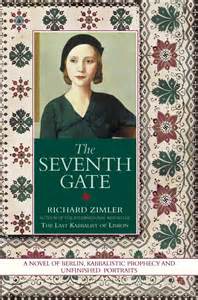
The Seventh GateThe Seventh Gate
Constable, 2007

In 1990 the discovery of seven manuscripts of the sixteenth-century Kabbalist Berekiah Zarco sparked Richard Zimler’s internationally bestselling novel The Last Kabbalist of Lisbon (1996). Following its success, Zimler, an American living in Portugal, published two other novels about the Portuguese-Jewish Zarco family: Hunting Midnight (2003) and Guardian of the Dawn (2005).

The Last Kabbalist of Lisbon explores the fates of the Jewish community at the time of the Lisbon massacre of April 1506. Partly set in nineteenth-century Africa, Hunting Midnight is the story of a friendship between the Portuguese John Zarco Stewart and an African healer and freed slave named Midnight. Guardian of the Dawn takes us back to Goa at the time of the Catholic Inquisition in the seventeenth century.

The fourth novel in Zimler’s independent historical novels series is The Seventh Gate. Set in Berlin of the 1930s, it portrays Hitler’s brutal rise to power and the effects it had on the Jewish community and the disabled long before Second World War began. It subtly exposes how a whole nation could succumb to the madness of the Nazi regime; some willingly, others under extreme pressure. Meticulously researched and vividly brought to life, Zimler’s Berlin of the 1930s is a nightmarish place where loyalty between family members and friends as well as each individual’s sanity and heroism are tested to the limits.

In spite of its harrowing topic, The Seventh Gate is the kind of novel that makes you relax after the first twenty pages, knowing that there is another five hundred in store for you before the final curtain falls. Driven by superbly drawn characters, strong dialogues, and the unusual but beautifully touching love story at its centre, The Seventh Gate is a tribute to all the people who suffered similar fates at the hand of the Nazis as the characters in the novel.

The story is told by Sophie. In the Preface of the novel she is a fragile eighty-nine year old living in America and being taken care of by her nephew. After a spell in the hospital she decides to entrust him with her memories of the past when she was a teenage German girl in Berlin of the 30s and the world began to fall to pieces.

Sophie tells the story of Isaac Zarco, a descendant of the Kabbalist Berekiah Zarco, and the members of The Ring, now a clandestine group of Jewish activists trying to fight the Nazi regime. It is also the story of her brother Hansi, a distant child whom Sophie loves dearly and whose life is threatened by the Nazis. Misunderstood by her mother, betrayed by her father and Tonio, the boy she has a crush on, Sophie has to make some tough choices, trying to protect Hansi and her friends from the Nazi onslaught. The sudden wave of mysterious murders, disappearances and forced sterilizations makes her and Isaac realise that Berekiah Zarco’s worst fears might be about to come true, centuries after he wrote his manuscripts.

Artistically talented and mischievous, Sophie is a heroine one will not easily forget. Her passion for the cinema, her growing sense of righteousness, her awakening sexuality, and her selfless devotion to the people she loves sparkle with authenticity. The novel is interspersed with the poignant sketches she draws of her friends, adding to this overall effect.

Much has been written on Hitler’s Germany, but Zimler’s The Seventh Gate reveals a side of its inhumane machinery which has not been as prominent in the renderings of the time as it should have been, as the novel carefully examines how the horrors we associate with the time of the war already started happening in the early 30s with everyone watching almost in complete silence. Zimler probes the questions of how power is consolidated by intimidation and propagandistic lies, but also shows how small acts of courage and integrity can stand in its way. As Sophie comments on her younger self: “I’m still too young to know that people need only be frightened for their lives to swear that night is day. And that they can believe it’s really true.”

In an interview with Boyd Tonkin, Zimler stated that the relationship between the siblings Hansi and Sophie is his “monument” to the victims of the Nazi war on the disabled. The author expressed his wish that “every reader who reads the book with an open heart will be devastated by what happens to them both.” Because of the powerful storytelling of The Seventh Gate one cannot help but be.

Review first published in the Sunday Independent on 25 November 2007.

Book mark: Playing House by Katherine Stansfield

Playing House_book markPlaying House is the debut poetry collection by the author of The Visitor (2013), a remarkable novel about loss and longing in Cornwall at the turn of the last century. As in her rich prose, in her poetry Katherine Stansfield has an eye for everyday detail. Her poems make us pause and consider. Whether describing a cat trying to get to an interesting-smelling morsel under the fridge, the auction of one of John Lennon’s teeth, the recipe for a crisp sandwich, or “raspberries lured to ripeness by the rain”, she moves from the familiar to the surprising and enchants in the process. Her images are clearly defined. The voice is authentic, subtle but strong. The title of the volume comes from “First Place”, a poem about a couple’s attempts at adult life. Full of thought, fun and beauty, Playing House is the real deal.

Playing House
by Katherine Stansfield
Seren, 2014

An edited version of this book mark was first published in the Cape Times on 5 December 2014.

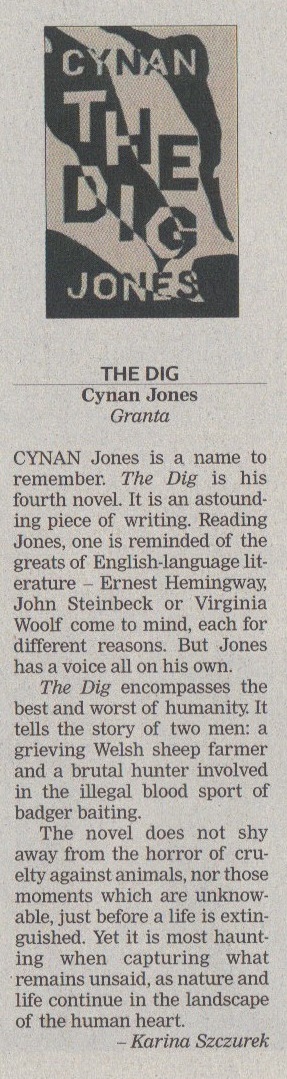
Book mark: The Dig by Cynan Jones

The Dig_book markCynan Jones is a name to remember. The Dig is his fourth novel. It is an astounding piece of writing. Reading Jones one is reminded of the greats of English-language literature – Hemingway, Steinbeck or Virginia Woolf come to mind, each for different reasons. But Jones has a voice all his own. His prose is pure muscle and yet it conveys the most delicate of impressions and emotions. The Dig encompasses the best and worst of humanity. It tells the story of two men: a grieving Welsh sheep farmer and a brutal hunter involved in the illegal blood sport of badger baiting. The novel does not shy away from the horror of cruelty against animals, nor those moments which are unknowable, just before a life is extinguished. Yet it is most haunting when capturing what remains unsaid, as nature and life continue in the landscape of the human heart.

The Dig
by Cynan Jones
Granta, 2014

An edited version of this book mark was first published in the Cape Times on 5 December 2014.

Book mark: Unexpected Lessons in Love by Bernardine Bishop

Unexpected Lessons in Love_book markThe retired psychotherapist Cecilia and her novelist friend Helen are courageously battling cancer. The experience of undergoing a colostomy and living with a stoma binds them. Both are confronted with motherhood in the autumn of their lives: Cecilia, when her son Ian dumps a baby she had no idea existed on her doorstep, and Helen, when she receives a message from the daughter she’d given up for adoption in her twenties. They and their families discover that love has a way of finding you when you least expect it.

The same applies to Unexpected Lessons in Love. The book is that strange creature: a novel which is not exactly well written, clumsy and implausible at times, but one which has such irresistible charm that it is impossible not to love. Sadly, the author died of cancer around the time of publication.

Unexpected Lessons in Love
by Bernardine Bishop
John Murray, 2013

An edited version of this book mark appeared in the Cape Times on 5 December 2014.

5 December

The 5th of December has been very dear to my heart since 2004 when I went to the airport in Vienna to pick up an author invited to the “1st Joint Symposium: South Africa in Perspective” at the University of Salzburg which I’d helped organise. The encounter changed my life. The author was André Brink. We were married one-and-a-half years later in Cape Town, my home for the past nine years.

In 2007, on 9 October, André and I went to see Nelson Mandela at his home in Cape Town.
Madiba1
It was another defining moment of my life. Jakes Gerwel and Zelda la Grange were also present. In my notes after the meeting I wrote “very caring and supportive” of Ms La Grange. It was touching to see her interacting with Madiba. We brought books with us, both Madiba and Ms La Grange being avid readers. The talk evolved around Buckingham Palace, rugby, Lech Wałęsa, literature, and the past. Before we left, I held Madiba’s right hand in both of mine and said thank you with tears in my eyes (again now pressing for release years later, just remembering the moment). The stories people tell about being inspired, wanting to be a better person, of glowing for days after meeting Madiba are all true: that was the magic of his presence, a charisma like no other.

At the time, Madiba was in town to support his wife, Graça Machel. Their relationship testifies to the fact that it is never too late for love and one should never be afraid to reach out for it.
MINOLTA DIGITAL CAMERA
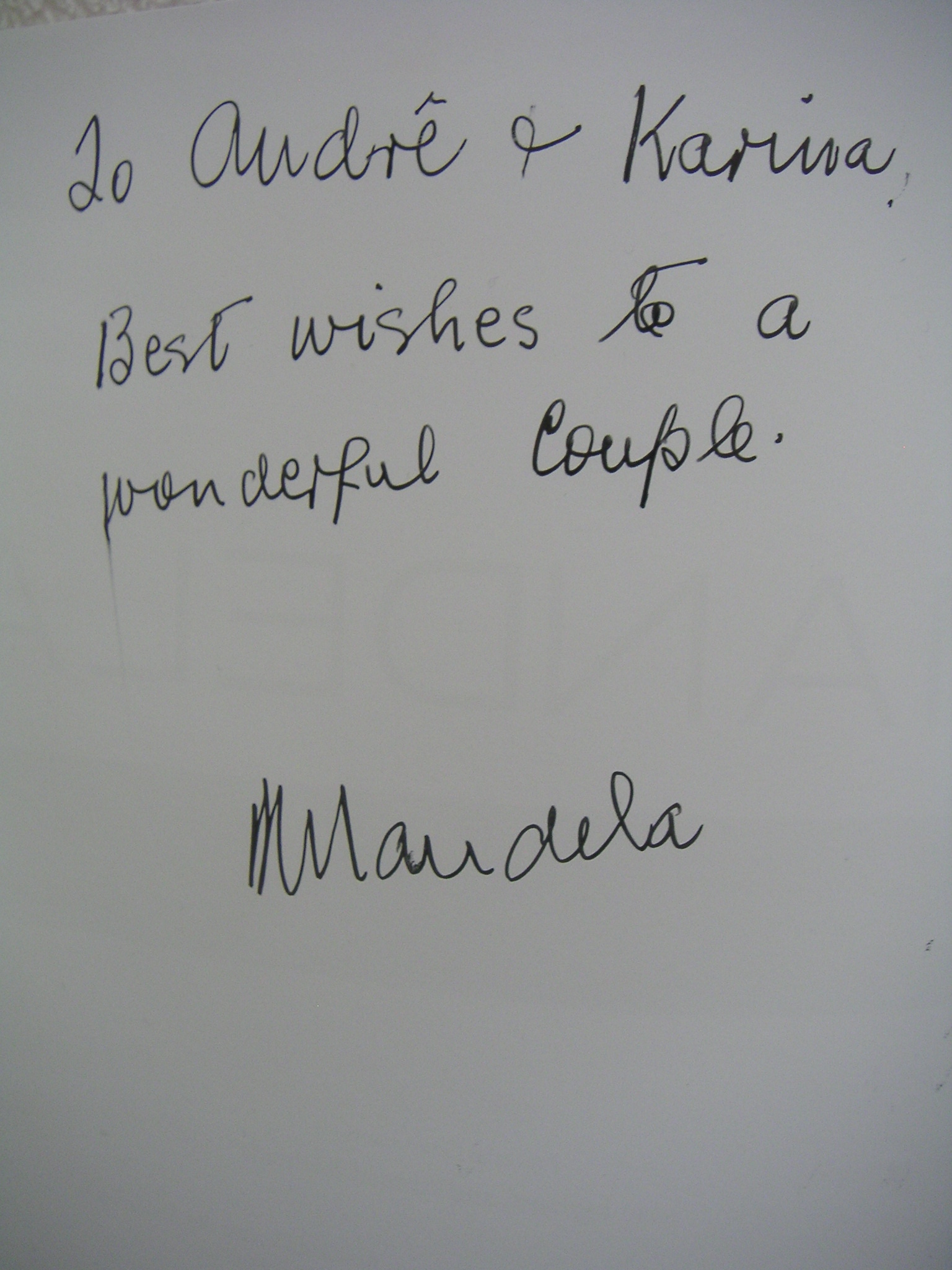
Because Madiba died on the 5th of December a year ago, the personal joy of this particular day will forever be infused with a deep sadness for us. His inscription in our copy of Mandela: The Authorized Portrait (2006) will, however, always feel like a blessing.
Mandela the Authorized Portrait

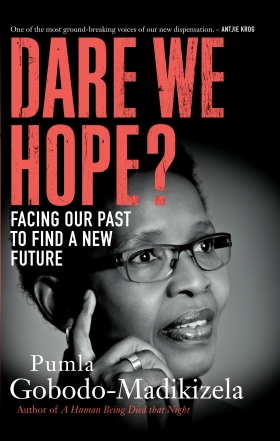
Review: Dare We Hope? Facing Our Past to Find a New Future by by Pumla Gobodo-Madikizela

Dare We HopePumla Gobodo-Madikizela’s collection of articles published between 1995 and 2014 offers a fascinating glimpse into the main issues plaguing contemporary South Africa. A professor in psychology, Gobodo-Madikizela was deeply involved in the proceedings of the TRC and wrote the award-winning A Human Being Died that Night, one of the most relevant and haunting books of recent years. It tells the story of her interaction with Eugene de Kock, the apartheid assassin known as Prime Evil.

Gobodo-Madikizela is a leading authority in research on trauma, memory and forgiveness. Many articles in Dare We Hope? focus on remembrance and reconciliation as relating to race, gender and power. Gobodo-Madikizela puts her finger on the insidious everyday ways we work against a common future by “attacking one another…in private and in public”.

Having recognised the seeds of discontent being sown and germinating in our society, Gobodo-Madikizela warns against the next revolution, “one in which the masses rise against a new breed of beneficiaries of privilege.” The “never-ending cycle of nothingness” that is poverty and lack of aspiration “strips away the humanity of individuals.” Unless we can create opportunities for people to lead meaningful lives, we will have no future as a society.

A large section of the book is devoted to dilemmas of leadership and morality. It is an incisive analysis of the “terrible shame”, the “moral rot” of the Zuma years and the terrifying legacy they are threatening to leave behind: “From the beginning, Zuma’s presidency was destined to corrupt the soul of the country.”

Gobodo-Madikizela identifies what is “missing in our democracy”: “a spirit of human solidarity that transcends the commitment to membership of one’s racial group or political party.” Her plea is for a shared humanity, for the understanding and acceptance of our diverse grievances, traumas and complicities, and, crucially, for the triumph of moral responsibility.

The articles in this book repeatedly call for dialogue: “Listening to one another and acknowledging the experience of loss on both sides would be a start.” It is a call for the employment of that wonderful faculty we all have in common: our imagination. It is also a call for moving beyond denial and revenge into a space where guilt can be articulated and forgiveness becomes a lived reality.

Dare We Hope? is an extremely sobering read. Gobodo-Madikizela is under no illusion that what she is narrating is anything but “a gruesome tale”. However, her voice is one of wisdom and, despite all, deep-seeded hope. To ignore her insights and not to heed her warnings could prove detrimental not only to individuals but to society at large. This collection is a much needed reminder that South Africa is in a dire need of more dissenting voices and, even more importantly, true leaders who can lead by example. Gobodo-Madikizela’s vision is a vital contribution in both respects.

Dare we hope? Perhaps. One thing is for certain; a lot of work needs to be done to rekindle the spark of an earlier promise.

Dare We Hope? Facing Our Past to Find a New Future
by Pumla Gobodo-Madikizela
Tafelberg, 2014

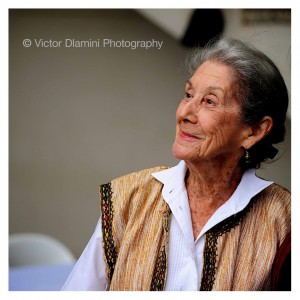
Nadine Gordimer – born on 20 November 1923

Photo by Victor Dlamini

Photo by Victor Dlamini

Today would have been Nadine Gordimer’s 91st birthday.

A tribute to Nadine Gordimer:

Nadine Gordimer changed my life. One of her short stories triggered my interest in South African literature. Her other short stories inspired me to write my own. She was an incisive essayist with the power to enrich our understanding of the world. I learned so much about literature, the human heart, South Africa and beyond through her writing. None to Accompany Me helped me figure out what kind of woman I wanted to be. I spent six intense years reading Gordimer’s work and its criticism for my doctoral thesis and I did not regret my choice of topic for a single day. I return to her work with eagerness and pleasure since then.

An interview with Nadine Gordimer on the occasion of her 88th birthday (2011):

Still in Gordimer’s lounge, I dare ask a personal question.

‘What makes you really happy?’

A short silence; my heart stops.

‘André would say chocolate,’ I volunteer out of desperation.

‘Well, that’s an evasive answer… I’m also very fond of black chocolate, but of course that’s a taste happiness.’

Another pause.

‘I have been unbelievably lucky by having forty-eight years with the love of my life, and I have that to treasure. Sometimes it is painful to do so, but other times…it’s there, I had it.’

Her life and work continue to inspire. She is missed.

Review: Tales of the Metric System by Imraan Coovadia

Tales“…for me, Tales of the Metric System is by far his most accomplished. It is definitely one of the most profound fictional takes on South Africa’s transition from the horrors of the apartheid era to the uncertainties of the present. Spanning four decades between 1970 and 2010, the novel captures the spirit of all crucial historic moments of the period by focusing on the lives of a few people, real and imagined, whose stories are intricately interlinked.”

Read the entire review on LitNet.

Tales of the Metric System by Imraan Coovadia
Umuzi, 2014

The official book trailer:

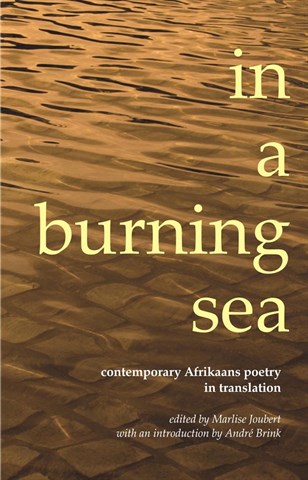
Review: in a burning sea – Contemporary Afrikaans Poetry in Translation edited by Marlise Joubert

in a burning seaMy Afrikaans is sufficient enough to follow everyday conversations, watch Afrikaans soapies and read Die Burger. But ever since hearing Antjie Krog read in her deep, melodic voice from her impressive oeuvre in Afrikaans I have wanted to understand more than just basics. Until that moment arrives, only translations allow me to savour some of the riches of Afrikaans writing. In poetry, these are not easy to come by. Of the few available in recent years in English, Krog’s Body Bereft (2006), Ingrid Jonker’s Black Butterflies (2007) and Wilma Stockenströrm’s The Wisdom of Water (2007) in particular belong to my all-time favourites.

in a burning sea is thus a highly anticipated publication which will hopefully pave the way for more translations. Altogether the anthology features thirty contemporary Afrikaans poets. Alphabetically arranged by authors’ names, the collection takes its title from a poem by Breyten Breytenbach, one of only a handful widely translated practitioners of the craft: “how often were we here / where only silver shadows stir / only through you I had to deny myself / through you alone I knew I had no harbour / in a burning sea”.

The editor Marlise Joubert, author of seven volumes of poetry herself and editor of four Versindaba anthologies (a publication inspired by the annual poetry festival by the same name), asked established poets and newcomers (but with at least two published volumes to their name) to submit ten poems from which a selection was then made for the book.

Among those included are the exciting young voices of Ronelda S. Kamfer (“the bullet nestled in his throat / his mother did not cry / the politicians planted a small tree / and the Cape Doctor tore it out / and flung it where the rest of the Cape Flats dreams lie – // on the flats”), Danie Marais (“On seconds thoughts, Stellenbosch, / you are a violated classic – / a bergie with an 1840s gable / for a hat…”), Carina Stander (“in the weak sunlight / filtering into the kitchen / mothers like calabashes / nattered on knitted goatskin”), and Loftus Marais (“and when i have to stand before Him / i’ll curtsy effeminately / and carefully explain to Him / that my catsuit / (folded in the suitcase next to the vanity case) / is fire resistant” – from The Second Coming) who hold more than their own along such greats as Breytenbach, Krog, Stockenström, Petra Müller, T.T. Cloete or Marlene van Niekerk.

Top translators of the likes of Michiel Heyns, often in collaboration with the poets, and the authors themselves made the work available in English. Hardly ever was I aware of reading translations, the Afrikaans poems feeling very much at home in their new incarnations. The originals are presented alongside the English for parallel reading.

André Brink’s introduction gives a short historical overview of Afrikaans poetry and its various trends, placing the selection in context. Most poems included are very recent, with a few exceptions dating back as far as M.M. Walter’s Apocrypha XII (1969): “When Eve clad herself amidst the grove of figs / in fashions by the heavenly Hartnell –”. Some poems had not been published at the time of submission, including Marlene van Niekerk’s eulogy Hamba kakuhle, Madiba.

What strikes one immediately when reading the anthology is how well local flavours mix with global traditions. The anthology opens with a landscape poem by Zandra Bezuidenhout about the last days of summer in the Midi: “the night is balmy with bonhomie / and aromas linger like tongues”. Bezuidenhout’s other poems are steeped in an irresistible sensuality whether she describes the sharing of a fig (“and offer the plum-red sweetness / as token of our bonded state”) or an exhibition by Marlene Dumas (“how transparent the nipple-bud / bleeding in berry-red passion”).

Universal themes are presented along concerns closer to home such as in Martjie Bosman’s Scorched Earth (From Ouma Makkie’s stroke-stricken mouth I inherit / two bitter words: insult and scorn / and the mournful knowing that generations / settled this family land in vain”), or Daniel Hugo’s in memoriam poem to Ingrid Jonker, Escape (“I love walking – drunk on ozone – / up to Three Anchor Bay…everywhere sewage smells / algae, seal vertebrae, mussel shells / a clotted, stinking ink-fish / and – stone-cold sober – you see / at times a poet’s body”), or Krog’s colonialism of a special kind (“people are made ashamed that they have forgiven // because at the deepest level / we respect anger / understand hate / admire revenge”).

in a burning sea gives one an enticing taste of what is happening in Afrikaans poetry at this point in literary history. Not all the poems selected take one’s breath away, but they definitely put one in a mood for more.

in a burning sea: Contemporary Afrikaans Poetry in Translation
edited by Marlise Joubert
Protea Book House, 2014

An edited version of this review was published in the Cape Times on 14 November 2014.

Book mark: The Lullaby of Polish Girls by Dagmara Dominczyk

LullabyAnna’s family emigrates in the 1980s before the changeover in Poland and settles in New York. Missing her roots and extended family, every summer Anna returns to Poland on her own and spends the holidays in her old neighbourhood where she befriends Justyna and Kamila. Together, they survive the ups and downs of puberty: jealousies, hang-ups about their developing bodies, the turbulences of first loves, budding sexualities and substance abuse. Some things go horribly wrong and one day Anna refuses to come back for another visit. Years later, another tragedy brings the three friends together again. Poland is undergoing its own transition while the young women face the new reality and try to pick up the pieces of their broken dreams. The Lullaby of Polish Girls is a fast-paced story of growing up in a migratory world.

The Lullaby of Polish Girls
by Dagmara Dominczyk
Quercus, 2013

An edited version of this book mark first published in the Cape Times on 14 November 2014.

Dagmara_DominczyckDagmara Dominczyk is a Polish-American actress who has appeared in the film The Count of Monte Cristo, as well as several Broadway and TV productions. She majored in Drama at Carnegie Mellon University and graduated in 1998. She is married to the actor Patrick Wilson and they live with their children in New Jersey, USA.