 Dene Smuts once said that “there are two approaches to opposition lawmaking work: making a noise and making a difference.” Throughout her courageous life she chose to make a difference. Smuts completed the manuscript of Patriots and Parasites: South Africa and the Struggle to Evade History shortly before her unexpected death in April last year. Her daughter Julia midwifed the project to completion.
In the Festschrift included at the end of the book, Jeremy Gauntlett notes Smuts’s “portable spine” which she lent out “often to many weaker people.” Before entering politics, she took a stance against censorship as a journalist and editor of Fair Lady. She resigned from the magazine in protest when her editorial independence was threatened over a story she ran about Winnie Mandela. She insisted on “readers’ right to know”. The longest-serving female parliamentarian, the first female chief whip, a lawmaker renowned for her work on the Constitution, Smuts was central to the birth of the new South Africa. She understood the importance of “cultivating the garden” that is our country.
The memoir is not a blow by blow account of Smuts’s private life. But when you read closely, the person who emerges from between the lines is a remarkable, inspiring human being who led by example. The book is testimony to her brilliant mind and fierce integrity. You might not always agree with what she has to say, but you never doubt that her heart is in the right place. She is unflinching in her analysis of contemporary socio-political developments and does not hesitate to call a spade a spade, or to mention when she is “incandescent with anger”.
There is no pussyfooting around burning issues of racism, polarisation, affirmative action, corruption, or reconciliation: “Just as apartheid was triggered by fanning the embers of cultural resentment of colonialism into the fire of Afrikaner nationalism, Thabo Mbeki brought out the bellows to reignite black resentment against white rule, both colonial and Afrikaner nationalist, when both had become history.” It is just another example of the ancient adage that we do not learn from history. And if anything, South Africa is one of the best embodiments of the effectiveness of the well-known policy: divide and rule (or conquer).
This is not the time to look for differences when common causes have to be addressed in order for the country to thrive as a whole, and Smuts’s incisive scrutiny of Mbeki’s legacy and the present government’s “misrule” points to the pitfalls we are facing. Only if we can all feel that we are “contributing to a new country”, will we be able to feel “at home”. Smuts recalls Jakes Gerwel’s words: “we had created the institutional mechanisms to deal with” the “remnants of the racist past”; “we should build on the positive foundations of transition and the Constitutional order to develop the non-racial reality already emerging.”
Patriots and Parasites is a passionate account of the importance of free speech, which Smuts championed in all her incarnations, whether as journalist or legislator. She points out the dangers of political correctness if allowed to stultify vigorous and necessary debate. Dialogue is pertinent to a healthy democracy. Communication consists as much of voicing concerns as listening. Smuts reminds of the occasion when in 1985 Ellen Kuzwayo was asked by white fellow women writers what they could do to help the cause: “All you can do is listen, listen.” Smuts herself kept her ear close to the ground as she knew the power of informed decision-making.
She gives compelling insight into the nitty-gritty of law-making, taking us back in time to the transition and recalling the turning points in history that made political change possible. The forces at play in the writing and implementing of the 1994 Interim Constitution and the 1996 Constitution are recorded in fascinating detail. Smuts remembers Kader Asmal acknowledging that “probably never before in history has such a high proportion of women been involved in writing a constitution.”
At the core of Patriots and Parasites is the knowledge that this is just one account of the palimpsest that is history. Other stories have to be told: “If the question is whether South Africa can evade history, then we need, at least, to hold up as true a record as possible of that history. The best way of doing so where records are not available, or are as contested … is to give as many accounts of what occurred as possible. This memoir is one such contribution to our recent history.” We owe it to ourselves to nurture and study these testimonies; not to allow recorded history to fall “into disarray, or decay”. Looking back, Smuts warns against apathy towards diverse manifestations of evil. Otherwise, as the reality around us shows over and over again, we will be “doomed to inhabit a world of false narratives”.
Smuts writes that “all we have to defeat this time, however hopeless it may sometimes look, is misrule and the erosion of everything we have already achieved”, and ends on an optimistic note: “It will be easier, this time.”
Patriots and Parasites: South Africa and the Struggle to Evade History
by Dene Smuts
Quivertree, 2016
Review first published in the Cape Times, 17 February 2017.
 In November 2017, the “coup that was not a coup” in Zimbabwe held the world’s attention as the seemingly impossible became reality: after decades of rule, Robert Mugabe was ousted from power. These Bones Will Rise Again by Zimbabwean-born journalist and novelist, Panashe Chigumadzi, is an incisive exploration of these events and the author’s personal response to the historical moment as it unfolds as well as the past that shaped it: “The struggles over history are complex, because the present continuously slips into the past, marking history as always ambivalent, incomplete, a work in progress.”
 A few years ago, after the death of his wife, Jolyon Nuttall joined his daughter and her family during a work visit at Harvard University in Cambridge, Massachusetts, in the United States. There, in a bookshop, he rediscovered the essay as a literary form and specifically fell under the spell of George Orwell’s essayistic endeavours. A newspaper man through and through, Nuttall has made a life out of words, as a journalist and a media manager. Retired now, he decided to turn to “episodes in my life that stand out in memory” and explore his past through the medium of the essay.
 Mohale Mashigo is a well-known musician who debuted two years ago as an author with the best-selling and award-wining novel, The Yearning. Since then, she has adapted a movie for a young adult novel, Beyond the River, and co-written comic books for the Kwezi series. Intruders is her first short story collection.
 Written over many years, the short stories included in Ahmed Ismail Yusuf’s debut collection have a mythical quality to them and tell a tale of a people searching to find peace in a time of turmoil. Yusuf grew up as a nomad in his native Somalia and relocated to the United States where he still lives and where he discovered his love for books and storytelling.
 Lara Feigel is a cultural historian and a literary critic, combining her interests to write about the meeting point between life, literature and history. In her last two books, she looks at how people whose quintessential purpose in life is the search for beauty and meaning survived their antithesis: war. In her The Love-charms of Bombs: Restless Lives in the Second World War (2013), Feigel wrote about five authors who were based in wartime London, driving ambulances, fighting fires, being creative, and loving passionately while desperately trying to remain alive.
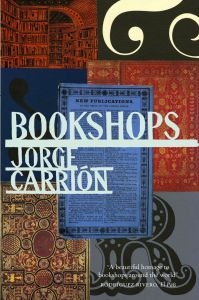 There are times when people proclaim either the death of reading, or the death of the book as a physical object, or the death of bookshops, and no matter how much sceptics try to kill off one of the most engaging and enriching human experiences, it prevails and with it does the book and its private and public homes: bookshops and libraries. As any passionate reader will verify, bookshops can be oases of literary bliss. Jorge Carrión travelled around the world to visit many of them and wrote a fervent reminder of why they matter: “Every bookshop is a condensed version of the world.” South African readers will delight in the mention of local authors and favourites places such as the
  “Who would want to read them?” we are asked at the back of Marike Beyers’s poetry collection, How to Open the Door. The answer is as easy as it is true: “Anyone interested in the recent inflection of various Englishes and … inflections of the ‘soul’.” In deceptively simple words Beyers captures complex memories of family scenes and relationship dynamics, stretching across time and space. There is loss, tenderness and pain: “here I am all razor blades / and concrete rubble / all corners sharp”. She is just as aware of language as of silence: “but there you stood / your mouth of broken birds”. There are people who live “outside of words”, but not the poet; “is it all too simple / is home then / this standing // in an open door”, she asks, and invites us to follow into the space of her poetic vision.
 The image on the cover of Prunings, Helen Moffett’s second collection of poetry, is an exquisite unfinished painting of a broom karee branch. The poems in the slim chapbook are similarly delicate and unusually fragmented. Together with her editor and founder of uHlanga Press, Nick Mulgrew, Moffett decided to display the editorial process of pruning the individual pieces, but also entire poems which were cut from the volume and yet are still included in square brackets with horizontal lines struck through them. It is work in progress on show. The final effect of this innovative collaboration is one of wonder. What is supposedly excluded is as powerful as what remains:
 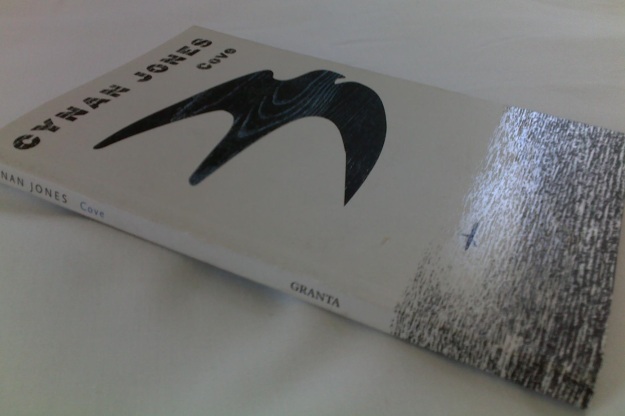 I was born in Poland, but as a student I used to live in Wales. About two years ago, I read a glowing review of Everything I Found on the Beach by the young Welsh writer Cynan Jones. The reviewer mentioned that the novel featured a Polish character. A Welsh novel with a Polish character was an irresistible combination for a reader with my literary background. I ordered and devoured it, and since then I have read every other novel or novella I could get hold of by the same author: The Long Dry, The Dig, and the latest, Cove.
 Karina Magdalena