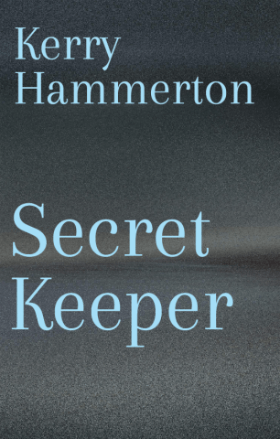
 Secret Keeper
Kerry Hammerton
Modjaji, 2018
To read the entire review, click here: LitNet
[…]
The keeper of the titular poem tends to secrets as others tend to bees. Like the insects, the secrets always return, “hairy bodies crammed into my mouth” wanting to escape (“The secret keeper”).
The last part of this captivating book, not unlike life itself, consists of poems of loss and grief. Here, too, there is a before and after, and once again it is impossible to imagine how “to get to the other side” (“This year”) when a loved one, the father, dies. The mourning child states: “I am better at my other life,/ where no-one is dead,/ where sadness doesn’t press/ its cold weight into my sternum/ creep along my clavicle, breathe into my spine” (“My other life”).
In Secret keeper, Hammerton manages to capture the essentials of most adult lives – love, loss, loneliness, anxiety, ageing and death – and leaves us pondering our own mortality, and that deep longing not to feel our insignificance “at night” when we are all alone under the “black sky, stars,/ the milky way”.
[…]
To read the entire review, click here: LitNet


 It has been a while since I’ve read, edited or contributed to an anthology of theoretical essays on South African literature. But, occasionally, I still have academic longings; therefore, I approached
 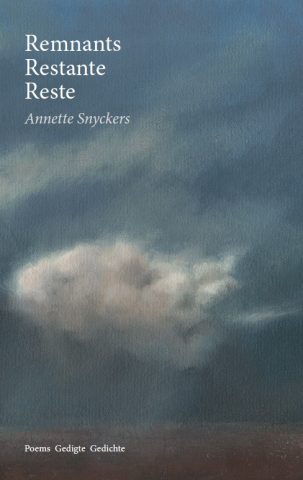 It isn’t often that you can delight in a poetry collection in three languages, but Annette Snyckers’s debut Remnants Restante Reste invites you to do precisely that. Writing in English, Afrikaans and German, Snyckers explores the possibilities of translation and creative expansion. Not all the poems included are presented in all three languages, but the ones that are add a magical layer to the poetry as the individual manifestations enhance and augment one another. The author notes: “Where a poem appears in more than one language, the first version is not necessarily the original version. Poems were written in different languages as I felt the need to write them, and all subsequent translations were done by me.” I feel fortunate to be able to enjoy all three versions in meaningful ways, but even if one of them eludes you, the remaining offerings in the collection are rich enough to suffice for a satisfying read…
 “Biography lovers may despair that the internet is making it improbable that biographers will still discover old, forgotten letters in dusty attics, revealing juicy secrets about celebrities. It still remains a problem when writers discard electronic records of their correspondence, but this book proves that emails can be every bit as romantic as old-fashioned letters, and all the more immediate.”
 The overwhelming impression I had while reading Abner Nyamende’s There’s always tomorrow was that the novel had not been edited properly, if at all. It began with the first page, where the word “darkness” features six times without apparent reason. And the unnecessary repetitions are only the tip of the iceberg. After finishing, out of curiosity I looked up Partridge, the publishing house, and was informed that, although backed by a giant international trade publisher, the company provides only self-publishing services to their authors. Editing seems to be part of the professional packages on offer, but I cannot imagine that it was employed in this particular case. In this regard I was appalled at the quality of the final product, and it is a pity, because the book has an important story to tell. If the author did pay for editing of any kind, he was cheated…
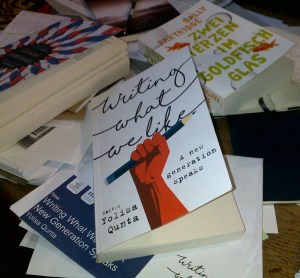 For a white person, reading Writing What We Like: A New Generation Speaks might feel like gatecrashing a party where some ugly truths will be revealed about you. Provocative and penetrating, Writing What We Like is a difficult book to review when you happen to be white, because one feels that one should not be talking at all, but listening only. One is torn between possible accusations of one’s own “intellectual arrogance” and the need for dialogue. And yet, a way to disrupt entrenched ways of thinking and to establish connections across barriers imposed on us by a turbulent and harrowing history is to try to imagine ourselves into the skins of others. That is where creativity and empathy begin – in writing, reading and interpretation – where we cease to view ourselves in any other categories but human. The ultimate goal is understanding, coupled with compassion. Everything else will follow from there.
 Karina Magdalena