
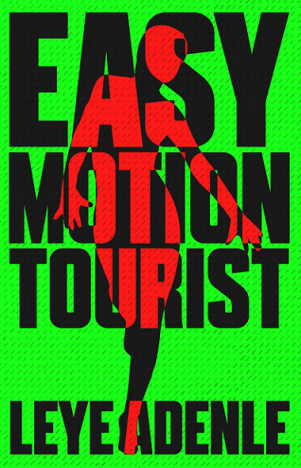
 “She knew these girls, these women. She understood their world. For them, prostitution was not a choice; it was a lack of choice.” Amaka, a gutsy lawyer trying to protect the sex workers of Lagos, knows that most of them will never get off the streets. Leye Adenle’s thriller Easy Motion Tourist is their story.
All Amaka wants is that the women in her care stay as safe as possible under the circumstances. Sometimes keeping them simply alive is as much as she can hope for. She establishes a secret network of contacts and a database of details on clients who pay for sex. The women Amaka works with can phone in and keep tabs on each other’s movements. Then, one day, one of the prostitutes turns up mutilated and dead in front of a bar where Guy, a British journalist, is trying against better judgement to appease his curiosity about local nightlife: “I was a white boy in Africa for the first time, on assignment to cover a presidential election that was still weeks away, the outcome of which was a foregone conclusion. This was only my second day in Lagos and the first night I’d gone out alone – exactly what I’d been advised not to do.”
Witness to the body-dump, Guy is arrested for questioning and rescued by Amaka at the police station where he see another gruesome murder of a suspect in police custody and has to fear the worst for himself. Together with the streetwise and brave Amaka, he embarks on a mission to find out who is behind the horrific killing of the prostitute, but he is completely out of his depth. He pretends to work for the BBC but is actually a reporter for a start-up internet TV news channel.
Guy decides to write about what he had witnessed, suspecting like everyone else that the murder was one of many ritual killings. “Every time there is an election we find dead bodies everywhere,” he is told; people are “doing juju to win elections”. During the investigation Guy begins to fall for Amaka, but is unsure whether she returns his feelings.
The story of the murder is reported on CNN, causing a lot of unease among the Lagos elites. Pressure is put on police inspector Ibrahim to solve the case and to protect the affluent from the ensuing chaos. A lot seems to be at stake, but no one truly knows what is happening behind the scenes and who is the mysterious Malik. Is he running the show? Is someone killing these women for witchcraft or illegal organ trade?
From luxurious hotel rooms to the gutters of Lagos, Easy Motion Tourist presents an uneasy, brutal metropolis where only the toughest survive: “a city of armed robbers, assassinations and now, it seemed, ‘ritualists’ had to be added to the list.” But among the ruthless violence and corruption there are rays of light, and Easy Motion Tourist offers an intriguing ending which might mean a promising sequel.
Easy Motion Tourist
by Leye Adenle
Cassava Republic Press, 2016
An edited version of this review appeared in the Cape Times on 10 March 2017.
 Lara Feigel is a cultural historian and a literary critic, combining her interests to write about the meeting point between life, literature and history. In her last two books, she looks at how people whose quintessential purpose in life is the search for beauty and meaning survived their antithesis: war. In her The Love-charms of Bombs: Restless Lives in the Second World War (2013), Feigel wrote about five authors who were based in wartime London, driving ambulances, fighting fires, being creative, and loving passionately while desperately trying to remain alive.
 Dene Smuts once said that “there are two approaches to opposition lawmaking work: making a noise and making a difference.” Throughout her courageous life she chose to make a difference. Smuts completed the manuscript of Patriots and Parasites: South Africa and the Struggle to Evade History shortly before her unexpected death in April last year. Her daughter Julia midwifed the project to completion.
 There are times when people proclaim either the death of reading, or the death of the book as a physical object, or the death of bookshops, and no matter how much sceptics try to kill off one of the most engaging and enriching human experiences, it prevails and with it does the book and its private and public homes: bookshops and libraries. As any passionate reader will verify, bookshops can be oases of literary bliss. Jorge Carrión travelled around the world to visit many of them and wrote a fervent reminder of why they matter: “Every bookshop is a condensed version of the world.” South African readers will delight in the mention of local authors and favourites places such as the
 “Who would want to read them?” we are asked at the back of Marike Beyers’s poetry collection, How to Open the Door. The answer is as easy as it is true: “Anyone interested in the recent inflection of various Englishes and … inflections of the ‘soul’.” In deceptively simple words Beyers captures complex memories of family scenes and relationship dynamics, stretching across time and space. There is loss, tenderness and pain: “here I am all razor blades / and concrete rubble / all corners sharp”. She is just as aware of language as of silence: “but there you stood / your mouth of broken birds”. There are people who live “outside of words”, but not the poet; “is it all too simple / is home then / this standing // in an open door”, she asks, and invites us to follow into the space of her poetic vision.
 The image on the cover of Prunings, Helen Moffett’s second collection of poetry, is an exquisite unfinished painting of a broom karee branch. The poems in the slim chapbook are similarly delicate and unusually fragmented. Together with her editor and founder of uHlanga Press, Nick Mulgrew, Moffett decided to display the editorial process of pruning the individual pieces, but also entire poems which were cut from the volume and yet are still included in square brackets with horizontal lines struck through them. It is work in progress on show. The final effect of this innovative collaboration is one of wonder. What is supposedly excluded is as powerful as what remains:
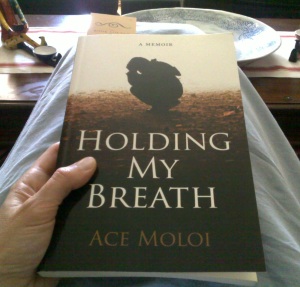 Holding My Breath by Ace Moloi is a heart-wrenching, deeply inspirational grief memoir. Written in the form of a letter addressed to Moloi’s late mother, it tells his story before and after his mother’s death. He writes in the Prologue to the book: “I have decided to break the silence between us. I am starting this conversation to remind you of your younger son and to update you on my life.” Moloi points out that mourning is like learning a new language – “the language of living without you.” His mother died of an unexplained illness when he was thirteen and left him and his older brother to fend for themselves. Their father was absent when they were growing up. The boys had to rely on other family members for support. They encountered abandonment, hunger and despair as the divided family was mostly incapable of caring for them.
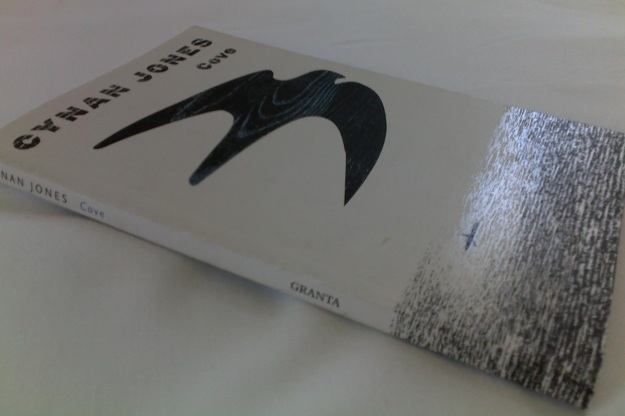 I was born in Poland, but as a student I used to live in Wales. About two years ago, I read a glowing review of Everything I Found on the Beach by the young Welsh writer Cynan Jones. The reviewer mentioned that the novel featured a Polish character. A Welsh novel with a Polish character was an irresistible combination for a reader with my literary background. I ordered and devoured it, and since then I have read every other novel or novella I could get hold of by the same author: The Long Dry, The Dig, and the latest, Cove.

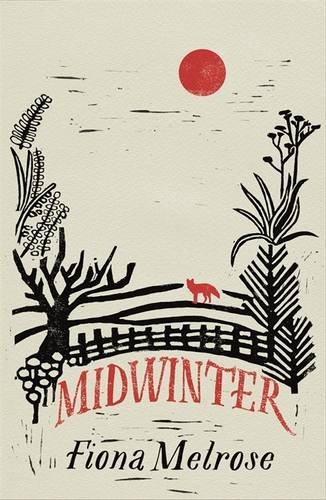 In an act of idiotic drunken bravery, two friends, Tom and Vale, steal a boat in a storm. The consequences for both of them are enormous. The incident lays bare a past supressed for a decade and a future which is just as heavy to carry. The laden, rain-drenched darkness of the night of the theft sets the tone for this atmospheric narrative. Fiona Melrose’s stunning debut novel Midwinter tells the story of loss, the way it breaks you down and the effort it takes to put together the shattered pieces.
 The author should also be commended for doing what much too often writers shy away from: writing entirely from a (gender) perspective which is not their own. At no time in the novel did I ever feel that I was not in the heads and hearts of a young man and his ageing father. Melrose uses first-person narrators for both to great effect: “For ten years I’d shirked the memories. I always felt them scratching at the darker corners of my mind, still feral; but sitting on a tree stump in the gathering dark, all of it – the space, the fear, the sorrow – all seemed to find me again.”

