
In the Acknowledgements of my novel, Invisible Others, I wrote: ‘My furry family, Glinka, Salieri and Mozart, true experts at life, keep trying to teach me how to make the most of it; I hope they will succeed one day.’ It is four years later, but no matter how desirable, being a cat is not an easy task. I might, however, be closer than ever. ‘Your immediate goal is to be a cat’, writes Jaron Lanier in the introduction to his Ten Arguments for Deleting Your Social Media Accounts Right Now (2018), a book that is, despite its title, ‘about how to be a cat.’
‘Cats have done the seemingly impossible: They’ve integrated themselves into the modern high-tech world without giving themselves up. They are still in charge. There is no worry that some stealthy meme crafted by an algorithm and paid for by a creepy, hidden oligarch has taken over your cat. No one has taken over your cat; not you, not anyone… Cats on the internet are our hopes and dreams for the future of people on the internet’, says Lanier. And he should know, not only as a Silicon Valley insider, but as someone who shares his life with cats – Loof, Potato, Tuno and Starlight – who taught Lanier ‘how not to be domesticated’.
Books, like cats, have the ability to change lives. I read Ten Arguments for Deleting Your Social Media Accounts Right Now over the festive season and it did exactly that: changed my life. I haven’t deleted the only social media account I have (yet?); that, too, is ‘part of your prerogative, being a cat’, as Lanier emphasises. But I did decide to change the way I interact with social media.
The problem with social media that Lanier identifies – ‘relentless, robotic, ultimately meaningless behaviour modification in the service of unseen manipulators and uncaring algorithms’ – is, of course, something that many of us have been aware of for quite a while. But it was ultimately his book that encouraged me to do something against it in my own private capacity. I am tired of the exploitative, manipulative, addictive, artificial, often toxic and aggressive, nature of social media. It seems that no matter how much you try to curate your experience, there is no way of avoiding all the negative side effects of engaging with the diverse platforms. There are just so many accounts that you can block without feeling that you are totally wasting your time and could invest it in something much more creative and positive, something that perhaps you yourself – and not some ruthless, greedy company – can profit from, if not exactly financially, then definitely intellectually and emotionally. It’s time to ‘detach from the behaviour-modification empires for a while’, as Lanier says.
‘Go to where you are kindest,’ he suggests, and it resonates with me deeply. Kindness is essential to my survival. It is kindness that has carried me to safety across the roughest storms of my life, and there have been way too many in recent years. I want kindness and calm in my life, and cats and books. That is what makes me happy, what makes life worthwhile for me.
What has changed? Nothing drastic. I stopped tweeting on 31 December. Mid-January, I am still missing it sometimes (it is addictive, after all), especially the interaction with friends and followers I truly care about but, mostly, I feel a lot of relief. I still look at notifications every now and then and acknowledge the ones which I would have in the past, and I use DMs to communicate with a few people, but I completely ignore my timeline. Many social media accounts are of interest to me, but I look at them directly when I feel like it. Basically, I shifted from an active participant to a passive observer. I want to give it a few months to see how I will feel about it all later in the year.
It is amazing how much time I save every day by not engaging with social media. And I decided to use that time for creativity. As Lanier says, the internet is not the problem, the problem is how we use it and how it is being used against us. Producing and sharing creative content about topics I am passionate about, that I or others can also profit from – directly or indirectly (from the exchange of ideas or book sales, for example) – feels right. It is crucial to consider, in Lanier’s words, ‘sustainable, dignified business models’ where a transaction between two parties does not have to go through a third one ‘who is paying to manipulate them.’ Lanier asks for social media that he can pay for, and where he can ‘unambiguously own and set the price for using my data, and it’s easy and normal to earn money if my data is valuable.’ I like that idea very much.
Lanier asks, ‘What if listening to an inner voice or heeding a passion for ethics or beauty were to lead to more important work in the long term, even if it measured as less successful in the moment? What if deeply reaching a small number of people matters more than reaching everybody with nothing?’
What if? Indeed.
I upgraded my blog, so that it does not feature any ads I cannot control; I love the new, clean look which is focused on my – personally chosen – content. The costs involved were minimal in comparison to the benefits.
I decided to choose my online news and entertainment sources directly and to pay for content I find valuable. Well-researched, -considered, -written and -presented content costs money to produce and I want its creators to be well-paid for their intellectual and creative work. Quality, not quantity – that’s what I seek.
The word ‘content’ itself deserves more attention. I find it problematic, but that’s a thought that needs further consideration.
I love paper and never read e-books if I can help it. Reading print media of diverse nature during the festive season made me remember how good it feels to lie next to the pool and turn the pages of an informative, fun magazine. I want more of that in my life again, too.
There is a wonderful passage about writing in Ten Arguments for Deleting Your Social Media Accounts Right Now. It turns a premise writers live by on its head: ‘You can’t read well until you can write at least a little’, claims the author, and continues, ‘The reason we teach writing to students is not in the hopes that they’ll become professional writers… Instead, we hope they’ll learn what it means to write, and to think, which will make them more thoughtful when they read.’ And he adds, challenging us: ‘You can’t use the internet well until you’ve confronted it on your own terms, at least for a while. This is for your integrity, not just for saving the world.’
Integrity, like kindness, deserves to be cultivated with the utmost care.
Finally, I find Lanier’s description of certain questions as ‘tender’ beautiful. Let’s ask more of those ‘tender questions’ together.
‘Empathy is the fuel that runs a decent society.’
— Jaron Lanier
(PS I tweeted the link to this post and pinned it to my timeline as a way of explaining my disappearance from Twitter; my friends have been asking whether everything was all right. It is. Thank you for caring!)

 Lara Feigel is a cultural historian and a literary critic, combining her interests to write about the meeting point between life, literature and history. In her last two books, she looks at how people whose quintessential purpose in life is the search for beauty and meaning survived their antithesis: war. In her The Love-charms of Bombs: Restless Lives in the Second World War (2013), Feigel wrote about five authors who were based in wartime London, driving ambulances, fighting fires, being creative, and loving passionately while desperately trying to remain alive.
 Dene Smuts once said that “there are two approaches to opposition lawmaking work: making a noise and making a difference.” Throughout her courageous life she chose to make a difference. Smuts completed the manuscript of Patriots and Parasites: South Africa and the Struggle to Evade History shortly before her unexpected death in April last year. Her daughter Julia midwifed the project to completion.
 There are times when people proclaim either the death of reading, or the death of the book as a physical object, or the death of bookshops, and no matter how much sceptics try to kill off one of the most engaging and enriching human experiences, it prevails and with it does the book and its private and public homes: bookshops and libraries. As any passionate reader will verify, bookshops can be oases of literary bliss. Jorge Carrión travelled around the world to visit many of them and wrote a fervent reminder of why they matter: “Every bookshop is a condensed version of the world.” South African readers will delight in the mention of local authors and favourites places such as the
  “Who would want to read them?” we are asked at the back of Marike Beyers’s poetry collection, How to Open the Door. The answer is as easy as it is true: “Anyone interested in the recent inflection of various Englishes and … inflections of the ‘soul’.” In deceptively simple words Beyers captures complex memories of family scenes and relationship dynamics, stretching across time and space. There is loss, tenderness and pain: “here I am all razor blades / and concrete rubble / all corners sharp”. She is just as aware of language as of silence: “but there you stood / your mouth of broken birds”. There are people who live “outside of words”, but not the poet; “is it all too simple / is home then / this standing // in an open door”, she asks, and invites us to follow into the space of her poetic vision.
 The image on the cover of Prunings, Helen Moffett’s second collection of poetry, is an exquisite unfinished painting of a broom karee branch. The poems in the slim chapbook are similarly delicate and unusually fragmented. Together with her editor and founder of uHlanga Press, Nick Mulgrew, Moffett decided to display the editorial process of pruning the individual pieces, but also entire poems which were cut from the volume and yet are still included in square brackets with horizontal lines struck through them. It is work in progress on show. The final effect of this innovative collaboration is one of wonder. What is supposedly excluded is as powerful as what remains:
 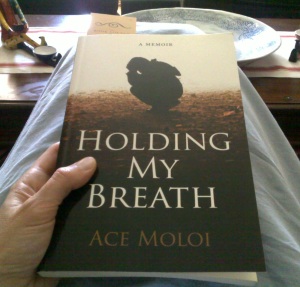 Holding My Breath by Ace Moloi is a heart-wrenching, deeply inspirational grief memoir. Written in the form of a letter addressed to Moloi’s late mother, it tells his story before and after his mother’s death. He writes in the Prologue to the book: “I have decided to break the silence between us. I am starting this conversation to remind you of your younger son and to update you on my life.” Moloi points out that mourning is like learning a new language – “the language of living without you.” His mother died of an unexplained illness when he was thirteen and left him and his older brother to fend for themselves. Their father was absent when they were growing up. The boys had to rely on other family members for support. They encountered abandonment, hunger and despair as the divided family was mostly incapable of caring for them.
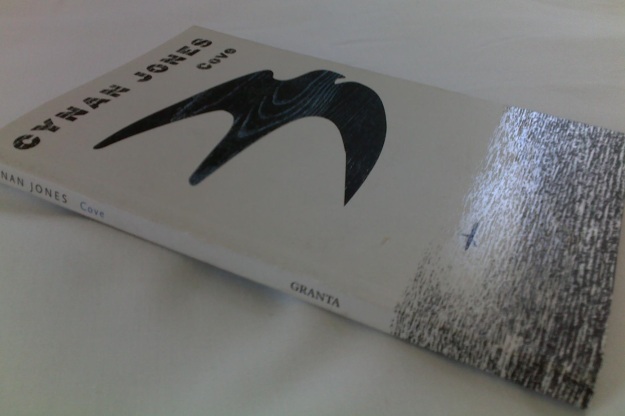 I was born in Poland, but as a student I used to live in Wales. About two years ago, I read a glowing review of Everything I Found on the Beach by the young Welsh writer Cynan Jones. The reviewer mentioned that the novel featured a Polish character. A Welsh novel with a Polish character was an irresistible combination for a reader with my literary background. I ordered and devoured it, and since then I have read every other novel or novella I could get hold of by the same author: The Long Dry, The Dig, and the latest, Cove.

