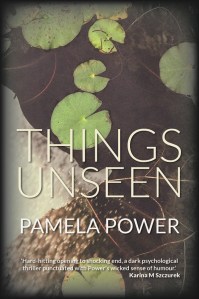
 Founded and headed by author Sarah McGregor, Clockwork Books is a new independent local publisher with a growing list of fascinating titles. Its latest release is Pamela Power’s second novel, Things Unseen, a psychological thriller set in the posh suburbs of Johannesburg. I first read it in manuscript form, and remember that I had to pause and take a deep breath after the shocking violence of the opening scene in which we witness the terrifying demise of a person and an animal. Let’s just say that the rest of the book is also not for sissies.
Not at first glance, but the following chapters are perhaps just as disturbing as the beginning. The novel attempts to describe the kind of violence which is nearly imperceptible to outsiders – emotional and psychological violence. We meet Emma and her husband Rick at their university reunion. Emma works for a local theatre company and she is friends with her boss Gay and her partner Sophie, a psychologist. Rick is an ambitious gynaecologist with a roving eye who treats Emma like a trophy, not a wife. She is aware of his numerous affairs, but turns a blind eye until she encounters Craig, her first big love, at the event. He is visiting from the UK where he’d settled many years ago. Faced with the question of what could have been, Emma begins to re-examine her life.
All is brought to an abrupt end the evening of the reunion when Emma, distressed about not being able to reach her mother nor their domestic worker Lizzie on their phones, abandons the alumni gathering and rushes back to discover her mother brutally murdered in their home, a mansion on a vast property meant for a large family with kids. Despite many attempts, Emma and Rick are childless. Their infertility is a source of great distress to Emma. The couple drifts further apart during the murder investigation and the tensions between them escalate upon the arrival of Ross, Emma’s troubled brother who lives in Australia. Emma is convinced that the main suspect in their mother’s murder – their gardener who is missing – could not be responsible for the gruesome deed although most clues point to the contrary. When her mother’s lawyer explains the unexpected wishes of the dead woman to her family, everyone is taken by surprise. And then Emma encounters a sickly sweet smell in their garden and the events of the night of the murder take on another evil twist.
Craig, a former policeman turned security expert, assists Emma in her search for truth. She refuses to look at the facts alone when her gut feeling tells her that they simply do not make sense. Craig trusts her intuition and applies his investigative skills to help her. Everything becomes even more complicated when they rediscovers their long-buried feelings for each other and begin falling in love again.
The main narrative is interspersed with a sequence of dark images from the past which gradually reveal the portrayal of the horrendous abuse of a child. It is clear that the child grew up to be one of the protagonists, an innocent victim turned ruthless perpetrator, but Power keeps the plot cards close to her chest and has the reader guessing who did what until the spectacular showdown at the very end.
Things Unseen is a fast-paced, haunting thriller which addresses our most intimate fears of invasions and violations in the context of present-day crime realities of the country, but also free of the socio-political context. What Emma and her family members experience could happen to anyone anywhere in the world. The challenges of the betrayals and losses she faces in her marriage will be known to many women, independent of race and class. The madness of grief and the inability to make sane choices when you are in its grips are part of the story. And Johannesburg, with all its social woes, is very much a character in the novel. Readers will recognise the everyday realities of the upper-middle-classes – the glamour and the horror of the rich and beautiful – but these form only part of the narrative drive, not a closer study of the underlying societal struggles.
Power is a scriptwriter and editor. Her dialogues are vivid, her characters are recognisable, and feel real. She has a wicked sense of humour which shines through despite the sombre themes. At the heart of her novel is a love story, a woman’s quest to reclaim and follow her dreams despite the horrific circumstances she finds herself in. Emma is surrounded by a tightly knit group of friends who help her to pull through and pursue her own path towards fulfilment. The characters grow on one as the story progresses and one can only hope for a sequel.
Things Unseen will appeal to readers who like to get lost in a good yarn. I can imagine that many will want to finish it in one sitting, so perhaps start reading when you have a nice pot of tea or a glass of wine ready on standby and know that, if you wish, you can disappear for a few hours into the world of Things Unseen.
Things Unseen
by Pamela Power
Clockwork Books, 2016
 The overwhelming impression I had while reading Abner Nyamende’s There’s always tomorrow was that the novel had not been edited properly, if at all. It began with the first page, where the word “darkness” features six times without apparent reason. And the unnecessary repetitions are only the tip of the iceberg. After finishing, out of curiosity I looked up Partridge, the publishing house, and was informed that, although backed by a giant international trade publisher, the company provides only self-publishing services to their authors. Editing seems to be part of the professional packages on offer, but I cannot imagine that it was employed in this particular case. In this regard I was appalled at the quality of the final product, and it is a pity, because the book has an important story to tell. If the author did pay for editing of any kind, he was cheated…
 Travelling in India, Karen Jennings visits an art gallery where “holograms of rare gold artefacts line the wall. A notice declares that precious items might be stolen and so holograms are the next best thing. They are fuzzy, unclear. It is like looking at an object at the bottom of a dirty pond.” It is a striking image that made me think of writing an autobiographical novel or a memoir. In the hands of a mediocre writer, recollections and artefacts can become like these blurred holograms. But Karen Jennings is not a mediocre writer.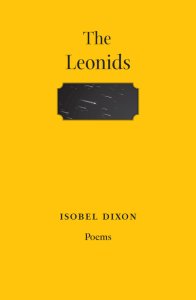
 The Bostik Book of Unbelievable Beasties
 Cats
Cats
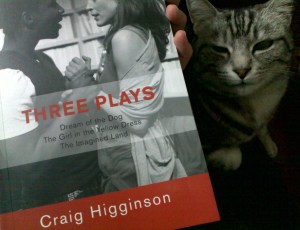 Reading a play is like listening to an opera on CD. Many would argue that both are best experienced on stage. There is nothing like a live performance, I agree. Yet, no matter how much I love going to the theatre or opera house, reading a play or listening to opera in the comfort of my own home can also be special.
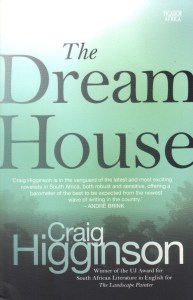 Dream of the Dog was first written and appeared as a local radio play in 2006, and was rewritten and staged the following year in South Africa before transferring overseas. Its action takes place in KwaZulu-Natal. An aging couple sell their farm to developers. The man in charge of the project turns out to be the son of one of their former workers. As he returns to the place, he brings with him long-supressed memories of violence and death on the farm. The play inspired Higginson’s latest novel, The Dream House (2015), which won the prestigious
 In a corner, with no way out, when everything seems lost, broken, incomprehensible, a tiny light might save you. Holding on to that light is not an act of bravery. It is an act of compassion. I survive because I have kind people in my life. Perhaps recognising and reaching out for that kindness is courage? I do not know. I know that the sharing, the true care of friendship, have saved me from utter despair. The women in my life. I repeat: The women in my life. I do not know what I would have done without You. I salute and cherish you!
 The first time I travelled to


 During the last McGregor Poetry Festival a poem was inscribed on the walls of Temenos, my favourite one from Stephen Symon’s stunning debut collection
  I arrived at Wordsworth Books rattled, but there were good friends, cheese and wine, and poetry – subtle, soul-restoring poetry. Beauty, like light, can save you. How precious that it can be contained in words. Thank you, Stephen and Nick, for caring about words.

 Questions for the Sea, the debut collection by Cape Town-based poet and graphic designer Stephen Symons is the latest exquisite offering from the independent local publisher, uHlanga. The sea, questions, light and poetry: an irresistible combination.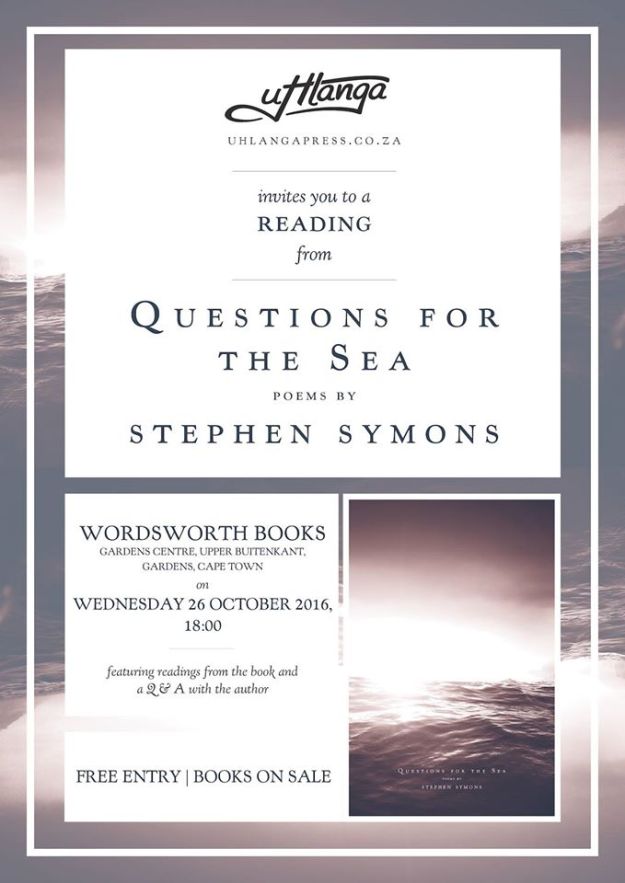
 Camaraderie. That is the word which comes to mind when I think back to the one day I spent at the fabulous Soweto Theatre, attending the inaugural The Star Soweto Literary Festival. It was quite a whirlwind affair. A day of talks, improvisation, laughter and tears. I invited myself. The moment I heard that the festival was happening – and it was organised in a shockingly short amount of time – I volunteered to speak, chair sessions, whatever, just to be there. I felt it in my bones that it would be special, and I wanted to be part of it.
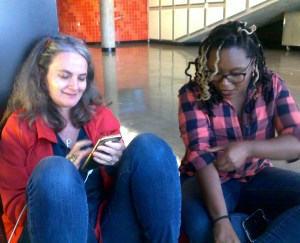 The day I was there, Saturday, the presence of the spirits of these literary giants was palpable. The attempt to establish “a truly non-racial” space for writers, artists and the public to engage with one another’s ideas was a great success. I attended with a dear friend, Pamela Power, the author of Ms Conception and the upcoming psychological thriller, Things Unseen. We came away inspired, glowing, and moved to the core.
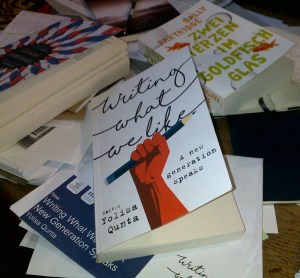 For a white person, reading Writing What We Like: A New Generation Speaks might feel like gatecrashing a party where some ugly truths will be revealed about you. Provocative and penetrating, Writing What We Like is a difficult book to review when you happen to be white, because one feels that one should not be talking at all, but listening only. One is torn between possible accusations of one’s own “intellectual arrogance” and the need for dialogue. And yet, a way to disrupt entrenched ways of thinking and to establish connections across barriers imposed on us by a turbulent and harrowing history is to try to imagine ourselves into the skins of others. That is where creativity and empathy begin – in writing, reading and interpretation – where we cease to view ourselves in any other categories but human. The ultimate goal is understanding, coupled with compassion. Everything else will follow from there.
