Review: The Wine Lover’s Daughter by Anne Fadiman

Anne FadimanAnyone who has read Anne Fadiman before will know what to expect of her latest book, The Wine Lover’s Daughter: A Memoir – excellent writing. I adore her work. It engages, soothes and delights me. She could write about any topic and I would want to read what she has to say. Her superb The Spirit Catches You and You Fall Down: A Hmong Child, Her American Doctors, and the Collision of Two Cultures (1997) is one of the most insightful renderings of the challenges which people encounter across cultures and languages. She is a master of the familiar essay. Book lovers will remember her marvellous Ex Libris: Confessions of a Common Reader (1998), Fadiman’s declaration of love for the written word.

Writing about your family members can be daunting, not a task to be undertaken lightly. Fadiman does it with wit and style. The Wine Lover’s Daughter is another of Fadiman’s declarations of love – the one she feels for her late father, the formidable Clifton Fadiman whose life spanned most of the twentieth century. A man of letters, an extraordinary editor, a famous radio and television personality, Clifton Fadiman was also known as a wine connoisseur and collector who drank half a bottle – seldom less or more – every night at dinner time until he was well into his nineties. “He once said that the cork was one of three inventions that had proved unequivocally beneficial to the human race. (The others were the wheel and Kleenex.)”

In remembering the life of her remarkable father, Fadiman does not gloss over the uncomfortable flaws of his character. This is true love, warts and all. She writes with compassion and humour, drawing a picture of a man who was deeply ashamed of his roots and desperate to escape them: “as a young man he had looked around him and realized that things were run by people who spoke well and who were not Jewish, not poor, and not ugly. He couldn’t become a gentile, but there was nothing to stop him from acquiring money and perfect language. The ugliness was a self-deprecatory exaggeration.” He was hard-working and on a mission: he did not want to be a “meatball”, transforming diligently “into something approximating foie gras.”

His family was worried about him when he was growing up, “since all he seemed able to do was read.” But that passion led him straight to the offices of the prestigious publisher Simon & Schuster, where he remained for most of his life. He was conservative in many ways but never adverse to dialogue, reshaping his views as the world around him was changing. He allowed his children to find their own ways. His daughter’s journey included coming to terms with the fact that, although she followed in his footsteps as a writer, wine did not agree with her palate.

The Wine Lover’s Daughter is a literary treat of note. Tender and generous, it will go well with half a bottle of your favourite vintage.

The Wine Lover’s Daughter: A Memoir

by Anne Fadiman

Farrar, Straus and Giroux, 2017

Review first published in the Cape Times, 24 November 2017.

Review: Love, Africa – A Memoir of Romance, War, and Survival by Jeffrey Gettleman

Love Africa“It’s easy to explain why you like something. But love? That’s tricky. That’s a story, not a sentence,” writes Jeffrey Gettleman, a foreign correspondent for the New York Times, in his first book, Love, Africa: A Memoir of Romance, War, and Survival. This is the story of two “obsessions”: a woman and a continent. As a young man, Gettleman travels to Africa for the first time and meets Courtenay, a fellow Cornell student. Both encounters shape the rest of his life. Now in his late forties, Gettleman has come to call Nairobi his home; and after many ups and downs, he and Courtenay married and started a family in Kenya.
In the early days, one of Gettleman’s friends and mentors, Dan Eldon, asks at a campfire in the Mikumi National Park: “You guys ever wonder what to do with a landscape like this? It’s, like, beautiful food you can eat; a beautiful woman you can kiss; but what are you going to do with a landscape this beautiful?” You can love it. If you are a journalist, you can also attempt to capture it in words. Gettleman credits Eldon for making “that all-important introduction: Jeff, World. World, Jeff.”

It is through his journeys to Africa and the people he encounters here that Gettleman decides to become a reporter and dreams of being a foreign correspondent in East Africa. “But writing is like travelling. Often you have to pass through a bunch of places you don’t want to visit in order to arrive where you do.” After interviewing the likes of Desmond Tutu and Salman Rushdie for a student newspaper as a graduate, Gettleman eventually cut his journalistic teeth in Brooksville, central Florida, at the St. Petersburg Times where he covered “small-town carnage, one-on-one war”. One of his big stories at the time was about the child molester and murderer, Willie Crain – “the ultimate depths of depravity”.

In 1999, Gettleman became a general assignment reporter for the Los Angeles Times. Soon after, he was writing from Afghanistan and the Middle East, and in 2002, he transferred to the New York Times – initially as a domestic correspondent, before he was sent to Iraq. It was only in 2006 that his Africa dream came true as he took over as chief of the East Africa bureau of the newspaper in Nairobi.

Gettleman won the Pulitzer Prize for International Reporting in 2012. Even if you don’t know his journalism, reading the memoir you will understand why. His writing is visceral; it is impossible to remain unaffected. He states: “There’s exactly one difference between an adventure and a tragedy: death.” Right from the tense opening pages of Love, Africa you know how tightly these two are intertwined, how high the stakes. The memoir exemplifies a hard lesson Gettleman learns – the one that contrasts a life wasted and a life lived: “Or maybe the lesson was simpler. It wasn’t about death. It was about life. It’s never long enough. So get it while you can.”

Gettleman is not the first mzungu to fall hook, line and sinker for this continent. Many have written about their experiences. What makes Love, Africa stand out among the diverse accounts is the vulnerability that Gettleman allows to underpin his writing. He constantly challenges, and accepts when necessary, his limitations as a journalist: “I didn’t have the capacity to absorb all that was being asked of me, nor the courage to tell these men who were putting their hand on my heart the truth. I wasn’t a conduit to a just world. I was simply a reporter.” But there is no doubt that he and others can make a difference, whether in small ways to individual lives they touch or on a grand scale when reporting leads to deeper awareness and changes in policy making. At one stage Gettleman notes: “if we could break Iraq, just imagine what we could do to a really poor place where few were watching.” He is fearless in his criticism, whether of his own or other governments – the right and the courage to do so should never be taken for granted.

There is no way of escaping helplessness in the face of the atrocities Gettleman has to cover as a reporter, and searching for the right way to do it is one of the most vital tasks. When writing, he finds himself having to fight editors for single words like “hacked” to express what he’d witnessed. But as he points out, “just because there was a million questions about what exactly you should do, that doesn’t mean you shouldn’t do anything.”

Some of his observations seem simple, but go to the heart of conflicts we hear about on the news or experience in our everyday. The following struck me in particular: “Elections are anxious in most Africa… They are not just a race. They are a test. The key questions is never who wins. It’s whether the loser accepts.” And this: “The only African countries that succeeded in overcoming this [colonial divisions] and building anything close to a national identity were those that took forceful steps to neutralize ethnicity or tribe (I use the terms interchangeably).”

Exploitation and betrayal mark our socio-political legacies. Gettleman’s greatest achievement in the book is to trace his own personal, intimate history of both against the background of the global story. His honesty is disarming as he recalls his path towards loyalty and integrity. It is strewn with the suffering of others, especially Courtenay. “I have few regrets in life,” he writes, “but here I wished I could redo everything. But I couldn’t, which left me simply hoping that that clumsy, hurtful time would slip deeper and deeper into a softly entombed past, like the tracks we left behind in the desert that the evening winds gently erased.” In the end, he is redeemed by the ancient truth: “This is all I need, my freedom and you. Take everything else from me. It doesn’t matter.”

Love, Africa: A Memoir of Romance, War, and Survival

by Jeffrey Gettleman

HarperCollins, 2017

Edited version of this review was first published in the Cape Times on 24 November 2017.

Review: Camino Island by John Grisham

Camino IslandJohn Grisham has published two dozen books since I last read him at university. His The Partner was my introduction to the thriller genre and, thinking back to the impact the brilliant twist at the end of the novel had on me, I still think I could not have asked for a better one. Twenty years on, and I still remember the shock and delight of the final revelation. Grisham had me fooled as much as the main character had been fooled by the real “partner” of the story. I read some of his other titles at the time, have watched a few of the films based on his books since then and loved all, but have not longed to return to reading Grisham until recently. The premise of Camino Island sounded too intriguing for a reader and writer like me to resist. Once again, Grisham did not disappoint.
This crime thriller is set in a world which will feel familiar to anyone who has ever been interested in the secret lives of books. How they are written, when do their manuscripts become precious and why, how do they change hands when they are published and when does their possession become a criminal offense are only some of the questions that perhaps not all readers ask themselves, but Camino Island answers in the most entertaining fashion. The story is relatively simple: the priceless manuscripts of F. Scott Fitzgerald’s five only novels are stolen from the Princeton University during a nearly perfectly executed heist. The opening chapters focus on the tense choreography of the criminal plan. A single drop of blood from one of the thieves leads to the first arrests of suspects, but they refuse to talk to the authorities and the trail to the missing treasure goes dead.

The FBI’s Rare Asset Recovery Unit is doing its best to find the manuscripts insured at a value of $25 million – the amount at stake for the prestigious insurance company which has to pay out if the goods are not recovered. Working closely with the FBI, Elaine Shelby begins an investigation on their behalf. Her approach boarders on illegal, but seems to have been far more effective in the past than official routes, and her latest plan looks like it might have a chance to succeed again.

Elaine recruits Mercer Mann, the protagonist of Camino Island, to spy on Bruce Kable, a bookshop owner located on the titular island in Florida and suspected of dealing in stolen rare books and manuscripts. The Fitzgerald originals are believed to be in his hands.

Mercer is a young, talented writer with a crippling university debt to pay off and on the verge of losing her job. She has a short-story collection and a highly acclaimed novel to her name, but has been experiencing a few years of a creative drought since her last publication and is desperate to write again. To escape her predicament she agrees to help Elaine who makes her a financial offer she can hardly refuse in her situation. She returns to Camino Island where she used to visit her beloved grandmother every summer when she was a child and where she still part-owns the cottage which she inherited when the grandmother died eleven years ago. Mercer’s assignment is to start on her second novel, get close to the other writers based on the island and, most importantly, to the mysterious bookseller at the centre of the literary community. Elaine hopes that Mercer can infiltrate the island’s literary scene in time to discover whether Bruce Kable is somehow involved with the disappearance of the Fitzgerald manuscripts and whether they are indeed hidden somewhere on the island.

A cat and mouse game ensues. No one knows whom to trust and what to do. And the people initially responsible for the theft of the irreplaceable manuscripts and not apprehended by the FBI are following their own agenda. They will stop at nothing to get their share of the millions the manuscripts are estimated to be worth on the black market.

Grisham delivers what he is famous for: the ultimate page-turner. I found myself as much involved with the plot as with the lives of his fascinating characters: the struggling writer who can’t make ends meet, longing “for the freedom of facing each day with nothing to do but write her novels and stories”, but aware that she might be selling her soul to the devil in order to achieve her dream; the bookseller who knows how to charm and satisfy his customers so as not to only stay in business but to prosper; his highly successful wife who spends a lot of time in France searching for antiques she sells on to discerning American buyers and seems to have no qualms about her own or her husband’s infidelities; the two gay women known for their bestselling romance novels and their writer friend whose new manuscript promises to be a flop while alcoholism threatens to destroy him; or the sly agent working around the clock to retrieve the stolen goods as her boss is liable to cover the insurance claim in case she fails.

What I do not recollect from my initial reading of Grisham twenty or so years ago is whether the prose of the early novels was as bland as this recent offering. There was not a single exceptional sentence in Camino Island that would have made me wonder at the ingenuity of the writer. Having experienced the stylistic prowess of a thriller writer like Mick Herron in the past few months, I was particularly struck how unappealing Grisham’s was in this respect. And yet, I confess to not having been able to put the novel down. Camino Island was great fun and it made me want to catch up on my Grisham reading. Apparently his next legal thriller, The Rooster Bar, is already in the bookshops. Exciting holiday read guaranteed.

Camino Island

John Grisham

Hodder & Stoughton, 2017

Review first published in the Cape Times, 17 November 2017.

Review: The Blessed Girl by Angela Makholwa

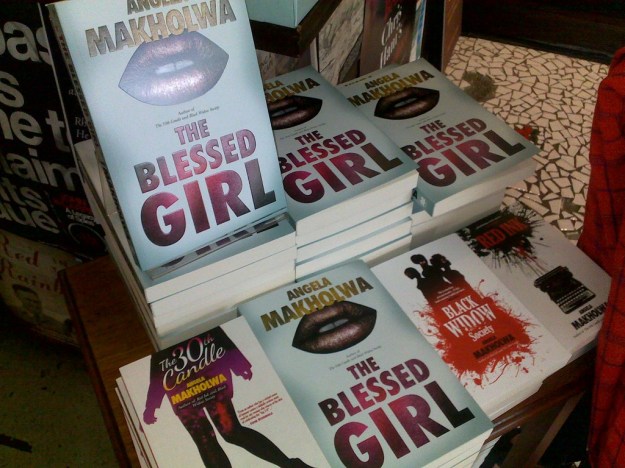
The Blessed GirlThe Blessed Girl is Angela Makholwa’s fourth novel. Although it was published only a few weeks ago, it has already gone into its second print run and I have an idea it is not going to be its last. The book sheds light on a phenomenon which has moved into the public eye in the last couple of years: the life of a blessee (usually a woman “who lives a luxurious lifestyle funded by an older, sometimes married partner in return for sexual favours” and who flashes that lifestyle on social media) and her blessers (the sponsors of that lifestyle and recipients of the sexual favours).
In interviews, Makholwa has stated that she did a lot of research into these opulent lifestyles and has spoken to people involved first-hand, even registering for a website which connects potential blessees with their blessers. The outcome is an authentic portrayal of the scene. Makholwa’s wit will make you laugh but while entertaining, she incisively delves into the much darker aspects of her story than the glitter lives of her characters would suggest on the surface. The Blessed Girl reads like chick-lit and does what the best of its kind achieve: for all its humour and light touches, it is a very serious analysis of the topic at hand.

Bontle Tau is the narrator of the novel and the blessee who seems to have it all: she is not even thirty, has the looks of a supermodel, owns her own penthouse apartment, drives a luxury car, throws money around on fancy restaurants, beauty treatments and designer goods like there is no tomorrow. She is offered business opportunities most of us can only dream of. It all comes at a price, of course. She is at the beck and call of her three main blessers who are all older, married, more or less affluent, and use her as they please. But she wants us to believe that it is all worth it, that she is the one exploiting others, not the other way around.

Bontle is not the kind of woman you would necessarily want to be friends with, and Makholwa makes sure that we know not to trust all that her protagonist is trying to sell to us, but she gives Bontle a voice that is genuine and thus allows us to care for her in a manner which surprised me. As the story progresses and Bontle’s seemingly charmed life unravels on the pages in front of us, it is nearly impossible not to feel empathy for the young woman as she makes her choices and deals with the ones forced on her. Makholwa paints a credible, moving backstory for her which explains Bontle’s position in life. It fills you with sorrow and anger. The ending of The Blessed Girl looked predictable at times, but Makholwa managed to surprise and I appreciated the unusual way Bontle’s fate unfolded. A book of our times; not to be missed.

The Blessed Girl

Angela Makholwa

Pan Macmillan, 2017

Review first published in the Cape Times, 10 November 2017.

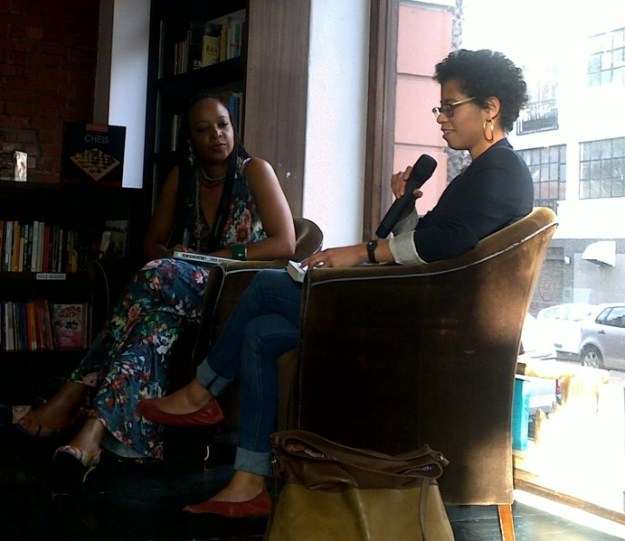
Angela Makholwa and Lauren Smith

Angela Makholwa and Lauren Smith at the launch of The Blessed Girl at the Book Lounge.


A time of feathers

HopeTraumatic events in your life have a tendency of distorting your perception of time. Accumulated layers of distress and pain can be paralysing. One of the saddest consequences of trauma is that it often becomes extremely difficult to live beyond the present moment, to imagine a future, especially a future that is kinder, filled with light. Survival mode takes a lot out of you. You have to be careful with your limited resources to simply take the next breath, to move one step forward. Just keeping still requires enormous effort.

I have been thinking a lot about my own near-inability in the last three years to make long-term plans. A year ago around this time, it felt like there was hardly any future left to look forward to. I lived from day to day, managing, coping. It is a strange state of being – when you don’t ask of a day, What good things may I expect of you? but just pray to get through it. And then, of course, the night awaits, and the morning beyond can feel like an eternity away, the darkness absolute.

Despite everything, I coped. Got on with it.

The morning always arrived. Eventually an evening in November when there was a glimmer of joy. Soon after mornings began to taste of hope.

You can never know when something happens to change it all. The small kindness, the little light. The few words which flutter with true meaning.

A year later, the past is undeniably with me; the pain might be slightly more rounder, but it hasn’t disappeared; I struggle to think about things beyond the end of this year. But, my everyday is gradually overflowing with opportunities and I have more and more strength to recognise and honour them.

Most of us do not want to just cope; we want to thrive, feel content. We want to welcome every day with a smile  to say good night, not fearing the night. We want to see the future and be able to reach for it with hands capable of holding on. Mine are still frail and tired from the burdens they have had to carry, but they are reaching out. And I plan to make the most of it.


“Hope” is the thing with feathers –

That perches in the soul –

And sings the tune without the words –

And never stops – at all –


— Emily Dickinson


Review: Elmet by Fiona Mozley

Elmet by Fiona MozleyEvery year, I try to pick at least one of the titles shortlisted for the prestigious Man Booker Prize and read it before the winner is announced in mid-October. This time, the novel which intrigued me the most on the list was Fiona Mozley’s debut, Elmet. The narrative draws you in from the first sentence: “I cast no shadow”, it begins, and continues in Mozley’s beautifully balanced prose that is balm for the aesthetic soul: “Smoke rests behind me and daylight is stifled. I count sleepers and the numbers rush. I count rivets and bolts. I walk north. My first two steps are slow, languid.” This kind of writing is difficult to resist.

Mozley’s story is deceptively simple: the siblings Cathy and Daniel are living with Daddy in the house he built with his own hands for the family. The land their home stands on used to belong to the children’s mysteriously elusive mother. Before Daddy reclaimed the land for them, Cathy and Daniel lived with Granny Morley and still went to school. Their parents came and went for different reasons, until one day one of them did not return. And then their grandmother died and Daddy decided to move the family to the place where their mother came from. Now, a distant neighbour takes care of the children’s schooling, but otherwise they are mostly allowed to roam free. They keep house, live off the land, drink and smoke, and fend for themselves – more or less successfully. Their Daddy used to box in illegal fights arranged by migrating travellers. He never lost. His reputation opens up possibilities, but eventually also comes to haunt him and his secluded family: “Everything he did now was to toughen us up against something unseen.”

Daniel, the younger of the siblings, is the novel’s narrator. His sister is not only older but tougher, wise and brave beyond her years. Despite the seeming neglect the children experience, there is a lot of tenderness and love in the family and there is little doubt that they do the best they can to take care of their own. The place they settle in York has an ancient history. In the novel’s epigraph Mozley quotes Ted Hughes’s Remains of Elmet: “Elmet was the last independent Celtic kingdom … even into the seventeenth century […it was] a sanctuary for refugees from the law”.

Elmet is remarkable for its mythical quality. The novel is obviously set in recent times in a specific landscape, but the story could have happened anytime and anywhere where those who think and live distinctly and want to carve out an existence outside the norm are hounded down and made to conform or to pay the price for their independence. From the opening paragraphs we know that something dark and dangerous is looming. Mozley builds up her narrative masterfully and when it explodes, it leaves you reeling and dazed. She did not win the coveted prize, but Elmet was a worthy contender and Mozley is a writer to keep on your literary radar.

Elmet

by Fiona Mozley

JM Originals, 2017

Review first published in the Cape Times, 3 November 2017.

Review: Dark Chapter by Winnie M Li

Dark ChapterOpening Dark Chapter, Winnie M Li’s debut novel, you will find out the following: it is a work of fiction, but the book is “inspired by the author’s own rape in similar circumstances”. Dedicated to “all the victims and all the survivors – and most of us, who are somewhere in between”, the narrative plays out in that “in between” space and is a harrowing account of a woman’s attempt to come to terms with her new frightening reality after being raped. The circumstances Li describes are somehow unusual, the telling perhaps even more so.

The protagonist of Dark Chapter is Vivian Tan, a twenty-nine years old, highly educated, professional American living in London on a visit to West Belfast as a George Mitchell Scholar to celebrate the tenth anniversary of the peace process. She decides to explore a hiking trail recommended by her travel guidebook. Walking on her own, she is accosted by a teenager with evil on his mind. The encounter ends in a brutal rape. It turns out that Johnny, the perpetrator, is only fifteen, illiterate, and lives in a nearby caravan park with his family of Irish Travellers.

“They say events like this change your life forever”, Li begins the novel and goes on to relate how Vivian and Johnny arrived at this point in their trajectories, what circumstances shaped them, and what happened in the aftermath of the horrid attack. Vivian immediately reports the rape to the police. At first, Johnny goes on the run, but then is turned in by his own family members (who believe his sanitised version of events), so that he can attempt to clear his name in court.

Li explains in the introduction to the novel that Johnny’s part of the story is “completely made up” and that the trial in the book did not take place as the “real-life defendant pleaded guilty”. Li imagines Johnny’s life and family and friends and writes the story alternatingly from both perspectives. Creating any character is a leap of the imagination but, as a rape survivor, putting yourself into the shoes of a rapist is an incredible act of empathy and courage. Nowhere in the novel does Li excuse Johnny’s actions, but she allows him a credible voice.

Writing Vivian could not have been any easier. Li had her own experience to draw on, but one of the greatest challenges that trauma poses for a survivor is the piecing together of a coherent narrative about what happened. Dark Chapter is a palpable portrayal of a woman’s journey to recovery as she holds the youngster accountable for the crime he committed against her by entrusting her story over and over again to the authorities: “How many more times does she need to be flayed alive in this process? Every single step of seeking justice involves exposing herself, more and more.” There seems to be on other way.

Earlier this month, Dark Chapter won the Guardian’s Not the Booker Prize. It is an extremely difficult but important read.

Dark Chapter

by Winnie M Li

Legend Press, 2017

Review first published in the Cape Times, 20 October 2017.

Review: Reflecting Rogue – Inside the Mind of a Feminist by Pumla Dineo Gqola

Reflecting Rogue

Pumla Dineo Gqola is a formidable writer who in her work discusses the most complex topics: slavery, stardom, rape, and feminism. She is the author of What is Slavery to Me? Postcolonial/Slave Memory in Post-apartheid South Africa, A Renegade Called Simphiwe, the 2016 Sunday Times Alan Paton Award winner Rape: A South African Nightmare, and the recently released Reflecting Rogue: Inside the Mind of a Feminist. A professor of African Literature at Wits University, Gqola has established herself as one of the leading intellectuals of the continent.

Reflecting Rogue comprises fourteen essays which range from academic to personal and often combine both approaches to tackle issues with socio-political implications and in the process gain a specific kind of authority because of their autobiographical touch: “I have revealed part of myself only known to my nearest and dearest: anxieties, joys, vulnerabilities.” As a way of introduction, Gqola recalls how as an eight-year-old she realised she was a writer when words offered her an escape into another language and thus freedom. She discovered the power of writing and writing’s relationship with power. It continues to be “at the centre of my life. It is where I love myself better.” She understands the risks involved, especially when you write from within the position of vulnerability that any intimate, personal writing entails. Unapologetically, she states: “There are reflections of and on living, loving and thinking as feminist. One feminist.”

The individual essays of the collection were written over a period of several years and offer insight into diverse subjects. In “Growing into my body”, Gqola traces the intricate relationship she has with her own “embodied memories”. Most readers will be able to relate to the perils implied: “I am not sure how much of myself I want to expose and render vulnerable, and so, instead, I play games with myself.” Racism, “notions of purity and contamination”, questions of approval and acceptance, are tough to consider and transcend. “It is crucial to begin to make new memories of embodiment”, Gqola writes, “forms that encourage pleasure and power.” She is heartened by seeing young Blackwomen “communicating comfort and love of themselves to themselves.”

“A Backwoman’s journey through three South African universities” is Gqola’s account of her experiences with “racist capitalist patriarchy” and her attempts to convert her “anti-racist and feminist politics into practice.” She advocates a thorough investigation of how “configurations of power mutate” and how we cope with the essential changes needed to avoid marginality of the majority of South African citizens. In another essay, Gqola quotes filmmaker Xoliswa Sithole who “argues repeatedly and convincingly about the manner in which Blackwomen are conned into embracing ‘modesty’ instead of owning our power, excellence and successes – and instead of openly celebrating each other’s.”

In two intensely introspective pieces on motherhood Gqola talks about how to be the best parent without compromising on a full life when the weight of entrenched women’s roles in partnerships and professional lives comes bearing down on your self-awareness and personal longings of fulfilment and independence. Gqola pays tribute to the people who helped her find a way “to belong to yourself and be committed to parenting well”.

She writes about the ideals and disappointments of freedom, of the “reminders of missed opportunities to create the country we dreamt of” and speaks about the dangers of ignoring differences when we negate the “need for accountability, atonement and justice” as well as not addressing the detrimental nature of heteropatriarchy. She argues for the necessity of “rage” in our dealing with the status quo, the speaking of truth to power instead of compliance and silence.

I had to dig deep into my academic past in order to follow Gqola’s discussion of the public’s conflicting responses to the exhibition Innovat1ve Women, curated by Bongi Bengu in 2009, but in general the book is incisive and accessible. Reflecting Rogue engages with underrepresentation of Black women in public spaces, whether political, creative or academic. Gqola recalls what it meant for her to encounter Alice Walker’s writing, how reading about black people’s lives in a black author’s work affirmed for her the possibility of becoming a writer. “A woman who does not want to apologise for valuing herself is a dangerous thing”, she states and gives reasons why she espouses womanism. Walker taught her “about letting go of the need for approval and external validation, which is so central to how women are raised all over the world.”

Discovering feminism was like a homecoming for Gqola, as it is for countless women independent of our backgrounds. We all believe in the same fundamental thing, but like any movement, feminism has developed different strands and allows for varied interpretations of which causes should take precedence and how they should be achieved. There were moments when I could relate to and at the same time felt alienated by passages in Reflecting Rogue. However, as Gqola claims, we are “rogues – unapologetically disrespectful of patriarchal law and order, determined to create a world in which choice is a concrete reality for all.” Part of that reality is Gqola’s choice to evoke Winnie Madikizela-Mandela, along with the Kenyan revolutionary Wambui Waiyaki Otieno and environmental political activist and Nobel Laureate Wangari Maathai, as women who “offer freeing visions of unsubjugated femininities.” I belong to the group of people Gqola mentions who can see little beyond Madikizela-Mandela’s involvement in “gross violations of human rights”, as stated in the final TRC report of 1998, and found her inclusion in the argument uncomfortably problematic.

Gqola’s tribute to the remarkable work of FEMRITE, the Uganda Women Writers Association, is free of such hauntings – a legacy entirely worthy of being celebrated. Reflecting Rogue also includes a public lecture Gqola gave during which she said: “Africa has to mean a present and a future home again for those who strive for a freedom linked to the freedom of those like – and unlike – us.” What I found most inspiring about Reflecting Rogue is the author’s unequivocal belief that “another world is possible.”

Reflecting Rogue: Inside the mind of a feminist

by Pumla Dineo Gqola

MF Books, 2017

An edited version of this review first appeared in the Cape Times on 20 October 2017.

Review: Self-Portrait with Dogwood by Christopher Merrill

Self-portrait with Doogwood review

“Trees and words branch into memoir”

Christopher Merrill is a highly acclaimed American poet, translator and editor. He is also the author of several books of nonfiction, including The Grass of Another Country: A Journey Through the World of Soccer and Only the Nails Remain: Scenes from the Balkan Wars. He recently visited Durban for the Articulate Africa Art and Book Fair where he spoke about his latest work, a memoir with the irresistible title Self-Portrait with Dogwood. Published earlier this year, the book is a series of vignettes about central episodes in Merrill’s life, all involving varieties of the dogwood tree. It might sound peculiar, but it is a delightful way of presenting a life.

“The average lifespan of a flowering dogwood is eighty years, and at the approach of my sixtieth birthday it occurred to me that I might create a self-portrait in relation to a tree that from an early age I have regarded as a talisman. Not a memoir, strictly speaking, but a literary exploration of certain events through the lens of nature”, Merrill writes in the prologue. His approach to the project and his elegant prose are reminiscent of the work of the great American essayist Anne Fadiman, whose own memoir, The Wine Lover’s Daughter, is to be published next month.

The individual chapters of Self-Portrait with Dogwood loosely follow the chronology of Merrill’s life, but never in the way you would expect. The structure challenges our “way of thinking about the tradition of writing memoirs.” Merrill begins with a seemingly typical childhood story of building “a fort under the dogwood tree” near the border of the neighbour’s property, but weaves the military history and legendary heroism of the region into his narrative. Mr Wright, their neighbour, was a Native American and the young Christopher played war with his son Michael, their childhoods infiltrated by the reality of the Cuban missile crisis and the Vietnam War. Mr Wright was responsible for conscientising Merrill by challenging his family’s political allegiances and making him aware about the destruction of the environment and the need to protect it.

Upon revisiting his early home as an adult, the absence of his dogwood tree prompts Merrill to note “that in addition to our inordinate fondness for shaping history by military means we are also adept at waging war on nature.” In his life, Merrill has been entangled in both styles of warfare and, as a passionate conservationist and cultural diplomat, has tried to steer the global consciousness towards better understanding of the perils involved.

Wars lurk behind many of Merrill’s enquiries and memories, but none as vividly as the one he finds himself in the middle of in the early 1990s in the former Yugoslavia. The memoir also includes outlandish stories about dogwoods. Experts have suggested that the trees might have been used in the Trojan War, perhaps even to build the infamous horse. A popular poem claims that the cross Jesus was crucified on was made of dogwood. “The dogwood, then, as metaphor – of the march of civilization, the Passion, growth and decline, love and war.” Merill writes about “dogwood diplomacy”, which was “the nickname bestowed upon a State Department initiative to promote friendship with Japan” and about why he was not allowed to visit the only two places in Russia where dogwood trees can be found.

He calls dogwood his “totem tree” and describes the role it played as witness to all crucial events of his life. In one of the most touching stories, Merrill recalls the pair of kousa dogwoods at the entrance to a park in Iowa City where he now lives with his family. The health of one of his daughters began deteriorating rapidly without apparent medical cause. The dogwoods in the park were in full bloom when she was at her lowest, but “acquired talismanic significance” during their visit and allowed Merrill to hope for her recovery. When they visited at the end of the season, and the trees were heavy with fruit, she was properly diagnosed and improving.

In his memoir, Merrill pays tribute to a few remarkable people who shaped him: a friend who became increasingly delusional at the same time as attempting to discuss the meaning of life via the literary greats with him; Charlie Ed, an African American who taught him what true disenfranchisement was and with whom Merrill worked in a lumberyard after getting in trouble with the police for drug possession; Jerry Munro, the owner of the nursery in which he worked for many years; and the poet Agha Shahid Ali, his dearest friend who died of brain cancer.

The words and wisdoms of writers like Herman Hesse, Walt Whitman, Emily Dickinson, Rachel Carson, and Henry David Thoreau dapple the narrative like light through a tree canopy. We turn to them for guidance and solace, especially in brutal times. Merrill describes his own experience of the post-9/11 era and trying to make sense of the layers of trauma surrounding the event.

As a wordsmith himself, Merrill acknowledges the fascinating idea that there might be a connection between trees and language as their branches attract birds and thus perhaps they inspire music: “Linguists posit that sometime in the last hundred thousand years our ancestors began to imitate birdsong and monkey alarm calls in delight, boredom, or terror, depending on the circumstances; the fusion of these two finite systems of communication from the animal world produced a third system, seemingly infinite, capable of conveying holistic messages. The integration hypothesis of human language evolution proposes that the combination of avian music and primate warning, the expressive and lexical layers of meaning, gave rise to grammar, and the rest in history – which is to say, the history of speech.” It is a marvellous way of looking at how one of our greatest feats – language – can be traced back to trees.

“In the nursery trade, dogwoods are called ornamentals, their flowering a highlight of spring.” Merrill’s writing feels like that kind of flowering: gentle, beautiful, full of life.

Self-Portrait with Dogwood


Self-Portrait with Dogwood

by Christopher Merrill

Trinity University Press, 2017


An edited version of this review was first published in the Cape Times, 13 October 2017.


Review: Khwezi – The remarkable story of Fezekile Ntsukela Kuzwayo by Redi Tlhabi

Khwezi“What is it about our society that excuses these monsters? Why are we not holding people accountable on all levels?” Redi Tlhabi asked at the recent Cape Town launch of her latest book, Khwezi: The remarkable story of Fezekile Ntsukela Kuzwayo. She was referring to the horrifying prevalence of sexual violence in South Africa and our inability to prevent it as well as to offer justice to its victims. In Khwezi, Tlhabi demonstrates how the legal system and we, as society, have failed the victims of sexual violence in general, and one person in particular: Fezekile Ntsukela Kuzwayo, for over a decade known to most of us only as Khwezi – the woman who decided to fight for her right to safety and dignity and accused Jacob Zuma of rape when he ignored both by having sex with her without her consent on 2 November 2005. Zuma was acquitted of the rape charge in May 2006. Kuzwayo, vilified and violated by his supporters, had to flee the country.

“We managed to carry on,” Tlhabi reminded us at the launch. “This should have been a turning point for South Africa, but it wasn’t.” Perhaps the publication of this brave and incisive book is giving us another chance a decade later. It is compulsory reading for anyone wanting to understand where we are as a country, as a people.

After years in exile, Kuzwayo returned to South Africa and agreed to work with Tlhabi to reclaim her name and life, but while we all now can read her story and know her by her real name, her life was tragically cut short when she died of AIDS-related causes a year ago.

“Here I am, attending a funeral instead of a triumphant book launch”, Tlhabi writes, continuing: “She was adamant – she would attend the launch and I was to introduce her by her real name.” But on 15 October 2016, Tlhabi, along other women, carried Kuzwayo’s casket at her funeral: “I was convinced that the book had died with her, that I could claim no moral authority for writing her story now that she was no longer here to vouch for it, but being in Durban that day gave me courage to carry on… This is her story.”

In an interview, Kuzwayo tells Tlhabi: “It was important for me to say to him, you cannot come onto my body and just do what you want to do. And soil me like that.” She adds: “I never saw myself as Zuma’s accuser, Zuma’s victim, or Zuma’s anything. I do not want any attachment to that man.”

In the book, Tlhabi gives us an insight into Kuzwayo’s restless and intricate life. Growing up in exile, the daughter of Mandla Judson Kuzwayo, a Umkhonto we Sizwe hero who died in a car accident when she was a child, and Beauty Kuzwayo, an actress who struggled to take care of her family after her husband’s death, the young Fezekile had to face displacement, loss and insecurity and survived three rapes before she turned fourteen. Repeatedly traumatised, she suffered from depression and anxiety. But her hunger for life and her irrevocable trust in the goodwill of people shine through. A trust that often exasperated those who loved her, also the author of her memoir. Tlhabi portrays Kuzwayo in all her beauty and troubled complexity and does not gloss over the tangled aspects of her personality.

Kuzwayo emerges from the pages a woman who had been asked to negotiate unbearable pain and yet retained her integrity throughout, even when an entire mob of manipulators, crooks, and seemingly well-meaning people was set to prove otherwise. Tlhabi recalls several episodes from the Zuma’s rape trial which are shocking, but we allowed them to happen on our watch. The most sickening is Adv Kemp trying to imply that Kuzwayo as a child gave consent to have sex with adult men. Judge van der Merwe did not stop this line of questioning, nor did he protest the invasive, unforgiveable questioning about her sexuality. They showed no understanding of trauma, nor the cultural traditions Kuzwayo grew up with.

“There are times when the legal, ethical and moral truths come together,” Tlhabi said this week at the Book Lounge, “but this was not one of those times.” However, she states unequivocally: “I believe her.”

Khwezi is Fezekile Ntsukela Kuzwayo. Khwezi is many women. Tlhabi relates Zuma’s inappropriate behaviour towards her and tells the story of one of her colleagues who had a similar experience. The memoir is “about every woman in South Africa,” she said. Khwezi is also I. Anyone affected by sexual predation knows how convoluted the issues of complicity, consent and shame we deal with are. “Not all men, but all women,” my psychologist told me at the time when I struggled to articulate my feelings when I was violated a year ago. “Not all men are monsters,” she said, “but all women experience forms of violation in their lives.” Terrifying but true. Patriarchy, entitlement, violence, denialism – past and present – have to be challenged and exposed. Breaking the silence is extremely difficult: “I could not imagine any woman coming forward to accuse a powerful man of rape after how Khwezi had been treated”, Tlhabi writes. But Kuzwayo and Tlhabi encourage victims and survivors of sexual violence and predatory behaviour to speak out and to fight for our integrity, safety and dignity. Tlhabi once told Kuzwayo: “even when justice is denied, withheld, perpetrators must know that we know who they are and how they operate. At least some of these horrible experiences must be written about. If not to document personal pain and loss, perhaps provide teachable moments for future generations?” More than ever we need “to have a meaningful and transformative conversation about sexual violence and the language of power.” As Tlhabi states: “If we are to declare ‘Remember Khwezi’, then we must do so boldly, courageously, honestly.” As she does in her ground-breaking book.

Khwezi: The remarkable story of Fezekile Ntsukela Kuzwayo

by Redi Tlhabi

Jonathan Ball Publishers, 2017

First published in the Cape Times on 6 October 2017.