 A while back, I spoke to a friend about the phrases ‘to handle something’ or ‘to have a grip on something’ in connection with the physical ability to hold, handle, or have a grip on something as a manifestation of an emotional and psychological capability.
Another friend once told me: your body never lies. She was adamant that we have to listen to our bodies in order to keep our minds and souls healthy.
A pain in your hands or arms could be a true psychosomatic symptom of your lack of grip on life. You are no longer capable of handling things. Metaphorically, something is slipping through your fingers and you are in no position to stop the process.
I can no longer move my right arm without experiencing pain. In fact, I am in constant pain no matter what I do. I type and write through pain. My body has been screaming for a long time now, and I have been trying really hard to listen to it attentively, but I realise that I have lost my grip on something, perhaps many things, and it is no wonder that I have been dreaming of rest, of doing nothing, of simply relaxing and allowing myself to recharge the batteries that have been empty for many months. I am no longer handling my everyday life the way I would like to. My mind, body and soul find no peace. In the last three years I have been through so much that expecting anything different would be expecting miracles. Grief, illness, theft, evil, betrayal, injustice, incompetence, car accident – any of these blows of fate would be enough to break you. Facing all within a relatively short period of time takes a lot out of you. No; not a lot. Everything.
Listening to your body is one thing. Action is another. Or rather inaction.
Since February I have been telling friends that I would be taking some time off to rest. No deadlines, no creative or critical writing, no editing, no translating, no appointments – no work of any kind actually. Just rest: meeting friends, reading for pure pleasure, sleeping late, walking, swimming, watching TV, basking in the sun, laughing (a lot!).
I have never been bored in my life. Maybe I could get bored for once? How long would it take?
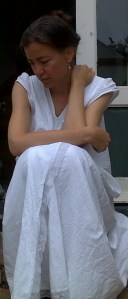 I had this grand plan of learning how to quilt while resting (I always find it reassuring, comforting, to see something come into being in my hands – activities like crocheting, knitting, or ironing soothe me). But now, not only has my plan of a self-imposed sabbatical been delayed because of work-related commitments I simply cannot get out of (I know, I know!) by two to three weeks, I actually cannot quilt, at least not until my arm recovers.
It is pathetic.
I realise that it is so much easier to take care of others. Now, I have to learn to truly take care of myself. I will do my job, because it is important to me, but I also have to grant myself some proper rest – because I am important to myself. When you live on your own, it is a surprisingly difficult lesson to learn. But, in the words of Manuel: “I learn, I learn!”
Be kind to yourself, they tell me. I try.
 Stanzas No 4
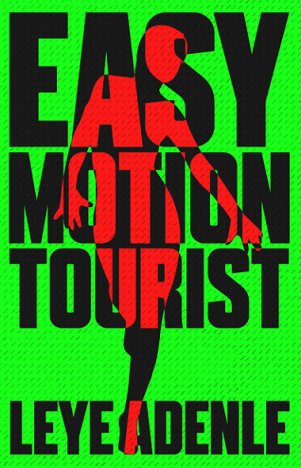 “She knew these girls, these women. She understood their world. For them, prostitution was not a choice; it was a lack of choice.” Amaka, a gutsy lawyer trying to protect the sex workers of Lagos, knows that most of them will never get off the streets. Leye Adenle’s thriller Easy Motion Tourist is their story.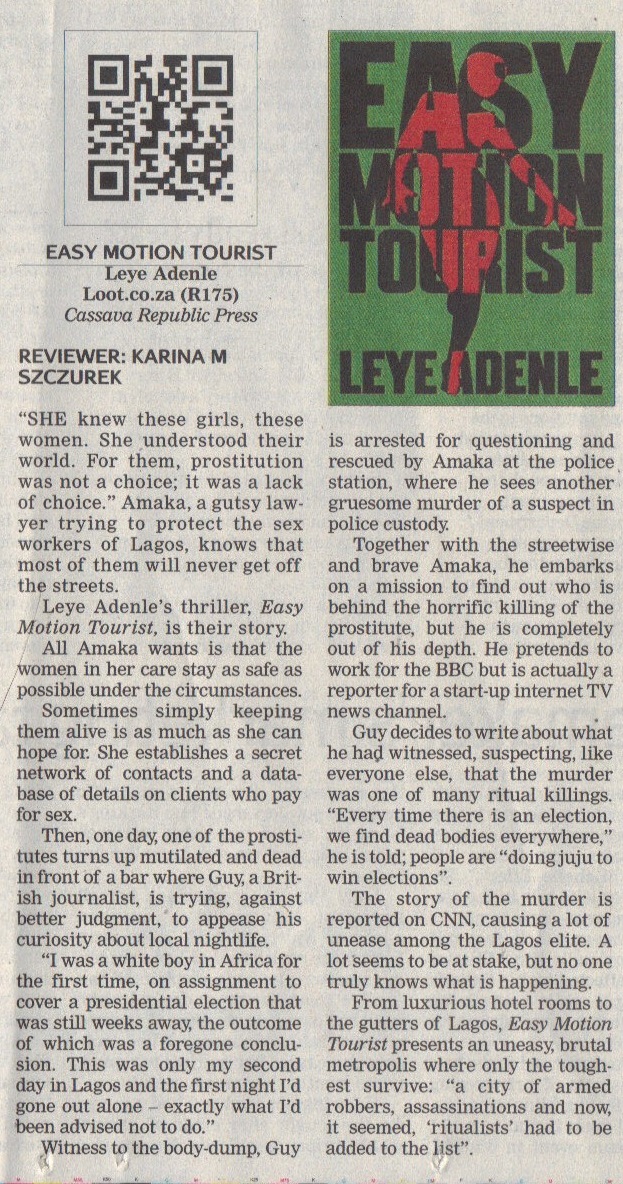
 Lara Feigel is a cultural historian and a literary critic, combining her interests to write about the meeting point between life, literature and history. In her last two books, she looks at how people whose quintessential purpose in life is the search for beauty and meaning survived their antithesis: war. In her The Love-charms of Bombs: Restless Lives in the Second World War (2013), Feigel wrote about five authors who were based in wartime London, driving ambulances, fighting fires, being creative, and loving passionately while desperately trying to remain alive.
 Dene Smuts once said that “there are two approaches to opposition lawmaking work: making a noise and making a difference.” Throughout her courageous life she chose to make a difference. Smuts completed the manuscript of Patriots and Parasites: South Africa and the Struggle to Evade History shortly before her unexpected death in April last year. Her daughter Julia midwifed the project to completion.
 There are times when people proclaim either the death of reading, or the death of the book as a physical object, or the death of bookshops, and no matter how much sceptics try to kill off one of the most engaging and enriching human experiences, it prevails and with it does the book and its private and public homes: bookshops and libraries. As any passionate reader will verify, bookshops can be oases of literary bliss. Jorge Carrión travelled around the world to visit many of them and wrote a fervent reminder of why they matter: “Every bookshop is a condensed version of the world.” South African readers will delight in the mention of local authors and favourites places such as the
  “Who would want to read them?” we are asked at the back of Marike Beyers’s poetry collection, How to Open the Door. The answer is as easy as it is true: “Anyone interested in the recent inflection of various Englishes and … inflections of the ‘soul’.” In deceptively simple words Beyers captures complex memories of family scenes and relationship dynamics, stretching across time and space. There is loss, tenderness and pain: “here I am all razor blades / and concrete rubble / all corners sharp”. She is just as aware of language as of silence: “but there you stood / your mouth of broken birds”. There are people who live “outside of words”, but not the poet; “is it all too simple / is home then / this standing // in an open door”, she asks, and invites us to follow into the space of her poetic vision.
 The image on the cover of Prunings, Helen Moffett’s second collection of poetry, is an exquisite unfinished painting of a broom karee branch. The poems in the slim chapbook are similarly delicate and unusually fragmented. Together with her editor and founder of uHlanga Press, Nick Mulgrew, Moffett decided to display the editorial process of pruning the individual pieces, but also entire poems which were cut from the volume and yet are still included in square brackets with horizontal lines struck through them. It is work in progress on show. The final effect of this innovative collaboration is one of wonder. What is supposedly excluded is as powerful as what remains:
 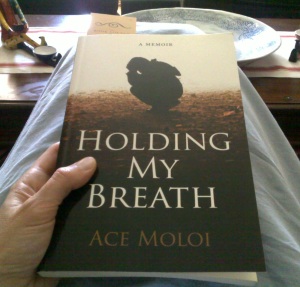 Holding My Breath by Ace Moloi is a heart-wrenching, deeply inspirational grief memoir. Written in the form of a letter addressed to Moloi’s late mother, it tells his story before and after his mother’s death. He writes in the Prologue to the book: “I have decided to break the silence between us. I am starting this conversation to remind you of your younger son and to update you on my life.” Moloi points out that mourning is like learning a new language – “the language of living without you.” His mother died of an unexplained illness when he was thirteen and left him and his older brother to fend for themselves. Their father was absent when they were growing up. The boys had to rely on other family members for support. They encountered abandonment, hunger and despair as the divided family was mostly incapable of caring for them.
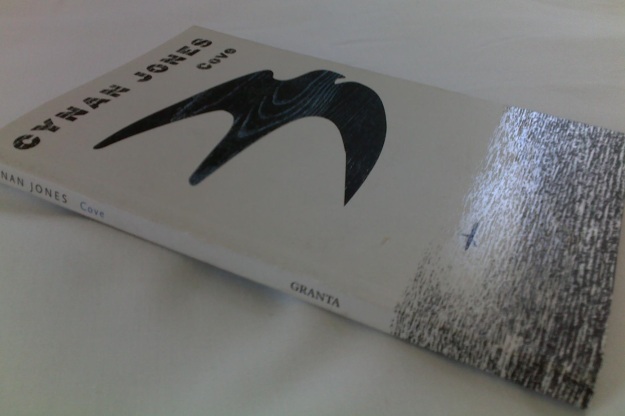 I was born in Poland, but as a student I used to live in Wales. About two years ago, I read a glowing review of Everything I Found on the Beach by the young Welsh writer Cynan Jones. The reviewer mentioned that the novel featured a Polish character. A Welsh novel with a Polish character was an irresistible combination for a reader with my literary background. I ordered and devoured it, and since then I have read every other novel or novella I could get hold of by the same author: The Long Dry, The Dig, and the latest, Cove.
 Karina Magdalena