Tag Archives: Cape Times

Review: Synapse by Antjie Krog

SynapseReading Antjie Krog’s latest volume of poetry translated into English, Synapse (Mede-wete in Afrikaans), I was faced with an old personal dilemma: How much hard work is too much in order to reach that moment where meaning and aesthetic pleasure reveal themselves to you as a poetry reader? I don’t have an adequate answer. Perhaps everyone’s threshold is different anyway. In the end all you have is your very individual frame of reference, as a friend recently reminded me.

In any poetry volume you will find poems which will immediately speak to you. Others will require a specific key to unlock a feeling of appreciation. Rereading, research, or exploration of context will eventually reward your effort. Some poems will forever remain inaccessible no matter the amount of goodwill you put in. And then there will be those which will simply leave you cold. The poems in Synapse fit into all these categories.

The volume is divided into two parts: The Yard and Four Efforts in Linguistic Synapse Tracing. The first part opens with a series of epigraphs which are followed by thirteen poems, all focused on the images of the yard and the farm. These I find the strongest and most captivating in the book. In the epigraphs we are introduced to spaces in which the land and its ownership take centre stage and gender roles are clearly defined. The poems speak of the death of a patriarch, familial roots which reach into a troubled past, grief, guilt, race relations, and the ancient questions of owning and belonging.

As the poem 11. fossilised tree trunk makes clear, everything is connected, embedded, echoed throughout history. And yet, everything changes: “after all the years we gurgle (the only outlasting ones) / burdened with the dying light and bloodsick with heritage / : the new ones prepare to enter the yard” (13. old yard). At the heart of one’s relationship with the land are beauty and language: “places that could always snap my skeleton into language / coil me into voices bore into my entrails / expose a certain wholeness of belonging as my deepest tongue / tear chorales and something like discord from my brain” (6. live the myth).

This is the kind of poetry that leaves one gasping for air, which opens up new spaces in one’s understanding and feeling about the past and everyday reality in this country.

The Yard continues with poems which grapple with morality and reconciliation. The idea of interconnectedness is challenged in hold your ear to the tear in the skin of my country where already the format of the poem signals separate spheres of understanding the concept of forgiveness. The words of the speaker of the first section, Cynthia Ngewu, who testified in front of the Truth and Reconciliation Commission about the murder of her son, one of the Guguletu Seven, cascade onto the page like a waterfall. The neat couplets which follow represent an ordered attempt to understand the motives and worldviews of the officer who was involved in the killing. In the end, we are told, “it was futile to try to weave interconnectedness into / the concrete bunker that lives inside Mr Barnard’s whiteness”.

The bleakness of moving beyond such divisions is captured in miracle where South Africa’s relatively peaceful liberation is juxtaposed with present-day, all-consuming greed and violence: “we have become the prey of ourselves caught up / in ethnic avarice and total incapacity for vision”.

More intimate poems about ageing, memory, grand-motherhood, domesticity, or the I-you constellation of lovers reveal the wonders of the world along deeper philosophical questions about our capabilities and responsibilities. The tone ranges from sombre to light-hearted. Krog is one of the few poets out there who can smuggle Skype, wifi, the Internet and memory sticks into poetry and make them look as if they almost belonged. Also, when she swears, she makes it count.

The poem convivium astounds with its breadth: “what use my caress in the breath-earthed night if a centre- / less universe opens space in the nonexistent for dark / matter to overpower a few broken beads of light?” The poem, like the human body at the core of its universe, “tuneforks such abundance”.

Apart from a handful exceptions, especially the Lament on the death of Mandela, the latter part of the volume, specifically the obfuscated Four Efforts in Linguistic Synapse Tracing left me baffled. The tightness and clarity of the preceding poems dissolved in musings where it became more and more difficult to follow the poet on her journey. The academic in me insisted I persevere and come to grips with the pieces, but the Sunday morning reader just wanted to return to the earlier poems in the collection or open another book. The Sunday morning reader won.

Synapse
by Antjie Krog
translated by Karen Press
Human & Rousseau, 2014

A ‘butchered’ version of this review appeared in the Cape Times on 19 December 2014, p. 12.

Book mark: Tokoloshe Song by Andrew Salomon

Tokoloshe SongJust when he thought that his life is going to be all peace and quiet after giving up a career as a lawyer to restore old boats, Richard is called in for an emergency at the shelter for mistreated tokoloshes where he volunteers. There he meets Lun. After a false start, they become friends and embark on a roller-coaster adventure which takes them across the country to Nieu Bethesda and back in search of the grain of truth at the heart of an ancient myth. They receive assistance from Emily and Sindiwe, midwives of a secret order. Hot on their heels are a ruthless drug lord and a world-class assassin.
I’m not a fantasy fan, but I have enjoyed some of Salomon’s award-winning short fiction. Tokoloshe Song is his debut novel for adults and is as delightful and entertaining as his stories.

Tokoloshe Song
by Andrew Salomon
Umuzi, 2014

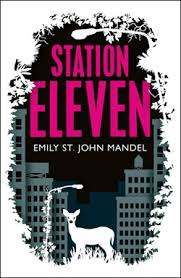
Book mark: Station Eleven by Emily St. John Mandel

Station ElevenWithin a short period of time a lethal flu wipes out 99% of the world’s population. Civilisation as we know it grinds to an abrupt halt. Station Eleven tells the story of a handful of survivors of the mayhem which ensues. At its centre is the resourceful Kirsten of the Travelling Symphony, a group of actors and musicians performing Shakespeare.

Spanning a few decades before and after the collapse, Mandel draws a bleak picture of humanity, but the darkness is penetrated by flashes of light and goodwill. Creativity, art, self-expression pave the way to society’s precarious rebirth as the individual characters realise how strongly the drive to be remembered is anchored within them. A thrilling page-turner which is simultaneously though-provoking and entertaining, Station Eleven is being deservedly compared to the likes of Margaret Atwood. This is speculative fiction at its best.

Station Eleven
by Emily St. John Mandel
Picador, 2014

Book mark: The Night Watchman by Richard Zimler

The Night WatchmanChief Inspector Henrique Monroe of the Lisbon Police Department is brilliant at what he does, but gets help from a very unusual source. When a successful businessman is murdered under strange circumstances in his home, Monroe is called to investigate. The complex case awakens memories of Monroe’s distant past of growing up in Colorado with his younger brother Ernie, and threatens to unravel the fragile new reality the cop had been constructing around himself in Portugal ever since. His search for truth takes him to the country’s highest echelons of power. What he finds is horrifying, but tragically common. The Night Watchman portrays a troubled, corrupt society any South African reader will recognise. Tense, deeply felt, the novel asks a pivotal question: “Was it a paradox that truths left unspoken ended up taking away your voice?” The disquieting answers it provides are heart-breaking.

The Night Watchman
by Richard Zimler
Corsair, 2014

Book mark first published in the Cape Times on 12 December 2014.

In 2007, I reviewed one other novel by Richard Zimler:

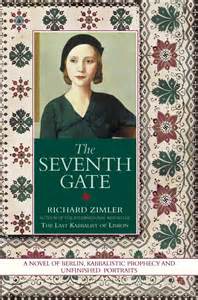
The Seventh GateThe Seventh Gate
Constable, 2007

In 1990 the discovery of seven manuscripts of the sixteenth-century Kabbalist Berekiah Zarco sparked Richard Zimler’s internationally bestselling novel The Last Kabbalist of Lisbon (1996). Following its success, Zimler, an American living in Portugal, published two other novels about the Portuguese-Jewish Zarco family: Hunting Midnight (2003) and Guardian of the Dawn (2005).

The Last Kabbalist of Lisbon explores the fates of the Jewish community at the time of the Lisbon massacre of April 1506. Partly set in nineteenth-century Africa, Hunting Midnight is the story of a friendship between the Portuguese John Zarco Stewart and an African healer and freed slave named Midnight. Guardian of the Dawn takes us back to Goa at the time of the Catholic Inquisition in the seventeenth century.

The fourth novel in Zimler’s independent historical novels series is The Seventh Gate. Set in Berlin of the 1930s, it portrays Hitler’s brutal rise to power and the effects it had on the Jewish community and the disabled long before Second World War began. It subtly exposes how a whole nation could succumb to the madness of the Nazi regime; some willingly, others under extreme pressure. Meticulously researched and vividly brought to life, Zimler’s Berlin of the 1930s is a nightmarish place where loyalty between family members and friends as well as each individual’s sanity and heroism are tested to the limits.

In spite of its harrowing topic, The Seventh Gate is the kind of novel that makes you relax after the first twenty pages, knowing that there is another five hundred in store for you before the final curtain falls. Driven by superbly drawn characters, strong dialogues, and the unusual but beautifully touching love story at its centre, The Seventh Gate is a tribute to all the people who suffered similar fates at the hand of the Nazis as the characters in the novel.

The story is told by Sophie. In the Preface of the novel she is a fragile eighty-nine year old living in America and being taken care of by her nephew. After a spell in the hospital she decides to entrust him with her memories of the past when she was a teenage German girl in Berlin of the 30s and the world began to fall to pieces.

Sophie tells the story of Isaac Zarco, a descendant of the Kabbalist Berekiah Zarco, and the members of The Ring, now a clandestine group of Jewish activists trying to fight the Nazi regime. It is also the story of her brother Hansi, a distant child whom Sophie loves dearly and whose life is threatened by the Nazis. Misunderstood by her mother, betrayed by her father and Tonio, the boy she has a crush on, Sophie has to make some tough choices, trying to protect Hansi and her friends from the Nazi onslaught. The sudden wave of mysterious murders, disappearances and forced sterilizations makes her and Isaac realise that Berekiah Zarco’s worst fears might be about to come true, centuries after he wrote his manuscripts.

Artistically talented and mischievous, Sophie is a heroine one will not easily forget. Her passion for the cinema, her growing sense of righteousness, her awakening sexuality, and her selfless devotion to the people she loves sparkle with authenticity. The novel is interspersed with the poignant sketches she draws of her friends, adding to this overall effect.

Much has been written on Hitler’s Germany, but Zimler’s The Seventh Gate reveals a side of its inhumane machinery which has not been as prominent in the renderings of the time as it should have been, as the novel carefully examines how the horrors we associate with the time of the war already started happening in the early 30s with everyone watching almost in complete silence. Zimler probes the questions of how power is consolidated by intimidation and propagandistic lies, but also shows how small acts of courage and integrity can stand in its way. As Sophie comments on her younger self: “I’m still too young to know that people need only be frightened for their lives to swear that night is day. And that they can believe it’s really true.”

In an interview with Boyd Tonkin, Zimler stated that the relationship between the siblings Hansi and Sophie is his “monument” to the victims of the Nazi war on the disabled. The author expressed his wish that “every reader who reads the book with an open heart will be devastated by what happens to them both.” Because of the powerful storytelling of The Seventh Gate one cannot help but be.

Review first published in the Sunday Independent on 25 November 2007.

Book mark: Playing House by Katherine Stansfield

Playing House_book markPlaying House is the debut poetry collection by the author of The Visitor (2013), a remarkable novel about loss and longing in Cornwall at the turn of the last century. As in her rich prose, in her poetry Katherine Stansfield has an eye for everyday detail. Her poems make us pause and consider. Whether describing a cat trying to get to an interesting-smelling morsel under the fridge, the auction of one of John Lennon’s teeth, the recipe for a crisp sandwich, or “raspberries lured to ripeness by the rain”, she moves from the familiar to the surprising and enchants in the process. Her images are clearly defined. The voice is authentic, subtle but strong. The title of the volume comes from “First Place”, a poem about a couple’s attempts at adult life. Full of thought, fun and beauty, Playing House is the real deal.

Playing House
by Katherine Stansfield
Seren, 2014

An edited version of this book mark was first published in the Cape Times on 5 December 2014.

Book mark: The Dig by Cynan Jones

The Dig_book markCynan Jones is a name to remember. The Dig is his fourth novel. It is an astounding piece of writing. Reading Jones one is reminded of the greats of English-language literature – Hemingway, Steinbeck or Virginia Woolf come to mind, each for different reasons. But Jones has a voice all his own. His prose is pure muscle and yet it conveys the most delicate of impressions and emotions. The Dig encompasses the best and worst of humanity. It tells the story of two men: a grieving Welsh sheep farmer and a brutal hunter involved in the illegal blood sport of badger baiting. The novel does not shy away from the horror of cruelty against animals, nor those moments which are unknowable, just before a life is extinguished. Yet it is most haunting when capturing what remains unsaid, as nature and life continue in the landscape of the human heart.

The Dig
by Cynan Jones
Granta, 2014

An edited version of this book mark was first published in the Cape Times on 5 December 2014.

Book mark: Unexpected Lessons in Love by Bernardine Bishop

Unexpected Lessons in Love_book markThe retired psychotherapist Cecilia and her novelist friend Helen are courageously battling cancer. The experience of undergoing a colostomy and living with a stoma binds them. Both are confronted with motherhood in the autumn of their lives: Cecilia, when her son Ian dumps a baby she had no idea existed on her doorstep, and Helen, when she receives a message from the daughter she’d given up for adoption in her twenties. They and their families discover that love has a way of finding you when you least expect it.

The same applies to Unexpected Lessons in Love. The book is that strange creature: a novel which is not exactly well written, clumsy and implausible at times, but one which has such irresistible charm that it is impossible not to love. Sadly, the author died of cancer around the time of publication.

Unexpected Lessons in Love
by Bernardine Bishop
John Murray, 2013

An edited version of this book mark appeared in the Cape Times on 5 December 2014.

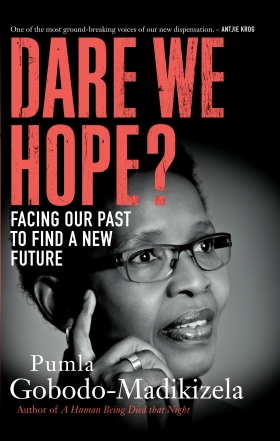
Review: Dare We Hope? Facing Our Past to Find a New Future by by Pumla Gobodo-Madikizela

Dare We HopePumla Gobodo-Madikizela’s collection of articles published between 1995 and 2014 offers a fascinating glimpse into the main issues plaguing contemporary South Africa. A professor in psychology, Gobodo-Madikizela was deeply involved in the proceedings of the TRC and wrote the award-winning A Human Being Died that Night, one of the most relevant and haunting books of recent years. It tells the story of her interaction with Eugene de Kock, the apartheid assassin known as Prime Evil.

Gobodo-Madikizela is a leading authority in research on trauma, memory and forgiveness. Many articles in Dare We Hope? focus on remembrance and reconciliation as relating to race, gender and power. Gobodo-Madikizela puts her finger on the insidious everyday ways we work against a common future by “attacking one another…in private and in public”.

Having recognised the seeds of discontent being sown and germinating in our society, Gobodo-Madikizela warns against the next revolution, “one in which the masses rise against a new breed of beneficiaries of privilege.” The “never-ending cycle of nothingness” that is poverty and lack of aspiration “strips away the humanity of individuals.” Unless we can create opportunities for people to lead meaningful lives, we will have no future as a society.

A large section of the book is devoted to dilemmas of leadership and morality. It is an incisive analysis of the “terrible shame”, the “moral rot” of the Zuma years and the terrifying legacy they are threatening to leave behind: “From the beginning, Zuma’s presidency was destined to corrupt the soul of the country.”

Gobodo-Madikizela identifies what is “missing in our democracy”: “a spirit of human solidarity that transcends the commitment to membership of one’s racial group or political party.” Her plea is for a shared humanity, for the understanding and acceptance of our diverse grievances, traumas and complicities, and, crucially, for the triumph of moral responsibility.

The articles in this book repeatedly call for dialogue: “Listening to one another and acknowledging the experience of loss on both sides would be a start.” It is a call for the employment of that wonderful faculty we all have in common: our imagination. It is also a call for moving beyond denial and revenge into a space where guilt can be articulated and forgiveness becomes a lived reality.

Dare We Hope? is an extremely sobering read. Gobodo-Madikizela is under no illusion that what she is narrating is anything but “a gruesome tale”. However, her voice is one of wisdom and, despite all, deep-seeded hope. To ignore her insights and not to heed her warnings could prove detrimental not only to individuals but to society at large. This collection is a much needed reminder that South Africa is in a dire need of more dissenting voices and, even more importantly, true leaders who can lead by example. Gobodo-Madikizela’s vision is a vital contribution in both respects.

Dare we hope? Perhaps. One thing is for certain; a lot of work needs to be done to rekindle the spark of an earlier promise.

Dare We Hope? Facing Our Past to Find a New Future
by Pumla Gobodo-Madikizela
Tafelberg, 2014

Book mark: The Lullaby of Polish Girls by Dagmara Dominczyk

LullabyAnna’s family emigrates in the 1980s before the changeover in Poland and settles in New York. Missing her roots and extended family, every summer Anna returns to Poland on her own and spends the holidays in her old neighbourhood where she befriends Justyna and Kamila. Together, they survive the ups and downs of puberty: jealousies, hang-ups about their developing bodies, the turbulences of first loves, budding sexualities and substance abuse. Some things go horribly wrong and one day Anna refuses to come back for another visit. Years later, another tragedy brings the three friends together again. Poland is undergoing its own transition while the young women face the new reality and try to pick up the pieces of their broken dreams. The Lullaby of Polish Girls is a fast-paced story of growing up in a migratory world.

The Lullaby of Polish Girls
by Dagmara Dominczyk
Quercus, 2013

An edited version of this book mark first published in the Cape Times on 14 November 2014.

Dagmara_DominczyckDagmara Dominczyk is a Polish-American actress who has appeared in the film The Count of Monte Cristo, as well as several Broadway and TV productions. She majored in Drama at Carnegie Mellon University and graduated in 1998. She is married to the actor Patrick Wilson and they live with their children in New Jersey, USA.

Review: The Gonjon Pin and Other Stories – The Caine Prize for African Writing 2014

The Gonjon PinThe Caine Prize for African Writing has a reputation of launching literary careers. Previous winners include Helon Habila, NoViolet Bulawayo, and Henrietta Innes-Rose. The Caine Prize collections of stories comprise each year’s shortlisted entries and pieces written during a workshop organised in conjunction with the prize.

By nature an anthology of short stories is usually a mixed bag. This year’s volume, apart from some excellent exceptions, is not particularly accomplished. Reading most of the contributions one senses amazing talent and potential, but the stories, even two or three of the shortlisted ones, feel unfinished. They intrigue, but do not wow despite varied themes, innovative approaches to form and content, and moments of stylistic beauty. All the elements of great short-story writing are present, but they hardly ever feature together in one piece.

African writing has a certain reputation, on the continent and beyond. Depending on individual tastes, readers either fear or count on stories of socio-political relevance, everyday hardship and disillusionment, the diaspora experience, violence and abuse, the HIV pandemic, neglect or instability. There is a prevalent feeling of ‘things falling apart’. The Gonjon Pin and Other Stories includes all of the above and in that sense does not disappoint.

The shortlisted stories stand out for their originality. In Diane Awerbuck’s Phosphorescence (South Africa), a suicidal young woman bonds with her daring grandmother over the bulldozing of a city landmark. While following the election back home on television, a Zimbabwean family tries to negotiate between a quarrelling couple in Tendai Huchu’s The Intervention (Zimbabwe). Billy Kahora’s protagonist develops an uncanny relationship to a zoo gorilla in The Gorilla’s Apprentice (Kenya). And in the winning entry, My Father’s Head by Okwiri Oduor (Nigeria), a woman tries to conjure up her dead father by drawing him, but his head refuses to fit into her sketches.

The shortlisted story which impressed me the most, however, was Efemia Chela’s Chicken (Ghana/Zambia). A young writer of remarkable assurance, Chela has that rare gift of making you pause again and again to appreciate a striking image or a perfectly balanced sentence while never allowing you to take your mind off the story she is telling. Chicken is about a woman who cuts the ties to her family and tries to survive on her own in the big city by making some tough choices.

Of the twelve workshop stories, the titular The Gonjon Pin by Martin Egblewogbe (Ghana) and The Lifebloom Gift by Abdul Adan (Somalia/Kenya) were a true discovery. Reminiscent of the mad and irresistible story-telling of such authors as the Israeli Etgar Keret or the Welsh Alex Burrett, these surreal tales made me sit up, laugh, shake my head, and marvel at the incredible power of the genre. Egblewogbe has his characters dealing with a man’s functioning genitals hanging on a study wall. Adan creates a world where an unusual man spreads cult love by stimulating people’s moles. It is gems like these that make reading anthologies worthwhile.

The Gonjon Pin and Other Stories: The Caine Prize for African Writing 2014
Jacana/New Internationalist, 2014

First published in the Cape Times, 10 October 2014.