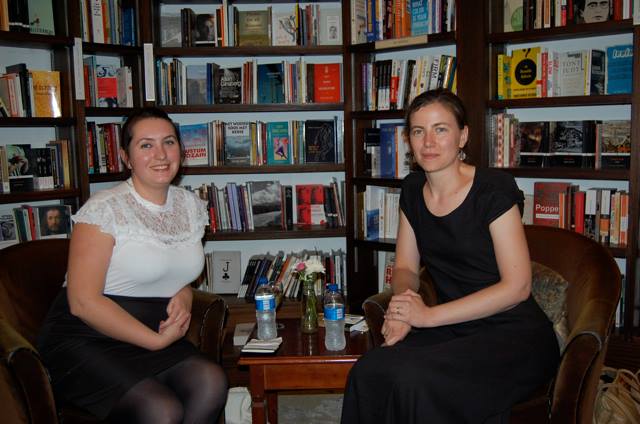
Invisible Others is making her first steps in the world. These are some of the questions I have been asked about the novel during the launch last Tuesday (interviewed by S.A. Partridge) and during the Woordfees event (interviewed by Ingrid Winterbach) on Thursday. A rough reconstruction of my replies follows.
How does it feel to hold the novel in your hands?
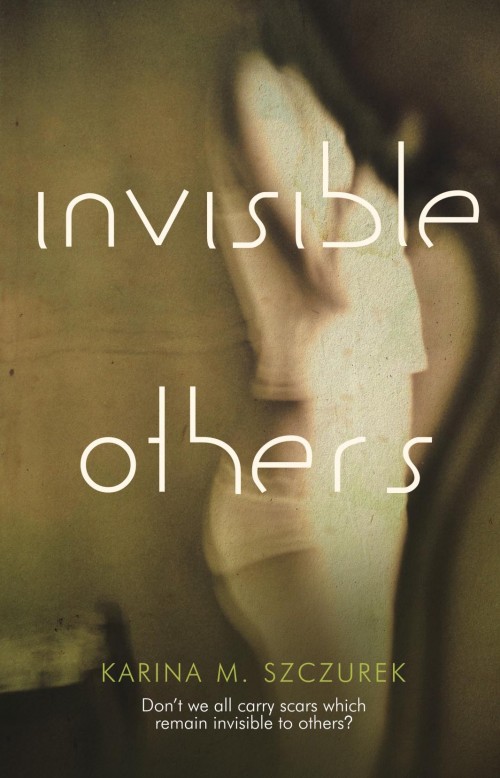
It still doesn’t feel real. I think it will take a few weeks to sink in, to properly realise that something that has lived on in my head for so many years is finally out there, contained in an object that has turned out to be so beautiful. I am grateful for all people involved in the production process of the physical book, especially Hanli Deysel and Danél Hanekom, whose ideas, designs, guidance and the willingness to cooperate were exceptional. It isn’t a given that an author is included in the decision-making pertaining to this part of a book publication.
How did the novel begin?
As a short story, and with a single image. For a long time I’d thought of myself a short story writer, but I was curious whether I could write in the longer form. To test myself, I went to a writer’s retreat in Calvinia and began writing my first novel there. In the course of my stay in Calvinia I realised that I could do it, but the story I was writing (a more typical first novel about growing up) was too autobiographical, too close to the bone, and I was not prepared to share it with an audience, at least not yet. So the manuscript ended up in my drawer. I then picked up an unfinished short story I was working on at the time. It began escalating into something longer and eventually resulted in Invisible Others. But it all started with an image of a woman and a man having a picnic in a park I knew in Paris. That scene is still in the novel. I knew that they were somehow trying to reach out to one another, but it was not easy for them to connect. The novel became an exploration of the reasons behind this difficulty.
Will there be another novel, or are you returning to the short form?
I am working on a YA novel, and I have a half-finished speculative fiction novel waiting on the backburner. But I love short stories and will continue writing them. I am intrigued by the challenge of the short story, of having to make every word and gesture count. Sometimes I feel that everything I write is about gestures, tiny imperceptible things like a glance or a twitch of a finger can change the course of a story. Capturing these moments in fiction fascinates me.
How does an academic background inform your writing?
I am aware of trends, patterns, some theory which is a good and a bad thing. As a writer, I would like to build on existing developments, but not be trapped by them. Having a very individual and specific migratory background, and yet being thoroughly shaped by my knowledge of local literature, I believe I can contribute something different to the scene. At the same time, very often being aware of what is happening can be limiting and discouraging.

Carolina’s park
I wrote about a deeply personal side of Paris – the spaces I know and love in the city, like the
Polish Bookshop or some of the restaurants and parks mentioned in the novel. But I don’t want to claim that I know Paris well. It is a city which constantly eludes me no matter how eager I am to grasp it.
I was also very much aware of the fact that Paris is one of the most written about places on the planet, and that I did not want to compete with such a significant body of work. Trying to do justice to the setting, I concentrated on a few familiar, intimate spaces. I worked from memory, but also took photographs, drew little maps, made many notes, and used Google Maps for verification. But there was a moment where imagination took over and the descriptions in the novel do not always correspond 1:1 with reality. Also, I discovered that during the time it took me to write the book some places I used as settings had changed: a restaurant I mentioned disappeared completely; the
bookshop changed its layout and expanded. In that sense, the Paris of the novel is at times a purely imagined space.
Both Cara and Konrad find refuge in Paris – why Paris as a runaway place?
For Cara, the reason why she chooses Paris becomes obvious as the novel progresses. For Konrad, it is a place that is essential to his research. From the first, Paris was always part of the story. The story chose it. On the one hand, I persisted with the setting because I liked the idea of it being an unusual place for a contemporary English-speaking South African to emigrate to. It used to be much more obvious for Afrikaans speakers to travel to Paris in the 50s, 60s and beyond. A whole generation of Afrikaans writers were shaped by their Parisian encounters. On the other hand, I did not want to write another novel about an exiled South African returning to the country of their birth. Cara and Konrad do not emigrate because of socio-political or historical circumstances, but for purely personal reasons. I wanted to write about a different migratory experience which reflects a different aspect of the reality of our globalised world – one where people migrate and choose to stay or even move on, but do not return to their country of origin. In that sense, I wanted the novel to defy expectations.
What about other research?
My characters know a lot more than I do about art, history, typesetting or geography. They have different passions and fears from mine. I wanted to make things which originated in my head come to life for others. I had to read up enough on all these subjects in order to make them believable.
And national identity?
There are two ways in which I wanted to engage with issues of identity in the novel: as an everyday experience without necessarily political or historical connotations; and an academic pursuit where these connotations matter strongly, but are nearly entirely confined to the research Konrad does, they do not spill over into his own lived experience. But on the whole, I wanted to remain on a rather superficial level while handling these issues by concentrating on the nostalgia for one’s country of origin in daily life which manifests itself in preferences for certain food, music, art, reading, drinks, proverbs, or customs. It was important for me to show that despite these obvious and natural longings, like so many people in today’s world, Konrad and Cara can make a home for themselves away from the places of their birth.
In the novel, you come across as an authority on art. What is the role of visual art in your life?
To be honest, I know very little about visual art apart from my own responses to some artists’ work. I have a deep love for beauty and objects. There is something about the timelessness and reliability of an object which fascinates me. I surround myself with objects which have meaning for me, some of these are art pieces – hardly ever of any general value, but always of enormous personal value to me. One of the reasons I fell head over heels in love with The Book of Happenstance (by Ingrid Winterbach) is the portrayal of the relationship the main character has with her collection of shells. It is one of the most, if not the most, accurate description of what I often feel for objects which matter to me, and what their loss means to me.
I am a huge fan of Siri Hustvedt’s work as a novelist and as an observer. Her books on art and looking at art are inspiring and moving. The theory is just as important as the response, and the clarity of her presentation of both is astounding.
Which artists, if any, inspired the art in Invisible Others?
These might seem like completely incompatible influences, but for Lucas’s work I thought of Francis Bacon, Egon Schiele and Tamara de Lempicka; for Dagmar’s work I thought of William Kentridge and Renée le Roux. But no specific real image inspired any of the imagined paintings which appear in the novel. It was more like the combined mood of these oeuvres that I tried to capture in the art featured in Invisible Others.
Invisible Others is a timeless story where technology takes a backseat – was this a conscious decision?
Very much so. It also reflects my own life and attitude towards social media, media in general, and the internet. I love the opportunities technology and media offer, but I have also become very cautious in using them. The internet provides us with enormous advantages; it can enrich our lives, but it can also be a dangerous tool with a sting. The exposure to media nearly destroys Cara’s life. She consciously tries to hide from it all. Konrad is weary of the pitfalls of the internet and yet can’t resist its temptations. To his credit, instead of speculating, he tries to keep an open mind and find out what he needs to know from the only person who can tell him the truth about what happened.
Why the attraction of love triangles and dysfunctional relationships?
When we are honest with ourselves, most of us will have to admit that there are many things – essential things – in our relationships with others which we cannot articulate – such as our fears, desires or passions. I have always been fascinated by this inability to communicate between people, and personally, I have worked all my life in my relationships to conquer it. But often instead of communicating, we end up falling into triangular relationships – not necessarily with other people, a hobby or work can be such an escapist third party – to satisfy what cannot be brought to light in the relationships which truly matter to us. We are mostly suckers for suffering. We need to suffer to feel alive. There aren’t many people out there who are happy without drama, who can appreciate the simple, good things in life.
Do invisible others doom relationships before they even happen?
They do. For better or worse, we carry around the memories and ghosts of people who have shaped and influenced our lives and very often we are either unaware of their presence or not courageous enough to admit to it or face it. These invisible others can interfere with our present relationships if we allow them to haunt us. Finding a way to see and understand these spaces and figures makes relationships possible, or not, if we fail. This is where fiction comes in for me: writing is often an attempt at trying to penetrate those spaces.
What drives Cara into the affair?
A powerful attraction. She falls for the wrong man and persists in the relationship. It seems to me that we often stay in relationships because we believe that we have already sacrificed so much for them, we simply have to make them work, even if the only sensible thing to do is to cut one’s losses and walk away.
Why should the reader identify with her?
I hope readers will travel a journey with Cara similar to my own. When she appeared to me in that picnic image in the park, she started off as a puzzle, a mystery, one I did not particularly warm to, but one who intrigued me. I wanted to understand her, to see what made her tick, and almost inevitably I started caring for her in the attempt. Cara defied me. She showed me that sometimes people do terrible things not because they are terrible people, but because they can’t help themselves. One can appreciate or forgive a lot as long as one understands the reasons. This is part of what Siri Hustvedt refers to as “a call for empathy” and the reason why I chose the passage from one of her essays which explains this phrase for the epigraph of Invisible Others.
The ending of the novel was puzzling – can you comment?
The ending somehow surprised me as well. It has everything to do with the fact of how Cara took over her own story, how she did not allow me to leave her entirely in the lurch (as I was keen to in the beginning). It is an open ending. It is wonderful for me to see how some of my readers are beginning to interpret it. Deep in my heart I can feel what happened to Cara, but I still want readers to decide for themselves.
In the novel, Cara turns to reading for solace or guidance. What would you like readers to take away from this novel?
I suppose a bit of both, but mainly solace – I don’t feel that I have the right to guide anybody. But if readers find a moment of truth or revelations in the novel which penetrates their own invisible others and inspires them to explore, communicate, understand these spaces, the magic of fiction would have happened, and that would be more than I would dare to hope for.
You are married to one of the most important contemporary South African writers with an overwhelming oeuvre to his name. Isn’t it a bit intimidating?
Not at all. In the beginning, when I started getting to know André I was a bit scared of his creative process. I know that for many it can be a process of solitude and exclusion and I did not know how I would fit into, or around, it. But then I discovered how open to sharing André was, how generous and supportive, and I relaxed completely. Our studies are at the opposite ends of a passage in our house. There is a lot of communicating going on between them, and invitations to tea.
André’s body of work is enormous, and I am its greatest fan. It doesn’t intimidate me because I have no intentions of competing with it – that would be ridiculous. My writing is very different, the stories I want to tell are my own. I am grateful for all of André’s support and expertise, but I also know that it works both ways. I offer the same to him. There is no room for intimidation in our personal and literary relationship.
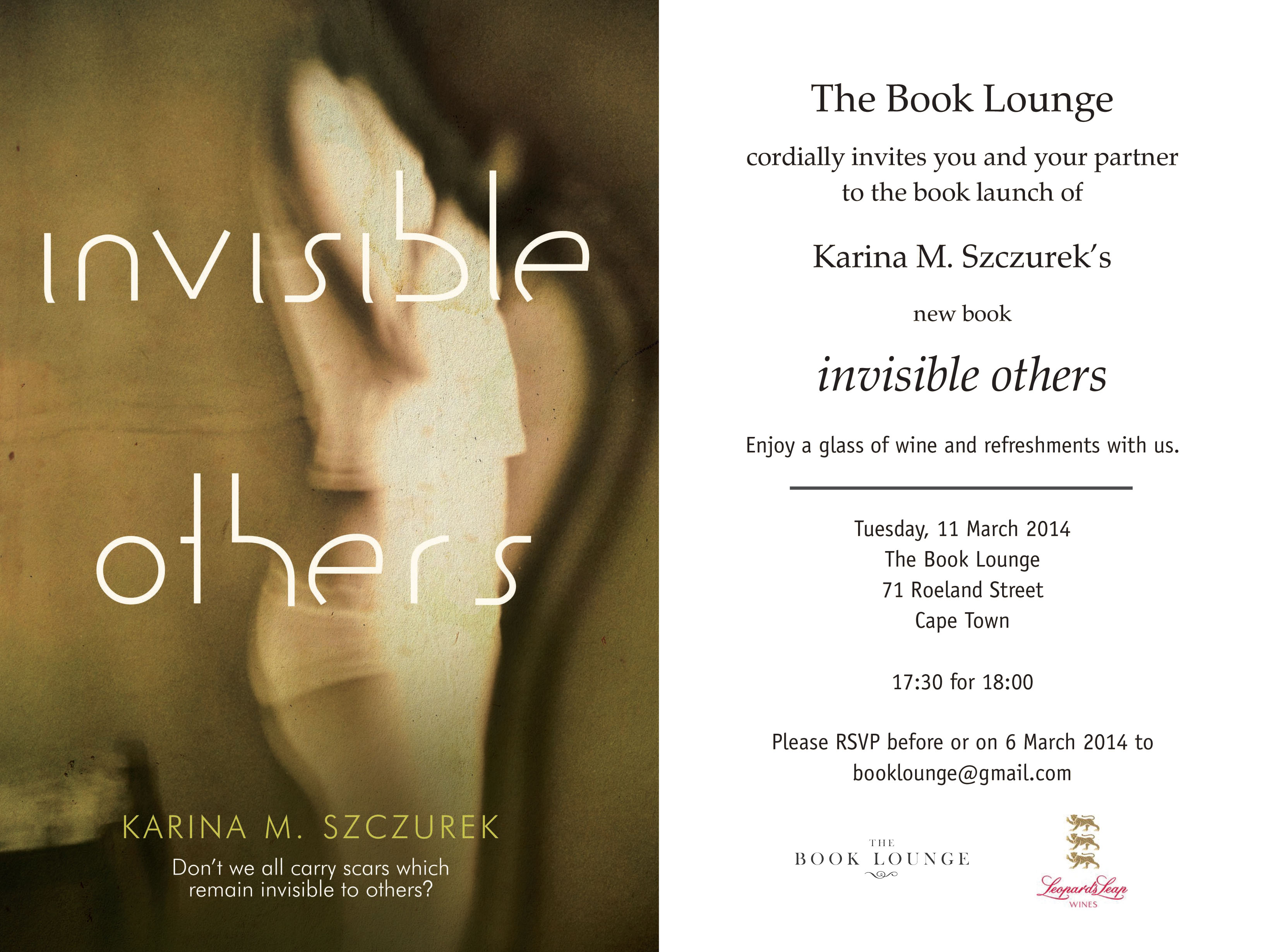
 The following is an invitation to my “homecoming launch” at the Rondebosch branch of the Protea Bookshop:





 Karina Magdalena