Category Archives: What I’ve Written

Book mark: Unsettled and Other Stories by Sandra Hill

UnSettledThe feeling one is left with after reading Sandra Hill’s debut story collection Unsettled is reflected in the title of the book. Hill paints vivid portraits of what it means to be a woman in different places and times. It is a finely layered picture of the everyday and the unusual. The mother of one of the characters insists that one should read poetry “slowly, expectantly, the way you eat oysters”, as the “magic…comes after you swallow.” Although every story is a fully contained piece, read together, they acquire that magic of swallowing oysters. Saturated with local flavours, settings, history, Unsettled offers evocative, intimate glimpses of women’s lives – their dreams, desires, worries and regrets – many readers will find uncannily familiar, sometimes perhaps difficult to acknowledge: “Life can take us away from where we belong, but we don’t lose the longing for it… If we are lucky we get to make our way back.”

Unsettled and Other Stories

by Sandra Hill

Modjaji, 2015

First published in the Cape Times, 25 March 2016.

Review: Stations – Stories by Nick Mulgrew

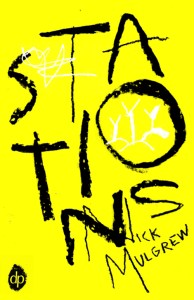
StationsIt’s difficult to believe that this is only Nick Mulgrew’s debut collection of stories. Stations reads like the work of a seasoned writer. Here is someone with acuity and a perfectly pitched voice. Not surprisingly, his writing is already highly acclaimed.

As the title suggest, the individual pieces in the book take their cue from the Stations of the Cross, in which Jesus’s last steps before crucifixion are commemorated. The dialogue between the structural skeleton of the book and each tale is striking. “Athlone Towers”, the volume’s first story, or “stop on a slow road to purgatory” as the spine of the book professes, uses the powerful image of the demolition of the famous Capetonian landmark to portray the demise of a relationship. At the same time it echoes Jesus’s condemnation to death. In the fourth “stop” of the book, “Ponta do Ouro”, a young man accompanies his mother on a fraught Christmas holiday to Mozambique. His parents are in the middle of a divorce. The corresponding station reflects Jesus’s encounter with his own mother shortly before his death. In “Restaurant”, a hopeful entrepreneur has to close down her restaurant. Her suffering mirrors Jesus’s death on the cross. In all of the stories, the devotional references are very subtle but enrich the reading substantially.

The way the stories engage with their religious context reminded me of Krzysztof Kieślowski’s Decalogue, the Polish director’s ten films based on the Ten Commandments. What captures the reader’s imagination is the way the teachings are translated into a modern, often secular, narrative that we can all relate to.

Mulgrew’s characters are in transit, on the verge of a discovery or transformation. His stories are set around South Africa and beyond, even in the afterlife. The titular story takes us on a trip through the purgatory, which is reimagined as an alternative version of the Cape Peninsula: “Everything was familiar, but not familiar enough to be comforting… My heart dropped. This place had a geography that had to be relearned.” It is one of the most profound readings of the tensions and dilemmas of present-day Mother City. “Mr Dias”, “Posman”, or “Die Biblioteek vir Blindes”, also grapple with contemporary issues such as racism, affirmative action, or intolerance, but are more preachy and a slightly less successful.

The stories which spoke to me best were of intimate nature, focusing on topics close to the heart: rites of passage, grief, revenge, sexuality, or relationships between siblings, lovers and strangers. It is in these spaces that Mulgrew connects with the reader most poignantly, describing what might otherwise go unnoticed: “You lean to kiss me between the back of my ear and the top of my neck; in that place that doesn’t have a name.”

Mulgrew and I co-edited a book of African short stories. Watching him as an editor was a fascinating experience. His fine-tuned sensitivity and attention to detail are exceptional. He is also a fine poet, a true language practitioner. These talents reverberate in the arresting prose of Stations.

Stations: Stories

by Nick Mulgrew

David Philip, 2016

Review first published in the Cape Times on 18 March 2016.

Review: Mongrel – Essays by William Dicey

Mongrel EssaysThere is nothing quite as satisfying as an excellent personal essay, and William Dicey’s Mongrel contains six gems of the genre. Dicey has been on my literary radar for a while now. In the past decade, whenever I found myself admiring a beautifully designed local book, Dicey’s name would often feature on the copyright page. His first book, Borderline (2004), a travel memoir about canoeing on the Orange River, is one of those titles readers remember fondly whenever mentioned, but apparently, it is out of print. Fortunately, I found a copy in our library. I have been meaning to read it for years, and Mongrel has finally made me realise that I need to succumb to the longing.

The essay collection opens with four epigraphs which already warn us that what lies ahead will not be as clear-cut as one might assume.

Allow me to quote a few snippets:

– “Fiction, nonfiction – the two are bleeding into each other all the time …” (Geoff Dyer).

– “The writer getting in the way of the story is the story, is the best story, is the only story” (David Shields).

And my favourite:

– “[T]he strays of literature have tended towards the ill-defined plot of the essay” (Hugh Walker).

The tone of the essays ranges from intimate through personal, playful, or analytical, to simply bizarre. The latter becomes immediately obvious when you consider the title of the first piece in the collection, “Miss Meat Festival”, and its first sentence: “Hannes Rheeder, I love you like a fish parcel.”

Dicey and his friend Justin are travelling north to the Hantam Meat Festival in Calvinia, an “annual celebration of mutton and lamb”…

Continue reading: LitNet

Review: Reacher Said Nothing – Lee Child and the Making of Make Me by Andy Martin

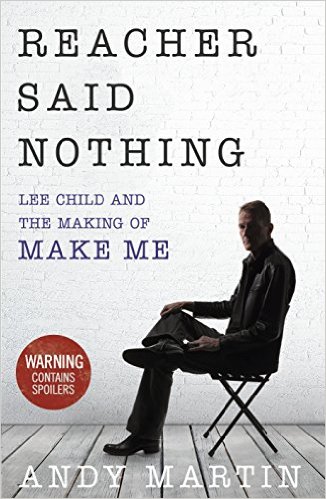
Reacher Said NothingMany of my friends will know this story: last year, after my husband died, reading became one of my grief’s casualties. For weeks, I struggled to open a book. That changed when I turned to Lee Child’s Killing Floor. It was just the right kind of light but intelligent and thrilling entertainment that I needed to get hooked on reading again. In the following nine months, I read all other nineteen novels in the Jack Reacher series, and many others.

Having become such a passionate fan, I was excited to find out about Reacher Said Nothing: Lee Child and the Making of Make Me. The author, the Cambridge academic Andy Martin, asked Child whether he could shadow him during his writing of Make Me, the twentieth and latest Reacher novel. He was keen to observe and record Child’s creative process as it happened, proposing “a kind of literary criticism but in the moment, in real time, rather than picking it up afterwards…trying to capture the very moment of creation…you would have someone (i.e. me) looking over your shoulder as you are typing the words.” Five days before the first word of Make Me appeared on Child’s computer screen, he agreed to the literary adventure.

Reacher Said Nothing not only takes us behind the scenes of Make Me’s genesis, but Child’s entire career. It goes back to 1994 and the day when Child bought the paper and pencil with which he wrote Killing Floor, the first in the bestselling series. He now writes on a computer, eating quite a lot of junk food and drinking ridiculous amounts of coffee. With Martin there, literally on the couch behind him, Child attempts to verbalise what happens when a writer picks up a pen, or keyboard, and begins dreaming. In this respect it is as much a book for readers as for writers. When writing, Child thinks like a reader; that’s his thing. But there is no magic formula. Only a lot of doubt, hard work (each Reacher is about 100 000 or more words long), and when you are lucky, a good story to tell. Millions of devoted fans across the world can testify that Child knows how to pick them.

Andy Martin also has a great story to tell. Reacher Said Nothing reads like a thriller. Like a master of the genre, Martin builds up the tension to the moment when Child sits down to write the first sentence. From there, he continues about the power of storytelling – the written word’s extraordinary potentials for both, writers and readers.

“He would have been good around the campfire, Lee – he would definitely make you forget about the wolves or the saber-tooth”, Martin writes. But it’s not only the engrossing plot. One of the things that immediately struck me about Child’s writing is a captivating attention to stylistic details such as word choice, syntax, punctuation – a kind of poetry that I now realise is fully conscious, intentional. “It all mattered, linguistically”, Martin writes. It’s about noticing things. And to see the process unfold is fascinating. Child writes only one draft, but the meticulousness with which he constructs the narrative allows him to.

Martin also accompanies Child to literary events, signings and interviews. He speaks to his fans. They spend a lot of leisure time together, watching football or meeting friends for dinner. I loved the humour of Reacher Said Nothing, the banter between the two authors, and Martin’s often hilarious commentary. An early scene: “‘It’s reverse Freudian,’ Lee said. ‘You’re on the couch and you are analysing me.’ I said nothing. He flexed his fingers. ‘Naturally I’m going to start, like all good writers, by…checking my email!’”

Martin and his subject surface from Reacher Said Nothing as two people who are really passionate about what they are doing, are prepared to work their fingers to the bone in pursuit of their visions, and know how to have fun while doing it: “I live in a permanent daydream. I get paid to daydream narratives”, Child says. Reading the book one is inspired, but also reminded that writing is laborious.

Child’s relationship with his fictional character Jack Reacher is most intriguing, and strangely comforting. Anyone who has non-existent people occupying their heads knows what it’s like. Fiction is a thrill, and all of us, readers and writers alike, are junkies. Together with Martin, Child attempts to unravel the two-decade-old mystery behind his character’s worldwide appeal to men and women alike.

It wouldn’t surprise me if Reacher Said Nothing sparked a craze among authors wanting to have a meta-book written about the creation of their own novels in real time as they emerge on the page. It might become a genre in its own right, but Martin’s and Child’s example will be hard to equal or top.

Reacher Said Nothing: Lee Child and the Making of Make Me

by Andy Martin

Bantam Press, 2015

Review first published in the Cape Times on 11 March 2016.

Book review: I’m Travelling Alone by Samuel Bjørk

TravellingAloneDespite my irredeemable addiction to Lee Child’s Jack Reacher series, I do not often turn to thrillers or crime fiction for entertainment. But Night School, the next Reacher adventure, is coming out only in September, and since the nights are getting longer, it is nice to have a few good stand-ins in the meantime. Locally, I really enjoyed the recently published Sweet Paradise by Joanne Hichens: tight plotting, great writing, a scary villainess, and a heroine with balls. It surprised me, and that is a quality I truly appreciate in genre fiction.

I remember picking up Henning Mankell’s The Man from Beijing and realising how it would end just after a hundred pages. For the rest of the book, I had hoped the author would astonish me, but he didn’t. That kind of disappointment is not easily forgiven. But Scandinavian crime and thriller authors have been making huge waves on the international literary scene in the last decade or so. I devoured Stieg Larsson’s Millennium trilogy and like millions of readers around the world could not get enough of its intriguing main characters, Lisbeth Salander and Mikael Blomkvist.

It seems that there is a new kid on the Scandinavian crime block, Samuel Bjørk (pen name of the Norwegian writer and musician Frode Sander Øien). His I’m Travelling Alone is making international headlines, reaching the prestigious German magazine Der Spiegel’s number one bestselling spot and selling TV series rights to ITV. It comes with a quote on the cover, warning his compatriot Jo Nesbø to “watch out”. Being unfamiliar with Nesbø’s work, I cannot compare, but judged solely on its own terms, I’m Travelling Alone is a spine-chilling, page-turning novel.

In 2006, a baby disappears from the maternity unit of Ringerike Hospital in Hønefoss in the south of Norway. Half a dozen years later, a six-year-old girl is found dead hanging from a tree. Dressed like a doll with an airline tag which reads “I’m travelling alone” around her neck, the girl is soon believed to be the first victim of a serial killer about to strike again. A race against time begins. Holger Munch is put in charge of finding and bringing the killer to justice. Despite, or precisely because of, being the typical middle-aged, overweight, chain-smoking, sadly divorced, veteran police investigator, Holger is instantly endearing. As is his partner, the deeply disturbed but fascinating, thirty-something Mia Krüger.

In the beginning of the book, Mia is living in complete solitude on an island, drugged and drunk, mourning her beloved sister and awaiting her own death. It takes some persuading from Holger to sway her to postpone her suicide in order to help him solve the case. They both have a troubled past to atone for, and have no clue how it is about to surface to haunt them.

The next girl is found murdered and two more go missing. But then the ruthless killer changes his (or her? the police are uncertain) MO and contacts a journalist writing for a daily, placing him and his editorial team in front of an impossible choice: Who dies next? And when Mia and Holger discover that the next intended victim is someone they both know and care about, the urgency to track down the perpetrator intensifies unbearably. The hunt leads them to a mysterious sect and an old-age home where Holger’s mother lives. What at first seems a dead end reveals itself as a deadly possibility. And the murderer is always a step ahead.

The two investigators, the police squad, and family and friends around them are all well-drawn characters one takes immediate interest in and liking to. They propel the story forward. Additionally, to a certain extent, I’m Travelling Alone felt like armchair travel. I have a very soft spot for Norway, having travelled the country, loved its landscape, read some of its brilliant classics, and made a few Norwegian friends for life. I actually visited some of the places mentioned in the novel, have experienced the weather and tasted the food. Reading all the everyday details of the characters’ lives has brought back many great memories. I couldn’t resist and had some herring again while reading.

I was spellbound almost to the end. However, the last twenty pages let me down. To be honest, I am not sure that I understood how all the puzzle pieces of the story fit together or whether the author managed to tie up all the loose ends, yet it somehow did not matter. I found the ride as far as the last four or five chapters exhilarating and the strangely abrupt ending did not spoil the fun. I sincerely hope that Mia and Holger will return and I look forward to the next Samuel Bjørk crime novel with great anticipation.

Review first published in the Cape Times, 4 March 2016.

I’m Travelling Alone

by Samuel Bjørk

Doubleday, 2016


Book review: Letters of Stone – From Nazi Germany to South Africa by Steven Robins

Letters of StoneReading about the Holocaust is never easy. Facing its terrible truths, especially when your own family is involved, is heroic.

Anthropologist Steven Robins had no inkling of what he would unearth when he embarked on a quest to discover more about the three women in an old photograph that had sat in his childhood home for years. He was born in 1959 in Port Elizabeth. He and his brother Michael grew up oblivious to their Polish and German ancestry and to the fates of their father’s relatives during the Third Reich.

The journey Robins takes in Letters of Stone connects “different times and places”. It is a journey that took nearly three decades to complete – between the time Robins interviewed his father in Port Elizabeth in 1989 and the publication of this astounding book. To begin with, Robins had very little to go on. But a series of uncanny coincidences led him further into the labyrinth of the private history of his family, and beyond.

Continue reading: LitNet

The Break-up

Break-Up LitNet illustration

It was an awkward situation. I was standing there, in front of my best friend’s door, with a cardboard box and an old suitcase in my arms, feeling foolish. I could hear her drying her hair inside. Taking a deep breath, I pressed the bell.

“Coming!” Marlene shouted, switching off the hairdryer.

When she opened the door, the dark hallway of the flat building was flooded with sunshine. It was the beginning of a hot summer day, the humidity in the air promising rain later in the afternoon. Marlene’s damp red curls looked on fire in the bright morning light.

She hovered in the doorframe, staring at the box and the suitcase, twisting one of her curls between a forefinger and a thumb.

“Hi,” I volunteered.

“Hi, come in.” She disentangled her fingers from her hair and swept her hand aside in a gesture of welcome. The flimsy bathrobe she was wearing came undone as she did so, and I glimpsed a perfect, small breast before she tied the garment tighter around her waist.

“This is weird,” she said, following me into the flat.

I pressed my lips together and agreed. “You can say that again.”

We were facing each other, not really knowing how to proceed. Nothing had prepared us for this odd situation.

“I don’t know.” She paused. “I don’t know whether all the clothes will fit into this suitcase.” She rushed through the second part of the statement. “The box might also be too small for all the other stuff,” she added with a shy smile.

“That’s alright, maybe you’ll have a bag or something for me?” I looked her straight in the eye, without returning the smile. I didn’t know what was really expected of me. Was I supposed to be distant? Angry? Sympathetic? I had no clue. Deep inside, I simply wanted to be neutral, but that didn’t feel right either. But how was I to pick sides?

“Right!” She gracefully turned on her bare heel. “Let me show you the stuff first.”

She led me to her bedroom. As always, the place was in a state of chaos. I never saw her make her bed, or pick up all the magazines and books from the floor. She was the fastest and least discriminating reader I knew; the likes of Dan Brown and Virginia Woolf were strewn all around us. We shared the passion of reading, but I was more careful with my choices, and I liked to be organised. Pedantic, is how Marlene described it. I preferred to think of myself as fastidious.

“That’s all I could find.” She pointed at a pile of clothes on the bed next to one of the crumpled pillows. “Some pieces were still in the laundry basket, so he might want to check.”

She reached for the box I was carrying. “Let me try to get the other stuff in here for you.”

While I was packing the suitcase, she put some DVDs, CDs, computer games and comic books from another pile on the floor into the box.

“I’ll get a plastic bag for the sneakers and the roller blades,” she said and left the room.

With difficulty I zipped up the bulging suitcase and looked at the box. I recognised the top CD cover: Lady Gaga. Kester once played the record for us. I tried to keep up with the latest in music, but some developments were beyond me.

Marlene returned, packed the remaining items, and handed me the bag.

“This won’t change anything between us, will it?” She was facing the window and the lucid sunlight illuminated her features again. I knew her well enough to recognise what was coming. I wasn’t good with tears, especially not hers.

“Of course not,” I reassured her, put the bag aside, and pulled her into a loose embrace. Her hair smelled like summer rain on hot concrete.

Continue reading: LitNet

Book review: The Seed Thief by Jacqui L’Ange

The Seed ThiefThere are writers and then there are writers. Most of us can only dream of becoming the kind of writer Jacqui L’Ange already is, and the stunning The Seed Thief is only her debut novel. Her prose is luminous. It feels as if her words are caressing the pages they are printed on. Enthralled from the beginning, I was reading with bated breath, afraid that the author could not sustain such excellence through an entire novel, that she would take a false step, get lost along the way, and lose me as a reader. But The Seed Thief is one of those rare books which deliver on all fronts and leave you completely satisfied.
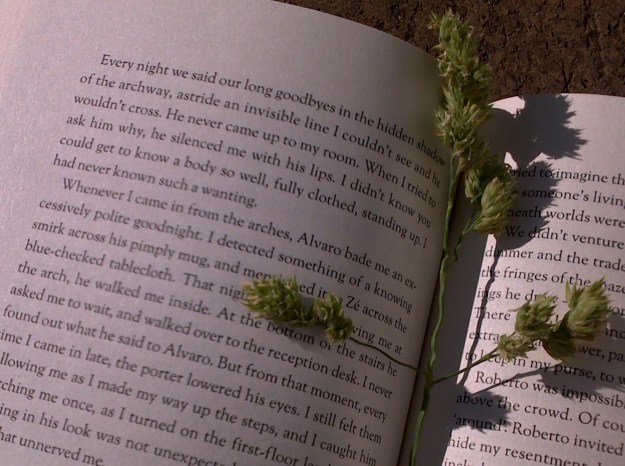
The novel tells the story of Maddy Bellani, a South African botanist with migratory roots. She works for one of the world’s seed banks in Cape Town, specialising in fynbos and dedicated to preserving the floral diversity of our planet for future generations. Brazilian by birth, Maddy is sent on a mission to Salvador, Bahia, to locate and secure the seed of the Newbouldia mundii, an African tree extinct on its continent of origin, but rumoured to have survived in Brazil, where it had been taken to by Africans during the slave trade. The plant is desired not only for preservation, but specifically for its medicinal properties. And some people are prepared to do anything to get their hands on it.

Maddy embarks on the mission after the break-up of her relationship with Nico: “Only now that it was finally ending, could I admit how much I’d wished we could have turned the mutual vulnerabilities that brought us together into something less fragile.” She is haunted by a family tragedy from the past and the relationship with her estranged father who finds out about her visit to their home country and attempts to get in touch: “Just knowing that he knew I was here made my emotional barometer plunge.”

Keen on redefining herself in Brazil, Maddy flies to the other side of the world in pursuit of the elusive Newbouldia mundii. The seed is protected by the practitioners of Candomblé, an Afro-Brazilian religious community worshipping gods and goddesses called orixás. Negotiating their different customs and loyalties is not easy and, as Maddy discovers, sometimes what you get in the end is not exactly what you set out to find.

Seeds are like love, unpredictable in the paths they travel. They take root in the most unlikely places, often against all odds. In order to gain access to the treasure she seeks, Maddy has to gain the trust of the Candomblé terreiro (the house of worship) and Zé, the mysterious man who guards their garden: “The rhythm of our interaction became a gentle ebb and flow. He would open up and play, then retreat and observe. Whenever he retreated, I found myself wanting to follow, to draw him back out and close to me. When he came in too close, I pulled back just enough for him to gather himself like the tide.”

Continue reading: LitNet

wanting_The Seed Thief

Book review: Roberto Calasso’s The Art of the Publisher

The Art of the PublisherEvery now and then, a book comes along which changes your life. For me, Roberto Calasso’s The Art of the Publisher is one of them. But you don’t have to be – or, like me, want to become – a book publisher to find this gem an inspiration.

For quite a while now, publishing has been steeped in a pervasive atmosphere of gloom and doom, especially in South Africa. The threat of the internet, the e-book, the retail giant Amazon, and the financial crisis have made life for the printed book difficult. Locally, a seemingly general disinterest in South African fiction and foolish political decisions have made survival tougher for our publishers, and consequently, of course, for us writers. Book sales are not encouraging. Publishers scaling down even less so. Yet, watching developments like the self-publication of Paige Nick’s latest novel, Death by Carbs, or new publishing ventures like uHlanga and Tattoo Press, I have a feeling that some creative and daring people in the country are on to something which gives me many reasons for optimism.

Roberto Calasso’s essays collected in The Art of Publishing attest to the fact that it all comes down to basics. And the basics are vision and quality. It is these two aspects of publishing that readers throughout centuries have best responded to with enthusiasm. These are no trade secrets, just simple rules which those who have been successful in publishing have always followed.

Critic, writer, and a publisher himself, Calasso has been at the forefront of Italian publishing for decades. His love for literature and the book shines through every single paragraph of The Art of Publishing. His passion is one of beauty. His insights are heartening to read.

When it matters, publishing is not about money, although, as with all art forms, moderate financial rewards cannot and should not be excluded. There are enough examples out there to prove the case. All aspects of the form play an integral part in its success: “choice and sequence of titles published…texts that accompany the books, as well as the way in which the books are presented as objects.” Calasso does not deny that this is “the most hazardous and ambitious goal for a publisher, and so it has remained for five hundred years”, but he also reminds that “literature loses all of its magic unless there’s an element of impossibility concealed deep within it.”

He goes into the fascinating history of publishing, asks what constitutes culture, celebrates the great publishers of our times, explores the relationship between the publisher and the writer, demonstrates how crucial the nourishment of writers and the care for the book as an object are to a thriving publishing environment, and most importantly, to our intellectual and emotional lives.

Calasso also shows that even if often unbeknownst to us why a particular publisher attracts our enthusiasm, as readers we understand the value of our “repeated experiences of not being disappointed.” And that is what only a publisher of vision and quality can offer.

The Art of the Publisher by Roberto Calasso

Translated from the Italian by Richard Dixon

Penguin Books, 2015

Review first published in the Cape Times, 22 January 2016.

Two comments:

When I truly enjoy a book I have the need to share it with others. I have already bought several copies of The Art of the Publisher for friends, two more today…

I was attracted to the book in the first place because it appealed to me as an object. I saw it displayed at the Book Lounge in Cape Town and could not walk away from it…

“Your library is your soul”: Reflecting on Kate Atkinson’s A God in Ruins

A God in Ruins_Costa

Despite her substantial literary success, I did not know Kate Atkinson’s work before A God in Ruins was recommended to me by a friend whose taste I value. It won the Costa Novel Award in the beginning of this month, as did Atkinson’s previous novel, Life After Life (2014). The two are related, but can be read independently. I hope to turn to the sibling soon, as A God in Ruins is one of the most exquisite novels I have ever read, and the idea of Atkinson’s backlist reassures me greatly.

A God in Ruins is many things. It is the story of a British family set against the historical background of the past century. It is a novel about war and its aftershocks. It is a fine enquiry into human nature. But above all, it is a declaration of love for literature, its power and its manifold mysteries. And it is highly ambitious. What astounds about A God in Ruins is that it never falls short of these formidable ambitions. Such novels are rare. They take root in your mind and blossom in your soul. Even ferocious readers encounter a novel like this only once in a while.

The way it captures fiction’s ability to heal, to open up spaces in us we never even knew existed is striking. It is poetic in style as well as in its wisdom. For me personally, A God in Ruins was a magical key. It opened two doors in my life. Two doors connecting the past to my fragile present: one appeared while I was still reading, the other after I’d finished the novel. I stepped through the first, an imaginary one, during one of those serene nights when you are at peace with the world and yourself. It was around midnight. I was lost in the arms of a comfy easy chair; a soft caramel light illuminated the room. When I looked up from the book, I saw something so beautiful that I wanted to hold on to it forever. But I was scared to disturb the scene by searching for my camera, so I turned to the last blank page of A God in Ruins and drew a sketch of what was in front of me: a moment of flickering hope. It is also engraved in my heart.

The second door was real. It is the door to my late husband’s library. There are innumerable books in our house. We have roamed among them with the great pleasure that exploring books can bring only to two readers in love. When I finished A God in Ruins, I was crushed by the inability to share it with André. It was published a few weeks after his death. But I knew, had he been alive, I would have passed the novel to him the second I was finished with it that early Sunday morning, and I would have asked him to read it immediately so that we could discuss it in detail. Instead, I was all alone in an empty bed and all I could do was weep. What I have discovered about grief and loneliness is that it is not the lows which are unbearable, but the emptiness of the highs, when all you want to do is experience them with the person you love and there is no-one there to hold you…

Continue reading: LitNet