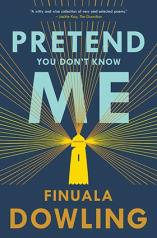
 If you are a reader of poetry, the last thing you should do is heed the instructions of the title of Finuala Dowling’s latest collection. Pretend You Don’t Know Me: New and Selected Poems brings together a selection of some of her best poetry from four previous volumes (three of them out of print now) and twenty-two new poems, each of which will make you want to know her work – not only the poetry, but the prose as well. Dowling is also the author of four novels, with a fifth to be published later this year. She is the recipient of the Ingrid Jonker, Sanlam and Olive Schreiner Prizes and is rated as one of the most significant South African poets writing in English today.
Dowling is like the lighthouse on the cover of Pretend You Don’t Know Me. Her words shine a light for souls lost at sea. She has the ability to hold vast expanses of human experience in a few lines, and to make it look effortless. That is what made me fall in love with her work a long time ago, and I was delighted to encounter many of my favourite poems from her older collections here. Her new poems – full of loneliness and sadness, but also warmth, courage and fragile hope – continue to satisfy like no others. Let me quote just one example. In Q&A for an Unfair World, not only the individual sense of helplessness is captured, but our global anguish: “Will this meeting ever end? / No. / What are we saying goodbye to? / Everything. / Is the wrong person in charge? / Yes.”
Through her keen insights and rare sensitivity, Dowling allows us to smile despite all that, and it’s no coincidence that Pretend You Don’t Know Me ends with the word “welcome”.
Pretend You Don’t Know Me: New and Selected Poems
by Finuala Dowling
Kwela, 2019
Review first published in the Cape Times on 30 August 2019.


 It was by chance that I read Musawenkosi Khanyile’s debut poetry collection on a rainy morning, still tucked up in my bed. But it was no coincidence that the juxtaposition of the comfort of my bedroom and the realities described in the volume repeatedly moved me to tears. Unapologetically autobiographical, the poems included in the book trace the author’s journey from childhood to adulthood, from his rural family home, through the township, to the city. A journey undertaken by many, but not often evoked in poetry with such distinct tenderness that it takes your breath away.
 The Wickerlight is the second book in Mary Watson’s The Wren Hunt series for young adults. In the first book, the protagonist Wren is chased and taunted by a few boys in the woods around Kilshamble, the village where they all live. Set in modern day Ireland, but one in which magic is as real to the novel’s characters as social media, the next instalment in the series picks up the story of one of these boys, David. He is a member of the judges, one of the ancient draoithe clans. Their sworn enemy for centuries are the augurs.


 The other sessions were Finuala Dowling reading from her latest poetry volume, Pretend You Do Not Know Me, a ‘best of’ collection which also includes stunning new work; followed by John Maytham performing “Being Human”, a poetry script compiled by Finuala; Wilhelm Verwoerd talking about “that last name”; and Duncan Brown encouraging us to “rewild” our lives. While John was still in the audience, listening to Finuala, I was reaching for a tissue to deal with the emotions her poetry was evoking in me and glanced at him wiping away his own tears. We were both incredibly moved. And then, John made us laugh and cry with his exquisite reading of the poetry Finuala prepared for him. There was one particular poem that made us all crave chocolate cake so much that some delicious sinning was happily indulged in at lunchtime.


 There aren’t really many among the cast of characters in Mick Herron’s Jackson Lamb spy thriller series that you would want as a friend. On the whole, they are a bunch of losers. It’s almost always certain that they’ll either let themselves or their colleagues down. Yet, you can’t help but follow their (mis)fortunes with feverish anticipation.
 Opening an Ingrid Winterbach novel fills me with excitement every single time. She is one of my favourite contemporary Afrikaans writers and I am immensely grateful that her work is available in English.
 The sixth Jackson Lamb thriller, Joe Country by Mick Herron, is hitting our bookshelves. The Drop is a novella in the series that only a few months ago introduced a new character into the cast of Regent Park’s drop-outs whiling away the time as “slow horses” in Slough House, where Jackson Lamb rules supreme. Whereas most of them arrive on Lamb’s doorstep after a major screw up in the field, the new addition ends up in the dubious care of the obnoxious Cold War spy through a set of weird coincidences. His fate is sealed after Solomon Dortmund, an old spook, observes an envelope changing hands in a way that stirs all the retired spy’s hard-wired intuitions into action.
 “Now, there are storytellers, and there are Storytellers”, the narrator of Water No Get Enemy, one of Fred Khumalo’s stories collected in Talk of the Town, tells us about Guz-Magesh, a larger than life character who features in two of the pieces: “His well of tales is bottomless.” He has that in common with his creator. Khumalo is the author of four novels. His short stories have been considered for prestigious awards and featured in several magazines and anthologies. Talk of the Town is his debut collection.
 Karina Magdalena