
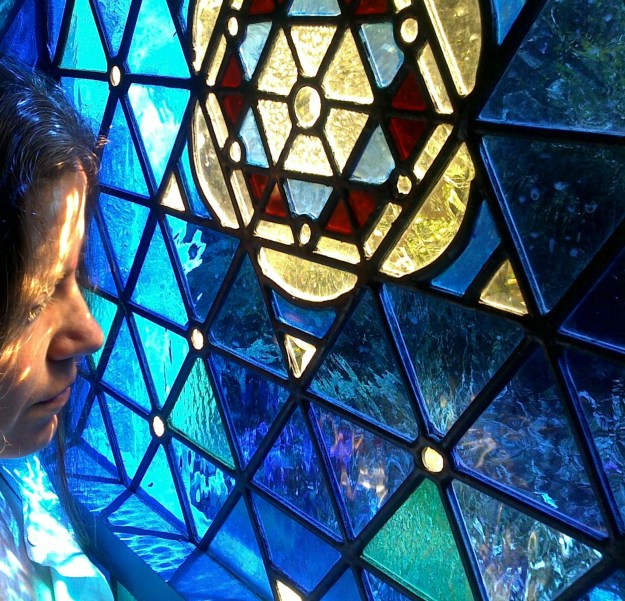
How often can you shatter and remain whole?
Death. Loss. Grief.
House break-in.
Cancer scare.
Institutions breaking you down by sheer incompetence and lack of understanding.
Death, again. And again.
Car accident.
And then… . A void, a negation of time and space, of reality. How do you describe something or someone whom you tell, repeatedly: ‘I can’t breathe. I am in unbearable pain. I feel small. I am fragile. Vulnerable. Skinless. Please do not hurt me…’ And they violate your body and soul regardless? I do not know. Perhaps some things cannot be described. Sometimes words are too good to contain this, this… ? 
I care about words.
Another shattering.
Another loss.
What remains are the pieces. And a life-long illness. Deal with it, Karina.
 In a corner, with no way out, when everything seems lost, broken, incomprehensible, a tiny light might save you. Holding on to that light is not an act of bravery. It is an act of compassion. I survive because I have kind people in my life. Perhaps recognising and reaching out for that kindness is courage? I do not know. I know that the sharing, the true care of friendship, have saved me from utter despair. The women in my life. I repeat: The women in my life. I do not know what I would have done without You. I salute and cherish you!
 The first time I travelled to Temenos in McGregor, the retreat was recommended to me by my friend Margie. She knew what I was going through and said that the beauty and silence would be good for me. I fell in love with the place. One-and-a-half years later I went back, for the beauty and the silence. It is a silence punctuated by the outrageous screams of peacocks and the reluctant striking of the church tower clock. People smile, from the distance.


You can do things, or just be. Read. Sleep. Eat well. There is a bric-a-brac shop in the middle of McGregor which sells the best olives in the country. Tebaldi’s, the restaurant at Temenos, serves delicious meals. There are donkeys. Wine estates. Dusty heat. Tarot card readers and aroma therapists. Kindness, in the place and its people. The veld. And lazy sunsets which make you believe in tomorrow. It is all right to go to bed before 8pm. To read next to the pool for hours. To start brewing coffee at 5am and drink it on the stoep of your cottage while watching the light yawn and rise in the magical garden around you. Meditate, or just sit doing nothing at Temore, The Inner Temple of the Heart, with its soothing blue light.


Wherever I go, I find coins. I call them my lucky coins. In South Africa, usually, 5c or 20c; 50c if I am really lucky. When I arrived in the gardens of Temenos, I found a R2-coin next to my car. Then, a few hours later, another R2-coin next to the pool. And the next day, while I was telling this story to my friend Helen (our stays at Temenos overlapped for one day and one night) during our sunset walk in the veld – in that very moment – I found another one next to our path. I want to believe that good things are coming. That despite the insanity of reality surrounding us in these troubled times, the kindness of people will prevail.

 During the last McGregor Poetry Festival a poem was inscribed on the walls of Temenos, my favourite one from Stephen Symon’s stunning debut collection Questions for the Sea. What synchronicity to find it there when I was returning home last night for the Q&A at Stephen’s reading/launch at Wordsworth Books in Gardens. On the way to the Gardens Centre, I stopped at The Book Lounge to pick up a book I’d ordered earlier, only to find out about the violence in the streets outside the bookshop just hours before. Louanne and Werner spoke about lost children and fear. They cancelled the event scheduled at the bookshop for that evening. The book I was buying was a gift for my friend Louisa who recently shared the remarkable Falling by Elizabeth Jane Howard with me. I started reading it at Temenos. Uncanny is not the word… There is a collective wisdom of women out there, to tap into it, to allow it to nourish and heal you, that is what I am reaching out to.
 I arrived at Wordsworth Books rattled, but there were good friends, cheese and wine, and poetry – subtle, soul-restoring poetry. Beauty, like light, can save you. How precious that it can be contained in words. Thank you, Stephen and Nick, for caring about words.
My words are safe. I find strength in the beauty of peahens. I love my Friends. I can’t wait to share my McGregor olives with them.

And I am very curious what R6 of luck will gift me.

 Questions for the Sea, the debut collection by Cape Town-based poet and graphic designer Stephen Symons is the latest exquisite offering from the independent local publisher, uHlanga. The sea, questions, light and poetry: an irresistible combination.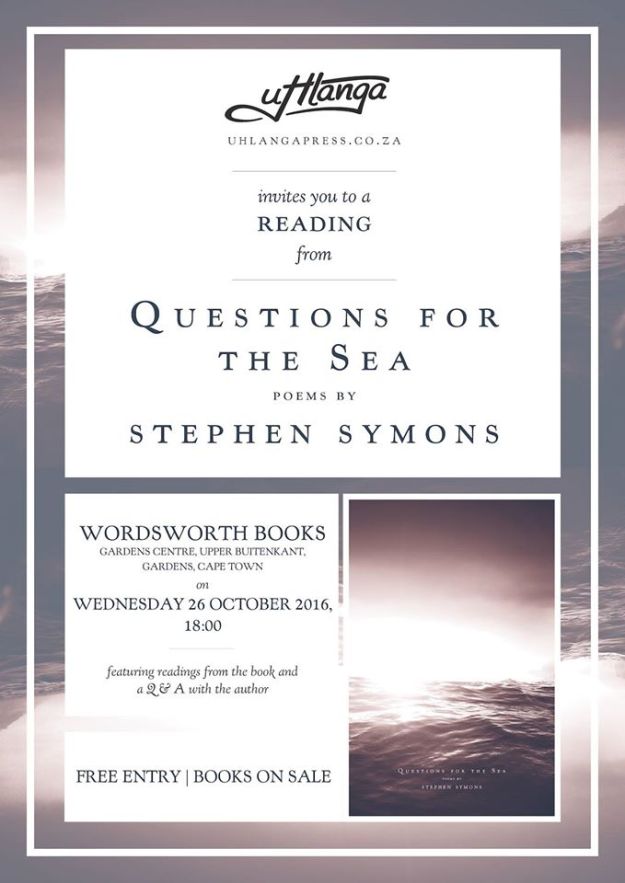


 Camaraderie. That is the word which comes to mind when I think back to the one day I spent at the fabulous Soweto Theatre, attending the inaugural The Star Soweto Literary Festival. It was quite a whirlwind affair. A day of talks, improvisation, laughter and tears. I invited myself. The moment I heard that the festival was happening – and it was organised in a shockingly short amount of time – I volunteered to speak, chair sessions, whatever, just to be there. I felt it in my bones that it would be special, and I wanted to be part of it.
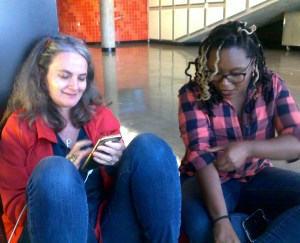 The day I was there, Saturday, the presence of the spirits of these literary giants was palpable. The attempt to establish “a truly non-racial” space for writers, artists and the public to engage with one another’s ideas was a great success. I attended with a dear friend, Pamela Power, the author of Ms Conception and the upcoming psychological thriller, Things Unseen. We came away inspired, glowing, and moved to the core.
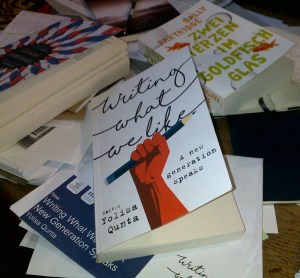 For a white person, reading Writing What We Like: A New Generation Speaks might feel like gatecrashing a party where some ugly truths will be revealed about you. Provocative and penetrating, Writing What We Like is a difficult book to review when you happen to be white, because one feels that one should not be talking at all, but listening only. One is torn between possible accusations of one’s own “intellectual arrogance” and the need for dialogue. And yet, a way to disrupt entrenched ways of thinking and to establish connections across barriers imposed on us by a turbulent and harrowing history is to try to imagine ourselves into the skins of others. That is where creativity and empathy begin – in writing, reading and interpretation – where we cease to view ourselves in any other categories but human. The ultimate goal is understanding, coupled with compassion. Everything else will follow from there.
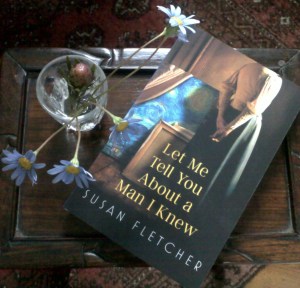 I welcome every Susan Fletcher novel with open arms. Let Me Tell You About a Man I Knew is her sixth. It completely delivers on the promise of its predecessors. Set in the Provencal town of Saint-Rémy where Vincent van Gogh spent a year of his life in an asylum and painted some of his most widely recognised works, the novel tells the story of a local woman whose life is disrupted by the arrival of the Dutch painter. Jeanne Trabuc is the wife of the asylum’s warden. In her fifties, a mother of three, she goes about her daily routines, remembering her adventurous youth and watching out for the mistral, “wind of change, of shallow sleep.”
 Throughout the years, few oeuvres have enriched my intellectual life as much as the works of the Welsh philosopher Mark Rowlands. At some stage, we are all confronted with the question of what makes life worthwhile, how to make the time we have on this planet meaningful. Unfortunately, not enough of us ask how to live in such a way as not only to enjoy the journey, but simultaneously do as little harm as possible to our fellow travellers, whether they be other humans, animals or the environment. We all muddle on. Rowlands does not claim to have the answers, but his attempts at approaching possible conclusions are fascinating to engage with.

 Karina Magdalena