Solitude of a different kind

First edition

First edition

Years ago, a family friend lent me a copy of the novel in Polish translation. The cover was mostly black with some image in front I can’t recall. I also don’t remember our friend praising the book in any particular way. He just thought I needed to read it. The novel waited for me on my bedside table for a few months, perhaps longer, if memory serves me right. Luckily, our friend was in no hurry to get it back. I must have been about 20 years old, at university, buried under tons of other books and deadlines.

All of these are vague recollections.

What is distinct in my memory is the getting lost inside the novel after reading only a few pages. All else ceased to matter. I entered a completely different world. Every page was like a door opening on a new space in my head and in my heart – none of which I had a clue existed before. The experience was mind-blowing, earth-moving, and simply beautiful.

Who says a book cannot change the world? Sto lat samotności did, not only for me. In its many translations the novel has enthralled millions of readers around the world.

Published in 1967, ten years before I was born, Cien años de soledad is a classic in the truest sense of the word. Its author, Gabriel García Márquez, died yesterday at the age of 87. May he rest in peace. May his words live on forever.

Launch of Invisible Others at Protea Bookshop Rondebosch

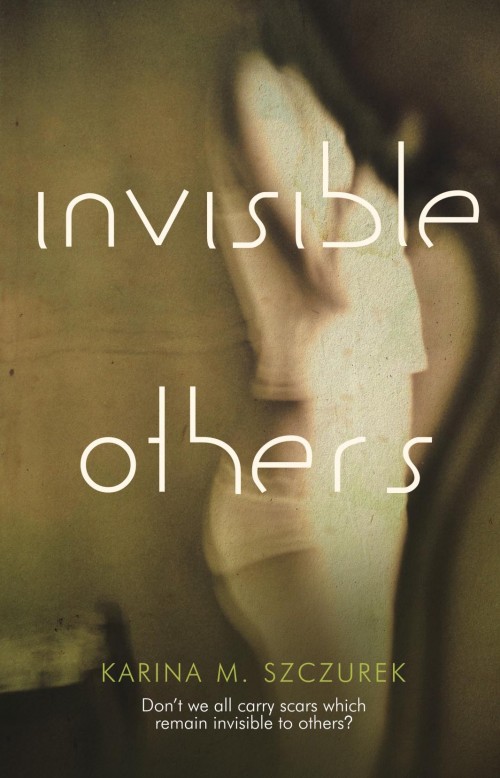
Invisible others 26 April 2014.indd The following is an invitation to my “homecoming launch” at the Rondebosch branch of the Protea Bookshop:

“Dear Reader / Geagte Leser,
It is with great pleasure that Protea Bookshop in Rondebosch extend an invitation to what we would like to call the homecoming launch of Karina Szczurek’s Invisible Others, on Saturday morning, 26 April. Karina will be here to discuss her debut novel with Emma van der Vliet.

Dit is met groot genoegdoening dat Protea Boekwinkel in Rondebosch u uitnooi na wat ons graag beskou as die tuiskomsbekendstelling van Karina Szczurek se Invisible Others op Saterdagoggend, 26 April. Emma van der Vliet sal met Karina in gesprek wees oor haar debuutroman.”

Date: 26 April 2014
Time: 11am
Place: Protea Bookshop Rondebosch
Shop 29
Rondebosch on Main
51 – 81 Main Rd
Rondebosch CT, 7700
Tel.: 021 685 9296

Emma, photo by Robert van der Vliet

Emma, photo by Robert van der Vliet

Emma van der Vliet is the author of Past Imperfect and Thirty Second World. I had the pleasure of working with Emma on both, Touch: Stories of Contact and Encounters with André Brink. I love her work and look forward to our discussion next Saturday. Protea Bookshop is located almost around the corner from my home and it is one of my favourite places in Cape Town – excellent staff and a wonderful collection of books. It is indeed a true “homecoming”.

Woordfees prize for debut writers

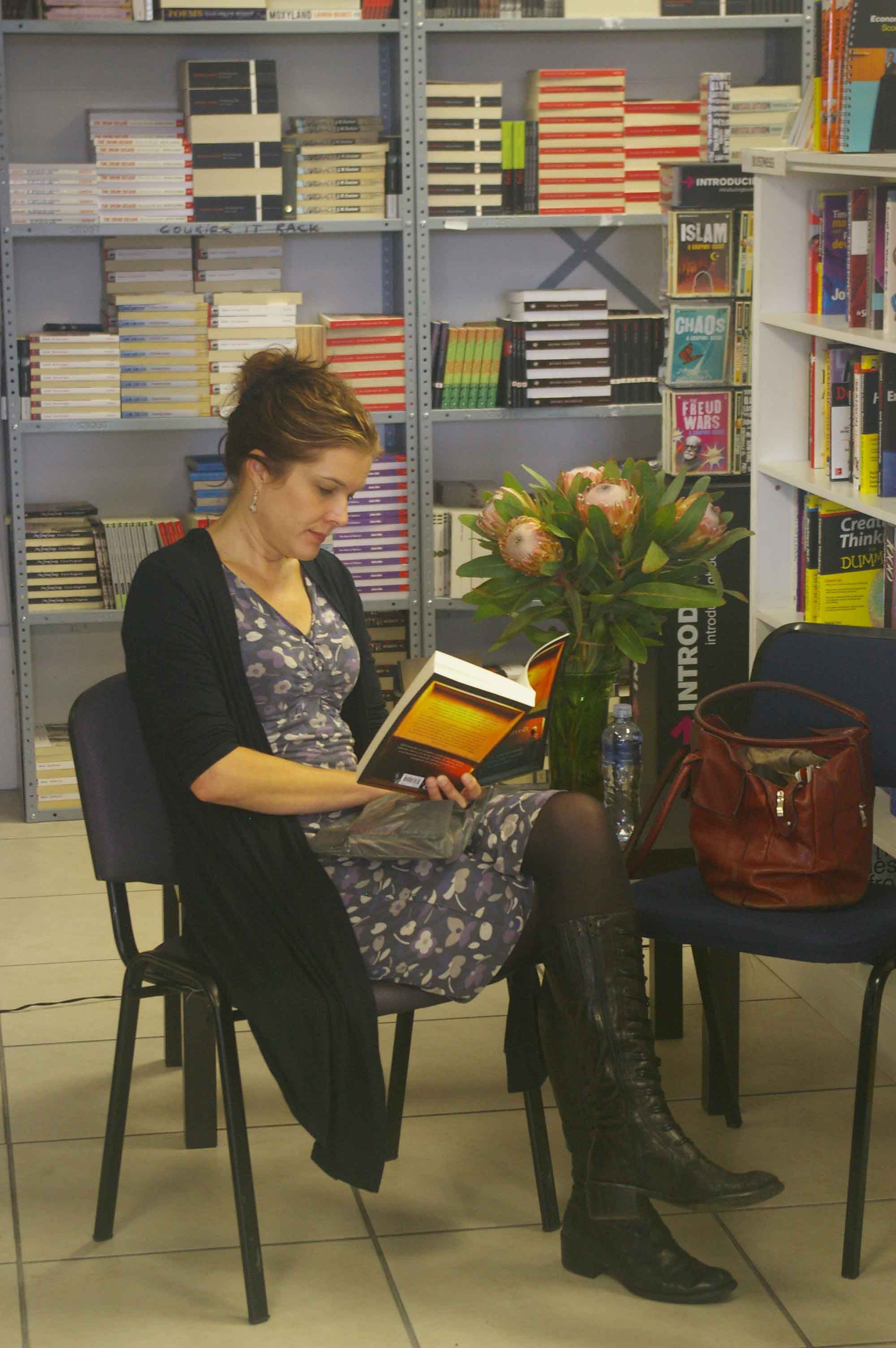
Karina with Invisible OthersInvisible Others is one of three books nominated for the Woordfees prize for debut writers (Ontmoetingsprys vir debuutskrywers by Woordfees 2014).
I am delighted with the news and very sorry that I will be on a plane during the awards ceremony. Holding fingers and toes crossed (also for a safe journey!).

Review: Arctic Summer by Damon Galgut

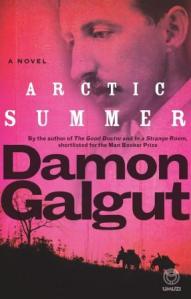
Arctic Summer coverThe publication of every new book by Damon Galgut is a literary event par excellence. Two of his latest three novels were shortlisted for the prestigious Man Booker Prize. He is the recipient of many other accolades, including the local CNA Prize for The Beautiful Screaming of Pigs (1991) and the Commonwealth Writers Prize for Best Book from the Africa Region for The Good Doctor (2003). Galgut’s beautifully supple prose, his mastery of narrative forms, and his feel for characterisation always offer a rewarding literary experience. Arctic Summer is no different.

Like Galgut’s last novel, In a Strange Room (2010), Arctic Summer is partly set in India. Galgut’s descriptions of the places his astutely drawn characters traverse are as always a feast for all senses. In many other respects, however, it is a great departure from Galgut’s previous work. Evoking the early life of the British novelist E.M. Forster (1879-1970), Arctic Summer is a biographical novel, focused on its protagonist’s travels to India and Egypt as well as the relationships he shared with his mother and the few men who stirred his love and desire.

It is the time after Oscar Wilde’s trial and exercising caution in the display of one’s sexual longings is paramount to one’s survival. For most of the novel, Forster’s yearnings remain unfulfilled. The struggle to articulate what is one of the greatest taboos of his time and to put his desire into practice – whether in life or his work – takes centre stage in the novel.

Arctic Summer opens in 1912 with Forster on board a ship heading for India where he intends to visit Syed Ross Masood, a young Muslim man to whom he had been a tutor in England. The two men developed a deep, yet often unsatisfying, relationship, which is clouded by Forster’s love for Masood and his heterosexual friend’s inability to respond to his unwanted advances. The trip unfolds in unexpected ways. But it is Masood and the stay in his native country that eventually will inspire Forster’s masterpiece, A Passage to India (1924).

It is only in Egypt during the First World War when Forster volunteers to work for the Red Cross that at the age of thirty-seven he is seduced by a recuperating soldier. Then he meets and falls in love with Mohammed el-Adl, a tram conductor, who despite being also heterosexual and later happily married, allows Forster certain sexual liberties and appears to share his affections.

During Forster’s later sojourn in India he becomes embroiled in a relationship with Kanaya, a barber at the court of the Maharajah Bapu Sahib to whom Forster becomes Private Secretary. Devoid of feelings which he so desperately craves and blackmailed by Kanaya, Forster feels lonelier than ever.

Galgut brilliantly describes not only the precarious situation in which gays, or “minorities” in Forster’s terminology, found themselves at the beginning of the twentieth century, but also the pitfalls of power relations across race and class that accompany Forster’s ventures into the land of mostly unreciprocated love. The subtlety with which Galgut imagines the shifts in Forster’s psyche and the way his discoveries impact on his work, especially A Passage to India, the posthumously published Maurice and the unfinished Arctic Summer from which Galgut’s own title derives, is remarkable.

Even though with this novel Galgut enters the well-established field of fictional author biographies (locally, Michiel Heyns’s The Typewriter’s Tale or J.M. Coetzee’s Foe spring to mind), there is a great risk with imagining the lives of real people, especially well-known historical figures. Reading Arctic Summer, I often had the feeling that it is a novel where it should have been a biography and a biography where it should have been an autobiography. It is specifically Galgut’s dedication of his novel which echoes Forster’s original dedication of A Passage to India to Masood that makes one question the real inspiration and background of Arctic Summer. The parallel suggests that at least some of the emotional and psychological texture which Galgut ascribes to Forster’s and Masood’s relationship in Arctic Summer might have an autobiographical source.

Judging from the acknowledgements, Galgut’s research into E.M. Forster’s life must have been extensive. But like most readers, I’m neither a Galgut nor a Forster scholar, so it is impossible for me to judge where and to what extent the lines between Forster’s life and Galgut’s imagination and own experiences blur. Even more difficult is to define why such “untidy borders”, in the words of critic Ellen Rees, trigger occasional twinges of unease when reading the novel.

And yet, there is no doubt that this meticulously crafted book is a tribute to an intriguing man and his work. A deeply felt, melancholic novel which charts the subliminal links between creativity and desire and brings to life a fascinating literary figure, it is another bright feather in Galgut’s literary cap.

Review first published in the Cape Times on 28 March 2014, p. 32.

10 Questions

Invisible Others1. What question are you asked the most frequently?
How does one pronounce ‘Szczurek’? People usually remember me as the one with that weird name and hardly ever get it right. But I don’t mind. I know they mean me.

2. What is the question you dread being asked about Invisible Others?
It wouldn’t be very wise to give it away here… Officially, I don’t dread any questions about the novel.

3. Invisible Others is your first novel and at first you wanted to publish it under a pseudonym. Why?
People engaged in criticism often misinterpret their own role in the literary community. I wanted to avoid having to deal with those kinds of frauds, but I realised that a pseudonym wasn’t the answer.

4. Do you think being André Brink’s wife can count against you as a novelist?
Perhaps, but it will count against me with people who base their judgements on matters which have nothing to do with the real me or the real André, and definitely not with my work, so I can’t really take that attitude seriously.

5. You write about sex without the shackles of Calvinism. Are Polish women more open to talk about sex than South African women?
Not at all. My open approach to sexuality has nothing to do with my being Polish. Sexuality is such an essential part of who we all are; it is important to me to write about it as a lived, not only an imagined (and thus often distorted), experience.

6. In Invisible Others you describe Paris in a sensual and cinematically evocative way. Why are you so drawn to this city?
The story demanded being set in Paris. My role was to try to do justice to the city which has been written about so widely. I focused on the spaces which have personal meaning for me, like the Polish Bookshop.

7. You and your family fled Poland when you were still young. In what way has this shaped the Karina you are today?
In every way. A migratory background marks people the way gender, class and race do – it influences everything you do in life. We fled the then-communist Poland in 1987 when I was ten years old and settled in Austria where my parents still live. They wanted a life of freedom and opportunities for us. They certainly succeeded!

8. What is your favourite thing about South Africa?
Multiculturalism – it is what made me feel at home here the moment I stepped off my first flight to Cape Town a decade ago.

9. And your least favourite thing?
Fear.

10. You and your husband André are both masterful tellers of love stories. Will you ever write about your own romance in fictional form?
If we ever did, our love story would not need the veil of fiction to be told. In a way we are telling it already, in bits and pieces of our non-fiction writing.

First published in Afrikaans in Beeld.

Book mark: Crossing Borders, Dissolving Boundaries edited by Hein Viljoen

Book mark_Crossing Borders_small copyThresholds, frontiers, or bridges can function as barriers or points of access, and they can represent opportunities or risks. They are indispensable in our way of perceiving and categorising the world, and make for a fascinating topic of creative endeavours as well as their interpretations. Focusing on diverse genres from different places and time periods, the twelve essays collected in this volume offer insightful glimpse into this area of research. The topics range from a reading of borders and abjection in the film version of Marlene van Niekerk’s novel Triomf (1994) to ideas of insanity and transgression in Thomas Harris’s thriller The Silence of the Lamb (1988). Read as a whole, the collection calls out for a bridging concept of borders, their crossing and dissolving in such farflug places as Lappland, the Karoo, or the human mind.

Book mark first published in the Cape Times, 21 March 2014, p. 10.

Crossing Borders, Dissolving Boundaries
Ed. Hein Viljoen
Rodopi, 2013

Liesl Jobson on the Book Lounge launch of Invisible Others

With Sally, photo by Liesl Jobson

With Sally, photo by Liesl Jobson

With my Mom and André, photo by Liesl Jobson

With my Mom and André, photo by Liesl Jobson

“At the launch of Karina Szczurek’s debut novel, Invisible Others, at The Book Lounge last week, this most welcome addition to the South African literary canon received high praise from those in the know. ‘It is a beautifully written novel,’ said an Mervyn Sloman, ‘in a spare style that is simultaneously lavish – it must be the French connection!’ Sloman said the characters are fully drawn with the author sustaining a ‘wonderful novelistic tease’ that keeps one turning the page. ‘This book is an absolute gift to us!’ he said.

Szczurek was joined in conversation by the talented YA novelist, Sally Partridge, who confirmed Sloman’s assessment of Invisible Others as ‘beautiful’. She introduced Szczurek as an author who wore many hats – an academic, editor, essayist, poet and an award-winning playwright. She said the book is an intense study on the nature of damaging relationships and asked Szczurek why she chose to write about this topic….’

Continue reading…
Report by Liesl Jobson

For more photographs click here.

Conference: Writing the ‘Rainbow Nation’?

poster_klein Early next month, I’ll be attending an international conference “examining 20 years of post-apartheid literature” in Regensburg, Germany, where I’ll be giving a paper on cityscapes in recent South African writing. Other participants include Crystal Warren of the amazing National English Literary Museum in Grahamstown and Willie Burger of the University of Pretoria with whom I edited Contrary: Critical Responses to the Novels of André Brink.

Conference brief:
“In his controversial essay “Preparing Ourselves for Freedom” (1989), Albie Sachs warned against seeing literature (and culture more generally) as merely a form of propaganda for ‘the struggle,’ arguing instead for texts that display “ambiguity and contradiction”. What road did South African literature take after this critique of ‘struggle literature’?” Continue reading…

As part of the conference there will be a panel conversation and a reading featuring Mike Nicol and Angela Makholwa.

Click here for the Provisional Programme.

ITCH e.12 – Taboos

Taboos by Francois Smit

Taboos by Francois Smit

The latest issue of ITCH e.12 is out. The theme: TABOOS.

I acted as coordinating editor for e.12 and contributed the following:

Review of Way Back Home by Niq Mhlongo
“…And it seems that what Mhlongo is telling us is that we need to confront that past again, not in the ways we have been doing in the last decades of our flawed transition, but in a more holistic, accepting way that combines the best of all our problem-solving tools, whether indigenous or Western, modern or traditional, black or white.” Continue reading…

Review of Untitled by Kgebetli Moele
“…But this is no story of a teenage romance which will end for the heroine with an unforgettable First Time with the Boy of Her Dreams. Instead, Untitled is a devastating chronicle of other unforgettables: the abuse and violence – emotional, psychological and physical – that girls face in South Africa.” Continue reading…

Q&A with Helena S. Paige
“…Finding new words for vagina, penis, groan, thrust and pant. At one point Helen suggested that after this we write a sex thesaurus. As in sex, so in writing sex, variety is the spice of life. We tried very hard to keep things original and not use cheesy terms like lady garden, or throbbing manhood. And we banned all lip-biting, by way of homage to Fifty Shades.” Continue reading…

Q&A with S.A. Partridge
“…All these broken lives would have been so different if they had just communicated properly with each other from the start. James and V’s promised love story, which held so much potential, was sabotaged by their inability to say how they really felt about each other.” Continue reading…