 It was by chance that I read Musawenkosi Khanyile’s debut poetry collection on a rainy morning, still tucked up in my bed. But it was no coincidence that the juxtaposition of the comfort of my bedroom and the realities described in the volume repeatedly moved me to tears. Unapologetically autobiographical, the poems included in the book trace the author’s journey from childhood to adulthood, from his rural family home, through the township, to the city. A journey undertaken by many, but not often evoked in poetry with such distinct tenderness that it takes your breath away.
All the Places offers you a glimpse into the heart of what it means to grow up with the odds staked against you, but does so without an ounce of self-pity and, perhaps more strikingly, without gratuitous exposure. The subtlety and restraint with which Khanyile approaches his subject matter is remarkable. He captures lifetimes into a few lines and makes you feel, acutely – not so much the difference between the stories he tells and those of privilege, but the common humanity of all our dreams: “In the class without a door, I took the exercise book of a little girl / who smelled of paraffin and looked at the tree she had drawn – / a leafless tree with no bird in it” (A School Visit). When asked what she wanted to be one day, the girl tells him: doctor.
Khanyile himself is a clinical psychologist with another degree in creative writing. But coming from Nseleni, he recalls the gaps in his family home’s walls, the constantly leaking roof, the demeaning trips to the outside toilet, and that in order “to survive the streets that gush out blood / and open into graves” you had to know how to “outrun the rain”. All the Places is dedicated to Khanyile’s brother Zamo: “I left you the dining room floor / and graduated to a bed / after our sister left for varsity” (Find the Truth).
As the collection’s title suggests, many of the poems focus on specific geographical spaces. In Nseleni, Khanyile states “that the goal is to make it out alive.” But even if you do escape and beat the odds, negotiating hard-earned privileges comes with its own challenges. In The World Opens Up, he asks: “What are the side effects of surviving the township?” The titular poem opens with the lines: “All the places he goes to / remind him of where he comes from.” And in Bantry Bay, a man at a guesthouse cries at the sight of the sea: “Why all this sentimentality about what’s not his? / The sea is not his. This balcony is not his. / All that he has is himself – / when does he cry about that?”
A great gift to its readers, All the Places allows you to look at the world with fresh eyes, with compassion.
by Musawenkosi Khanyile
uHlanga, 2019
Review first appeared in the Cape Times on 16 August 2019.


 The Wickerlight is the second book in Mary Watson’s The Wren Hunt series for young adults. In the first book, the protagonist Wren is chased and taunted by a few boys in the woods around Kilshamble, the village where they all live. Set in modern day Ireland, but one in which magic is as real to the novel’s characters as social media, the next instalment in the series picks up the story of one of these boys, David. He is a member of the judges, one of the ancient draoithe clans. Their sworn enemy for centuries are the augurs.
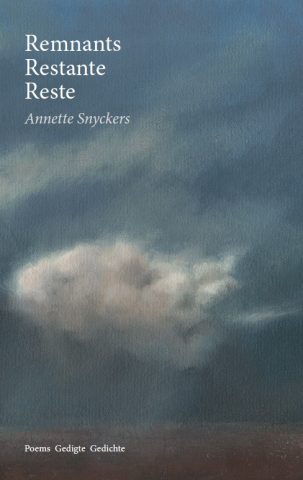 It isn’t often that you can delight in a poetry collection in three languages, but Annette Snyckers’s debut Remnants Restante Reste invites you to do precisely that. Writing in English, Afrikaans and German, Snyckers explores the possibilities of translation and creative expansion. Not all the poems included are presented in all three languages, but the ones that are add a magical layer to the poetry as the individual manifestations enhance and augment one another. The author notes: “Where a poem appears in more than one language, the first version is not necessarily the original version. Poems were written in different languages as I felt the need to write them, and all subsequent translations were done by me.” I feel fortunate to be able to enjoy all three versions in meaningful ways, but even if one of them eludes you, the remaining offerings in the collection are rich enough to suffice for a satisfying read…


 The other sessions were Finuala Dowling reading from her latest poetry volume, Pretend You Do Not Know Me, a ‘best of’ collection which also includes stunning new work; followed by John Maytham performing “Being Human”, a poetry script compiled by Finuala; Wilhelm Verwoerd talking about “that last name”; and Duncan Brown encouraging us to “rewild” our lives. While John was still in the audience, listening to Finuala, I was reaching for a tissue to deal with the emotions her poetry was evoking in me and glanced at him wiping away his own tears. We were both incredibly moved. And then, John made us laugh and cry with his exquisite reading of the poetry Finuala prepared for him. There was one particular poem that made us all crave chocolate cake so much that some delicious sinning was happily indulged in at lunchtime.


 There aren’t really many among the cast of characters in Mick Herron’s Jackson Lamb spy thriller series that you would want as a friend. On the whole, they are a bunch of losers. It’s almost always certain that they’ll either let themselves or their colleagues down. Yet, you can’t help but follow their (mis)fortunes with feverish anticipation.
 Opening an Ingrid Winterbach novel fills me with excitement every single time. She is one of my favourite contemporary Afrikaans writers and I am immensely grateful that her work is available in English.
 The sixth Jackson Lamb thriller, Joe Country by Mick Herron, is hitting our bookshelves. The Drop is a novella in the series that only a few months ago introduced a new character into the cast of Regent Park’s drop-outs whiling away the time as “slow horses” in Slough House, where Jackson Lamb rules supreme. Whereas most of them arrive on Lamb’s doorstep after a major screw up in the field, the new addition ends up in the dubious care of the obnoxious Cold War spy through a set of weird coincidences. His fate is sealed after Solomon Dortmund, an old spook, observes an envelope changing hands in a way that stirs all the retired spy’s hard-wired intuitions into action.
 “Now, there are storytellers, and there are Storytellers”, the narrator of Water No Get Enemy, one of Fred Khumalo’s stories collected in Talk of the Town, tells us about Guz-Magesh, a larger than life character who features in two of the pieces: “His well of tales is bottomless.” He has that in common with his creator. Khumalo is the author of four novels. His short stories have been considered for prestigious awards and featured in several magazines and anthologies. Talk of the Town is his debut collection.
 A seminal step in the right direction
