Category Archives: What I’ve Read

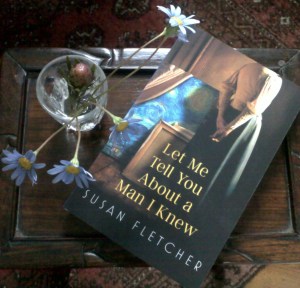
Book review: Let Me Tell You About a Man I Knew by Susan Fletcher

Susan FletcherI welcome every Susan Fletcher novel with open arms. Let Me Tell You About a Man I Knew is her sixth. It completely delivers on the promise of its predecessors. Set in the Provencal town of Saint-Rémy where Vincent van Gogh spent a year of his life in an asylum and painted some of his most widely recognised works, the novel tells the story of a local woman whose life is disrupted by the arrival of the Dutch painter. Jeanne Trabuc is the wife of the asylum’s warden. In her fifties, a mother of three, she goes about her daily routines, remembering her adventurous youth and watching out for the mistral, “wind of change, of shallow sleep.”

Something about her husband’s latest patient unsettles Jeanne. Her curiosity about the man who is known for having harmed himself and for having appeared naked in public leads Jeanne to break her husband’s rules about not visiting the asylum or engaging with any of its patients. She goes to meet the fascinating stranger and a tentative friendship develops between them. Jeanne makes it possible for Vincent to leave the asylum to paint: “And he walks, Jeanne thinks, as reapers walk back from their trees: a sense of a day’s work done. And does he glance at the white-painted cottage as he goes? Jeanne likes to think he does. A glance, as if in gratitude. This newly untethered bird of blue overalls and gold.” She recognises his talent, believes in his sanity. He in turn reawakens her senses and long forgotten dreams.

Jeanne thinks of her grown-up sons who are making a way in the world for themselves and her friend Laure whose desire for freedom had led her to abandon her husband. She recalls the crippled woman who took care of her when Jeanne’s mother died after giving birth to her. And her loving father whom Jeanne nursed towards the end of his life after he’d suffered a stroke.

As a young woman, Jeanne had “been bold, reckless. Not caring for rules.” She’d once stood half-naked in the yard, “her wet hair, like a wing”, and understood the freedom and power of such exposure. Now, her body ageing, her marriage empty of tenderness, she realises that there is still something that she wants from fate, and it is not what she has, “a little life of washtubs and duty.”

Let Me Tell You About a Man I Knew is a story about change and courage, about breaking silences and not being afraid to reach out for what we expect from the people we share our existence with. Fletcher’s portrayal of Jeanne’s awakening is subtle and profoundly moving.

Fletcher’s prose is mesmerising, seductive. There is no other way of putting it. She paints emotions with sensitive strokes, but in bold colours. As she caresses language, words glow under her pen. Her work is full of light and nuance. Let Me Tell You About a Man I Knew is a joy.

Review first published in the Cape Times, 19 August 2016.


Book review: A Good Life by Mark Rowlands

A Good LifeThroughout the years, few oeuvres have enriched my intellectual life as much as the works of the Welsh philosopher Mark Rowlands. At some stage, we are all confronted with the question of what makes life worthwhile, how to make the time we have on this planet meaningful. Unfortunately, not enough of us ask how to live in such a way as not only to enjoy the journey, but simultaneously do as little harm as possible to our fellow travellers, whether they be other humans, animals or the environment. We all muddle on. Rowlands does not claim to have the answers, but his attempts at approaching possible conclusions are fascinating to engage with.
Some of Rowlands’s books are written for experts in his field of knowledge and are not as easily accessible as his bestsellers Running with the Pack: Thoughts from the Road on Meaning and Mortality or The Philosopher and the Wolf: Lessons from the Wild on Love, Death and Happiness (still a personal favourite which belongs to that wonderful category of books I claim as life-changing). His latest, A Good Life, is also written for the general public and comes with an intriguing twist that will thrill all passionate readers, even more so if they happen to be writers as well.

Unlike Rowlands’s other books, which are clearly non-fiction and often include autobiographical elements, A Good Life is actually a novel. It is a philosophical inquiry into what constitutes the titular good life, but it comes in the form of dystopian speculative fiction. In 2054, while South Florida is quickly sinking into oblivion because of the rising sea levels, the fictitious character Nicolai finds a manuscript written by his late father and annotated by his mother. He decides to complete it with his own comments on the narrative his parents had left behind, never certain how much of their text is fiction and how much is fact. The book seems to be telling their life story by tackling such crucial issues as abortion, compassion and empathy, marriage, animal and environmental rights, euthanasia, and death. The discussion of these topics is at times unsettling, as it shakes up many widely held beliefs. At the same time, anything that Rowlands writes is always full of delightful humour and reassurance that not all is gloom and doom. There is hope and real goodness in the world.

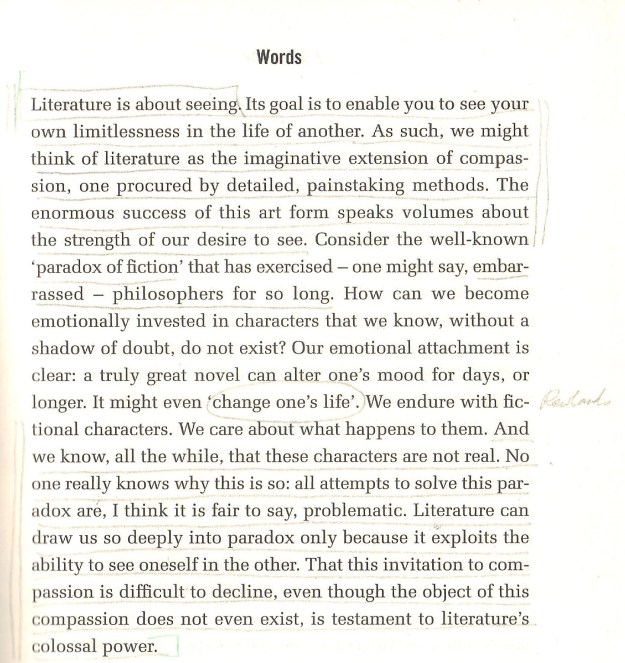
It is not too late to recognise how we are all connected; not only to each other, but to the planet we call home. Compassion is one of our main tools. It is fuelled by the imagination. A Good Life as a whole makes a stunning case for the “colossal power” of literature: “We are all just words somewhere.” When you reach the final pages of the book, the different strands of the narrative intertwine to reveal something quite simple, and yet it feels as if a miracle had unfolded right in front of your reading mind. That is the beauty of a Mark Rowlands book.

Rowlands on lit

A Good Life: Philosophy from Cradle to Grave

by Mark Rowlands

Granta, 2015

Review first published in the Cape Times, 5 August 2016.

“That’s what friends are for”

This time it was rage. No melancholy insomnia, just a big fat stick of fury ready to explode, the fuse much too short. I had been so livid that I walked around wanting to headbutt people, especially myself for being… well, not wise, to put it mildly. A volatile state. And once again Jack arrived, all in black, mattress-pressed, and ready for another clandestine rescue mission. He has a knack for showing up when most needed. Ryno sent him. A clandestine mission expert himself, Ryno is my publicist and friend, aka Work Husband, and he knew how much I coveted Reacher #21, Night School. When the proof copies arrived in his office, one was rushed off to me. And so I went back to night school with Jack and learned some valuable lessons about his rules. Recently, I had failed to follow one, and paid dearly for disobeying. Jack knows how to trust his gut feelings, follow his instincts, analyse, predict, outsmart, wait – patiently – and strike when least expected. Night School is vintage Reacher, all tension, wits and charm. Frances Neagley is back at his side. And oh, that crisp writing which seduces me every time. Yes, all men want to be like him, all women want to… Obviously! Because:

“…her hands flat and open, her palms close to the bed, hovering, skimming a cushion of air, as if she was balancing.”

with Jack

In September, Andy Martin, the “gonzo academic”, author of the must-read Reacher Said Nothing, is one of the international Open Book Festival participants in Cape Town. If you are a Reacher fan, or a surfer, come and listen to him talk about both.

In October, the second Jack Reacher film is released, based on Never Go Back.

Night School will be published on 8 November 2016.

Book review: The Scattering by Lauri Kubuitsile

The ScatteringIt is December 1907 in Tsau, Bechuanaland, after the Herero and Namaqua genocide perpetrated by the Germans occupying German South-West Africa, today’s Namibia. The Herero couple Tjipuka and Ruhapo have survived “the scattering”, but lost nearly everything in the process. When we first encounter them, they are together, but terrifyingly estranged. Tjipuka traces her husband’s body, trying to remember all that she’d loved about it, but the memories are overshadowed by his distance and the blood and cruelty of lies which haunt them: “Being dead made a lot of things uncertain.”
The narrative takes us back to the moment of their first encounter in Okahandja in 1894. We witness their falling in love, the certainty with which they decide to face the future together, their courage and strength. The juxtaposition of the image of these young lovers with the ruins of the people they’ve become is shattering. One anticipates that whatever had happened to them in the intervening years must have been horrendous and will not be easy to read about, but it is impossible to resist the urge to know. The Scattering recounts their journey.

Interwoven with theirs is the story of Riette. After her brother dies, her parents have little use for her on their farm in the Transvaal and even though she had trained to be a nurse and wishes nothing else but to pursue the profession in Kimberley, she is married off against her will to a widowed neighbour: “Riette wondered how two people could be so unknown to each other, and yet so intimate.” At the beginning of the Second Anglo-Boer War, her husband goes off on commando and leaves her alone on the farm to fend for herself and his two daughters. As a result of Kitchener’s scorched earth policy, the three women end up in a British concentration camp where Riette forms an unlikely alliance. Hardship, sickness and death prevail in the camp, but Riette finds protection in a forbidden love relationship. “They would survive this war, this horrible, bloody war, and find their lives on the other side”, she hopes. Betrayal and loss will accompany her on her path: “She didn’t want to live with the shadow of who she was and what she’d done forever darkening her life.”

In 1904, across the border, the tension between the Germans and the Hereros rise. The infamous German commander Lothar van Trotha issues his gruesome orders: “Any Herero found inside the German frontier, with or without a gun or cattle, will be executed. I shall spare neither women nor children. I shall give the order to drive them away and fire on them. Such are my words to the Herero people.”

Believing in the beginning that they can take on the German army, Ruhapo and other Herero leaders decide to attack and reclaim their land around Okahandja, now occupied by the enemy. “Have they not taken enough? I would rather die, my blood watering this land, this land of the Herero, our land, than let them take anything else”, Ruhapo tells his wife. Full of foreboding, Tjipuka is afraid. In the next three years, she and her people will have to face evil in all its incarnations, and attempt to survive against all odds.

But what does it mean to survive if everything you believe in, everything you love is gone? Repeatedly, she will ask herself whether the price to be paid is not too high: “They were no longer complete humans. They were something else. Something less than that.” In the desert, she will look at the familiar stars at night-time and wonder how they could remain “unchanged by all the evil they have witnessed?” Separated from his family, Ruhapo will ask himself what is the worth of pride, land or cattle when loved ones have to be sacrificed for them? Nothing could have prepared any of them for what awaits ahead.

The Scattering impresses on several fronts. Through the life stories of two seemingly insignificant women Kubuitsile links two seminal events of the early twentieth century history in Southern Africa. Two fates out of millions, but they personify the remarkable resilience of women throughout history: “War is for men. It’s always for men. They have a dark place where war grows.” Without consciously pointing to it, the novel exposes the cradle of the worst evils to emerge in the twentieth century: eugenics, concentration camps and the mass extinction of peoples believed to be inferior by those in power.

Kubuitsile’s depictions of war, violence and oppression are vivid but never gratuitous. Her writing is lyrical, affecting. It allows the reader to develop a deep sympathy for the characters, especially when they are confronted with impossible choices which leave no one unscathed. Her portrayals of people on all sides of the diverse conflicts are strikingly balanced. She shows the ambivalence of our passions and the decisions we make in order to survive. The Scattering is one of those superb historical novels which live on in the reader, simultaneously sounding a warning and shining the light of hope.

The Scattering

by Lauri Kubuitsile

Penguin Books South Africa, 2016

Review first published in the Cape Times on 24 June 2016.

Book review: The Woman Next Door by Yewanda Omotoso

The Woman Next DoorNeighbours: a word loaded with connotations. The biblical instruction of “love thy neighbour”, Verwoerd’s “policy of good neighbourliness”, Robert Frost’s “good fences make good neighbours”, and the usual neighbourly mistrust, animosity, even prejudice come to mind. Yewande Omotoso quotes Simone Weil for her epigraph: “The wall is the thing which separates them, but it is also their means of communication.”
The Woman Next Door tells the story of two cantankerous old ladies – one white, one black – who are neighbours in a fictitious wealthy estate in Constantia, Cape Town: “It was known that the two women shared hedge and hatred and they pruned both with a vim that belied their ages.”

Seemingly, however, Hortensia James and Marion Agostino have a lot in common. Both are in their eighties, widowed, with highly successful careers behind them. Yet their lives have left them bitter and lonely. Interestingly, what separates them most clearly, skin colour and money, transpires to be quite superficial, as both of them are masters of pretence. What really divides them is something which stands between all of us when we encounter another human being of whatever background: the fear of reaching out and making oneself vulnerable enough to connect intimately…

Continue reading: LitNet

Book review: Pleasure by Nthikeng Mohlele

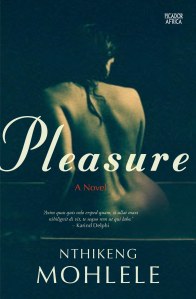
PleasureThe title of Nthikeng Mohlele’s fourth novel delivers on its promise. Pleasure is a mesmerising, unusual book. At times I was hesitant to call it a novel. The story of Milton Mohlele, his dreams and musings, which he attempts to distil into writing, reads like a meditation. As literary history echoes in his name, Milton could be an alter ego for most writers seeking to find not only meaning but pleasure in the written word – to capture that elusive something which makes us sigh deeply with content when, if ever, we truly encounter it.
Pleasure opens in a bathtub, with Milton reminiscing about the women in his life and his late father, who was a writer of note. One of Milton’s preoccupations is to figure out how to avoid having to tread in his footsteps: “What more is there to say other than that the man was brilliant and is deceased?”

Often, I found my mind drifting, with the book’s images and insights as my guide. Exquisitely written, Pleasure allows you to abandon yourself to language: “This made me happy; a feeling that fell like snowflakes, like confetti showered on couples at weddings, like raindrops illuminated by car headlights, fireworks exploding sky high in magnificent, temporary fiery arrangements, falling back to earth in languid, crystal, dazzling, smoky slow motion.” Milton assures us that he “notices things”, “even the smallest, most insignificant of them”.

The observations are precise, beautiful, also in the face of evil (“a word stripped of all pretensions”). A dream sequence in the book adds a profound dimension to Milton’s considerations. In the dream, an American soldier’s life is spared and he is taken prisoner by a SS commandant. He meets an alluring woman at Wolfschanze, Hitler’s headquarters, where he finds himself among men “who could will anything into being”, including a reality in which the ash of their victims rains into coffee cups across Europe.

Once awake and contemplating the meaning of his vision, Milton is not oblivious to the fact that similar horrors happen right next to him, in present day Cape Town. He insists that Africans “should dream, or imagine themselves outside of only being black and colonised and enslaved”, that we are all part of a wider world. Towards the end, he also realises that depending on context, killing can be an act of kindness.

Pleasure never lulls us into easy answers, not everything can be “scrutinised, fully known, owned.” But it is a book full of wisdom which invites the reader to ponder the intricacies of existence. Its proclamations on love and the preciousness of the opportunities life offers are stunning: “Pleasure, I have learned, is a solitary phenomenon; it does not mix well with remorse and regrets and mistakes…at its most elementary pleasure survives on selfishness, on discreet contracts, undemocratic arrangements.” After all, most of us “want to die being able to say, I have loved in my life – truly loved, been molten and cooled and hammered by love, cast and polished.” Some of us, transformed, write.

Pleasure

by Nthikeng Mohlele

Picador Africa, 2016

Review first published in the Cape Times on 20 May 2016, p. 10.

FLF 2016: my scheduled events

FRIDAY 13 May:

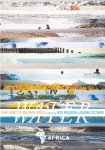
Water coverStationsAffluenza

[45] 16h00 Writers of few(er) words

Karina Szczurek chats to Mark Winkler (Ink), Nick Mulgrew (Stations) and Niq Mhlongo (Affluenza) about the art of keeping it short while ensuring impact.


SATURDAY 14 May:

[67] 11h30 Writing relationships

Under the Udala TreeLike It MattersPleasure

Chinelo Okparanta (Under the Udala Trees), David Cornwell (Like It Matters) and Nthikeng Mohlele (Pleasure) get to the heart of how writers depict love, sex and friendship through their characters. Chaired by Karina Szczurek (Invisible Others).

[74] 13h00 André Brink Memorial Lecture

Sindiwe MagonaAndré

(Photographs: Victor Dlamini)

Karina Szczurek welcomes you to the second annual lecture in honour of her late husband André Brink, and will introduce Sindiwe Magona (prolific author and writer-in-residence, University of the Western Cape). She will offer an outsider’s take on this giant of South African letters in a talk titled “André Brink: enigma, betrayer, villain or hero?”    


SUNDAY 15 May:

[116] 11h30 Literary letters

Everyday MattersFeatured Image -- 1244

Finuala Dowling chairs a discussion with Margaret Daymond (Everyday Matters: Selected letters of Dora Taylor, Bessie Head and Lilian Ngoyi), Karin Schimke (Flame in the Snow) and Karina Szczurek (Flame in the Snow), about what the personal correspondence of significant figures reveals about their writing, themes and lives.

Book tickets here: FLF 2016 

KarinaMSzczurek


KARINA M. SZCZUREK is the author of Truer than Fiction: Nadine Gordimer Writing Post-Apartheid South Africa. She is also the editor of Touch: Stories of Contact, Encounters with André Brink; Contrary: Critical Responses to the Novels of André Brink (with Willie Burger), and the 2015 SSDA anthology, Water: New Short Fiction from Africa (with Nick Mulgrew). She also writes short stories, essays and literary criticism. Her debut novel Invisible Others was published in 2014.

Review: When Breath Becomes Air by Paul Kalanithi

When Breath Becomes AirReading dead authors is not unusual, but opening the late Paul Kalanithi’s When Breath Becomes Air feels different. He wrote it knowing he was dying and it was published by his widow a year after his death. The immediacy of the knowledge is uncannily palpable. For me, the experience was even more intimate on two different levels. Firstly, I also had a cancer scare recently and Kalanithi was my age when he died. In retrospect, his memoir made me count my blessings, again, as I am healthy and have escaped with just a fright. Secondly, like me, as a young person he struggled to choose between two vocations: medicine and literature. Unlike me though, he chose medicine. But literary longings had never left him and when life became unbearable, like many of us he found some amount of solace in the written word.

The striking title of the book derives from lines of an Elizabethan sonnet: “You that seek what life is in death, / Now find it air that once was breath.” To contemplate it alone is already an experience in itself. In the forward, we are told: “Be ready. Be seated. See what courage sounds like.” Can one ever be ready for death? I doubt it, especially not when at the age of thirty-six, with the most promising medical career ahead, you look at a CT scan of your lungs and become aware that they are riddled with tumours.

At this stage of his life, Paul is about to complete the decade-long training necessary for becoming a professor of neurosurgery. He is married to Lucy, also a doctor. Because their relationship is strained, he does not know at first how to break the dreadful news to her.

When Breath Becomes Air tells Paul’s story before and after the lethal verdict. We see his aspirations taking him to the heights of what is possible in his field. Every day he is confronted with illness, decay, and death – of others. He is constantly challenged to question what makes life meaningful. Some of the descriptions of his daily routines as a medical student and doctor are not for the faint-hearted. Even less so is the narrative of him becoming a patient. It is gut-wrenching to realise how the potential Paul had worked so hard to build will “go unrealised”. With searing honesty, he describes his attempts at making the most of the time left at his disposal and the ambition that drives him in the face of ultimate defeat. He writes how, paradoxically, the illness heals his marriage, and how he makes the courageous decision to become a father to a child who will most likely not remember him. Knowing that his words will outlive him, he writes the book.

When Breath Becomes Air is published with a beautiful epilogue by Lucy, “his wife and a witness”, who carries on with “love and gratitude alongside the terrible sorrow, the grief so heavy that at times I shiver and moan under the weight of it.”

When Breath Becomes Air

by Paul Kalanithi

The Bodley Head, 2016

Review first published in the Cape Times, 22 April 2016.

Review: Affluenza by Niq Mhlongo

AffluenzaEvery new book by Niq Mhlongo is literature to my ears. His three novels, Dog Eat Dog (2004), After Tears (2007) and Way Back Home (2013), were fresh, gritty and not to be ignored. Reading them in sequence you witness a writer coming into his own, developing an unmistakably individual voice that captures a historical moment like no other. That moment for Mhlongo is now. If you want to take the pulse of present-day South Africa, you can turn to his work for insight.
Dog Eat Dog encapsulates the lives of a group of Wits students at the time of the first democratic elections. After Tears describes the challenges and disillusionments of their generation after graduation. In Way Back Home the characters have seemingly made it, but their lives are haunted by greed, corruption and ghosts from their past. Never afraid to tell it like it is, Mhlongo offers a brutally honest glance into contemporary South Africa.

In his first short-story collection, Affluenza, he continues in this vein, but at the same time the writing is even grittier. Four of the eleven stories were published before. The topics range from farm murder, suicide, and paternity to animal attacks in a game park. Mhlongo does not shy away from difficult discussions surrounding the issues of race, gender, sexuality or class, pointing to the horrendous levels of miscommunication arising when people approach one another with bigotry…

Continue reading: LitNet

Silver linings: Stranger by Sihle Ntuli

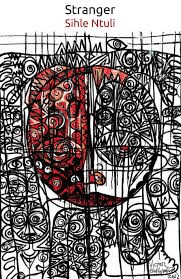
StrangerThe thing with poetry is that it either works for you or it doesn’t. I do not know many people who read it for pleasure. Nowadays, poetry certainly seems to be an acquired taste. I often abstain myself, prose being my staple food. But every now and then a poem or, if I am lucky, an entire volume comes along that makes my heart swell with gladness. Sihle Ntuli’s Stranger is one of those gems. The author asked me to review his debut poetry collection. I do not know why, but I am delighted, and honoured, that he did.

Divided into six parts, Stranger offers a glimpse into contemporary South Africa from the perspective of a keen observer with a distinct, edgy voice. Ntuli might be only in his mid-twenties, but his sense of perception is sharp beyond his years. From the first poem to the last, the reader is drawn into the kaleidoscope of his world and its vivid patterns. In “kwa mashu f section bus stop”, commuters’ souls are whisked away to places where they attempt to make a living, “as billboards block the sun”, feeding their impossible dreams. The distinction between the crushing greyness of daily existence and the possibility of a golden life of opportunity features in other poems, such as “friday”. Here the moving opening lines:


in between creases on foreheads

living has folded thoughts

into blankets and sheets

unfolded in dreams


to lie down to pillow talk

to walk behind grey matters

to watch brain revolving around desires unfulfilled


my grey life upon eyes

the all-seeing eye


the sun losing colour when it dies

the aggressive night

black blood protrudes

moon blows cold wind on wounds

the heart weighing tons upon tons


living life like it’s golden is expensive

it costs a lot to be virtuous and true


Ntuli writes about the reality of the South African township and being a young man in contemporary South Africa, but his vision goes beyond. He captures universal moments of hardship, the kind of poverty which does not only manifest in material lack, but also in the soul, which longs for beauty and is confronted with despair instead. “monday” chronicles the exhaustion and hopelessness of the everyday which is hard to overcome: “the phrase ‘things change’ / speaks only to those who expect to get returns” and the “spoon through your chest” brings out both “blood and beauty / as you love and feel pain in the same colour”.

Violence and loss are linked, the brutality and pulse of street life exposed. Occasionally, to cope you hope for escape, take some pill or other substance: “mind coming to age / life and bland taste / less trouble”. That substance can be love; no matter, as long as it alters your consciousness and your ability to feel. The mind wants to flee the desolate, hostile world. The wish to tell it like it is, though, is clearly there – the need to separate illusion from truth. Ntuli reads the world, its delusions and dreams, and tries to navigate the difference.

At the same time, he offers moments of unbearable tenderness, as in a phrase like “silence in your eyelids”, or my favourite poem of the collection, “the walls”:


the everyday

should not seep

through           the walls


it is behind these walls

that truth undresses

then lies


Grief is palpable in many poems, captured most poignantly in a few lines in the last stanza of “late”: “early morning / dressed in black / the sun rose / our flowers on top of caskets / the late as candles”. His images are striking, definitely not easily forgotten, thus his words do not die on the page but continue a life of their own through the associations they awaken in the mind of each and every reader who immerses herself in them.

The title of the collection resonates throughout, but is most strongly captured in “the stranger”: “towards him / they throw adjectives / the suffocating symphony / the injustice / words slant to one side / lying”. Race, skin colour, otherness, and contrasts between ordinary lives lived in obscurity and silver linings shining on the horizons whether in words or sunsets bring with them a palette of visual impressions which Ntuli makes us reconsider. Nothing is just a colour: “i sit on the side silently / living life like it’s silver / as the lining is blocked by the roof”.

Recurring in the collection are references to music. It is in the rhythm of every poem, “between jazzy notes without words”. Like music, the lines are meditative, haunting, thought-provoking. They help us negotiate the world, “moved by thoughts that have no rhythm”. But unlike one of his narrator’s contemporaries who seem to be more interested in being DJs rather than poets, as many in the struggle were (“gospel gold”), Ntuli carves out his creative space in words. His is a new struggle: for his own voice, for the recognition of his reality and vision.


Stranger by Sihle Ntuli

Aerial Publishing, 2015


Review by Karina Magdalena Szczurek