Flame in the Snow: The Love Letters of André Brink and Ingrid Jonker

tearsinthefence's avatarTears in the Fence

Translated by Leon De Kock & Karin Schimke (Umizi 2015)

Afrikaans, one of the official languages of South Africa, spoken by some seven million speakers and widely recognised by the leadership of the African National Congress for its contribution to dissident literature has produced a number of writers of global significance. It remains a vibrant literary culture as the writing of J.M Coetzee, Marlene van Niekerk, and others testify. The love letters of novelist, André Brink and poet, Ingrid Jonker, written between April 1963 and April 1965, return to the reader to a time of protest against censorship when no criticism of South Africa’s race policy was tolerated, and is perhaps a timely reminder for South Africans.

Brink, at the beginning of his career as a novelist, teaching at Rhodes University, Grahamstown, and Jonker, writing her second poetry collection, whilst working as a proofreader in Cape Town, fell head over…

View original post 641 more words

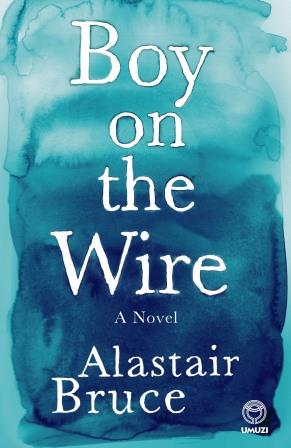
One of our greats in the making: Alastair Bruce’s Boy on the Wire

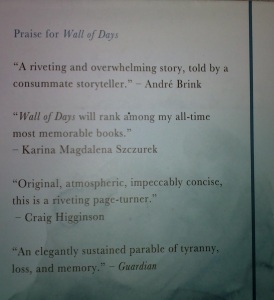
Wall of DaysThe first one arrived in manuscript form for evaluation. I started reading it in bed in the morning and nearly didn’t get up until I was finished. The exhilaration of the encounter is still with me years later. I thought I was reading one of South Africa’s greats. Galgut or Coetzee came to mind – not a debut novelist.

My reader’s report glowed with praise. The novel was eventually published as Wall of Days (2010), locally and abroad, also in translation. The author turned out to be a young man from PE who moved to the UK. Last year, Alastair Bruce published his second novel, Boy on the Wire, and it is just as haunting as his first.

In the Prologue of Boy on the Wire, John Hyde walks cautiously through his childhood home in Port Elizabeth. In one of the rooms, he sees a man, “or he imagines he can see the man … He knows, too, he cannot touch him, cannot touch the lying man. If he even touched the tip of his fingers to the man’s forehead, it would all be over.” Nothing is “clear”. What is real, what is imagined? Everything hinges on the distinction. The confrontation with the “man who lied, who told the story, a wild, fanciful story, about the death of a child, a hard and unyielding story” is what the novel is about.

Boy on the WireThe narrative takes us back to a Sunday in the December of 1983 when John, his brothers Paul and Peter, and their parents travel to the mountains in the Karoo for a family holiday. But only four of them return home. And there are no real survivors. The tragedy literally plunges them all into an abyss.

Trauma disrupts time, memory and narrative. Storytelling can be one of the most efficient mechanisms of attempting to deal with it. In order to cope with the death of one his brothers, John tells a story. But his version of the events leading up to the tragedy has severe consequences for the family: “The death of a child – there’s no coming back from that.”

We encounter John again in his thirties. In his early twenties, he’d left his family and South Africa behind, making a clean break and emigrating. Alienated from his past, and from himself, he marries Rachel and makes a successful living in London. But one day he sees a figure outside his window which draws the illusions of his past into the fragile reality he has built around him, and he is forced to return to South Africa to confront the mystery of that fatal December day in the Karoo. But as Rachel will realise: “If you examine a mystery closely enough, for long enough, certainty will follow. Certainty, but not necessarily truth.”

Boy, Bruce can write! It is austere writing, but not without a certain lyricism. No words go amiss, all hit the target. At times, the narrative tension becomes relentless, even to a point of frustration. Bruce is a master of creating smokescreens for his readers. In both, Wall of Days and Boy on the Wire, you are never sure what the real story is, or who in the story is real or imagined. The beauty of his novels lies in the intriguing mind games – it is impossible not to want to know what happened. But Boy on the Wire is not a light, entertaining read. The novel is emotionally exhausting. It creeps under your skin.

Boy on WireWhereas Wall of Days was as close to perfection as a novel can get, I had some difficulties with the characterisations in Boy on the Wire. The portrayal of John and Rachel’s relationship after his return to South Africa wasn’t convincing enough for me. I could not relate to Rachel’s responses to the unfolding of the events and found the explanations of her behaviour implausible in a few moments. Furthermore, I am not sure that readers who are unaware of the effects of trauma on the mind will find enough narrative guidance in the story to read John’s mental states as plausible. I also found my suspension of disbelief tested when it came to the simple day to day logistics of inhabiting an inherited house.

Despite these reservations, which took very little away from the impressive impact Boy on the Wire had made on me, I can’t wait to see what Alastair Bruce will do next. Without any doubt, he is on his way to becoming one of our greats.

Boy on the Wire

by Alastair Bruce

Umuzi, 2015

Book review: Roberto Calasso’s The Art of the Publisher

The Art of the PublisherEvery now and then, a book comes along which changes your life. For me, Roberto Calasso’s The Art of the Publisher is one of them. But you don’t have to be – or, like me, want to become – a book publisher to find this gem an inspiration.

For quite a while now, publishing has been steeped in a pervasive atmosphere of gloom and doom, especially in South Africa. The threat of the internet, the e-book, the retail giant Amazon, and the financial crisis have made life for the printed book difficult. Locally, a seemingly general disinterest in South African fiction and foolish political decisions have made survival tougher for our publishers, and consequently, of course, for us writers. Book sales are not encouraging. Publishers scaling down even less so. Yet, watching developments like the self-publication of Paige Nick’s latest novel, Death by Carbs, or new publishing ventures like uHlanga and Tattoo Press, I have a feeling that some creative and daring people in the country are on to something which gives me many reasons for optimism.

Roberto Calasso’s essays collected in The Art of Publishing attest to the fact that it all comes down to basics. And the basics are vision and quality. It is these two aspects of publishing that readers throughout centuries have best responded to with enthusiasm. These are no trade secrets, just simple rules which those who have been successful in publishing have always followed.

Critic, writer, and a publisher himself, Calasso has been at the forefront of Italian publishing for decades. His love for literature and the book shines through every single paragraph of The Art of Publishing. His passion is one of beauty. His insights are heartening to read.

When it matters, publishing is not about money, although, as with all art forms, moderate financial rewards cannot and should not be excluded. There are enough examples out there to prove the case. All aspects of the form play an integral part in its success: “choice and sequence of titles published…texts that accompany the books, as well as the way in which the books are presented as objects.” Calasso does not deny that this is “the most hazardous and ambitious goal for a publisher, and so it has remained for five hundred years”, but he also reminds that “literature loses all of its magic unless there’s an element of impossibility concealed deep within it.”

He goes into the fascinating history of publishing, asks what constitutes culture, celebrates the great publishers of our times, explores the relationship between the publisher and the writer, demonstrates how crucial the nourishment of writers and the care for the book as an object are to a thriving publishing environment, and most importantly, to our intellectual and emotional lives.

Calasso also shows that even if often unbeknownst to us why a particular publisher attracts our enthusiasm, as readers we understand the value of our “repeated experiences of not being disappointed.” And that is what only a publisher of vision and quality can offer.

The Art of the Publisher by Roberto Calasso

Translated from the Italian by Richard Dixon

Penguin Books, 2015

Review first published in the Cape Times, 22 January 2016.

Two comments:

When I truly enjoy a book I have the need to share it with others. I have already bought several copies of The Art of the Publisher for friends, two more today…

I was attracted to the book in the first place because it appealed to me as an object. I saw it displayed at the Book Lounge in Cape Town and could not walk away from it…

“Your library is your soul”: Reflecting on Kate Atkinson’s A God in Ruins

A God in Ruins_Costa

Despite her substantial literary success, I did not know Kate Atkinson’s work before A God in Ruins was recommended to me by a friend whose taste I value. It won the Costa Novel Award in the beginning of this month, as did Atkinson’s previous novel, Life After Life (2014). The two are related, but can be read independently. I hope to turn to the sibling soon, as A God in Ruins is one of the most exquisite novels I have ever read, and the idea of Atkinson’s backlist reassures me greatly.

A God in Ruins is many things. It is the story of a British family set against the historical background of the past century. It is a novel about war and its aftershocks. It is a fine enquiry into human nature. But above all, it is a declaration of love for literature, its power and its manifold mysteries. And it is highly ambitious. What astounds about A God in Ruins is that it never falls short of these formidable ambitions. Such novels are rare. They take root in your mind and blossom in your soul. Even ferocious readers encounter a novel like this only once in a while.

The way it captures fiction’s ability to heal, to open up spaces in us we never even knew existed is striking. It is poetic in style as well as in its wisdom. For me personally, A God in Ruins was a magical key. It opened two doors in my life. Two doors connecting the past to my fragile present: one appeared while I was still reading, the other after I’d finished the novel. I stepped through the first, an imaginary one, during one of those serene nights when you are at peace with the world and yourself. It was around midnight. I was lost in the arms of a comfy easy chair; a soft caramel light illuminated the room. When I looked up from the book, I saw something so beautiful that I wanted to hold on to it forever. But I was scared to disturb the scene by searching for my camera, so I turned to the last blank page of A God in Ruins and drew a sketch of what was in front of me: a moment of flickering hope. It is also engraved in my heart.

The second door was real. It is the door to my late husband’s library. There are innumerable books in our house. We have roamed among them with the great pleasure that exploring books can bring only to two readers in love. When I finished A God in Ruins, I was crushed by the inability to share it with André. It was published a few weeks after his death. But I knew, had he been alive, I would have passed the novel to him the second I was finished with it that early Sunday morning, and I would have asked him to read it immediately so that we could discuss it in detail. Instead, I was all alone in an empty bed and all I could do was weep. What I have discovered about grief and loneliness is that it is not the lows which are unbearable, but the emptiness of the highs, when all you want to do is experience them with the person you love and there is no-one there to hold you…

Continue reading: LitNet

Book review: The Penguin Lessons – A True Story by Tom Mitchell

The Penguin LessonsLast year, I realised that I have a penchant for penguins with foreign names. Midyear, I was enchanted by Misha, the penguin who stars in Andrey Kurkov’s wonderful novel, Death and the Penguin (originally published in Russian in 2002). Towards the end of 2015, I fell in love with Juan Salvado, the protagonist of Tom Michell’s memoir, The Penguin Lessons.

When he was in his twenties, Tom Michell travelled to Argentina to teach at a boarding school during the politically volatile 1970s. In his free time, he explored South America. On one of his trips, he arrived at a Uruguayan beach to discover a massacre: corpses of oil-coated penguins scattered all around on the sand. There was one survivor among them, a Magellan penguin barely moving, covered in oil and tar like all the other birds, but clearly still alive.

“I needed a penguin like a penguin needs a motorbike,” Michell writes, but on the spur of the moment, he resolved to rescue the penguin and took him back to the flat he was staying in. The ensuing story of their initial encounter and the fascinating relationship which developed between the young man and the sea bird is one of most moving books I have read last year.

After a nearly disastrous but hilarious attempt at cleaning the penguin in the pristine bathroom of his hosts’ home, Michell tries to set the bird free, but his new acquaintance is extremely reluctant to be abandoned again. Not knowing what else to do, he names the penguin and devises a plan to smuggle him into Argentina. And so their adventures and a remarkable friendship begin.

Back at the boarding school, Juan Salvado forms the most extraordinary relationships with the students and staff alike, irrevocably changing all their lives. Michell’s commentary on the socio-political situation of Argentina of the time is subtle but highly intriguing. His descriptions of penguin and human natures and how the two can relate to one another are simply beautiful.

Magallan penguins do not live forever and since all of this had happened four decades ago, I assumed that there would be heartbreak at some stage in the book. I was reading the dreaded scene in a coffee shop where another customer became quite concerned about me when she saw my copious tears falling. I was too choked up to articulate my sorrow, but she understood when I pointed at the open book in front of me. I cried again before the last page, but not because of sadness. There are two revelations towards the end of the book which touched me deeply: one concerns the reason why Juan Salvado refused to go back to the sea when Michell first met him, the other is a description of a recent find among Michell’s memorabilia. If there ever was a feel-good book, The Penguin Lessons is it. It goes to show that, occasionally, we all need a penguin in our lives.

The Penguin Lessons: A True Story
by Tom Mitchell
Penguin Books, 2015

First published in the Cape Times, 15 January 2016.

Rambling on about books: Reacher Said Nothing by Andy Martin

PersonalIt’s not often that you get to star in a Fairytale where you are The Princess and a real Hero comes to save you, but that’s the story of my Christmas Miracle.

To say that last year was rough for me would be a bit of an understatement. Yet being a glass-half-full kind of person, I will not deny that magic and beauty did not abandon me when all else seemed lost. Both continued flowing not only from the hearts of the amazing people who love me but also from complete strangers.

One of the most magical moments of last year was encountering Jack Reacher, my Hero. Falling in love – fictional or otherwise – is a beautiful gift. When that love allows you to reclaim something as precious as reading is to me, then you let your long braid hang out the window and hope that your Knight In Mattress-Pressed Armour holds on tight. Nearly twenty books later – i.e. approximately 2 000 000 words – he still does! (In my book, that’s a miracle in itself.) I am almost finished with Personal – the last of the existing Jack Reachers for me – trying to make it last by reading only for comfort when Dragon Insomnia rears her ugly head, but soon that adventure will also come to an end and I will have to join the rest of the Reacher Creatures who are counting the days until September when Night School, Reacher No. 21, is published. As a reader, I ask myself what are all the other months in the year for? But I suppose Lee Child should be allowed to sleep at some stage. And I need to get my act together and follow Jack’s example by simply sleeping when I want to. Perhaps I must see whether headbutting works on dragons…?

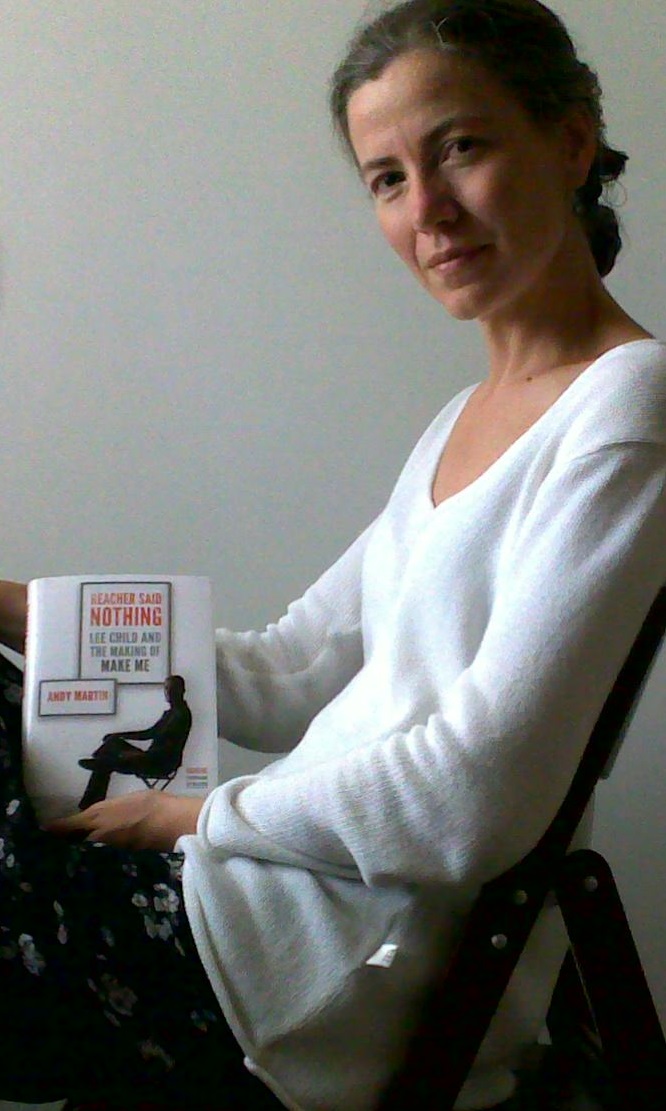
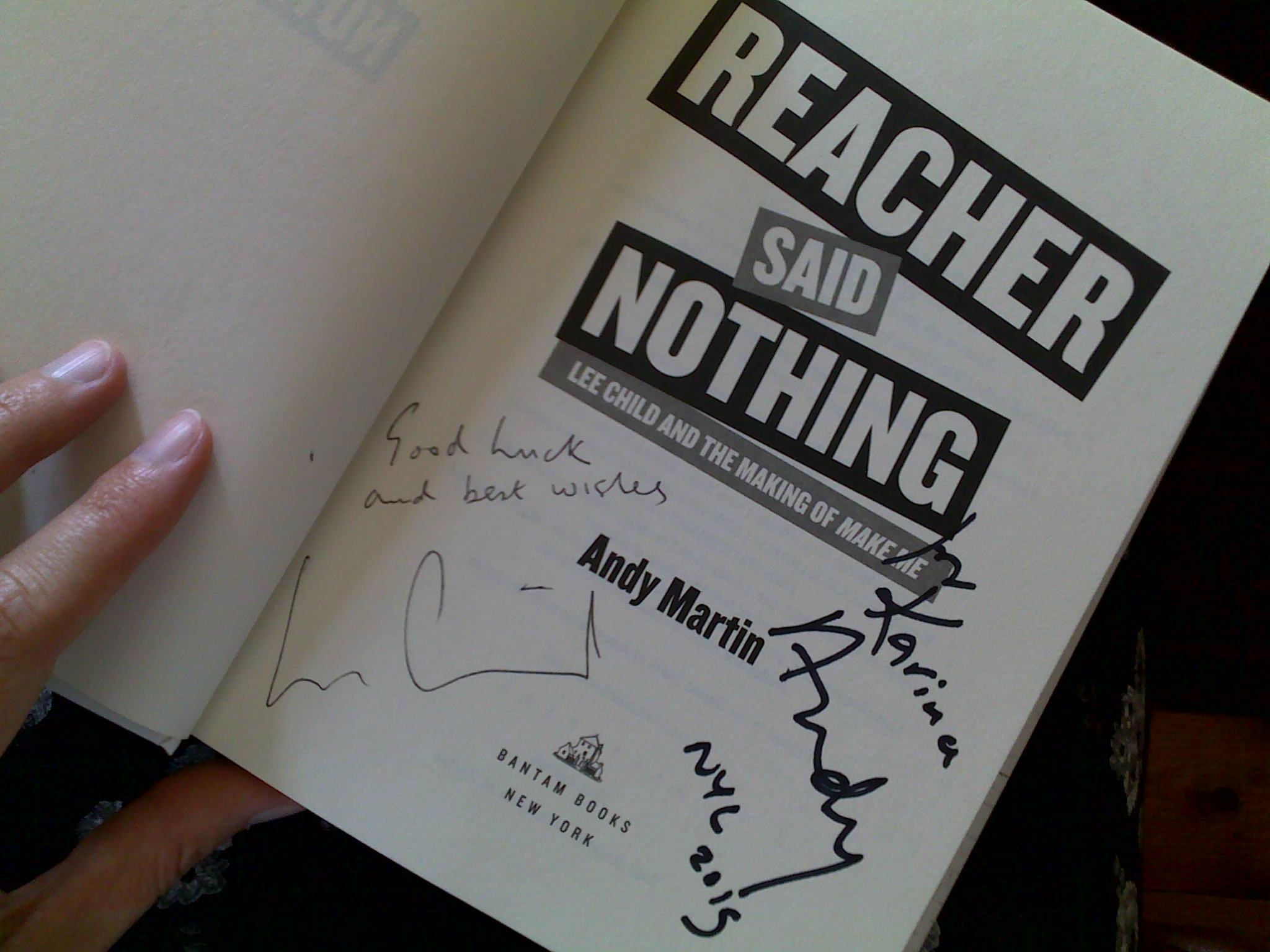
Reacher Said NothingHaving become one of Jack’s greatest fans, you can imagine my excitement when I found out about the publication of Andy Martin’s Reacher Said Nothing: Lee Child and the Making of Make Me. It appeared towards the end of last year and before it became available in South Africa (still waiting for it to arrive on our shores, so that I can share it with friends who love Jack as much as I do), I tweeted about it, saying something like, “What could possibly make me happy for Christmas?”, and adding, “Karina said nothing.” At that stage, I hadn’t clicked that Andy Martin and I were actually following each other on Twitter. My friend Helen Moffett, whom I’d infected with Reacher Fever, saw my tweet, and kindly offered to get me a copy of Reacher Said Nothing as at the time she was staying in the U.S. where the book was already in the bookshops. Lo and behold, Andy Martin saw our Twitter exchange and generously offered not only to send Helen a book for me, but to sign it, get Lee Child to sign it, and to add a second signed copy for her into the parcel. There are moments in life when it is easy to believe in fairytale miracles. And this was only the beginning!

Helen received the promised gifts, but resisted the temptation to read the book until her return to South Africa in mid-December when she delivered my copy to me and we began our Christmas tandem reading of Reacher Said Nothing. And what a joy it has been! The book is everything that a Reacher fan might have wished for, and more.

Reacher Said Nothing signedReacher Said Nothing is dedicated to “all those loyal readers of Lee Child who may have bought this book by mistake” and opens with two epigraphs: a quote from James Boswell’s The Life of Samuel Johnson, and one from one of my absolute favourites, Alberto Manguel’s A History of Reading in which the author writes about the different ways of reading – for the action and characters of the story, and for the detailed exploration of the texture of the narrative. Andy Martin’s ensuing analysis of Lee Child’s creative process is both.

Martin approached Child with the idea for the project in 2014, only days before 1 September when Child traditionally begins writing his next Reacher novel. It was to be the twentieth in the series, Make Me. In an email of 22 August, Martin proposed “a kind of literary criticism but in the moment, in real time, rather than picking it up afterwards…trying to capture the very moment of creation…you would have someone (i.e. me) looking over your shoulder as you are typing the words.” Five days before the first word of Make Me appeared on Child’s computer screen, he said yes. And off they went.

Writing a book as great as Reacher wasn’t easy.

Reacher Said Nothing takes us not only behind the scenes of Make Me’s genesis, but also to the day in 1994 when Child bought the paper and pencil with which he wrote Killing Floor, the first in the Reacher series, and explores much of the before and in-between from uncertain beginnings to stratospheric success. More importantly, it throws light on the magic that happens whenever any writer picks up a pen and begins dreaming. In this respect it is as much a book for readers as for writers. When writing, Child thinks like a reader; that’s his thing. But there is no magic formula. Only a lot of doubt, hard work, and hope. Trust. And when you are lucky, a good story to tell.

Andy Martin has a great story to tell. Reacher Said Nothing itself reads like a thriller. Like a master of the genre, Martin builds up the tension to the moment when Child sits down to write the first sentence. From there, he continues about the power of storytelling – the written word’s extraordinary potentials for both, writers and readers. After all, one particular book Child read as a kid led him to the life he has today. His own books have entertained millions of readers around the world for two decades. Even though I am not particularly fond of crime fiction or thrillers, Child’s books have changed my life, and I am grateful. It is all about the “[h]ope of a hero coming to save you. Hope of becoming a hero.”

“He would have been good around the campfire, Lee – he would definitely make you forget about the wolves or the saber-tooth”, Martin writes.

Yes. And about the pain of grief…
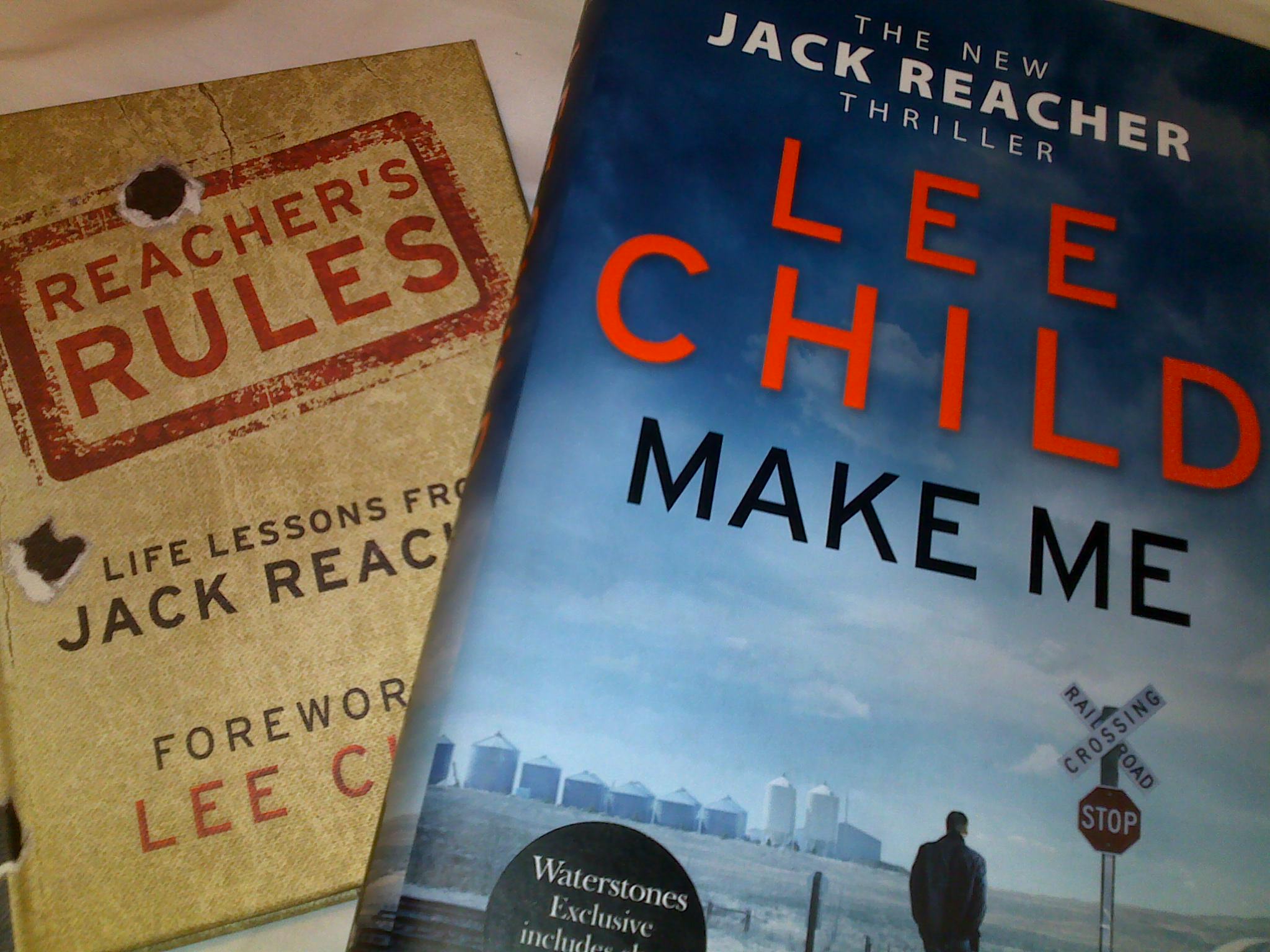
Make Me and Reacher's Rules
From the start when I began reading Killing Floor, I recognised and was captivated by a quality in the novels that intrigued me: an attention to word choice, syntax, punctuation – a kind of poetry that I now realise is fully conscious, intentional. “It all mattered, linguistically”, Martin writes. It’s about noticing things. And to see the process unfold is fascinating. Child writes only one draft, but the meticulousness with which he constructs the narrative allows him to.

I loved the humour of Reacher Said Nothing, the banter between the two authors, and Martin’s often hilarious commentary. An early scene:

“‘It’s reverse Freudian,’ Lee said. ‘You’re on the couch and you are analyzing me.’
I said nothing.
He flexed his fingers. ‘Naturally I’m going to start, like all good writers, by…checking my email!’”

There are numerous smileys in the margins of my copy of the book. I have scribbled, underlined, single and double, all over.

Martin and his subject emerge from Reacher Said Nothing as two people who are really passionate about what they are doing, are prepared to work their fingers to the bone in pursuit of their visions, and know how to have fun while doing it: “I live in a permanent daydream. I get paid to daydream narratives”, Child says.

It pleased me no end to discover that they both eat cheese and marmalade sandwiches. And to read about “the grape in the fridge”.

Lee Child’s relationship to his fictional hero is highly interesting. Anyone who has non-existent people – I am hesitant to write – living in their heads, knows what it’s like. Creation is a thrill. All of us, readers and writers alike, are junkies.

My final verdict on Reacher Said Nothing? Allow me to quote:

“‘Outstanding,’ said Lee. He pointed out that it was one of Reacher’s favorite words.”

Completely unrelated to me, the name ‘Karina’ is mentioned in Reacher Said Nothing. It made me smile. A Karina is rumoured to appear in Andy Martin’s next book, Reacher Said Something, but that’s another story about writing about writing about writing… Another daydream.
Karina in Reacher Said Nothing
In Make Me, Reacher is concussed. “He’s rambling on about books. A bit like you,” Child says to Martin when writing the scene.

And I am about to headbutt a dragon, and live happily ever after.

To be continued…

Chris Barnard 1939 – 2015

“And now Chris Barnard…” Breyten Breytenbach wrote for today’s Die Burger.

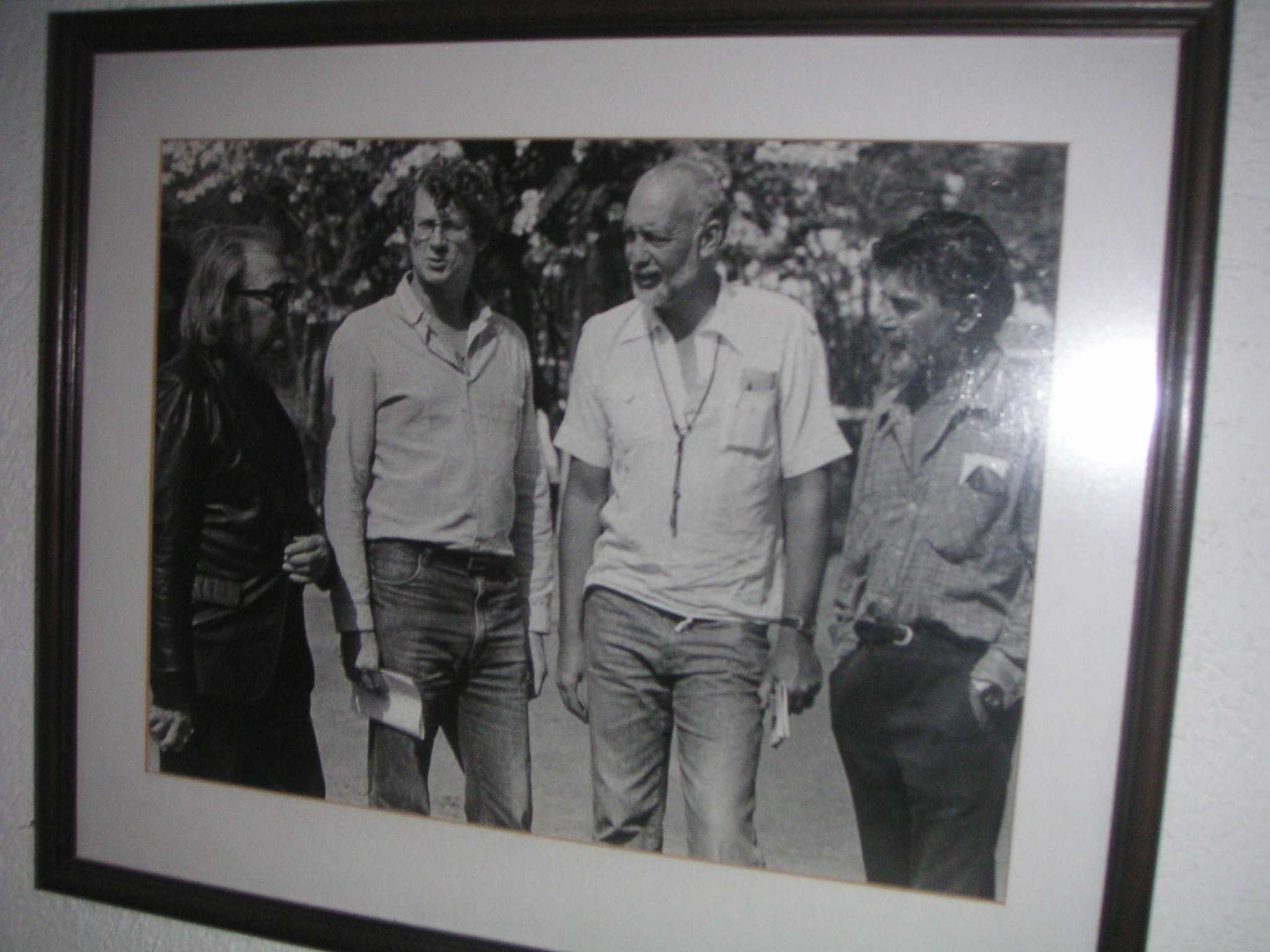
I did not know Chris and his wife Katinka well, but the few times I spent in their wonderful company are locked away in my heart as warm memories. They were both kind to me, open, welcoming. André loved them. We visited their home in Mpumalanga in 2007 where I took this shot of a photograph hanging in their house (Chris and André in the middle):
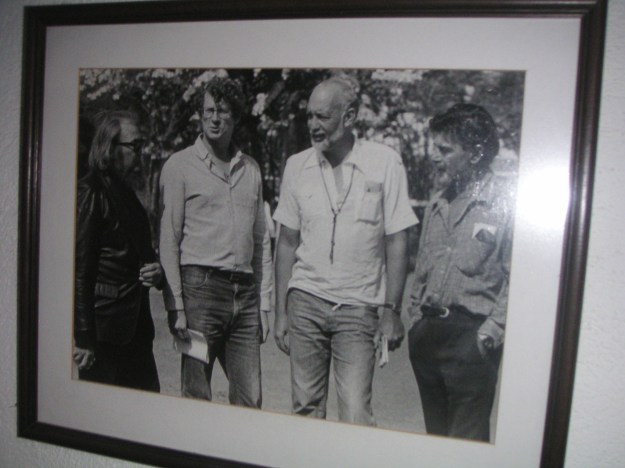
MINOLTA DIGITAL CAMERA
More recently, I remember a day when we sat together in the sun outside their house in Onrus, drinking what from that day on became my favourite South African bubbly: Krone Borealis. There were strawberries and laughter. The warmth of friendship.

My thoughts are with Katinka and her loved ones.

The opening passage of the chapter “Sestigers, Censors and Security Police” from André’s memoir, A Fork in the Road:

It was during the years leading up to my return to Paris in ’68 that censorship turned really bad. The situation was surprisingly complicated. Among the events that held me in South Africa, there was the emergence of a new generation of Afrikaans writers, the Sestigers (‘Sixtiers’); among those that prompted me to leave was the almost simultaneous crackdown of censorship. The complication lay in the fact that, in the South Africa of the Sixties, neither could be imagined without the other.

Within only a few months of my return in August, 1961, I received a letter from the young author Chris Barnard (no relation, I should make very clear, of the surgeon who a few years later became famous for succeeding with the world’s first heart transplant). Chris was then fiction editor of the magazine Die Brandwag, for which I had during my student years, and even during my stay in Paris, written potboiler short stories. He offered me an opportunity of emptying my drawers of old manuscripts. But much more importantly, he broached the subject of ‘a new generation’ of writers in Afrikaans. This was something that had much preoccupied me in Paris. I had even written an impassioned essay for the magazine Huisgenoot pleading for such a new wave of writing: taking my cue from the Dutch writers known as the Tagtigers (‘Eightiers’) of the previous century, who had swept away all the dead wood of conventional writing in Holland to establish a spectrum of bold and passionate prose and poetry that infused the Romantic movement in the Low Countries with the inspiration of Impressionism and Symbolism. In our context, of course, it was no longer a matter of Romanticism, but all the ripple effects of Modernism and Existentialism. My essay wasn’t published until several years later, as a kind of nostalgic backward glance, but from the correspondence with Chris it was soon evident that we were fired by the same kind of vision for a drastic overhaul of Afrikaans fiction.

Ever since the Thirties, when a group of young Afrikaans poets had boldly established radical new forms of individualism, our literature had been striving to break away from the more conventional expressions that had characterised it since the time of the First Language Movement in the late 19th century. Various spasms of renewal had followed, but these were invariably restricted to poetry. Fiction and drama still lagged depressingly behind; and by the time European literature was already experimenting with exciting new forms of writing, Afrikaans fiction was still largely stuck in 19th century Naturalism, echoing, at second or third hand, the surface features of the bleaker endeavours of the form, but without the passions of the great Russians, or the genius of a Hardy or a Hamsun, let alone an Undset, a Proust or a Musil. Our fiction, as the poet N. P. van Wyk Louw characterised it, was still locked in a local, cosy kind of realism dominated by locusts, drought and poor-whites.

Now came the discovery that a new generation of Afrikaans prose writers was waiting in the wings: we had widely different backgrounds and styles and interests, but one passion we shared – to bring Afrikaans literature, particularly fiction and drama, up to date with the rest of the world. Most of us, by that time, had spent shorter or longer periods abroad, mainly in Paris, and that experience emphasised the parochial closeness of the local cultural scene. Chris had not yet taken his gap year, but was preparing for it – in spite of the misgivings of his then wife. I can remember her arguing: ‘I’m really not eager to go to Europe. I’m scared that it may change my view of the world, and I’m so happy with the one I have right now.’ What made the comment memorable was that it exactly captured the attitude of all too many Afrikaners at the time.

Several authors had begun to move into prominence during the fifties. The early leading figure was Jan Rabie (born 1920) with his piercing brown eyes and defiant black goatee, strongly inspired by French writers like Henri Michaux and the Existentialists during his long stay in Paris, whose work was in no small measure one of the reasons why I ultimately decided to go to Paris myself – and one of the consolations about coming back in 1961, when he broke new ground with his passionate explorations of the Afrikaners’ early interaction with Africa. There was also Etienne Leroux (born 1922), a Mephistophelian figure always obscured behind dark glasses, soon to become the leading novelist of the generation, whose outrageous satires in the vein of the myth-mongering of his time provoked the religious and political establishment with his irreverence and wit. But he presented this establishment with a peculiar challenge: as the son of a respected cabinet minister in the Nationalist Government, he was not an easy target for ostracism or attack. Bartho Smit (born 1924), a dramatist, deceptively gentle in manner and appeareance. As a publisher, uncomfortably ensconced in the right-wing house of Afrikaanse Pers-Boekhandel, later Perskor, he became something of a mentor to most of the rest of us and was the moving spirit behind the quarterly journal Sestiger which, for the two years of its existence, became the mouthpiece of the whole group. After early work in a conventional, if charming, vein, Dolf van Niekerk (born 1923), a self-effacing loner, made an electrifying impression with his existentialist reimagining of early 20th century Afrikaner history. The other Sestigers were younger. Adam Small (born 1936) was the only coloured writer in the group, an affirmative presence with his angry and satirical poetry, his virulent rejection of apartheid, and his brilliant play, Kanna hy kô hystoe (Kanna Comes Home), which brought Afrikaans drama up to date with what had been happening in the rest of the world: an evocation of the lives of a coloured family who are forced to bear the brunt of the only one among them who manages to break away and lead a prosperous life in Canada, until the death of the materfamilias, Makiet, forces Kanna to return home. Abraham (Braam) de Vries, born in 1937, whose eyes, forever gleaming behind thick glasses, missed nothing, soon became adept at exposing the terror and magic that lurk below the surface of the everyday. And of course Chris Barnard (born 1939), a gentle giant, revealed an early interest in the taboos of apartheid before making a decisive break with realism in favour of symbolism, and an exploration of the absurd.

On the fringes of the Sestiger group the most important new writer was Breyten Breytenbach, who had settled in Paris in 1960, while I was still there, although we did not meet until 1964, when Ingrid and I were on our disastrous way to Spain. Breyten hit the world of Afrikaans letters like a force of nature, splashing a Black-Southeaster rain of surrealism, existentialism and Zen Buddhism across the still rather arid South African landscape. For many years, and in the minds of many people, the appellation of Sestiger applied pre-eminently to Breyten. Yet he persistently refused to be regarded as a member of the ‘movement’, both before and after his imprisonment from 1976 to 1983 on largely trumped-up charges of ‘terrorism’.

Others on the periphery of the core group of Sestigers included the master of Chekhovian impressionism, the short-story writer Hennie Aucamp; Elsa Joubert with her explorations of Africa and her persistent redefinitions of the Afrikaner world and heritage; and Karel Schoeman, who rather preciously cultivated the image of the enigmatic outsider, whose delicate prose explores the human condition within a South African context. In his best work he is a consummate novelist, but he resolutely steered a course separate from that of the Sestigers.

And then there was Ingrid. Who was a Sestiger in all but name, and who produced the major poetic work of the time in Afrikaans. Her prose alone, a handful of exquisitely wrought stories and sketches, should qualify her for inclusion in the group. So did her dramatic break with the ancien régime represented by her father, her uncompromising rejection of apartheid, and her embracing, under the influence of Uys Krige, of the free-verse forms of Lorca and his South American successors.

Last year, for Chris’s 75th birthday, André wrote the following tribute (published in Die Burger, if I remember correctly):

Dit was in die vroeë jare van die Sestigs, toe ek nog in Parys aan die studeer was, toe ek vir die eerste keer ’n brief van Chris Barnard uit Parys ontvang het. Daarmee het ’n korrespondensie aan die gang gekom wat tot vandag toe nog nie heeltemal sy einde bereik het nie, ofskoon die klimmende jare ons al op verskillende maniere probeer bykom of stilmaak het.

Op ’n tyd het Chris beplan om met sy destydse vrou, Annette, vir die eerste keer op Grahamstad by my en Estelle, my eie eerste paaltjiewagter, te kom kuier. ’n Nogal rampspoedige eerste kennismaking, want soos dit teen donkeraand geblyk het toe die Barnards hul bagasie uit die motor wou gaan haal waar ek die tasse al met die intrapslag uit die motor in die straat vlak voor die voordeur wou gaan aflaai en ons gesamentlik agtergekom het dat daar g’n teken meer was van ’n tas klein of groot nie. Waarskynlik het ons toe al pens en pootjies ingesleep geraak by die gesprek waarmee ons toe reeds begin het en waarby daar tot heden vandag toe nog nie tekens van ’n verslapping sigbaar is nie.

In die loop van daardie aand het Annette al wat flikker is, uitgehaal om dit aan die twee jong konstabels by die gestrande motor te vertoon, toegelig met histrioniese vermoëns wat vir my heelwat meer beïndruk het as vir Estelle: sy het verseg om in die swyende tweestryd tusen die twee vroue kans gesien om selfs maar ’n aks bes te gee. En Chris het ’n oorpyn ontwikkel wat vir niks wou skrik nie. Maar dit alles het minder as niks geweeg vergeleke met ’n lotsbestemming nie.

In die tussenjare was daar in die vriendskap al korter of langer hiate, om beter of swakker redes, van die soort wat jy maar in byna elke menslike verhouding teenkom; maar nooit – selfs nie in die maande wanneer dit tydelik tot stilstand gestotter het as een van die twee, of soms albei, deur ‘omstandighede buite ons beheer’ – voorlopig onkapabel was nie, was daar werklik enigiets gewigtigs in die weer nie. Chris was vir ’n ruk weg Parys toe, en daarna weer ek, en daarna is hy weer getroud, en toe weer ek, en toe weer ek, en toe weer ek, ensovoorts. Maar iets het tussen die twee van ons bly aanloop asof daar nooit enige onderbreking was nie. Op ’n onderwaterse vlak het ek en hy daardie gesprek tot vandag toe bly deurvoer. Nou is hy en Katinka saam, en ek en Karina, hy in Mpumalanga en ek in die Kaap. En mits die vlees geneë voel en die vermoë behou, behoort dit tot in lengte van dae so voort te gaan. Onder destyds se Sestigers is daar vandag nie danig veel meer oor nie, so ons sal maar aanhou tot waar die karrentjie sy staanplek kry.

Daar is min wat hierdie afgelope jare – nou waaragtig al meer as vyftig! – nie neerslag gekry het in ons korrespondensie nie. Soveel veugdes, soveel hartsere. Soveel huwelike, soveel egskeidings. Toe ek Ingrid destyds ontmoet het, was Chris een van die eerste vriende wat in ’n brief daarvan gehoor het; en ook hy wat heel eerste was om van die patetiese digpogings te siene gekry het wat ek vir Ingrid geskryf het. Oor die jare was ek jare lank een van sy eerste lesers, en omgekeerd (en vandag bly hy een van die bestes). Dit was – en is – wat ons probeer eerlik hou het teenoor mekaar. En dit is nie te versmaai nie.

Tussen hom en Bartho is die eerste gedagtes oor die moontlikhede vir vormgewing van Orgie gewissel. Met verloop van tyd het ek en hy elkeen, as ek nou reg tel, vier kinders verwek, en hande vol romans, verhale, draaiboeke en ander pennevrugte die lig laat sien. Oor en weer het ons gehelp om probleme uit te stryk, kritici uit te sorteer, idees te toets, mekaar op die skouers te klop, skoppe onder die gat te gee, of so na aan trane afvee te kom as wat ’n mens jou gevoeglik durf veroorloof het. Nie een van ons het verwag om so oud te word dat ons dertig van die agterkant af sou kon bekruip nie. En destyds was Sestig nog net ’n literêre begrip, g’n werklikheid of ’n simbool of ’n ding nie. Vandag is die wêreld ’n anderster plek. Maar op die een of ander manier probeer ons byhou. En ons kan nog altwee, deur die genade of een of ander moedswilligheid ons variasie probeer opsê van: Ek was toe Bart Nel, en ek is wragtag nog hy. En halleluja!

(Thank you, Izak de Vries, for proofreading the original text.)
Chris's books

Great, even life-changing – the books of 2015

Another great year of reading is coming to an end, although it did not start that way. I am grateful to the love that has returned my passion for reading to me when reading – when life – became unbearable.
books2015
Knowing how few books one can read in a lifetime (I won’t depress you with the estimate), I have become quite selective and wise about what I read. Thus, out of the sixty-three books I have read this year (until today, some not for the first time), almost all were good, thirty-one were great – among them were a few which were life-changing – and only two I did not finish. Of these two, one was brilliant, but I was reading it on 6 February and have not been able to return to it. The other one I had wonderful hopes for, but I was so disappointed and frustrated that after a hundred pages I decided not to waste more of my time on it. In the spirit of the festive season, the perpetrator shall remain unnamed.

The great ones I have finished, I would like to divide among four categories: relevant, delightful, exquisite, and life-changing (whereas some, of course, overlap).

There are old-time favourite authors on my list like Alexandra Fuller and Ivan Vladislavić, but also new discoveries like Pamela Power or Mark Winkler.

Relevant
Ingrid Jonker: A Biography by Louise Viljoen
Back to Angola: A Journey from War to Peace by Paul Morris
A Year of Magical Thinking by Joan Didion
J. M. Coetzee and The Life Of Writing: Face-To-Face With Time by David Attwell
Books That Matter by Marie Philip

Nor can we know ahead of the fact (and here lies the heart of the difference between grief as we imagine it and grief as it is) the unending absence that follows, the void, the very opposite of meaning, the relentless succession of moments during which we will confront the experience of meaninglessness itself.
(A Year of Magical Thinking by Joan Didion)

Delightful
The Unknown Unknown by Mark Forsyth
What Poets Need by Finuala Dowling
Ms Conception by Pamela Power
What I Didn’t See and Other Stories by Karen Joy Fowler
Death and the Penguin by Andrey Kurkov
The Chameleon House by Melissa de Villiers
Embers by Sándor Márai
Tribe by Rahla Xenopoulos
The Penguin Lessons by Tom Michell

I had a very efficient guano maker installed in my bath.
(The Penguin Lessons by Tom Michell)

Exquisite
The Long Dry by Cynan Jones
Leaving Before the Rains Come by Alexandra Fuller
101 Detectives by Ivan Vladislavić
To Kill a Mockingbird by Harper Lee
A God in Ruins by Kate Atkinson
The Dream House by Craig Higginson
The Alphabet of the Birds by SJ Naudé
We Are All Completely Besides Ourselves by Karen Joy Fowler
Sugar Man: The Life, Death and Resurrection of Sixto Rodriguez by Stephen ‘Sugar’ Segerman and Craig Bartholomew Strydom
the myth of this is that we’re all in this together by Nick Mulgrew
Wasted by Mark Winkler
Notes from the Dementia Ward by Finuala Dowling

We have to admit our massive love for people. If we don’t ever need to know its depth, we just feel the light on the surface.
(The Long Dry by Cynan Jones)

Life-changing
Flame in the Snow / Vlam in die Sneeu by André Brink and Ingrid Jonker
Killing Floor by Lee Child
Water: New Short Fiction from Africa
Mountains in the Sea: A Celebration of the Table Mountain National Park by John Yeld and Martine Barker
The Art of the Publisher by Roberto Calasso

I would like to single out two books I haven’t written about. Yet. Kate Atkinson’s A God in Ruins and Roberto Calasso’s The Art of the Publisher.
A God in Ruins
Atkinson’s novel is one of the most exquisite books I have read in my life. Its beauty and its declaration of love for the power of literature to capture eternity, to heal, to open up spaces in us we never even knew existed are staggering. Personally, I will always associate the novel with two seminal moments in my life. While reading it during one of those serene nights when you are at peace with yourself and the world, I saw something beautiful and drew a sketch of the scene at the back of the book. It is also engraved in my heart. And when I finished A God in Ruins, I was crushed by the inability to share it with André, but then something happened which gave me comfort and hope and the book will always be at the source of these feelings when it comes to reading. I hope to write about it before the year is over.
The Art of the Publisher
Calasso’s book speaks about everything I have ever known, felt, dreamt about or hoped for in publishing. I have known for years that one day I would become a publisher myself. The Art of the Publisher made me realise that the time has come to make that day become reality.

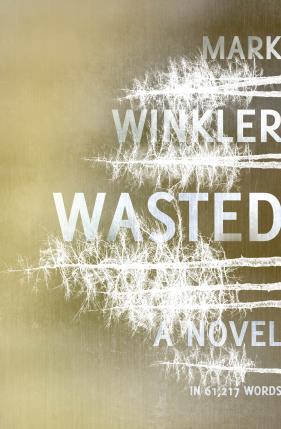
In/sanity: Mark Winkler’s Wasted

WastedWhere does sanity end and insanity begin?

Can anyone who intentionally kills or violates another person be thought of as sane?

Earlier today while driving, I saw a man, probably homeless, standing next to a garbage bin and talking to himself. It might have been the same man who a few months ago passed me in the street and out of the blue started screaming at me, forcing me off the pavement into heavy traffic. I was fortunate that cars avoided hitting me just in time. I wasn’t hurt, but petrified. I haven’t walked that route since.

I still like walking in our neighbourhood though, and do it nearly daily (it helps to keep me sane).

There were times this year when I did not feel sane myself. Grief is not a mental illness, but it is a state of vulnerability that makes you often act insane. I have experienced some really mad stuff since February. There were days when I thought of Valkenberg, and the idea seemed strangely serene. There are times in one’s life where all you want to do is lie down and let others take care of you. Just some peace and quiet, punctuated by kindness. We all have moments when we long for such spaces.

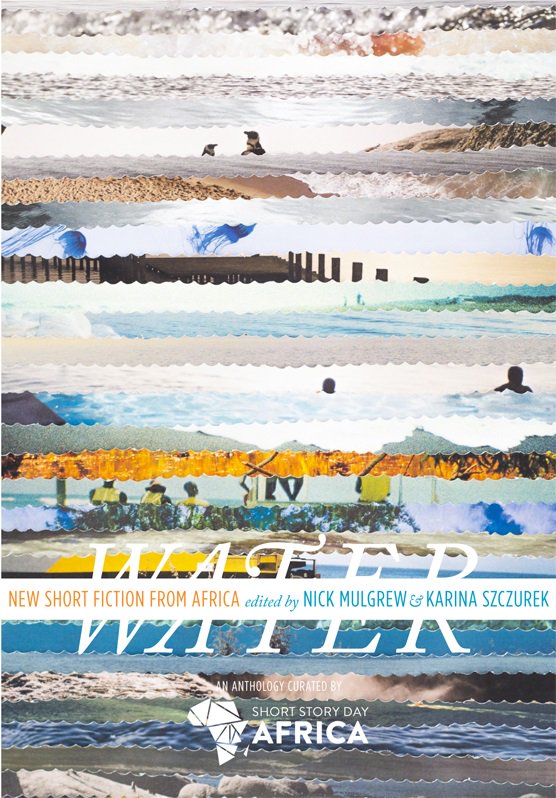
Water coverI finished reading Mark Winkler’s second novel, Wasted (Kwela, 2015), this morning, hence all these thoughts about in/sanity. I picked up the book because of the excellent story Winkler contributed to Water: New Fiction from Africa (forthcoming from Short Story Day Africa). I felt this was an author I wanted to get to know better. I have not been disappointed. Wasted is one of the best novels I have read this year. Well written (with an opening that is impossible to resist, and a middle and end that are even better), tense, darkly humorous, unpredictable and thought-provoking throughout, Wasted is one of those novels that creep under your skin. It strikes an admirable balance between seriousness and entertainment. Winkler manages to pull off that tough task of making you care for quite an unsavoury protagonist: Nathan Lucius is an enigma for most of the book and one approaches the unfolding of his story with trepidation, but you simply need to know what makes him tick.

We know he sleeps with the light on, has a dubious approach towards personal hygiene, does not allow anyone into the sanctuary of his flat where he collects old photographs of strangers he imagines as members of his family, and his relationships with his work colleagues, his widowed neighbour, a friend suffering from cancer, and his real family are unusual (if that is the right word), to say the least. The why behind his behaviour comes as quite a shock around two-thirds into the novel. But even earlier, around one-third into it, we come to the first unsettling revelation. The ending blows your mind.

What fascinates me about the novel is the portrayal of this character who is so recognisable and yet so foreign. You read along, and, if you’re honest, you allow yourself to realise that, yeah, I have done some similarly crazy shit, and, yeah, I have had similarly dark thoughts. The lights, the solitude, the blackouts, longing for forgetting, incapability of dealing with the frustrations of the everyday – been there, done that (perhaps not exactly to such extremes, but the point is that one can associate with it). Not wanting to spoil the surprise, let me just say that fortunately most of us don’t end up like Nathan. But it is a fine line that we all tread. That is what makes him such a great character. It’s easy to feel him.

Winkler is also the author of An Exceptionally Simple Theory of Absolutely Everything (Kwela, 2013) that I hope to get my hands on tomorrow at the celebration of The Book Lounge’s 8th birthday party. Wow, time does fly! Allow me to hope that it heals, too.

How to quench literary thirst?

Water coverSimple: with Water!

There is a wonderful anthology of short stories coming our way at the end of the year, and I am not only saying this because I had the privilege of co-editing it (with the multi-talented Nick Mulgrew): Water: New Short Fiction from Africa, curated by Short Story Day Africa.

Life should be about all those half-full glasses, and this particular one is overflowing with talent and inspiration. The great thing about most short fiction anthologies is that they give you samples of writers’ work which can lead to amazing discoveries. Most of the contributors to Water were new to me, but all of them, without exception, will remain on my radar of literary interests and I will follow their careers with anticipation.

I think that if you can read a short story a few times (which I had to do for all the stories in the collection) and can still enjoy it, discovering new aspects with each turn and deepening your appreciation, then it has to mean something. Next week, I will proofread all of them one more time before the anthology goes into print, and I do not dread the task at all, but actually can’t wait.

Short Story Day Africa has been doing incredible work since it came into being, offering a space for African authors to express their desires about the African story (as writers and as readers), connecting, inspiring, developing ideas, celebrating a genre that is without equals. A good short story is a good short story, and despite all the rumours that nobody writes, publishes, or reads it, the short story will survive and thrive, because many of us LOVE to write short stories, and we LOVE to read them! It’s all very simple, actually.

All of the contributors to the anthology are good writers and I salute them! When I single out only a few in what I am about to say, it is not because of favouritism, but because I feel that I am only at the beginning of a journey which Water is taking me on.

Efemia Chela: Every time she publishes a story, its exquisiteness astounds me. I know three. All three belong to the best of the best I have ever read. This is someone with a talent so precious that it should be cherished and nourished, so that it can grow strong roots in our literary community. One day, Chela might tower over it like one of those majestic baobabs which grace the African landscape.

Alex Latimer: His story in the anthology is bizarre, to say the least, but it speaks about grief in a way that has touched me deeply. Its handling of the emotion is so subtle and so beautiful, it will stay with me for a very long time. As will Alexis Teyie‘s story about the most unbearable of losses. When you get to the last line, it literally knocks you off your feet.

Megan Ross: After reading her story, I cannot wait to get my hands on the novel she is writing at the moment. May the muse be good to her.

Mark Winkler: He has already published two novels which I might not have looked at, hadn’t I fallen in love with his story in Water. I am nearly finished with his latest, Wasted, published earlier this year (the sense of humour and the unusual, totally unpredictable, plot!), and I will read the first, An Exceptionally Simple Theory (of Absolutely Everything) (2013), as soon as I can.

And then there is Dayo Ntwari: His story is exceptional as a story, but the world and the characters he creates in it are so fascinating that one feels there could be more to them than just this one incarnation. I would love to get to know them and the scary futuristic-mythical place they live in (which is such an astute reflection of our own times) better. Any literary agents out there looking for fantasy/speculative fiction/SF from Africa? Look no more. Just saying.

I can’t wait for readers to dive into Water and discover these treasure among twenty-one excellent stories. And I promise to report more on the journey these waters are taking me on.

water6