Tag Archives: André Brink

André Brink Tribute at the Woordfees

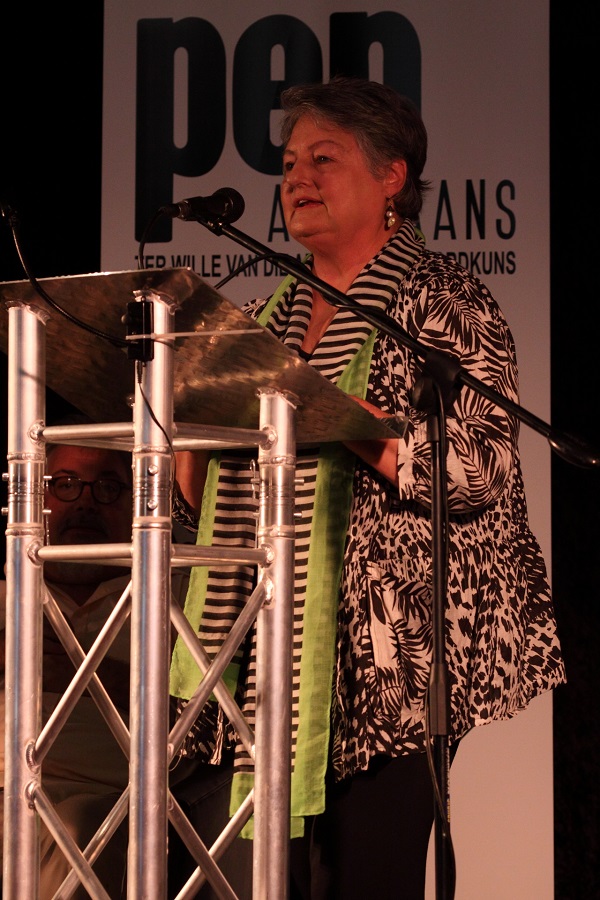
Writers, family and friends gathered on Saturday, 14 March 2015, in the afternoon at the Woordfees Book Tent to read from André’s work and correspondence, paying tribute and sharing stories. The event was organised by PEN Afrikaans & the Festival.

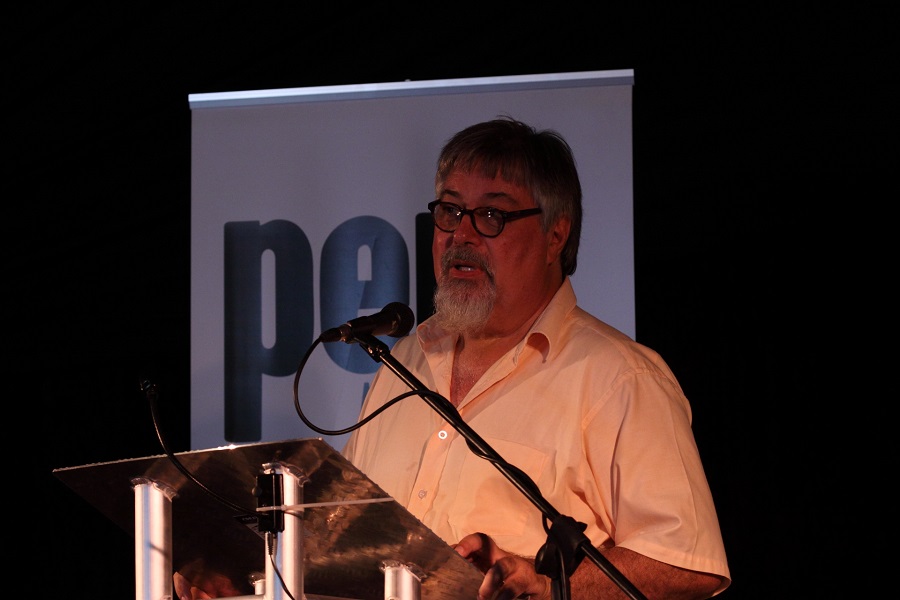
WoordfeesTribute1

Kerneels Breytenbach, friend, publisher, writer
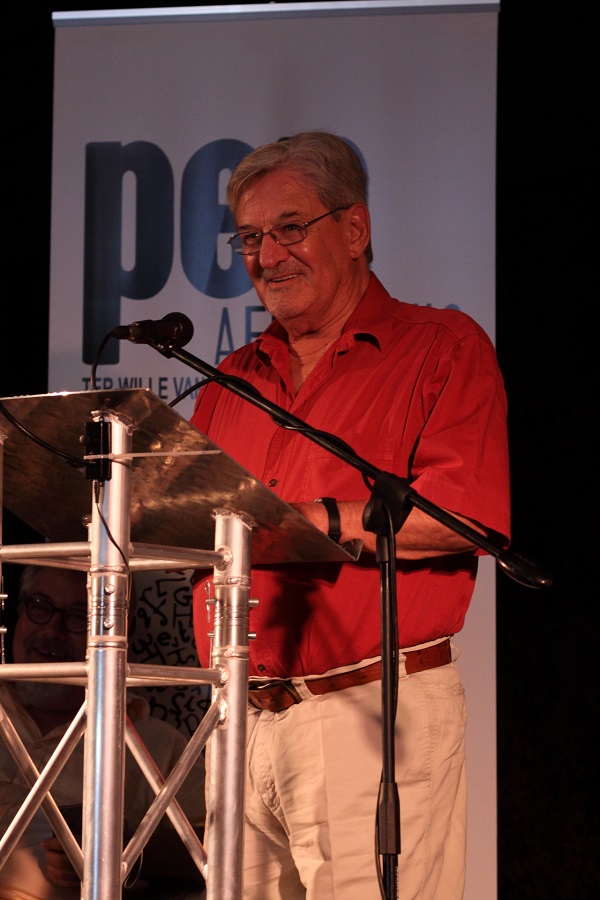
WoordfeesTribute2

Sonja Brink, daughter
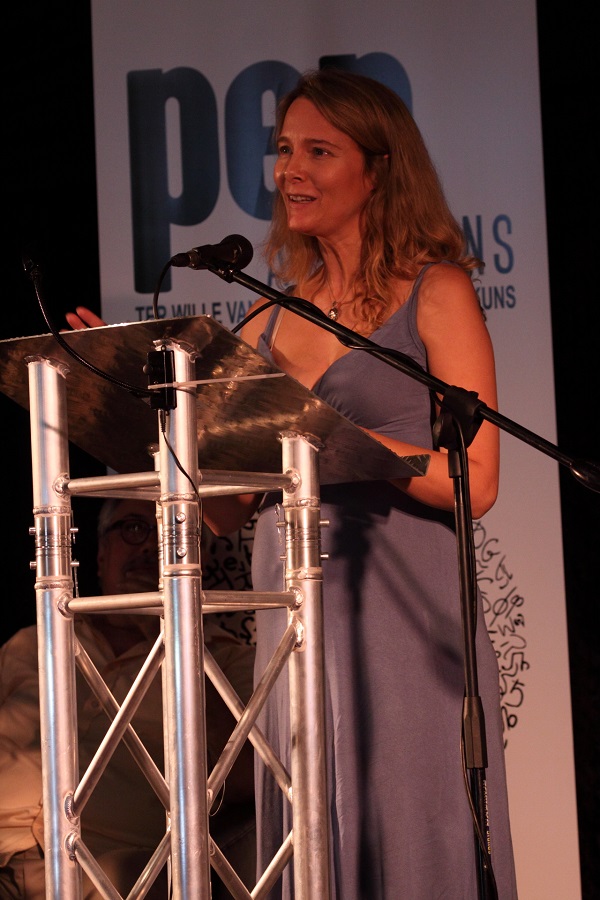
WoordfeesTribute4

Naas Steenkamp, friend, writer
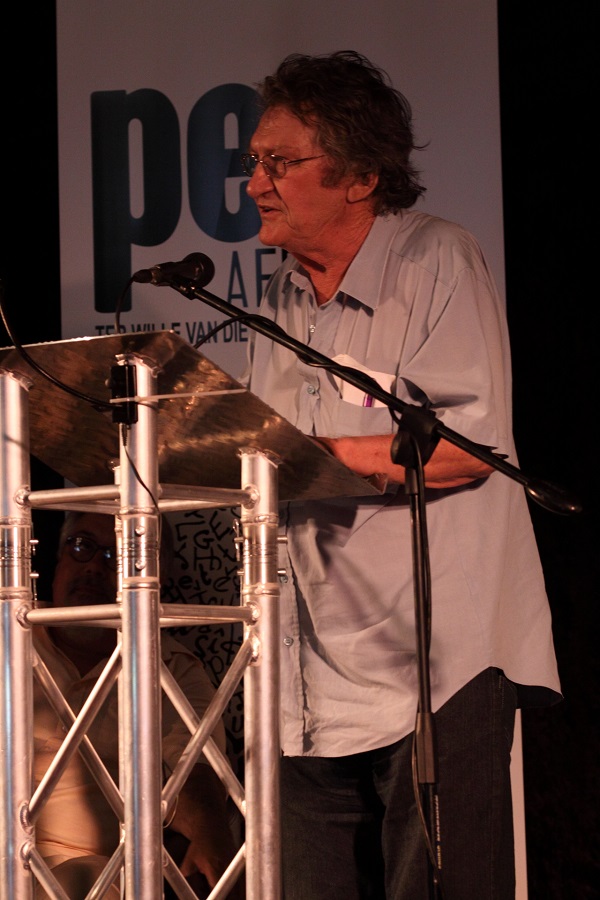
WoordfeesTribute5

Abraham Phillips, writer
WoordfeesTribute6

Willemien Brümmer & Matthias, friend, writer, journalist
WoordfeesTribute7

Abraham H. de Vries, friend, writer
WoordfeesTribute8

Pieter Fourie, friend, playwright, director
WoordfeesTribute9

Antjie Krog, friend, poet, writer
WoordfeesTribute10

Ingrid Winterbach, friend, writer, painter
WoordfeesTribute11

Bettina Wyngaard, writer, activist
WoordfeesTribute12

Hettie Scholtz, friend, publisher, literary godmother
WoordfeesTribute13

Danie Marais, poet
WoordfeesTribute14

& I
WoordfeesTribute3

(Photographs: Krystian Szczurek)

DAY ONE, SATURDAY 15 APRIL 2006

In 2006, for a week André kept a diary for Libération. This is the first entry of the week:

A good way to start my writer’s week: at a height of 11000 metres, flying over Africa. After ten days with my fiancée in Austria, I am returning to Cape Town. After the intense green of a Europe emerging from the snow, there is the familiar patchwork of browns and ochres. Back to roots: my own, and those of humanity. I have never felt a split between Africa and Europe inside me: what for some people is an experience of cultural and moral schizophrenia, has always been for me a source of richness and discovery. Both are part of me, both feed into me, both shape me and define me. If my physical birth is linked to the arid landscape of the Orange Free State, where everything was determined by the sense of space, by the endless distance between here (wherever ‘here’ was) and the horizon, by thorn trees, and fierce sunsets, and the hard omnipresence of stone, by ‘Bushman’ engravings on rocks and the traces of ancient fossils encrusted in hard places, my emotional birth (as I have often testified) happened at the time of the Sharpeville massacre, on a bench in the Luxembourg Garden.

And here Africa is below me again, its contours softened by distance, its suffering made dream-like, its cruelties and deprivations obscured by haze. Which seems like a metaphor for the distance and the haze that all too often, for all too many people, hide or distort the stark facts of the continent from the European gaze. How easy it is to see Africa as a scene of hopeless misery, a history of loss and failure, a disgrace to humanity. And yet this is where we all have our origin. This seemingly barren, useless tract of earth is our common mother; her vastness and relentlessness have nourished us, and taught us to survive. And for those of us who are prepared to remove the blinkers and dark glasses that protect our spoilt eyes, she is, still, a source of generosity and understanding, forgiveness and courage and strength. And, yes, of hope. Because she guards the source of what we have in mind when we speak of ‘humanity’: the wisdom of suffering that has endured through millennia, of humour that can smile at human folly and shortsightedness, of timeless faith in a future as long and as sure as the past. After exploitation and colonisation and oppression and contempt, she is indomitable rather than hard-headed, redeemed by agony rather than immersed in self-pity, prepared to share rather than to cherish herself, not vengeful but forgiving, filled not with despair but with hope, not with passivity but with the passion of faith.

It is home, and I am heading back to it.

– André Brink

5 December

The 5th of December has been very dear to my heart since 2004 when I went to the airport in Vienna to pick up an author invited to the “1st Joint Symposium: South Africa in Perspective” at the University of Salzburg which I’d helped organise. The encounter changed my life. The author was André Brink. We were married one-and-a-half years later in Cape Town, my home for the past nine years.

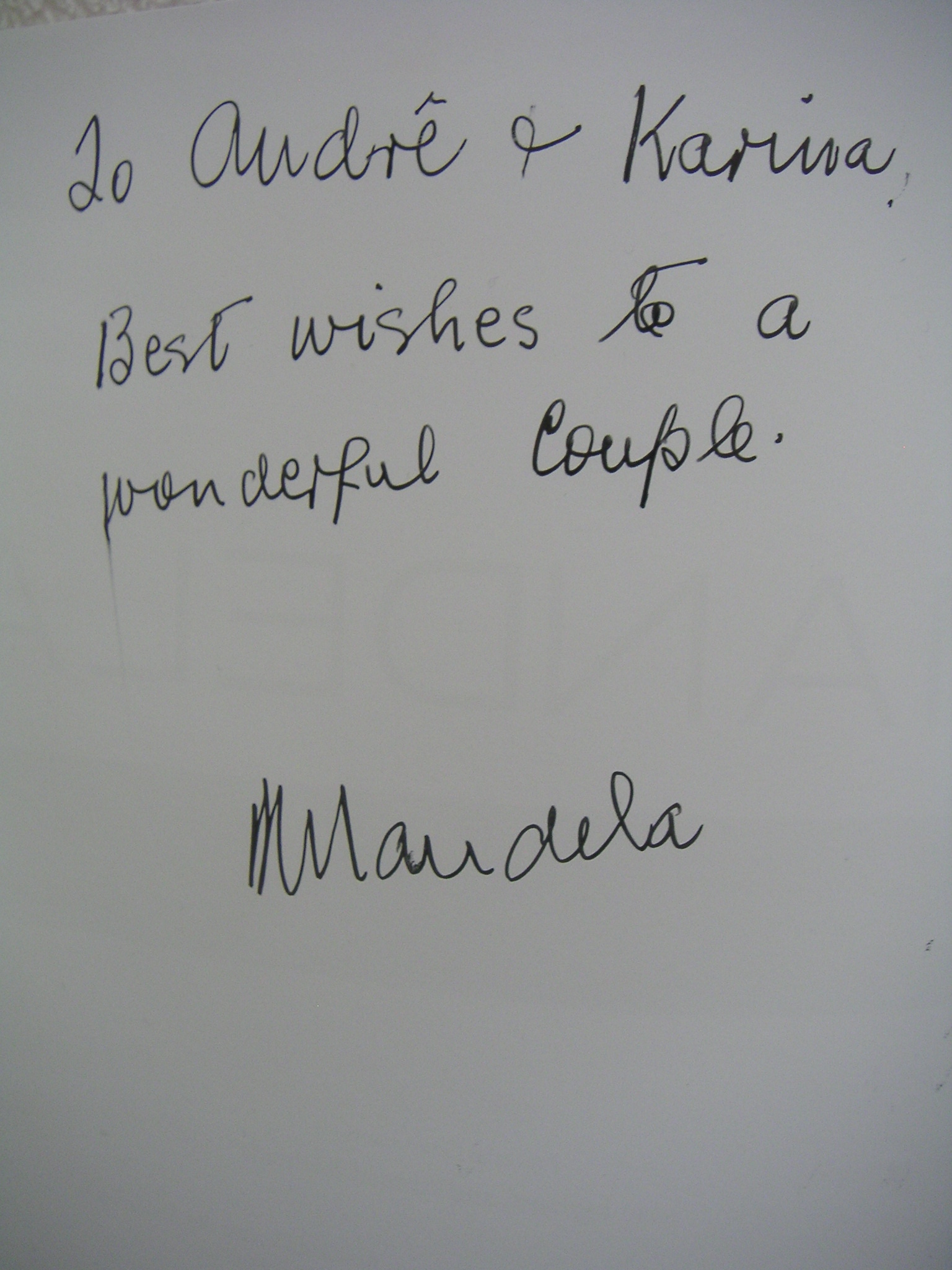
In 2007, on 9 October, André and I went to see Nelson Mandela at his home in Cape Town.
Madiba1
It was another defining moment of my life. Jakes Gerwel and Zelda la Grange were also present. In my notes after the meeting I wrote “very caring and supportive” of Ms La Grange. It was touching to see her interacting with Madiba. We brought books with us, both Madiba and Ms La Grange being avid readers. The talk evolved around Buckingham Palace, rugby, Lech Wałęsa, literature, and the past. Before we left, I held Madiba’s right hand in both of mine and said thank you with tears in my eyes (again now pressing for release years later, just remembering the moment). The stories people tell about being inspired, wanting to be a better person, of glowing for days after meeting Madiba are all true: that was the magic of his presence, a charisma like no other.

At the time, Madiba was in town to support his wife, Graça Machel. Their relationship testifies to the fact that it is never too late for love and one should never be afraid to reach out for it.
MINOLTA DIGITAL CAMERA
Because Madiba died on the 5th of December a year ago, the personal joy of this particular day will forever be infused with a deep sadness for us. His inscription in our copy of Mandela: The Authorized Portrait (2006) will, however, always feel like a blessing.
Mandela the Authorized Portrait

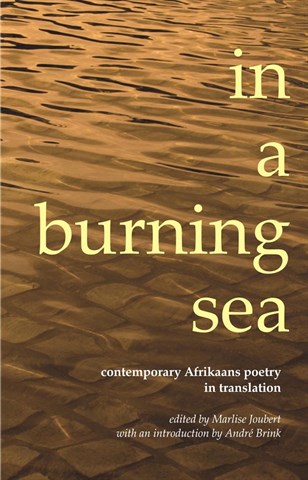
Review: in a burning sea – Contemporary Afrikaans Poetry in Translation edited by Marlise Joubert

in a burning seaMy Afrikaans is sufficient enough to follow everyday conversations, watch Afrikaans soapies and read Die Burger. But ever since hearing Antjie Krog read in her deep, melodic voice from her impressive oeuvre in Afrikaans I have wanted to understand more than just basics. Until that moment arrives, only translations allow me to savour some of the riches of Afrikaans writing. In poetry, these are not easy to come by. Of the few available in recent years in English, Krog’s Body Bereft (2006), Ingrid Jonker’s Black Butterflies (2007) and Wilma Stockenströrm’s The Wisdom of Water (2007) in particular belong to my all-time favourites.

in a burning sea is thus a highly anticipated publication which will hopefully pave the way for more translations. Altogether the anthology features thirty contemporary Afrikaans poets. Alphabetically arranged by authors’ names, the collection takes its title from a poem by Breyten Breytenbach, one of only a handful widely translated practitioners of the craft: “how often were we here / where only silver shadows stir / only through you I had to deny myself / through you alone I knew I had no harbour / in a burning sea”.

The editor Marlise Joubert, author of seven volumes of poetry herself and editor of four Versindaba anthologies (a publication inspired by the annual poetry festival by the same name), asked established poets and newcomers (but with at least two published volumes to their name) to submit ten poems from which a selection was then made for the book.

Among those included are the exciting young voices of Ronelda S. Kamfer (“the bullet nestled in his throat / his mother did not cry / the politicians planted a small tree / and the Cape Doctor tore it out / and flung it where the rest of the Cape Flats dreams lie – // on the flats”), Danie Marais (“On seconds thoughts, Stellenbosch, / you are a violated classic – / a bergie with an 1840s gable / for a hat…”), Carina Stander (“in the weak sunlight / filtering into the kitchen / mothers like calabashes / nattered on knitted goatskin”), and Loftus Marais (“and when i have to stand before Him / i’ll curtsy effeminately / and carefully explain to Him / that my catsuit / (folded in the suitcase next to the vanity case) / is fire resistant” – from The Second Coming) who hold more than their own along such greats as Breytenbach, Krog, Stockenström, Petra Müller, T.T. Cloete or Marlene van Niekerk.

Top translators of the likes of Michiel Heyns, often in collaboration with the poets, and the authors themselves made the work available in English. Hardly ever was I aware of reading translations, the Afrikaans poems feeling very much at home in their new incarnations. The originals are presented alongside the English for parallel reading.

André Brink’s introduction gives a short historical overview of Afrikaans poetry and its various trends, placing the selection in context. Most poems included are very recent, with a few exceptions dating back as far as M.M. Walter’s Apocrypha XII (1969): “When Eve clad herself amidst the grove of figs / in fashions by the heavenly Hartnell –”. Some poems had not been published at the time of submission, including Marlene van Niekerk’s eulogy Hamba kakuhle, Madiba.

What strikes one immediately when reading the anthology is how well local flavours mix with global traditions. The anthology opens with a landscape poem by Zandra Bezuidenhout about the last days of summer in the Midi: “the night is balmy with bonhomie / and aromas linger like tongues”. Bezuidenhout’s other poems are steeped in an irresistible sensuality whether she describes the sharing of a fig (“and offer the plum-red sweetness / as token of our bonded state”) or an exhibition by Marlene Dumas (“how transparent the nipple-bud / bleeding in berry-red passion”).

Universal themes are presented along concerns closer to home such as in Martjie Bosman’s Scorched Earth (From Ouma Makkie’s stroke-stricken mouth I inherit / two bitter words: insult and scorn / and the mournful knowing that generations / settled this family land in vain”), or Daniel Hugo’s in memoriam poem to Ingrid Jonker, Escape (“I love walking – drunk on ozone – / up to Three Anchor Bay…everywhere sewage smells / algae, seal vertebrae, mussel shells / a clotted, stinking ink-fish / and – stone-cold sober – you see / at times a poet’s body”), or Krog’s colonialism of a special kind (“people are made ashamed that they have forgiven // because at the deepest level / we respect anger / understand hate / admire revenge”).

in a burning sea gives one an enticing taste of what is happening in Afrikaans poetry at this point in literary history. Not all the poems selected take one’s breath away, but they definitely put one in a mood for more.

in a burning sea: Contemporary Afrikaans Poetry in Translation
edited by Marlise Joubert
Protea Book House, 2014

An edited version of this review was published in the Cape Times on 14 November 2014.

At Home in China

China1
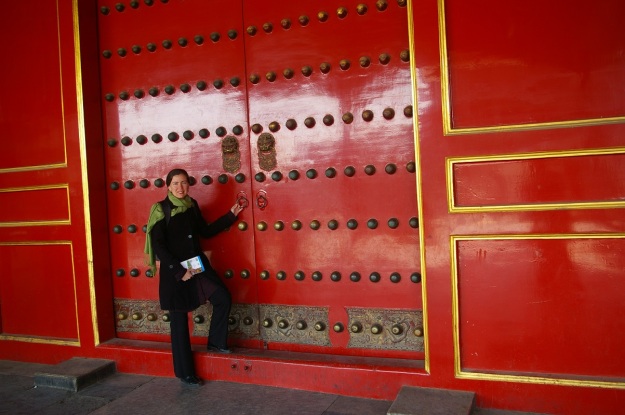
Unexpectedly, it felt like a homecoming. Our Dragonair flight from Hong Kong to Beijing landed in the late afternoon. From the moment we left the arrivals hall something in the air made me want to curl up inside myself and simply return to where we came from. And it was not the chilling wind; nor the constant drizzle.

The grey architecture’s sharp and unimaginative lines, the bleak atmosphere, the poverty and hopelessness of masses, the condescending attitudes of people in any kind of authoritative position, the schemers operating below the radar of the system, and the uncanny impression of being constantly watched as if surrounded by an omnipotent, unpredictably scary, presence – almost instantly I was transported back to the time I was growing up in Eastern Europe still under the thumb of communist rule, before the political changeover of the late 1980s. Something engrained in my bones, but dormant for so many years, resurfaced in recognition.

The traffic policeman in charge of the taxi flow at the Beijing Capital International Airport shoved us aside and signalled for us to wait. It transpired that we were judged to have too much luggage to fit into an ordinary taxi, with no other kind of taxi in sight. There were three of us, each in possession of a suitcase and a piece of hand luggage. We tried to suggest that we could at least attempt to load the luggage into a car or separate and take two taxis, but both ideas were rejected. After a while of hopeless waiting, a rickety minibus arrived, clearly not an official taxi. The driver ‘generously’ offered to take us all to our hotel for about twice the usual fee. We did not have a choice but to accept.

An insignificant scene, one could say, but it was just the beginning. For the reminder of the trip I was constantly aware of this familiarity between the Poland of my childhood and the present-day China and I marvelled again at the destructive power of the ideology behind the resemblance, at how two countries of such diverse cultural backgrounds – Eastern European and Asian – could be reduced to eerie similarity under the pressures of a single system of thought.

But beside the ache in my bones, the experience of discovering a few spots of China was one of the most memorable ones of my entire travelling life. For the first time, I realised what Americans were doing when they ‘did’ Europe in two weeks. Our attempt was of a similar nature. My husband André Brink and I visited China to attend two literary festivals, in Hong Kong and Shanghai. The invitation was facilitated by a dear friend of André’s, Gary Kitching, who kindly offered to accompany us not only to the official literary events but on most of our journey through the Land of the Dragon. Apart from visiting the two festival cities, we used the opportunity to fulfil lifelong dreams of walking on the Great Wall and seeing the warriors of Emperor Qin Shi Huang’s Terracotta Army.

It was our honour and pleasure to share parts of the journey with another South African writer, Mandla Langa who, like André, was a guest of both literary festivals. Mandla Langa’s latest novel, The Lost Colours of the Chameleon (2008) won the Commonwealth Writers’ Prize for Africa Region in 2009. During the two festivals Mandla read from the novel and spoke very movingly about his work, the hardships of exile, and the tragedy of having to cope with his brother’s death at the hands of the ANC. At shared events, Mandla and André discussed the different sides of the literary and political struggle they were both involved in during apartheid. On a more positive note, they shared with their enthusiastic audiences their feelings of optimism about the explosion of creativity in the New South Africa.

In Hong Kong at one of the literary events, together with Mandla, André was interviewed by Rachel Holmes, author of The Secret of Dr James Barry (2002) and The Hottentot Venus: The Life and Times of Saartjie Baartman (2007). She reminded them of the occasion they had met in London when Mandla was still in exile. André described the encounter in his memoir, A Fork in the Road (2008). He went to see Mandla and Essop Pahad at the time. As he took his leave, André was offered a packet of ANC coffee from Kenya and was told that they would drink it together when they were all allowed to come home “one of these days”. “The coffee will still be fresh,” André was reassured. Mandla accompanied him to the tube. André recalls in the memoir: “I walked huddled over the small packet I was carrying like precious loot under my arm. Mandla walked inclined towards me as if he, too, wanted to claim possession. Perhaps we were both imagining the flavour of that coffee: the smell of tomorrow. One of these days.”

For both of them, and for myself, the time of tasting freedom has arrived when at last we all found ourselves living in democratic countries, post-1994 South Africa and Austria respectively. But while we were travelling in China, signs of the ongoing repression and fear were everywhere: the Rio Tinto trial began in Shanghai amongst secrecy and doubt in the fairness of the process, Google was finally on its way out of the country refusing to accept the censorship imposed on the search engine, and an interview with the outspoken Chinese artist and activist Ai Weiwei, a victim of censorship and state violence, was repeatedly shown on BBC World. Very tellingly, there were hardly any Chinese readers attending the festival events.
China3
Even before arrival in the country, while applying for our visas we were told not to mention the fact that we were writers, academics or had any associations with the media. This might have either endangered the positive outcome of the application or at least made the process much more tedious, we were warned. So, André travelled as a retired teacher, I as a housewife. Neither was a direct lie, but both statements were far removed from the truth. The application went smoothly. To our great surprise, the Chinese Consulate in Cape Town even distributed free DVDs about the Dalai Lama. We did not dare take one when applying for the visa, suspicious of the unexpected offer (a possible test of the worthiness of the applicant?), but could not resist bringing it back home once the visas had been granted. We were curious whether it was a piece of propaganda. But it turned out to be shrewder than that. We only managed to watch thirty minutes of what seemed a factually correct documentary. Then we fell asleep; it was so boring. Clever, we thought.

We also discovered that in spite of being widely publicised in the print and online media, the literary festival in Shanghai we attended was strictly speaking illegal. This kind of schism is also part of the system I remembered from growing up. You constantly live your life on the border of legality. Your actions are tolerated until you overstep a line. Where that line is precisely located you never know until you cross it, and then all which has been ignored till then will be counted against you.

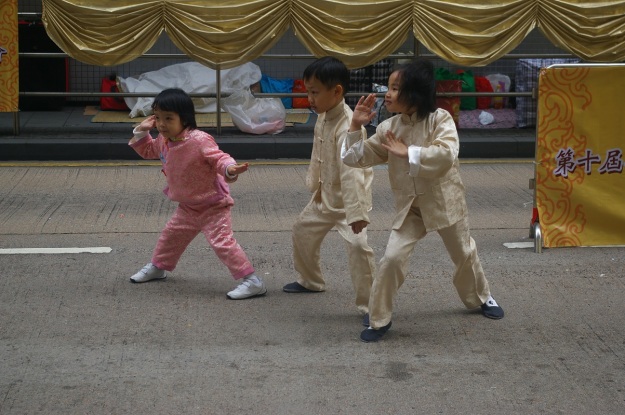
As a special administrative region, reflecting the policy known as “one country, two systems”, Hong Kong still enjoys a high degree of autonomy in all areas except defence and foreign affairs. The city hosted its literary events officially. Celebrating their tenth anniversary with a bang, the festival organisers invited the likes of Alexander McCall Smith, Junot Díaz, Louis de Bernièrs, Linda Jaivin, and Mo Zhi Hong whose debut novel The Year of the Shanghai Shark (2008) won the Best First Book for South East Asia and Pacific of the Commonwealth Writers’ Prize 2009 (the same year as Mandla won with The Lost Colours of the Chameleon).

The Hong Kong and Shanghai festivals often collaborate in bringing authors to the their audiences. So some faces were more or less familiar when we arrived in Shanghai. Contrary to expectations, literary festivals or conferences seldom offer good opportunities of getting to know other writers, especially if one is rather shy by nature, which, maybe surprisingly, many writers are. In spite of many organiser’s efforts to put them into social situations, writers often end up lonely in hotel rooms, passing the time from one event to another with TV or mini-bar content (more often than not, both), or if the gatherings take place in interesting settings, desperately trying to see as much of the area as possible. The latter happened to us, when André and I spent every free minute exploring Hong Kong and Shanghai instead of listening to other guests of the festival, no matter how alluring.

We did however, even if only briefly, catch up with Linda Javin, Louis de Bernièrs, and Mo Zhi Hong in Shanghai. On the terrace of the fabulous “M on the Bund” Restaurant (venue and one of the main sponsors of the festival), over James Bond martinis and the exotic Dragon’s Pearl cocktails we listened to the wonderfully flamboyant Linda Javin, author of the best-selling A Most Immoral Woman (2009), talking about her latest project, a traditional Chinese opera based on a story from a Ming Dynasty novel for which she has been asked to write the libretto. We actually managed to attend Louis de Bernièrs’s official event during which he delighted the audience with a reading of “Obadiah Oak, Mrs Griffiths and the Carol Singers”, a story from his recent collection Notwithstanding (2009), and charmed us all with his infectious sense of humour. With Mo Zhi Hong we shared a taxi to the airport in Shanghai and after a brief conversation were very sorry not to have been able to spent more time in the company of this erudite young man. The festival over, he was on his way back home to Auckland and we were travelling to Xi’an for our appointment with the world-famous Terracotta Army.

One of Emperor Qin Shi Huang’s megalomaniac ventures, the terracotta warriors are a sight to behold. What struck me most about visiting China’s well-known places of interest was that in spite of seeing them numerous times on television programmes or in photography books, one is not prepared for their size. Constantly I had to readjust the images in my head to the real thing. The Great Wall of China (also Emperor Qin Shi Huang’s brainchild) does not impress with its height, as I expected. It is actually quite low and narrow for most of its unfathomable length. But when you stand on one of its vantage points and it stretches away from you in both directions over the mountain ranges like a ribbon carelessly discarded on the seemingly impenetrable landscape, it takes your breath away. In Beijing, the infamous Tiananmen Square is so vast that one can hardly see from one side of it to the other and walking across it in bitter cold was quite a challenge. The Forbidden City is actually a city within the capital. We began our tour of it at the northern entrance and it took us over four hours of almost continuous walking to reach the South Gate where Chairman Mao’s portrait overlooks the scene of the terrible massacre which took place in 1989.

Similarly, no matter how often one had seen them on television, the enormous excavation pits near the city of Xi’an where the Terracotta Army stands exposed after thousands of years of existing only in legends, are simply awe-inspiring. Each individually crafted and meticulously reassembled after centuries of being buried in mud, the warriors testify to the outrageous and murderous dreams of a single individual. Thousands of craftsmen and workers were tortured and killed during the execution of Qin Shi Huang’s vision of the army that was to protect him in the afterlife. Since their discovery just over thirty years ago, thousands of archaeologists, scientists and helpers have been meticulously putting the warriors’ remains together to make them, and what they stand for, known to the world. I walked around the pits and was terrified by the hunger for power and greatness which called this army into being. It was a chilling experience, but I admired the incredible reconstruction work on site and the amount of knowledge experts have gathered about ourselves and our past from the excavation pits. If only we would learn from it.

Other ‘visionaries’ ruled the land. After the so-called Cultural Revolution of the late 1960s when China’s innumerable treasures were destroyed and a whole generation of artists annihilated, the country is in the throes of another ‘cultural revolution’, this time brought about by Big Money and Big Mac. Like many other fast-growing economies, China is in constant flux, its authenticity challenged by the same forces which are at work in South Africa and other westernised parts of the world. Recently modernised for the Olympic Games, China still looks like one gigantic building site. Entire cityscapes are dominated by high-rise flat buildings which function as dormitories for the expanding population. Transport networks, shopping malls, factories, office buildings, and all kinds of institutions rise from the ground like mushrooms after the rain. The one constant is forests of cranes. Higher, bigger and faster seems to be the motto for everything. I can imagine that architects must have a field day in a country where their imaginations are required to go beyond all limits.

One of the most spectacular modern sites we saw was the architecturally mind-boggling Pudong skyline in Shanghai, the characteristic Oriental Pearl Tower dominating the scene. Over the last two decades the district has become home to China’s commercial and financial buzz. Just across the Huangpu river from Pudong is Shanghai’s best-known historical landmark, the Bund. While we were visiting, we witnessed the exciting preparations for the World Expo all along its beautiful promenade.
China2
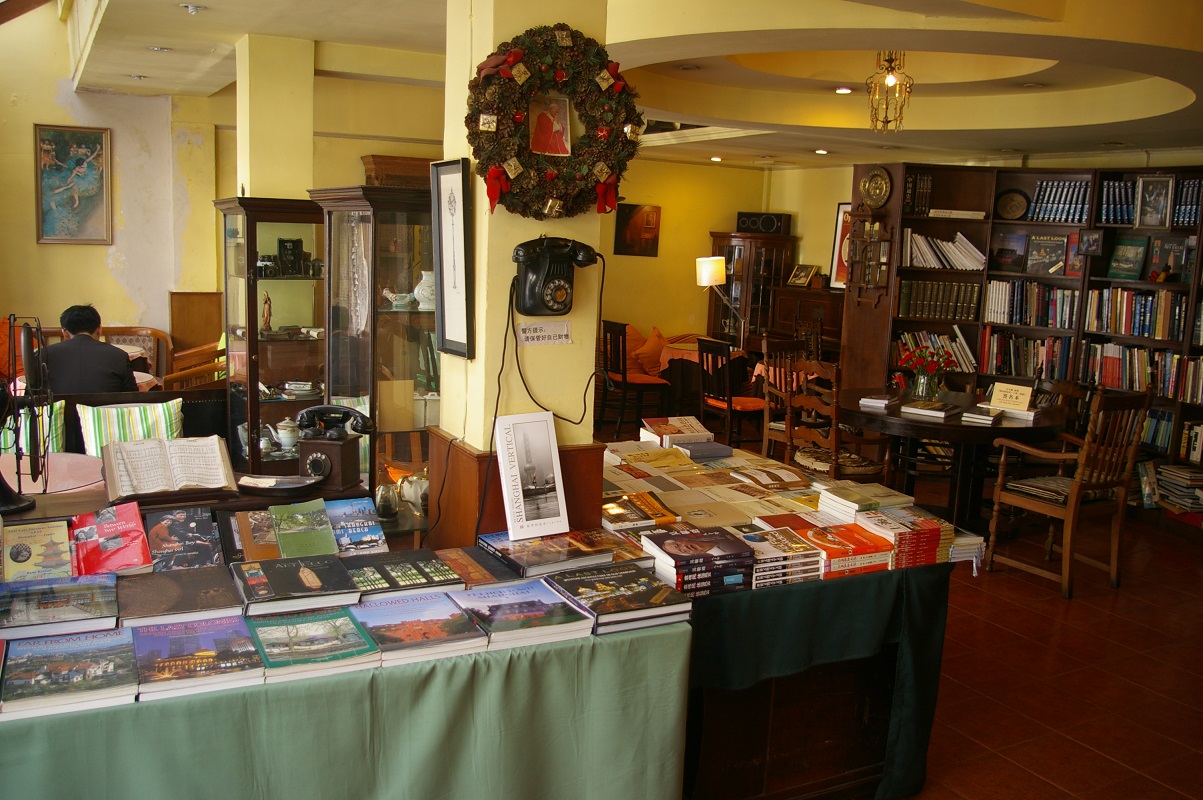
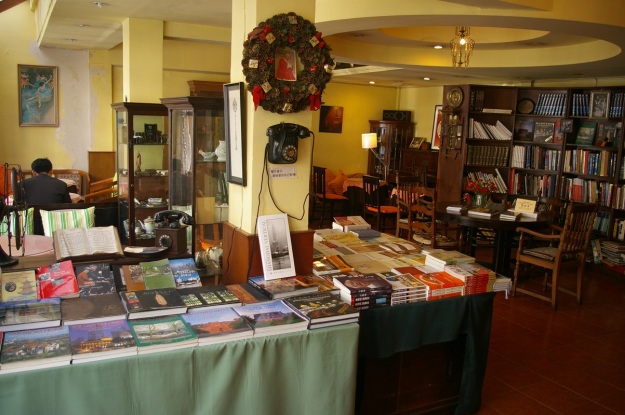
Yet, among all the splendour and chaos, the one place in China that is truly lodged in my memory is the Old China Hand Reading Room, a small antique book-cum-tea shop located in one of the quieter streets of the French Concession, another of Shanghai’s historical districts. It was founded by photographer Deke Erh and writer Tess Johnston and strikes the perfect balance between past and present, between Chinese and Western influences. Furnished with antique furniture and stocked with hundreds of old and new publications as well as many quirky trinkets of local and international origins, the shop is a must for all tea and book lovers. They also serve excellent cappuccinos in ancient porcelain cups. Just the thing after a long Sunday morning walk through the Concession, as André and I discovered.

Everywhere else we had what one really should have while travelling through China: tea. It is served at every opportunity, its distinct flavours and the rituals to bring them forth cultivated through millennia-old traditions. I have always loved tea but never appreciated it as much as after the visit to China. The souvenir I cherish most from our visit is my collection of exquisitely embroidered, colourful silk pouches from the Laoshe Teashop in Beijing which was recommended to us by our dear friend Alex Smith, the author of the travel memoir Drinking from the Dragon’s Well (2008). Inside the pouches conceal such wonders as Dancing Fairies, Love at First Sight, Birds of Heaven, and Whispering Flowers. If you put them in a transparent teapot and pour mild boiling water over them, the little green tealeaf bundles which are known by these fantastic names open up like blossoms and release a string of flowers – jasmine or lily – from their centre. The taste is as marvellous as the spectacle.

It is good to be back in Cape Town, where I’m truly at home, and to enjoy a bit of Chinese magic. Not all can be lost for a people who can create such perfect little artworks in a teacup. They may yet survive the dreams and visions of ‘Great Men’. And in spite of everything that is going wrong in our own country, I gain strength from the unsurpassed surge of creativity we are experiencing at the moment in South Africa. I just hope that my bones won’t begin to ache here, and I wonder whether I will ever be granted a Chinese visa again. Or will this article be placed in a file with my name on it, hidden away in some obscure cabinet?

First published in WORDSETC 8 (August 2010).

Our Literary Felines

Mozart after finishing Imre Kertész's Liquidation

Mozart after finishing Imre Kertész’s Liquidation

Inspired by a chat over dim sum and pu-erh tea with Alex Smith and her recent Three Cats blog post, as well as an exchange of cat photographs on twitter with Katherine Stansfield whose four Cats seem as literary as our Feline Family, I decided to share a few stories and photographs here with you.
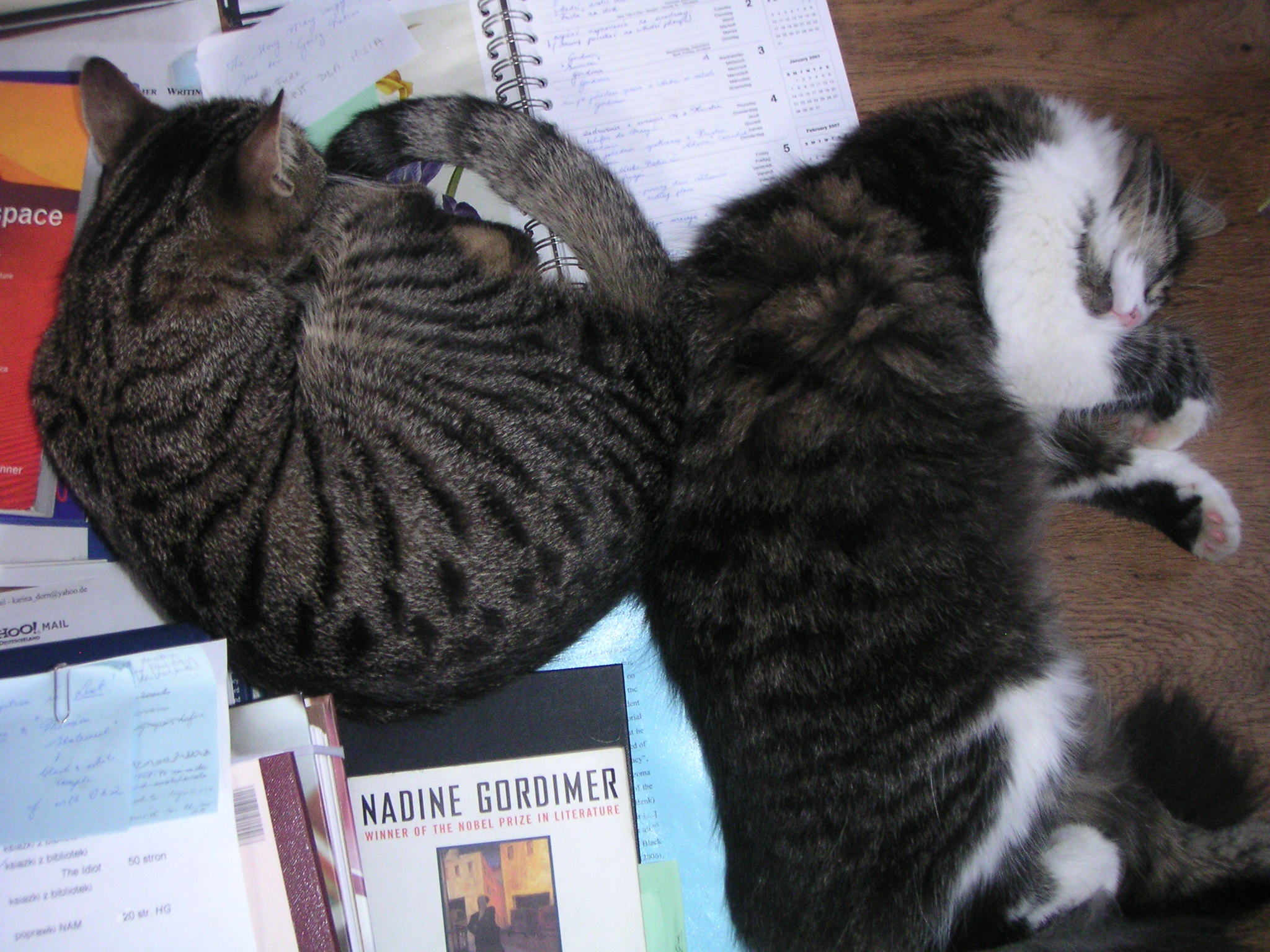
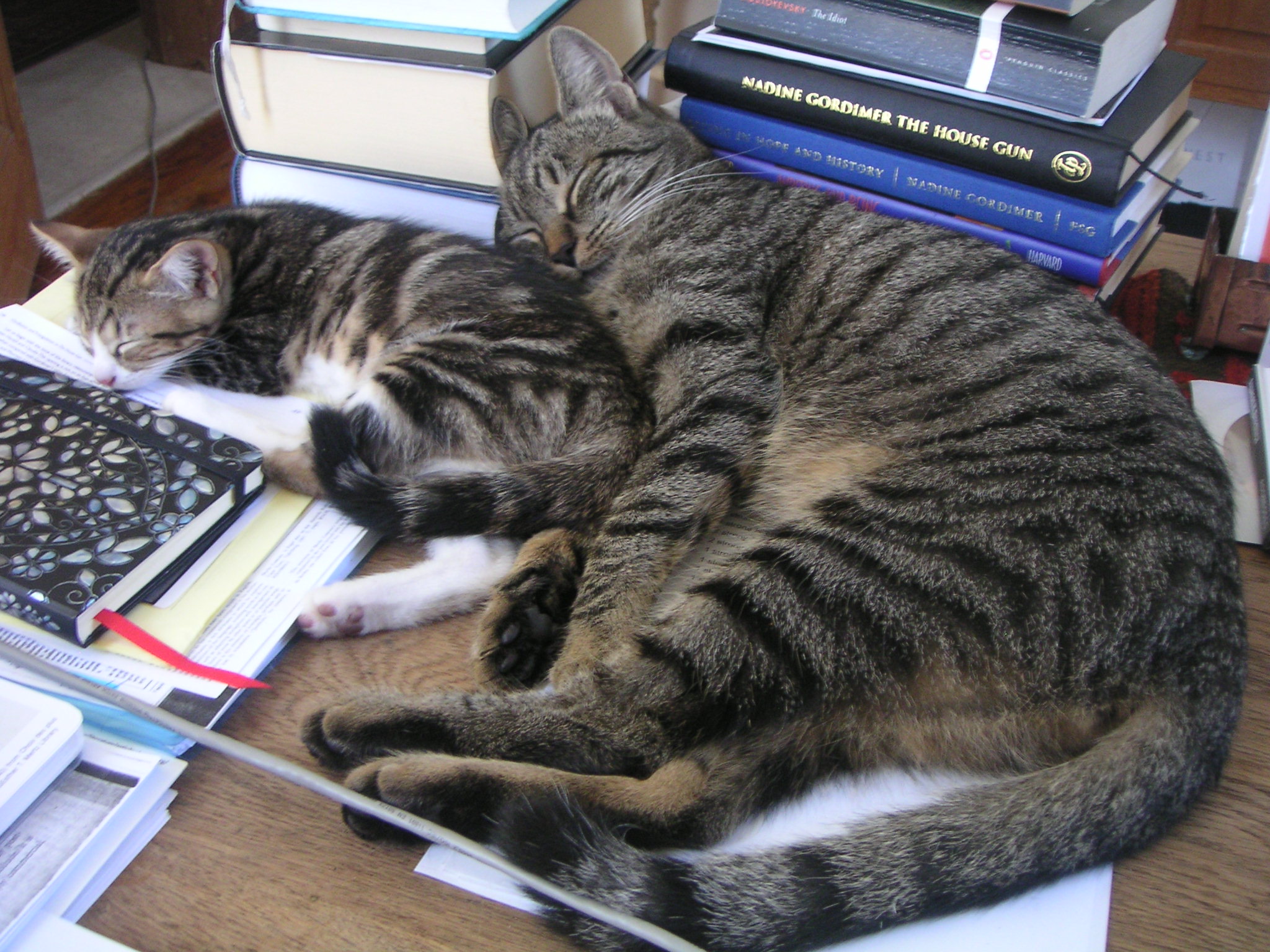
Anya and Mozart supervising the writing of my PhD thesis on Nadine Gordimer

Anya and Mozart supervising the writing of my PhD thesis on Nadine Gordimer


MINOLTA DIGITAL CAMERA
André and I don’t want to remember the ordinary boring life we led before Anya and Mozart (named after Anna Netrebko and Amadeus – they were born in the Mozart year) arrived on a KLM flight from Austria in 2006. It was quite a dramatic occasion, because their documents got lost along the way and their trip was postponed by 24 anxious hours. However, at last we received the news that they were safely on their way and we could pick them up from the airport. The plane landed, all the passengers – human and non-human – deboarded and we were told that we would get ‘our dog’ in a few minutes.
‘But we are expecting two cats,’ we protested with hearts in our throats.
The man glanced at the documents in his hands, ‘Yeah, right.’
Minutes passed, we remembered the lost documents and began to prepare ourselves for the Rottweiler travelling on Mozart’s pet passport while he and Anya were on their way to Australia for all we knew.
The airport official returned empty-handed, but assured us that ‘our dog’ was on his way.
‘You mean our TWO CATS!’ we shouted, but he was gone again.
At last, he returned with a cage containing two very vocal Kitties we recognised. Relief, relief!
We had read all the available cat books and prepared the house for their welcome, stressing about getting it all right, but Anya and Mozart were completely blasé about the entire trip to the other side of the world. The moment we arrived home, we let them out of the cage and stood around helplessly, watching for any signs of distress. They stretched, looked around, located the litter box, did their business, saw the food and the water, helped themselves, sniffed a bit around, and literally twenty minutes later were both stretched out on our bed, looking up as if to say, ‘So, when are you coming to bed?’

Our lives changed that day. They became a million times better!

Anya with one of her favourite novels, Jeanette Winterson's Lighthousekeeping

Anya with one of her favourite novels, Jeanette Winterson’s Lighthousekeeping


To lose Anya to a speeding car a few months later was shattering, for all three of us, worst for Mozart of course, but we all didn’t know how to deal with the loss. I still see her strolling through the house, waving her gorgeous bushy tale as if the world belonged to her. It did. We miss her terribly.
Mozart showing Salieri the ropes of supervising my PhD on Gordimer

Mozart showing Salieri the ropes of supervising my PhD on Gordimer


After the tragedy, friends recommended a kitten. That is how Antonia Salieri came into our lives in 2007. Born in a sewage pipe, she was a bit of a rough diamond at first, and so tiny that she constantly got lost under Mozart’s feet when he tried to play with her. Eventually, out of desperation, I presume, not knowing how to engage her otherwise, he danced on the scratching pole for her, bum and tail high in the air like a real pro. None of us will ever forget the performance, least of all the flabbergasted Salieri. Once she recovered from the shock, they settled into a co-habitation of mutual respect. Salieri quickly realised that the circumstances of her birth shouldn’t stand in her way of behaving like royalty and she earned herself the nickname Principessa from an Italian visitor to the Brink household. She only eats her food if served on the kitchen table (Royal Albert plates), takes up half of my half of the bed (she doesn’t care much for my back problems), and screams at me if I misunderstand ‘Catlise’, the most important language for any human to understand. Any cuddles happen only and entirely on her terms when she is ready for them.
As a kitten Salieri read Olga Tokarczuk

As a kitten Salieri read Olga Tokarczuk


Salieri pensive after reading the Sunday newspapers

Salieri pensive after reading the Sunday newspapers


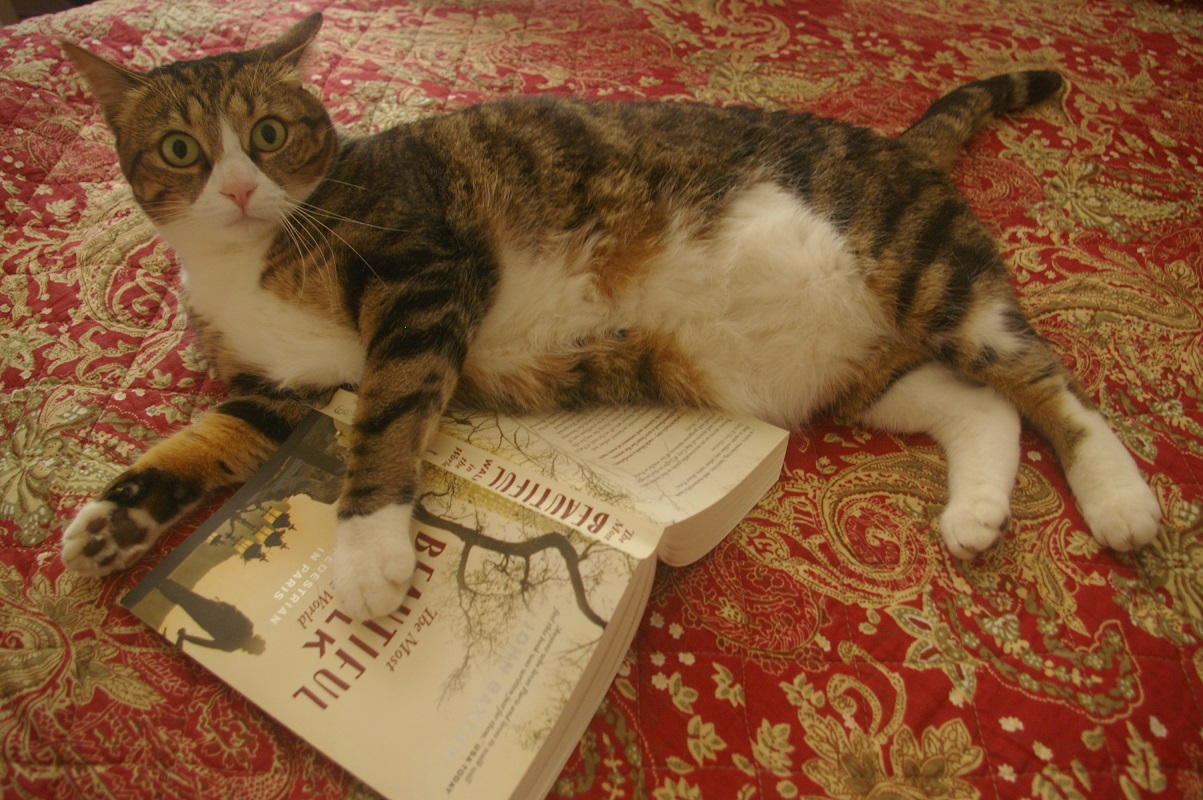
Salieri shocked how little she knew about Paris after reading The Most Beautiful Walk in the World by John Baxter

Salieri shocked how little she knew about Paris after reading The Most Beautiful Walk in the World by John Baxter


Salieri supervising André's translations of Ingrid Jonker's poetry for Black Butterflies

Salieri supervising André’s translations of Ingrid Jonker’s poetry for Black Butterflies

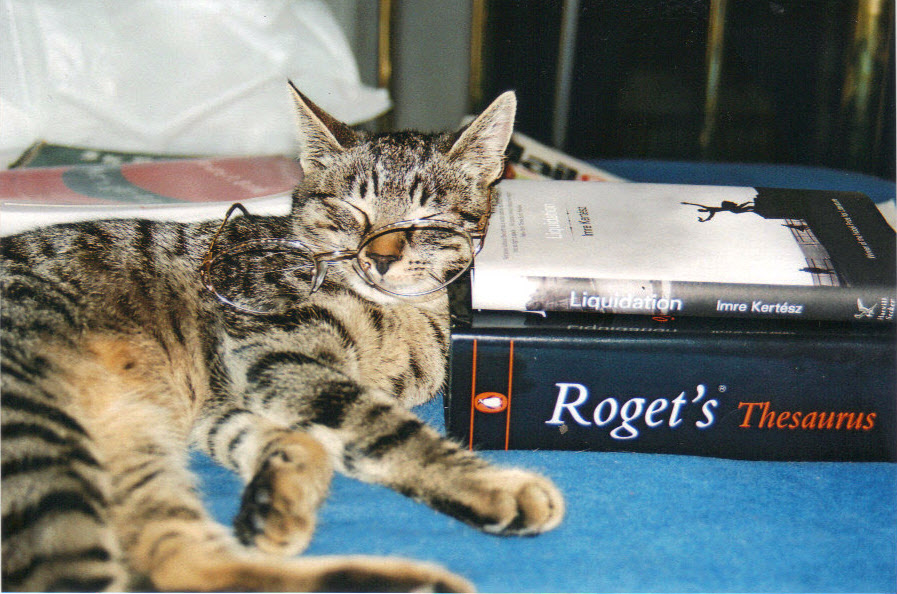
Salieri getting her teeth into Roget's Thesaurus

Salieri getting her teeth into Roget’s Thesaurus


Salieri trying to put some order into the chaos on André's desk

Salieri trying to put some order into the chaos on André’s desk


Mozart is our wanderer and partly adopted the neighbours as his other family. He is very wise, speaks Polish, German, English, Afrikaans, and Catlise fluently, understands many more languages and loves David Attenborough bird documentaries.
Mozart contemplating whether to read Granta magazine or Gordimer's Selected Stories next

Mozart contemplating whether to read Granta magazine or Gordimer’s Selected Stories next


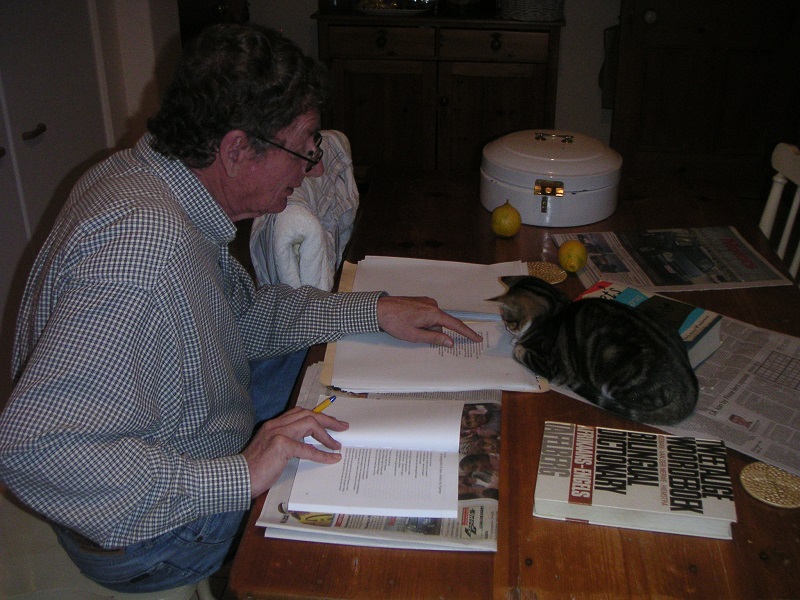
Mozart searching for a dictionary

Mozart searching for a dictionary


We never thought of another cat to join the household, but when Michela Glinka was placed in my hands with a red bow around her neck and we were told that she desperately needed a home, we had no choice. She arrived in 2008 with a tummy problem and kept us awake the whole first night. Between trying to somehow help her and changing our bed sheets for the third time, I was ready to give her back, but when we eventually all fell asleep in the morning and woke up together, I knew she was here to stay. She is now sleeping on my chaise longue in one of her nests.
Glinka in a nest

Glinka in a nest


Glinka5
Glinka is the ultimate nest-builder, fresh laundry is best, but any blankets or quilts will do. We also call her our birdie-cat because she chirps like a little bird. The moment I set foot out of the bed in the morning, she will be running through the house, chirping along the way to welcome me into the day. We make coffee together and then return to bed where she will sit on my chest (as close to my face as possible), have rusk crumbs, and read with me or go over to André to check whether his book is more interesting. Most of my writing happens with her in my lap or somewhere in the room.
Glinka with Lauren Beukes's Moxyland toy

Glinka with Lauren Beukes’s Moxyland toy

Glinka pondering a word she'd just looked up in a German-English dictionary

Glinka pondering a word she’d just looked up in a German-English dictionary


Glinka inspiring my writing

Glinka inspiring my writing

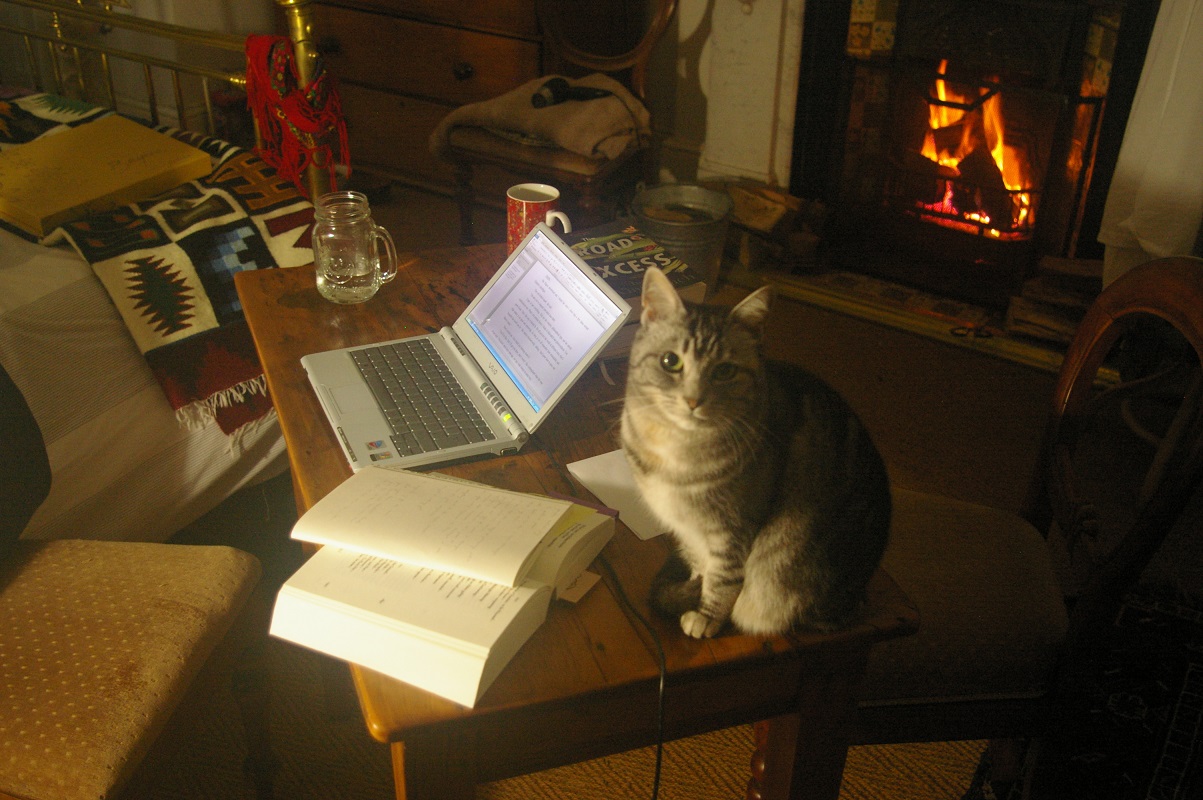
Glinka and I writing in winter close to the fireplace

Glinka and I writing in winter close to the fireplace


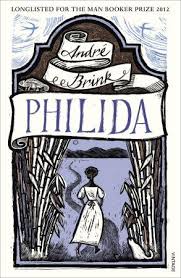
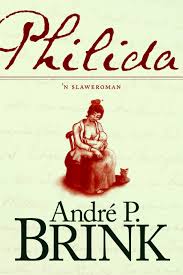
Glinka is most famous in the literary circles around the world as the cat who inspired Kleinkat in André’s Philida (2012), recently also published in Taiwan (I love the cats on the different covers).
Philida3Philida2Philida cover TaiwanFrom the acknowledgements of my Invisible Others: “My furry family, Glinka, Salieri and Mozart, true experts at life, keep trying to teach me how to make the most of it; I hope they will succeed one day.”

Feeling glamorous

Insig1
I don’t like shopping, especially for clothes & shoes. For special occasions, I still wear the dress I bought for my first high school reunion in 1997. I still wear the red shoes I bought at university, patches, tears, new soles & all (the other day I found the picture I drew of them in my diary at the time of the first fit…). I don’t wear make-up. I go to the hairdresser once a year. The last time I dressed up, had my hair put up, and asked a friend’s sister, a make-up artist, to do my face, it was for the M-Net Literary Awards dinner in 2011. I was a judge for the English category and wanted to celebrate the evening (Ivan Vladislavić’s remarkable Double Negative won).

INSIGYesterday, I had coffee with my lovely editor, Danél Hanekom, and we discussed my next novel. We also spoke about girly stuff like rugby. Awards dinners were mentioned. I remembered the M-Net evening, and how people approached my husband asking where I was while I was standing right next to him. Nobody seemed to recognise me all made up. I also recalled the day when Erns Grundling, Antonia Steyn, and an entire team of make-up artists, hairdressers, and assistants descended on our house to interview André and me for Insig a few months after our wedding in 2006. They took three hours to make me look the way I did in the photographs. I wore red lipstick! Next day, my back was sore from sitting up on a make-up chair for those three hours. When during a break I went to the bathroom, I looked up from the sink and got a fright – I did not recognise the face in the mirror.
Insig5
After meeting Danél, I passed a boutique on the way to my car. On a whim, I went in and looked at all the long dresses they had. There was one that, like my red shoes so many years ago, had my name on it. They had my size. The silk felt like heaven on my skin. I haven’t been sleeping well lately and I have lost some weight, so my poor figure and pale face looked tired in the fitting room’s mirror, but with a dress like that flowing from my shoulders I had to smile, and I simply felt glamorous again. So I bought it. Now, all I need is an invitation to another awards dinner…
Insig9
Insig10
Photographs by Antonia Steyn.

What I’ve learned about my brain in love

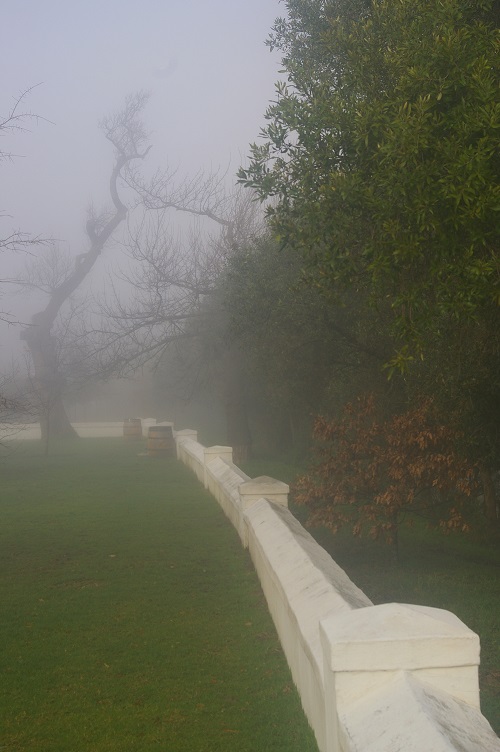
FogFor Women’s Day, my husband and I attended a special lecture-breakfast with Mark Solms at Solms Delta yesterday. We arrived in a dense fog, left bathed in sunshine. It wasn’t only the weather, but the illumination which came after the lecture entitled “The Brain In Love”.

Most of us know what love is. It’s individual and universal. The sum of all world literature is the grand story of love. Love is also science.

Scientifically speaking, it seems, there are five main observable components of love:
~ Bonding, forming attachments, pair-binding; it starts the moment you are born, first it’s the baby-carer bond which is naturally induced by opioids (love is a true addiction), then it develops into all the other attachments we form during our lifetimes; losing an attachment figure results in panic, ‘air-hunger’, withdrawal, which can shift into despair; then (if you are lucky) you let go and form other attachments.

Mark Solms with guests

Mark Solms with guests

~ Nurture and care, as opposed to the need of a child to bond; on average females (in all mammals) are more attached and caring than males.

~ Reward mechanism, also called the wanting mechanism, or the seeking system, or the basic appetite system, or optimism system – by whichever name it is dopamine-controlled; this is what makes us go out there into the world and seek fulfilment; it generates desire, doesn’t satisfy it.

~ Play, which is essential for survival; establishing the rules of engagement is crucial, it is all about finding boundaries; the 60-40% rule applies, which simply put means that none of us want to be submissive for more than 40% of the time, on average the 40% will apply to women, the 60% to men; if the 60-40% rule is upset, it usually ends in tears, fear, anger, or in the worst-case scenario in abuse.

~ Sex drive (obviously).

SunshineAll of us mammals engage in these activities. What makes humans unique is our developed pre-frontal lobe in relation to all emotional mechanisms. It is responsible for inhibition. This is our override mechanism. We can control our emotions. This is why we ‘don’t know our emotions as well as all other animals do…we are opaque to ourselves.’

Memorable quotes:
‘Love comes at you, it’s all about feeling…it’s not a cognitive business.’
‘Love matters to us.’
‘Love and randiness are not the same thing, but it comes into it.’
‘We scientists call it copulation – a simple matter.’

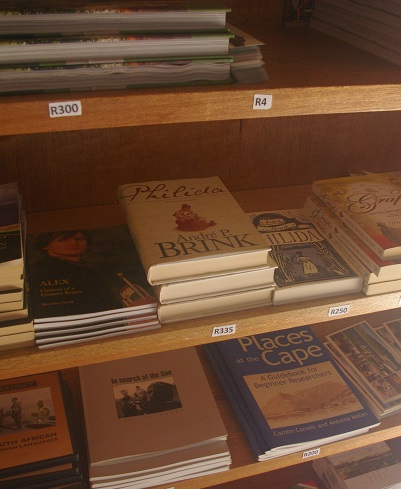
André's PHILIDA at the Solms-Delta Museum van de Caab

André’s PHILIDA at the Solms-Delta Museum van de Caab

‘No thinking happens during orgasm.’
‘You don’t have to give birth to your boyfriend to love him.’
‘Don’t overestimate the frontal lobes.’
On marriage: ‘I promise to be with you together forever even though I have a seeking system.’
On love: ‘It’s a complicated thing.’
(Don’t we know!)

The Day We Became Delta

(An edited version of the following article was published in the Sunday Independent on 9 November 2008; a bit of the background story to the post I want to write next.)

New lifeThey thought that he was just another white man come to make their lives miserable. The previous owner of the Zandvliet Delta farm filed for insolvency. The new one announced himself to the farm residents, wanting to meet every family individually. Nico Jansen, an outspoken member of the community, remembers his first encounter with Professor Mark Solms: “We were scared that he would want us off his land. But I knew we had to stand up for ourselves, because we belonged here.” He told Solms straight out, “You’re not going to kick us off!”

Mark Solms had no such intentions. Namibian-born, he emigrated in 1988 in search of better career opportunities. After having made a name for himself as a world-leading researcher into the brain mechanisms of dreaming, in 2002, he decided to follow his own dream of returning to Southern Africa. His late relative, Friedrich 4th Prince of Solms-Baruth, knew that Zandvliet Delta had been lost to creditors and recommended it. “He thought I would recognise the value of this place,” Solms recalls. “I came to look at the land after the great veld fires of that year. I remember the smoke-heavy air and the rustling of leaves when I walked around the farm. No decision had to be made; it was exactly the place I was looking for.”

The land in question, which became known as the Solms Delta, is situated in the Franschhoek Valley just off the R45 between Franschhoek and Paarl. The sheer beauty of the region and the quality of the wines produced here are world-famous. But Solms knew that settling and making wine in the area required a sensitivity to the historical burdens embedded in the local communities living in the Valley: “Very consciously, on a local scale I wanted to contribute to the transformation which was taking place in the country. I saw the farm as an opportunity. Only after getting here, I realised how challenging the whole project would be.”

Mark Solms was unprepared for the lack of enthusiasm and engagement he met with on the farm: “There seemed to be no common purpose or hope. The lethargy and depression were overwhelming.” For centuries people had lived here with strictly predetermined possibilities and would not think beyond them. He had to confront the “deeply uncomfortable role of a white farmer” which he suddenly personified. The attitude of most people on the farm was that, since he was the owner, they must be scared of him; or, if he does not live up to the role, then he can be taken advantage of. “We had to work around layers and layers of scar tissue,” he says. Moreover, he had to confront “the racism that exists in oneself”, and the tendency to transform while maintaining one’s own privileges.

Jansen was very sceptical about the plans Solms had for the Delta. “It was very difficult for us to believe in white people’s good intentions,” he remembers. But then Prof, as Jansen refers to Solms, took them by surprise. He met with all the families on the farm and addressed their fears directly. He also recognised Jansen’s leadership qualities and the young man became a facilitator between himself and the community: “He told me the reason he liked me was that I said what I thought, about him and the situation. It wasn’t a smooth path. There was a lot of mistrust on our part at first. But then Prof did two things that made people begin to respect him. He told us to work on our houses at the same time as we worked on his. Then he asked us what we were passionate about. Our answer was sports, especially rugby. So he had DSTV installed in all our homes.” These events were “attitude changing, real eye-openers,” Jansen recalls. “From the beginning Prof treated us as humans, and we decided to meet him halfway. Prof told us that he wanted to set right the things his people had done wrong. And I felt I could guide Prof’s dreams. I am proud of the fact that he didn’t break any of his promises.”

Shortly after his first visit to the Delta, Jansen telephoned Solms to tell him that the residents of the farm had organised “a prayer meeting to thank the Lord for sending them an owner they didn’t have to be scared of.” Solms knew that transformation would take time. Given human nature and the injustices of the past, “nobody can take your word for it in this place, sincerity has to be proven.” The changes have been gradual, but if he had to define the turning point, it would be the Bastille Day parade in Franschhoek last year. Tokyo Sexwale suggested using the festivities to celebrate, not the storming of the Bastille, but our local freedoms: the Huguenots’ freedom from religious persecution, freedom from slavery, Mandela’s freedom. The Solms Delta people created a unique float for the parade: a pyramid of wine boxes, each representing an inhabitant of the farm. They walked with the float, wearing t-shirts with their hands imprints on them in the colours of the South African flag, making music and waving to the crowds. It was “nation building on a small scale,” Solms remembers, “That day we were one, we were Delta, all of us.” The farm workers suddenly felt that a commercial event for the elites had turned into a festival in which there was a place for them. And to crown their achievement, they were awarded the prize for the best float. The feeling of belonging made Solms realise that they had “genuinely transformed the farm, in structure and feeling.”

In 2005, the Solms family established the Wijn de Caab Trust to benefit all the historically disadvantaged residents of the farm and other employees of the Solms-Delta wine company. In due course, Mark Solms convinced a dear friend from Britain, Richard Astor, to buy an adjacent farm, Lubeck Delta, and the Trust was restructured in the process. With the help of loan funding secured by the Solms and Astor families, the Trust purchased a third adjoining farm, Deltameer. The three linked properties now became equal partners in a common enterprise.

Alex van Heerden with Richard Astor and the Gramadoelas

Alex van Heerden with Richard Astor and the Gramadoelas

Richard Astor first visited his friend on Solms Delta in 2003. He returned several times and the beauty of the place grew on him, but he never considered settling here. In 2005, because of personal misfortune he needed a change and that was when Mark Solms suggested he buy the adjoining farm: “Mark managed to communicate his passion to me. I have been looking for a cause I could get involved in and it was suddenly easy to see the opportunities to make a difference here.” There was only one obstacle: “I love wine, but I can’t take it seriously; I don’t have the palate or Mark’s passion for it. He sees wine as an art form. I told him that the one art form I can be passionate about is music.”

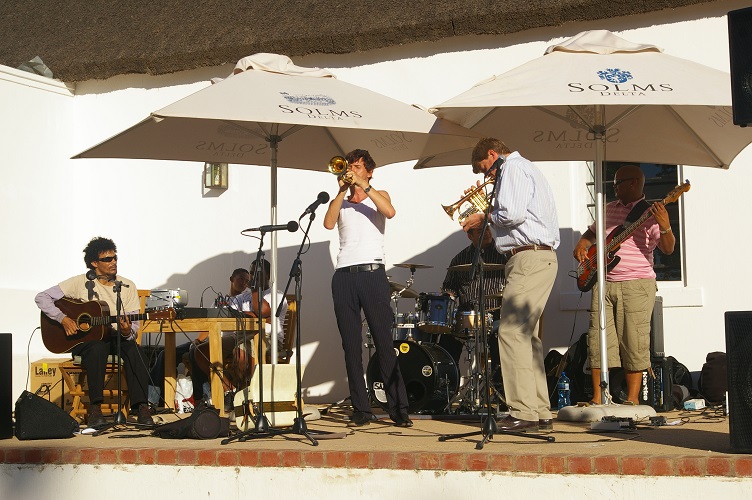
The idea for the annual Oesfees (Harvest Festival) was born. Celebrated for the first time in April this year, it was an enormous success. Farm workers from the entire area were invited to participate in the festivities, involving traditional music, local food and wines. Richard Astor, a cornet player, performed on stage with the likes of David Kramer and the Delta Optel Band, consisting of Solms Delta residents and led by the young Cape music enthusiast, Alex van Heerden.

Farm youth dancing

Farm youth dancing

“Alex fitted perfectly into the project. He brings music out of people,” Astor says in admiration. Employed by the Delta Trust (established by Astor), van Heerden can now pursue a lifelong passion: “I have always wanted to uncover the common musical heritage we Afrikaans-speaking people share in this area.” In the mid-1990s van Heerden founded the “Gramadoelas” band and began his field research work in the rural areas of the Cape to get material for them. The project was not financially viable; nobody was ever interested in getting properly involved. Coming to work for the Trust has been a dream come true for van Heerden. Forty people are now directly involved in the music projects on the farm. Two bands, the Delta Optel and a brass band, meet regularly for practice. Van Heerden and historian Tracey Randle are collecting materials for a music heritage centre which is to open on the farm in 2010. Van Heerden is also in charge of the Saturday evening concerts which will begin in December. “I feel healed by making music with my people,” he says, clearly moved, “There is a feeling of unconditional sharing involved.”

Mark Solms with David Kramer

Mark Solms with David Kramer

Richard Astor knows that “all these great people on the farm can’t be a coincidence.” He says of his friend, “Mark brings out the best in people in a realistic way. He builds confidence and helps people realise their potentials.” The pool of talented individuals involved in the Solms Delta projects attests to this.

Cathy Macfarlane began as administrator at the farm in March 2007. A former teacher with no experience in administration, equipped only with vast enthusiasm, she swiftly adapted: “Working here has been an adventure. It’s tough at times, but I love my job.” As Solms Delta’s administrator, she coordinates all the entities on the farm, interviews new staff members (mostly appointed internally), and until recently was responsible for the certification of wine. Her latest projects are a fynbos reserve and “Fyndraai”, a restaurant which from December onwards will delight farm visitors with traditional Khoi cuisine based on the dedicated research of food scientist Renata Coetzee.

Tracey Randle was fresh out of university when she came to work at the farm in 2004. Finding vast amounts of artefacts during the renovations of Delta, Solms had an idea for a museum on the farm and employed Randle to direct it. A passionate historian, she shares his vision on how history can be told in a multitude of voices, an idea inspired by André Brink’s novel A Chain of Voices. In 2005, Brink was invited to open the Museum van de Caab which became one of the most sought after tourist attractions of the region. The Museum is unique in that it seeks to present history from individual perspectives of all the people who have ever lived, worked and died on the farm. There is no attribution of blame, just a display of the resilience of the human spirit.

In 2004, Medwin Pietersen and Johan O’Rayn came to work at the Delta as security guards, but both had a passion for history, which they have been given the opportunity to develop at the Museum and by completing heritage management courses. Later this month they will be travelling abroad for the first time in their lives on an exchange program to Sweden: “We’ll be visiting museums and schools in Malmö and learning how best to teach children about history, heritage and culture at school,” says Pietersen.

At home, Pietersen’s wife is one of the teachers involved in supervising the farm children in their after-school activities. The after school is an initiative coordinated by Frances Semmelink, a social worker employed by the Wijn de Caab Trust to represent all its beneficiaries. She began working for the Solms family as an au-pair while studying social work at the University of Stellenbosch. Recognising her potential, Mark Solms invited her to invest her skills in helping the Delta community after she completed her degree. Her focus is education: “It’s crucial that we break the cycle of poverty and dependency, so that children can move on if they wish to in the future.” By providing financial assistance for education on all levels, private health care and encouraging independent home ownership, the Trust aims at broadening the horizons for its beneficiaries. Semmelink coordinates various other projects, including all sports activities on the farm: a rugby team coached by the cellar manager, Fanie Karolus, a young basketball team led by a noted American player, Kyle Ray, and a walking team participating this month in the Big Walk in Cape Town. Semmelink knows that one has to remain “realistic about change, it’s a slow process,” but people see that it is real and that they are truly making a difference. “There is still drinking and domestic violence, but it’s on the decrease. The community realises that they have the power to control and stop things. They recognise their responsibility.” She adds with a confident smile, “People are happy.”

Even though he swore early on in life that he would never work on a farm, today Nico Jansen is the estate manager of Solms Delta. “Before, I used to work for a construction firm. I never believed in farming because it had broken my people, but now I love it.” He is proud of all the achievements on the farm. “People started taking care of themselves, they drink less. They feel that they can uplift themselves and restore their dignity,” he says. “Every week people come to me asking for work here, and it’s not about money. It’s about the respect and equality we all share here.”

The cycle of fatalism has been broken. People on Solms Delta know they are the masters of their future and that their fates are interlinked. “If you can transform one farm, why not a valley or a province?” asks Solms. What is he happiest with? Being greeted with a smile by every person on the farm and hearing the spontaneous eruptions of music on his daily walks. He explains, “Music is a genuine expression of pleasure and cultural participation.”

As I leave Solms Delta inspired by these stories, the voices of all the people fuse into the words of Theresé Willemse, a young woman working at the Museum van de Caab: “We are a whole big family here.”