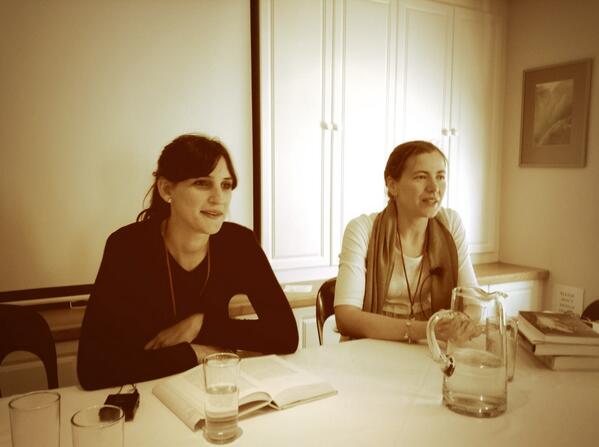
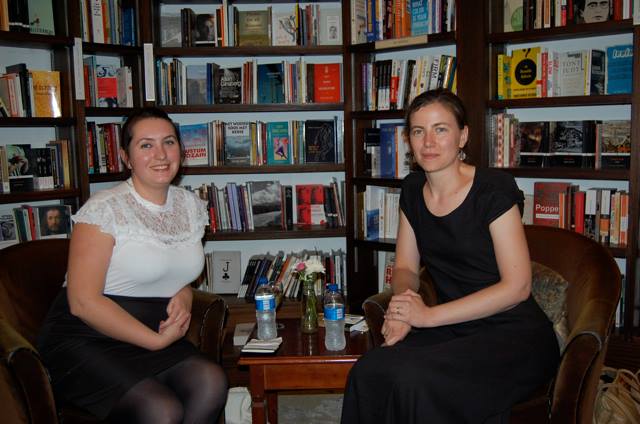
Nadia and I at the FLF, photo by Jennifer Platt
Another FLF has come and gone. It was my first one as a participating author. My event with Nadia Davids was a real joy. Nadia is wonderfully articulate, kind, a pleasure to talk to, and more beautiful in real life than in any photograph. We discovered that on top of everything else we have in common, she left South Africa the year I first arrived here. We seem to be leading these uncanny parallel lives. I hope there will be many more points of contact. We read from our novels, spoke about writing place and history, being first-time novelists, the genres we write in, and our lives as writers and critics.
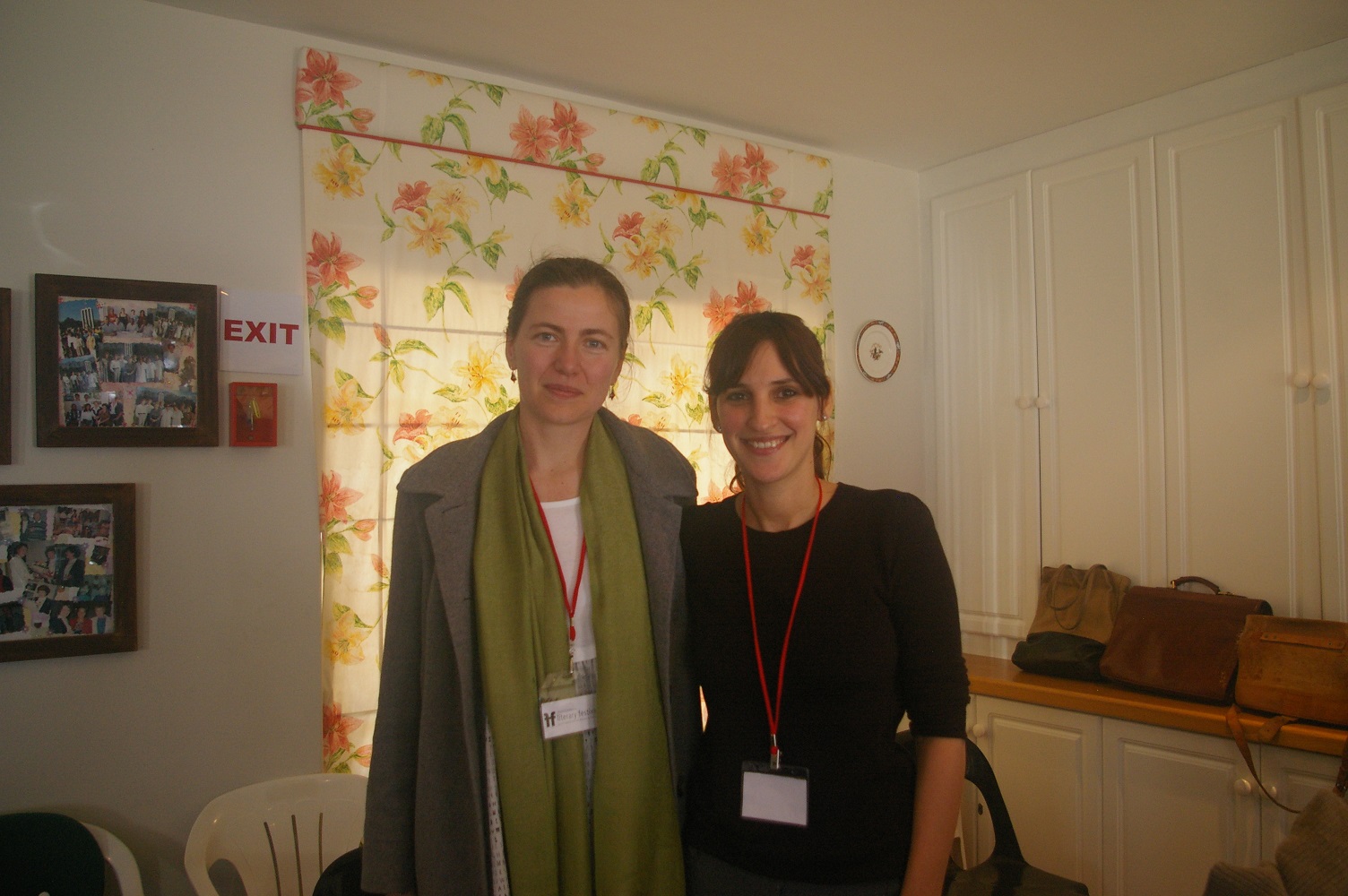
(Jennifer Platt from the Sunday Times twitted live from our event.)
The guest of honour at the FLF this year displayed her eloquence with light, shade and colour, bathing Franschhoek in its autumn glory. This is my favourite time of the year, and the beauty of autumn days like these past two fills me with a sense of wonder like nothing else. (There was this one autumn day in 1990 when my mother was hanging up laundry in our garden in Church Street in Warwick, NY, and I was just there, watching her, surrounded by the reds and browns and yellows of dying leaves, basking in the early morning light, the sun on my back, and silence between us when I thought, This is where love comes from, from the beauty of this world, it is nourished and sustained by it. Despite its craziness, the weekend reminded me of that day.)
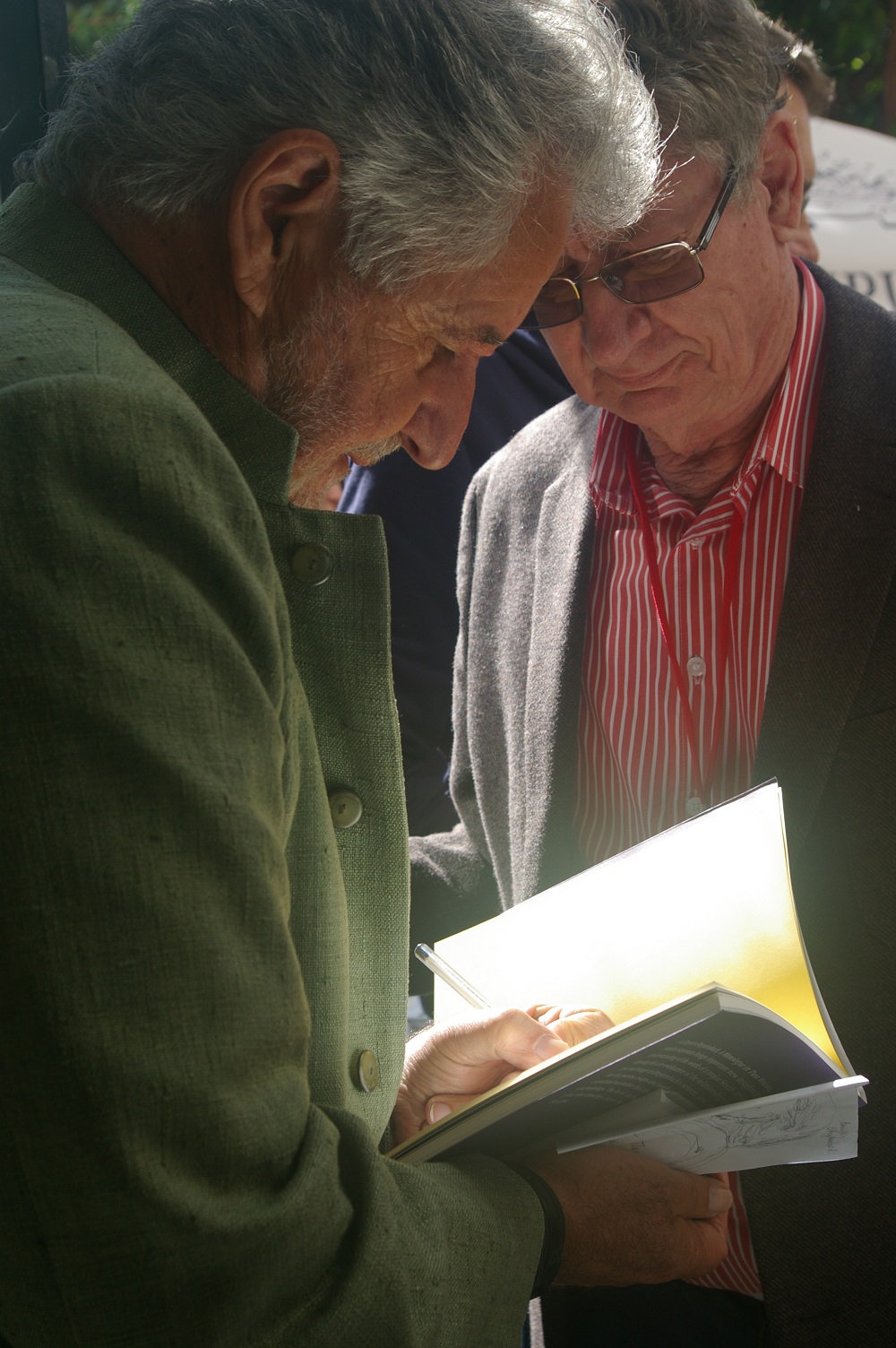
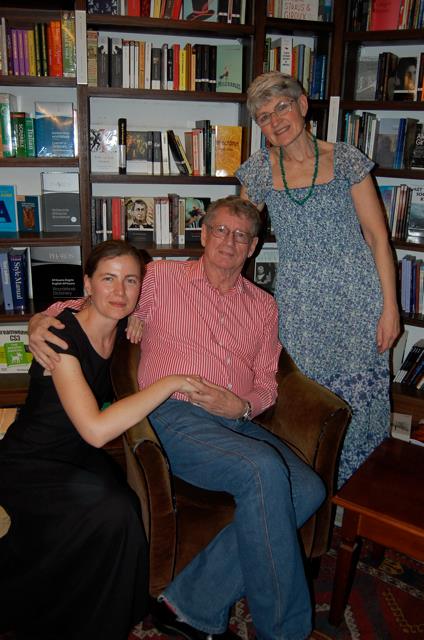
André with Breyten Breytenbach at the FLF
Franschhoek had all its other treats ready for us. Books and book lovers everywhere. The programme offered tons of stimulating encounters. The food and the wines were divine, as always. Gable Manor, the guest house we stayed in, was charming and cosy. In the words of Kgebetli Moele, the author of Untitled, who left a comment in the guest book the day before us: “Perfection!”
All that was missing was the time and space to enjoy it all, but festivals are by nature hectic creatures, especially if one is participating, leaving you dazed and exhausted for days afterwards. There is something about a festival that often puts me on edge. It’s not the participating on stage or being part of an audience, but rather the in-between of awkwardness when these boundaries are blurred.
I attended four sessions and a show during the weekend. The highlight was the show: Pieter Dirk-Uys’s AND THEN THERE WAS MADIBA! I have heard him speak at FLF and other events before, seen him numerous times on TV, and have cooked with Evita for years now, but I had never attended one of his live performances. Now I know that by not making it to one earlier, for years I have been depriving myself of laughter and insight. I will not be so stupid in the future. Dirk-Uys as Madiba or Zuma or Verwoerd was a sight to behold. He was priceless as Winnie. And underneath all the laughter and fun was a profound message of hope and being all together in this beautiful mess we call the New South Africa. There is always hope for a nation capable of laughing at its follies.
The sessions I attended were truly inspiring, worth every cent:
WHO GETS TO DECIDE WHAT’S LITERATURE
Jenny Crwys-Williams talking to Karin Schimke, Lauren Beukes and Imraan Coovadia about the interactions between authors, critics and readers. I found the following comments interesting:
Lauren said that nowadays authors have to be more social and put themselves out there. As Jenny pointed out, Lauren is highly successful in exploiting social media for book-promotion and is one of the few young South African writers who can write full-time because of commercial success. Lauren said that as a social person she counts herself lucky to be able to engage in the world of social media and enjoy it. She also said that she was fortunate in finding an agent who understood her vision. Lauren helps to promote other local writers by hosting The Spark on her blog. When she started with it, the idea was to have a white and a black writer alternatingly, which has proven impossible. It seems that black writers were not responding as readily to her requests as white writers (I had a similar experience when compiling Touch: Stories of Contact for which I was subsequently criticised, but I did approach many more black writers than ended up in the anthology; for various reasons some chose not to participate in the project; both Lauren and Imraan donated their fantastic stories for which I am still very grateful). She also praised her South African editor, Helen Moffett, who allows her to perform all kinds of acrobatic stunts in the air because she knows who is on the ground waiting to catch her if anything goes wrong. (As part of the trio Helena S. Paige behind the Girl series, Helen is not only a successful novelist, but also a sensual poet and a nurturer of South African literary talent.)
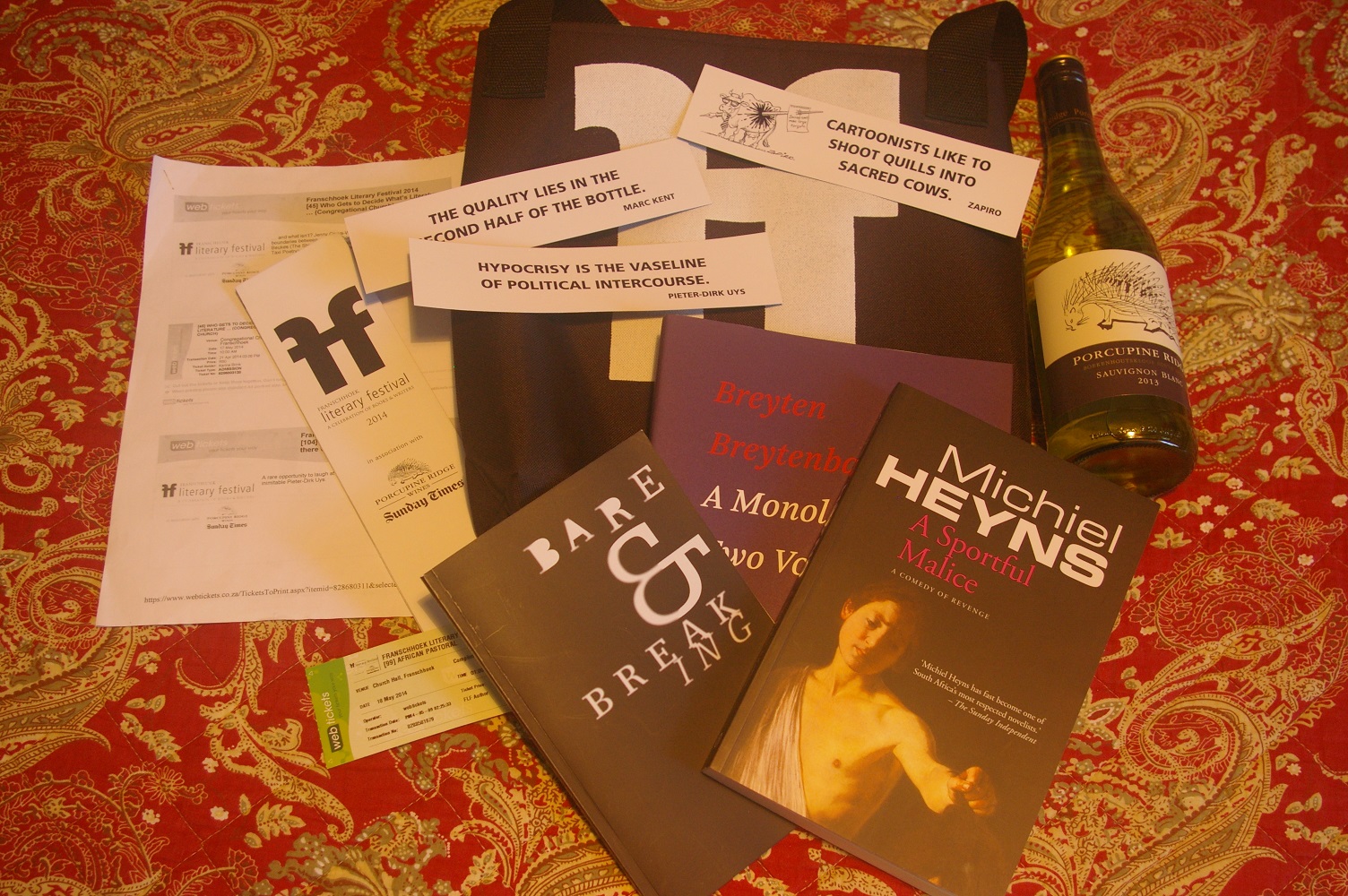 Karin conceded that as a journalist she understands that she should be participating in the world of social media, but admitted to finding it exhausting. She made a wonderfully vivid comparison between twitter and being at a crowded cocktail party where all one longs for is a breath of fresh air, but getting to the door proves to be nearly impossible. (I cannot say how grateful I was for that image – I am too frightened to even enter that room – I am the one outside in a quiet corner, sipping the champagne, and reading a book). Karin did not get out of her way to market her book of poetry Bare & Breaking when it was published in 2012. Like most writers, she would love to be able to write in her chosen genre fulltime, but has to make a living otherwise. She has no illusions about being able to live off writing poetry in South Africa, but that is not what it is all about for her. As a writer, one has to understand one’s motives for writing, she said.
Imraan spoke about the difficulty of talking about the reading experience which is deeply personal and not always easily shareable. I loved his comment about the fact that a change in taste is proof of a “living mind”. He also mentioned that for him there are different ways of being a writer in the world. He referred to Damon Galgut who is shy and simply gets on with his writing without unnecessarily putting himself out there. He also said something very interesting: Why spend so much time on publicity if the reason you write is to get rich? Instead, one could invest the time in becoming a billionaire by other, more straightforward ways. For him, writing is about the “book and you”.
(After the session I bought a copy of Karin’s Bare & Breaking. Some time ago, I published a review of four Modjaji poetry titles, three of which I found outstanding, one less so. The positive comments I made about the three books went largely unnoticed. For my comments about the fourth one I got lynched. The heated reaction of the publisher and friends of the author to my negative remarks about the fourth volume sadly put me off further Modjaji titles. This is how I missed out on Karin’s book until now. But some of her comments about the volume and her own approach to writing made me curious enough to ignore my decision to keep away from Modjaji titles. On Saturday evening, I read some of Karin’s poems in the luxurious bath of our room with a view at Gable Manor and the moment I got out, I made my husband read them. We were both bowled over by her “sound-shades”. I look forward to discovering the rest of the volume.)
Here is one gem:
“Morning Work” by Karin Schimke
We are cocked and angled
together like an African chair,
groin-hinged and eye-locked,
small-talking the sun up.
At the join we are genderless
until – out of two flat triangles –
something flowers at us,
blooms bright as though
our eyes are suns
and it must find light.
We give it light, and we laugh,
and then bury it, lids shut,
so it can seed again.
THE CONSIDERED CANON
Imraan Coovadia spoke to Nadia Davids and Michiel Heyns about the Western and the South African literary canons. All three are novelists, reviewers and academics.
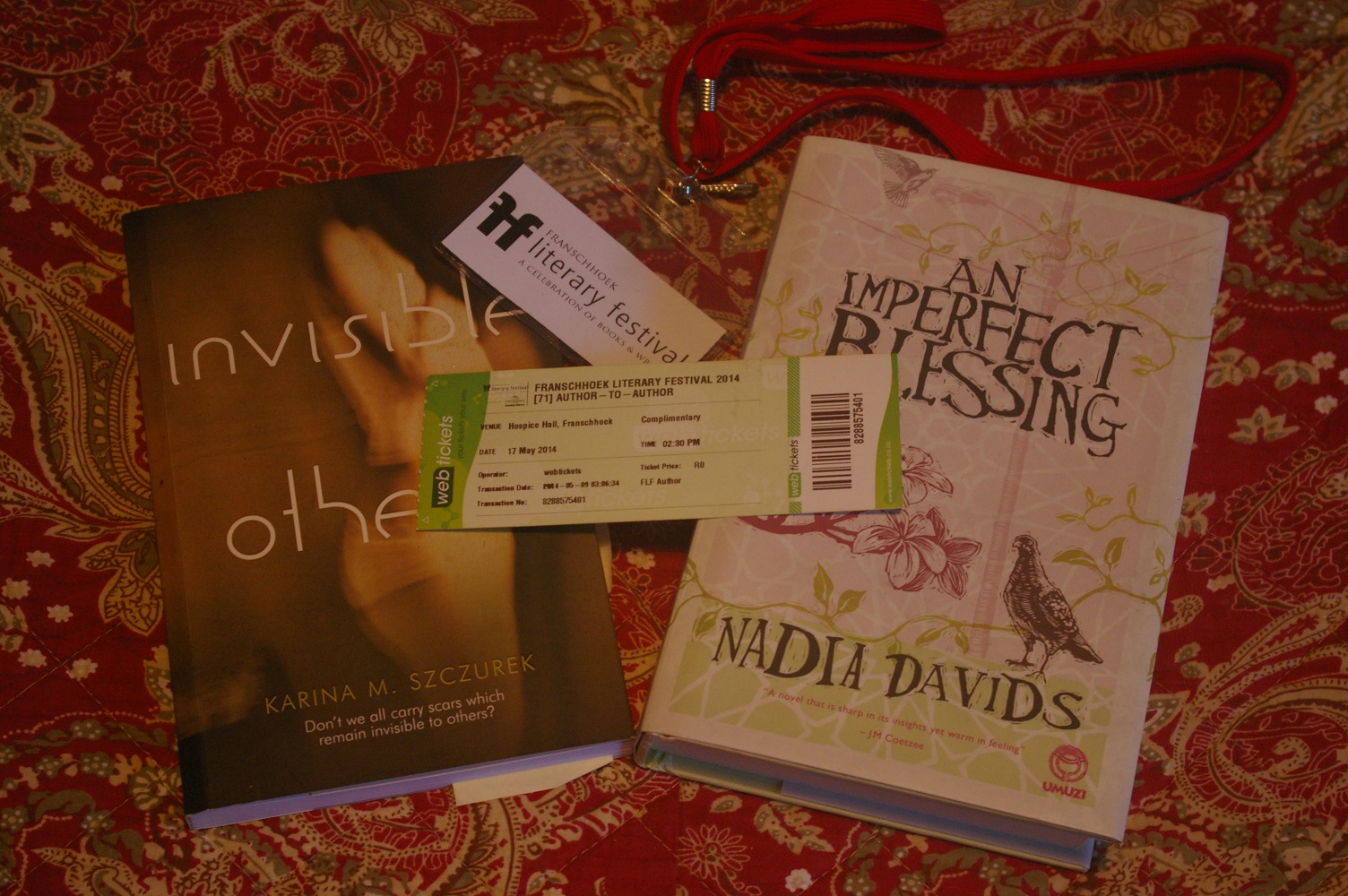 Nadia said something very moving about academics having the “privilege of learning to read deeply”. She sees the text as a social document that operates in the world, not only as something read for pleasure. During our talk the day before, I asked her whether her own novel, An Imperfect Blessing, was an attempt to write a people into history who had been underrepresented until recently, and she said yes, admitting that it was done with the full awareness of the pitfall of representation. That was her reason for including minute details of everyday Muslim family life in her story of specific historical moments (time round forced removals from District Six, the state of emergency in1986 and the year 1993, just before the first democratic elections). Michiel mentioned that while reading Nadia’s novel he was aware of her having read Jane Austen. What a compliment for any writer!
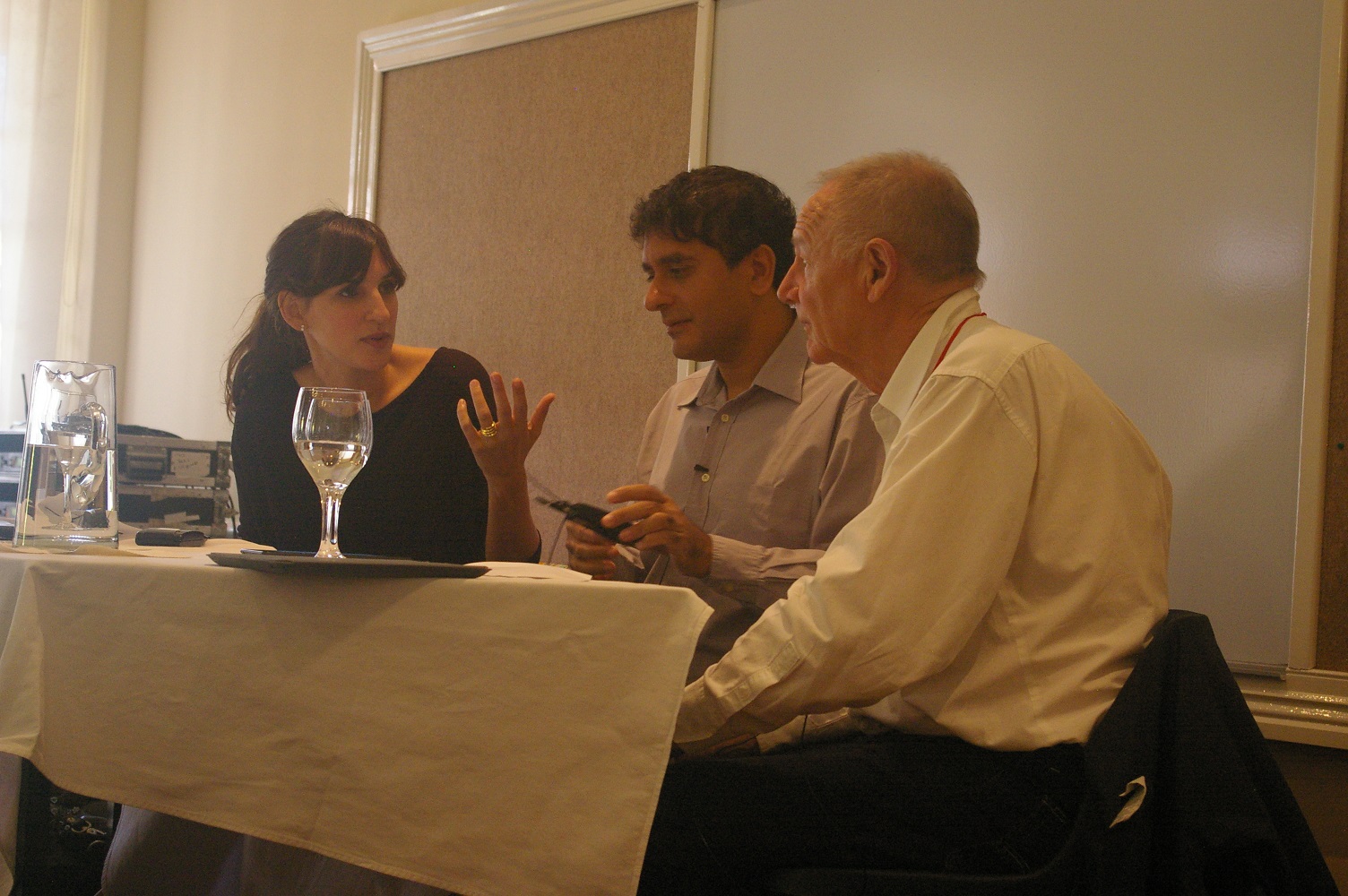
Nadia, Imraan and Michiel at the FLF
Imraan, who is an excellent book reviewer with the kind of gutsy eloquence which I lack, quoted from the curious Wikipedia entry about South African literature which made most of the audience shudder. Hope was expressed that people engaged in writing these entries will amend it to reflect less biased views. Imraan asked the panellists to name their own personal South African canons. The Story of an African Farm was there for both Nadia and Michiel. Michiel mentioned Bosman, Paton, J.M. Coetzee (Age of Iron and Disgrace); Nadia added Woza Albert!, The Island, Gordimer and Brink. Outside of South Africa, Nadia made a special mention of Anna Karenina, and Michiel of Middlemarch. Harold Bloom’s conservative take on the Western canon was discussed. Imraan found that according to Google the most mentioned South African books are Long Walk to Freedom, Cry, the Beloved Country, Country of My Skull, Heart of Redness, Ways of Dying, Spud, The Smell of Apples, The Power of One, and Master Harold and the Boys. He added Burger’s Daughter to the list himself, because “it should have been there.” I agree wholeheartedly.
Michiel Heyns is one of my favourite local book reviewers. (For five years, I’d had the honour of reviewing books alongside Imraan and Michiel for the Sunday Independent under the editorial guidance of Maureen Isaacson.) I always say that when I grow up I want to write reviews like his. I also had the privilege of working with him on Encounters with André Brink. Michiel is one of the few South African authors who see the entire world as their fictional playground, daring to write about topics other than local. I applaud him for that! Exciting news is that Michiel’s latest novel, A Sportful Malice, has been published last week. Talking about the Western canon, or any canon for that matter: the title derives from Shakespeare. Definitely something to look forward to! During the discussion, Michiel mentioned merit in relation to Nadia’s reference to the text as a social document. He spoke about literature and the canon as a “moral guide”, of showing you “how to live your life”. A test for any text is whether you are prepared to reread it, he said. I also think of it in terms of whether you want to share it with other people. The moment I find myself buying the same title over and over again for my friends, I know I have encountered a good book.
AFRICAN PASTORAL
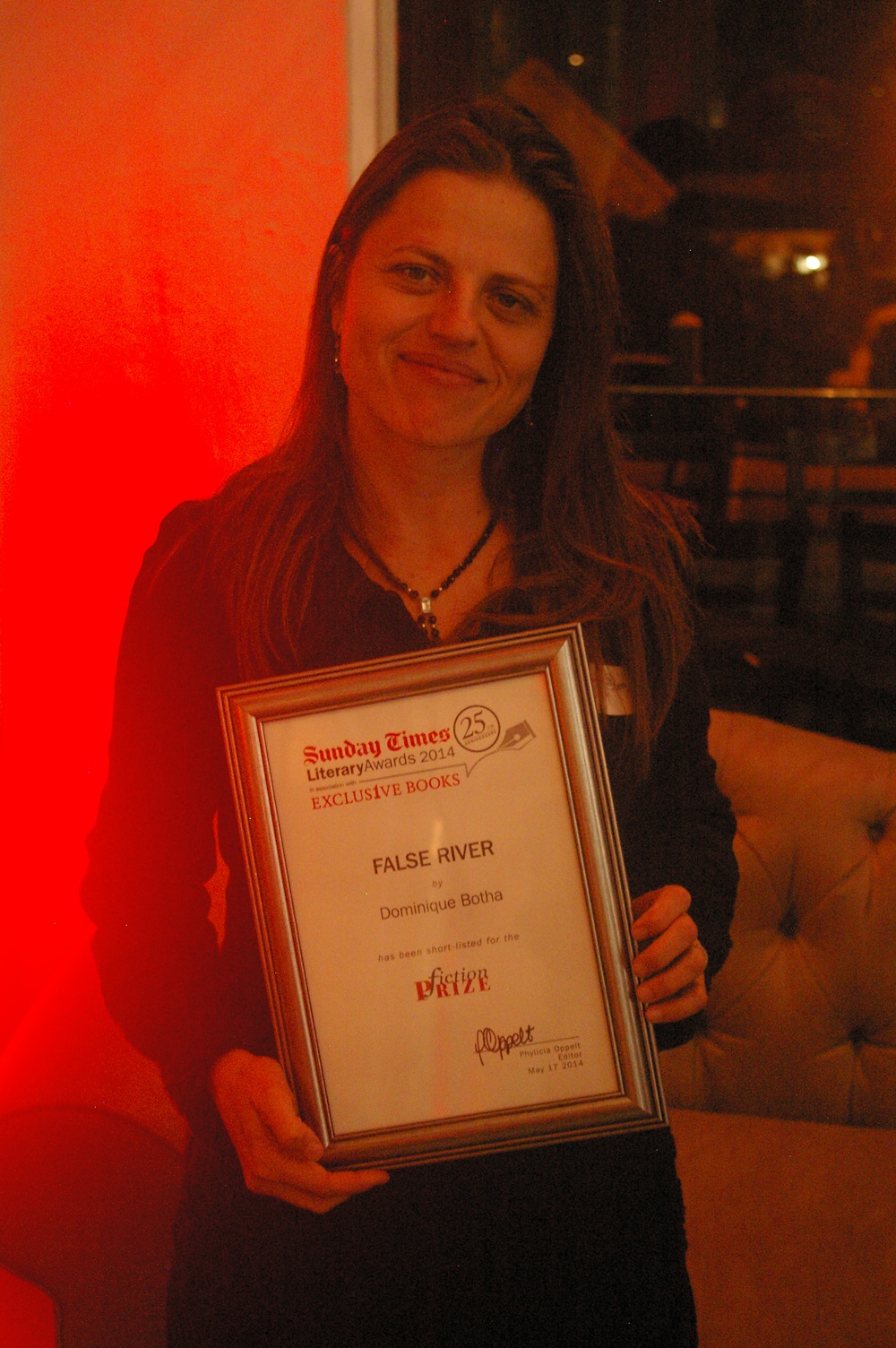 Harry Garuba talking to Dominique Botha, Claire Robertson, and André Brink about their latest novels, False River, The Spiral House, and Philida, respectively.
Claire and Dominique are first-time novelists. Like André, Dominique writes in both languages, Afrikaans and English. She recommended to everyone in the audience to write in Afrikaans if they could, as she was thrilled with the kind of enthusiasm and reception she encountered on the Afrikaans literary scene. Her novel is based on her family story and she has kept the names of her family members in the book: “It’s my take on something that may or may not have happened,” she said. She is of the opinion that “it is much better to write truth and call it fiction than to write fiction and call it truth”. (During questions from the audience, I asked about her decision to keep the real names for a fictionalised story. She said the names were beautiful and that changing them would not have removed the problematic aspect of the situation. The people involved would still know that they are being written about, only the larger public not. I’m not entirely convinced. In cases like this, I always try to imagine what it would be like for me: I would feel uncomfortable about my own brother writing a fictionalised version of me and using my name for it in a novel. It simply would feel that it wasn’t me. Why my name then? If he was writing a memoir or biography, and attempting to reconstruct memories in the process without intentionally fictionalising them, I would have no issue with him telling anything about the family past we share and using my name. In a novel based on fact, on the other hand, I feel that a name change signifies that fiction is part of the parcel, that the people are no longer the ones you knew in real life but partly imagined characters who might reflect on real people but are their own creatures. This is particularly true for me when one writes about people who are still alive and who owe their own versions of a story. I don’t want to pretend to have final answers to this complicated process, not even for my own work, but I think it is an aspect of writing that should be treated with utmost care.)
Claire, who had the rare experience in South Africa of having her book go beyond the first impression within a very short period of time, spoke about the idea of a farm novel which not only connects us to the land but to something much larger. After she’d finished her novel, it revealed to her that what she had been writing about is the “urge to perform acts of rescue”. While writing, whether as a novelist or a journalist, she looks for “tragic flaws”, not “wickedness”, in people, whether it is in the men of the Enlightenment or the architects of apartheid.
Tellingly, I forgot to note who during the discussion said that memory is a “very personal and unreliable thing”.
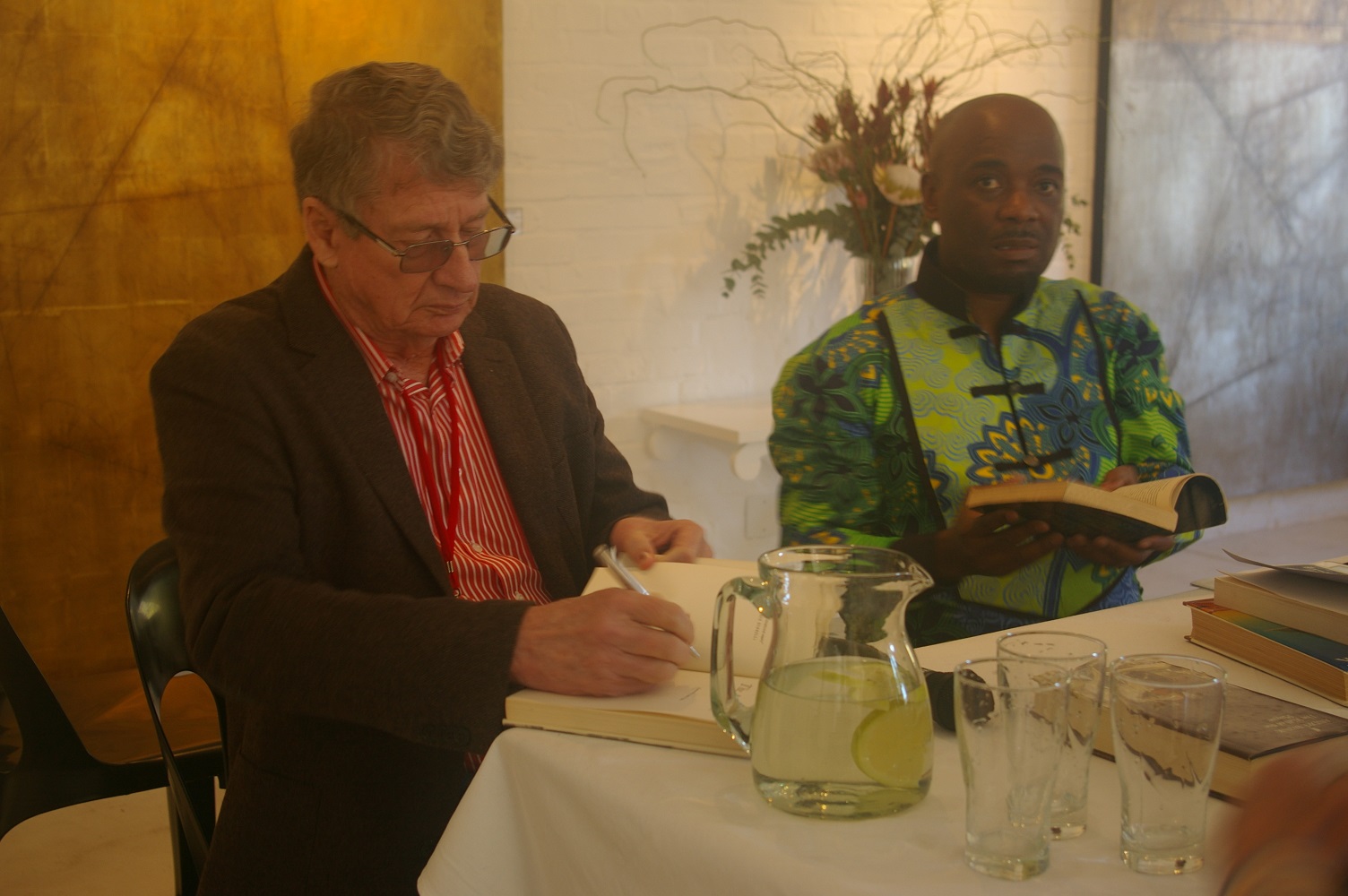
Victor and André
For André, whose novel Philida was born on and delves into the history of the nearby wine farm Solms-Delta, the act of writing begins when fact ends and imagination takes over. Through writing the story of Philida, he felt “enmeshed in my own life”. Philida could voice things which were difficult to communicate otherwise.
In the fourth event I attended (LITERARY DOYEN) Victor Dlamini, an insightful and patient interviewer (and one of my favourite photographers), spoke to André about his career, belonging, and Philida.
A note of thank you: Thank you Liz for all your kind words about my novel (you made my day!). Thank you to all for a weekend of literary delights!
Books sold (that I know of): 1 (thank you Nols – very kind of you! I hope you will enjoy it)
Books bought: 3
(I’m clearly not in it for the money.)








 Karina Magdalena