Writers’ Other Lives

Books in Mafra
“We pay our writers to write,” my Norwegian friend Kristin said as if it was the most obvious thing in the world and enlightened me about the Statens Kunstnerstipend, a “grant and guaranteed income programme with the objective to give creative and performing artists the opportunity to actively pursue their artistic career and to aid younger artists in establishing themselves as artists.” The programme offers diverse short and long-term grants as well as one-off bursaries for travel, study or material expenses for artists based in Norway. I was mostly fascinated by the “guaranteed income” support scheme: established artists can apply for this to provide them with the financial stability necessary for having “artistic enterprise as their primary form of occupation.” And the crux is that the recipients retain the right to this financial stability (paid monthly) until they reach retirement age.
Norwegians seem to take a much-quoted imperative to heart: “If you think culture is expensive, try ignorance!” The objective of their support programmes is to ensure that individual artists are able to contribute “to a diverse and creative wealth of art” in Norwegian society.

Listening to Kristin and reading about Statens Kunstnerstipend, I thought of the many writers I know in South Africa who struggle to make a living while pursuing their creative careers. For most, the situation is not desperate, but almost all pay their bills by other means than their creativity. I decided to approach a few of them to discuss the dynamics involved in being a writer and having an ordinary day job. Their valuable comments were often surprising and opened up many engaging ways of thinking about this topic.

We tend to think of creative people rushing home after long hours of suffering in their dreary jobs to lock themselves up in that special room of their own and devoting the rest of their waking hours to the Muse. What transpired from my interviewees is that, on the contrary, even though it is sometimes difficult to juggle their paid and creative work, they actually enjoy their money earning jobs just as much as they do their creative ones. Only the degrees vary.

Red InkAngela Makholwa is the author of the urban thriller Red Ink (2007) and the fresh-off-the-press chick-lit adventure The Thirtieth Candle. When she was fifteen, she decided “quite firmly” that one day she would publish a novel with “an authentically South African story”. Today, she is not quite sure anymore what that means, but she is definitely somebody who knows what she wants and how to get there. She runs Britespark Communications, a successful public relations and events management agency in Johannesburg, and feels fortunate to be “doing something that allows her creativity to flourish”.

Siphiwo Mahala is in a similar position. As Deputy Director for Books and Publishing at the Department of Arts and Culture, he works in his field, which gives him great satisfaction. He has always been passionate about reading and went on to study literature at university, finishing with an MA in African Literature at Wits. When he began publishing short stories, the overwhelming joy of “seeing his creative writing in print” inspired him to pursue this avenue further. He received the 2006 Ernst van Heerden Creative Writing Award for his first novel, When a Man Cries (2007), an incisive portrayal of township life in South Africa. He says that his day job is “essentially the best one that any literary enthusiast could do in the public service”. It includes the promotion of the culture of reading and writing and developing a sustainable book industry that encourages equitable development of all local languages: “The job itself is not too far from my personal ambitions hence it is so fulfilling.” Only drawback: “When a job is a passion it means that when something goes wrong it doesn’t end in the office, you take it home and your family falls victim of a situation they didn’t cause.”

When a Man CriesInspired by their day jobs, Angela and Siphiwo find that they can well manage the two spheres in their lives, creativity and work. However, sacrifices have to be made, as Siphiwo notes, and one has to accord creativity the time and space it deserves. Only then can you also “expect your potential reader to skip their favourite soap opera, miss hot gossip, and let the pots burn while reading your book,” he says.
Would they give up their jobs to write fulltime if they could make a living out of it? An emphatic yes in both cases in spite of the aforesaid. For Angela writing is “an esoteric experience” and she “envies those who can afford to do it fulltime”. Siphiwo considers writing his “first love”, but he is too realistic about making money out of it: “For as long as the culture of reading remains as low as it is currently in the country, we are not likely to have more than 10% of our writers writing for a living.” He might not write for a living, but he insists he “lives for writing.” Financial support from the government for writers would be welcomed by both, although Angela feels that it could make her feel obliged to write “about issues of enormous political or social impact”, while Siphiwo believes that any such support could truly work only with “a national writers’ association firmly in place.”

In their considerations, both authors allude directly and indirectly to an aspect of state-sponsored support for artists about which Sven Eick, author of the socio-critical novel Apetown (2007), feels strongly: “I am firmly behind the notion that artists should challenge society rather than attempt to have society endorse their work.” He also believes “that the tax-paying public should have the right to choose whether or not they want to support writers, i.e. by buying their books, and that it’s not the government’s business to fund writers on their behalf.” Sven highlights the corruptive aspect of making money with creativity: “If writing novels were to become my only source of income, then inevitably I’d begin writing novels to make money, and that would represent a corruption of the creative process for me. I think a 50/50 balance would be about right.” By which he means that he’d also “always want to do something other than writing.”

ApetownSven was working on cruise lines when he realised that he was destined to become a writer. He wrote regular updates of his experiences which attracted “a small, but dedicated following.” He knew then that he should invest more “energy” into writing. Today, he earns his living as a copywriter for a network of sports websites: “I find many aspects of the sports I cover interesting. Sport is really about narratives, and despite being somewhat saturated by the amount of sport I cover I still find these narratives interesting and engaging.” He wants to continue with a similar but more creative line of work in the future: “I’m interested in the business aspect of the internet, how to keep content free and informative whilst still generating revenue using non-intrusive and targeted advertising. However, I’d obviously prefer to write more creative content than the grunt work that occupies a lot of my time.” And even though he would not accept financial help from the government as a writer, he wouldn’t mind making money out of books, so that he could continue to write at leisure. “I guess this is any writer’s dream,” he says. “I just don’t want to become a book-a-year Wilbur Smith type.” He also suggests that “instead of governments paying writers it might be useful to fund initiatives like the Boekehuis in Calvinia, or other low-cost writers’ retreats where we could go away to write at no expense.”

Other writers would endorse state-funded grants, but like Sven, they cannot imagine giving up their other occupations in order to write fulltime. Multitalented, with degrees in drama, journalism, and creative writing, Willemien Brümmer always knew that she wanted to be “An Artist”, but it took her a long time to find her individual path. She published her debut short-story collection, Die dag toe ek my hare losgemaak het (The Day I Let My Hair Down) in 2008. She actually writes for a living, writing feature articles for By, the Saturday supplement of Die Burger, Beeld and Volksblad. Almost stumbling into journalism by accident, Willemien felt in the beginning that it was not creative enough; “it felt like stealing,” she remembers, and the wrongly perceived lack of creativity made her ashamed to call herself a “journalist”. She realised how inseparable journalism and creativity were only fairly recently. A few years ago, while completing her MA in Creative Writing, she wrote profiles of people “in the news” for Die Burger’s weekly column Oop Kaarte and recognised how similar the methods for writing articles and writing short stories were. The only difference is that “reality is often far more interesting than anything I can come up with,” she admits.

Die daagThis dimension of her work is decisive. She draws inspiration for her fiction from the stories she encounters in real life: “In my next book, fiction and journalism come together closely.” Still, writing fiction feels like “chocolates after dinner”, like “spoiling yourself,” says the Calvinist in her. As a perfectionist, Willemien invests a lot of time in each journalistic article, and despite having a lot of freedom in what she writes about, she sometimes feels torn between having to write about yet another subject and wanting to engross herself in the one she is currently working on. “It’s simply not enough to have only one week to write about somebody like Sindiwe Magona,” she laments about a recent assignment. “Nor is it easy to distance oneself from a story one is working on for a couple of months. It’s like falling in love; turning away can be a painful experience which also poses a lot of ethical questions. It’s not a natural situation; one has to become calculatedly distant and that’s not the kind of person I really am.” In this respect, Willemien would not hesitate to accept a grant to support her writing, journalistic and fictional: “It would allow me to concentrate, work in-depth, on both. In an ideal world I would write a book about each subject.”

Similarly, in an ideal world, the talents of Helen Moffett would not go to waste. “I wear many hats,” she writes on her blog. It would take an entire walk-in cupboard to display all, or at least some, of them: academic, copyeditor, mentor, teacher, cricket expert, and most recently the co-author of Bob Woolmer’s Art and Science of Cricket (2008) and author of the sensual poetry collection Strange Fruit (2009). With four academic degrees and thirty years of experience, Helen does not have a regular income because her health dictates that she work as a freelancer. Academic editing for clients all over the world pays the bulk of her bills. There is also fiction editing, manuscript assessment, training (writing workshops for academics and NGOs), copywriting, ghost-writing, and occasionally a life-saving royalty cheque courtesy of one of her prescribed academic titles.

As for Willemien, creative writing feels to Helen like “sitting down to pudding”. She has her notebook always at hand, because “poetry happens anytime”, and she has enough notes for stories, novels non-fiction to keep her busy for the rest of her life, if she could only afford to give up her bill-paying activities, especially academic editing. “If I have any kind of break, I write like mad,” she says with a dreamy smile on her face, “and I eagerly accept commissions for fiction. This means I get a deadline and the piece must be finish on time, allowing the work equal value and importance. It always feels like a holiday.”
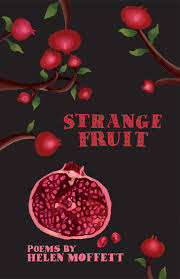
Strange FruitHaving constantly to worry about making a living, diminishes Helen’s potential as an academic as well as a creative fiction and non-fiction writer. She says an unambiguous yes to any grants for writers, however modest. Many wonderful opportunities slip by her because she cannot afford to invest her energies in them. In the last seven years, she has been trying to write a book on gender violence, a crucial topic in contemporary South Africa, and one that Helen is an expert on. “It’s tough to write; I’m only able to make any progress when I get a bit of funding for the project, but I still have some way to go.” Asked what she would do if she didn’t have to worry about the end of the month, she says she would write and devote more time to teaching: “I love teaching, but there is so little pay in it. Yet, I feel that it is my moral responsibility to transfer my skills. I just can’t lock up all that education and experience I’ve been fortunate to acquire over the years; not being able to pass it on is terrifying, but I have very little choice.” Even so, she insists on teaching a few courses a year, however poorly paid.

Drinking from a Dragon's WellIn comparison, Alex Smith fully intends to “make a living out of creative writing”, but she also wants to continue working in other areas as long as they do not sap her creativity. At present, she is a tutor for a novel writing course and a bookseller at Exclusive Books. “Working with books keeps me grounded. I’m a story addict and seeing the dozens of new titles arriving every day is heartening, but it also doesn’t allow for any illusions of grandness about writing. I feel writers and booksellers are readers’ servants.” Alex’s grandfather was a dedicated book collector, travelling to London to buy everything from antique tomes to rare first editions. She grew up surrounded by books and being around them makes her “immeasurably happy.” She has authored two herself, the novel Algeria’s Way (2007) and the travel memoir Drinking from the Dragon’s Well (2008). A third, Four Drunk Beauties, will be published next year. Talented and prolific, with a Creative Writing MA under her belt, Alex wouldn’t say no to financial support for creativity, but doesn’t feel anybody owes her anything. Having studied business science, for some years Alex earned a good salary as a successful creative and marketing director of a textile company. “But I always wanted to be a storyteller,” she stresses. “The way things are now, I’m free to write, and the price is debt, but it is my choice to be in this position. My heart’s desire is to explore real and imagined places, and play with turning those into stories.” Knowing her literary output and determination, one cannot help but feel assured that she will succeed at what she does with such unmistakable passion.

One author who has managed to write himself out of dire poverty is the inspirational Zanozuko Mzamo, or Zyd, as many know him. He is the author of a motivational book called A Year of Staying Positive (2007). Zyd grew up in Johannesburg, went into exile in the 1970s, studied economics in Zambia and Bulgaria, and returned to South Africa in the early 1990s to work in commerce. He was deeply unhappy with what he was doing, struggled to keep working, and eventually ended up broke and homeless. It was devastating, but the experience set him out on a journey of “soul-searching and gift finding”. He asked himself, “Who am I? What am I here for?”

A Year of Staying PositiveTo find answers, he visited libraries, fell in love with self-help literature, and discovered writing as a way of encouraging people. In 2005, he applied for a job at the community newspaper City Vision and even without pay persisted in publishing a weekly motivational column that garnered him a lot of recognition. He received so much positive feedback from his readers that with the help of Colleen Higgs and the Centre of the Book, he decided to self-publish 52 of his articles in book form. “A couple of publishers turned me down, but I wouldn’t be deterred, not even by the initial scepticism about the book in my community.”

His persistence and initiative were recognised by Carl Wesselink of the Kuyasa CDM Project (developing energy efficient housing in Khayelitsha). Carl Wesselink saw that Zyd’s book could inspire people and offered to buy two thousand copies of it to distribute in Kuyasa as well as to pay Zyd’s salary for a year. Today, Zyd coaches people in personal development and self-improvement in Kuyasa. He considers reading an indispensable ingredient of both. His latest initiative is the Teach a Child to Read Campaign, and he has two more books on the way. He finds the idea of state-funded support for his writing intriguing, but is scared that it would make him lazy: “I like challenges,” he points out. “When I was about to drown, I found my calling,” he says, relaxed and confident. “I hope to sell a million copies of my books.” His mere presence inspires. It’s easy to believe that he will make it.

All seven authors I spoke to seem to have found the right niches for their many talents. Financial support for their creativity wouldn’t drastically change their lifestyles, just utilise their talents in more efficient and rewarding ways. They all seem to have discovered what Zyd writes in one of his essays: “Life is what you make it.”

Sources:
http://www.kunstnerstipend.no/english/

First published in WORDSETC 6 (September 2009).

The Image of a Pie: Reflections on Open Book 2014

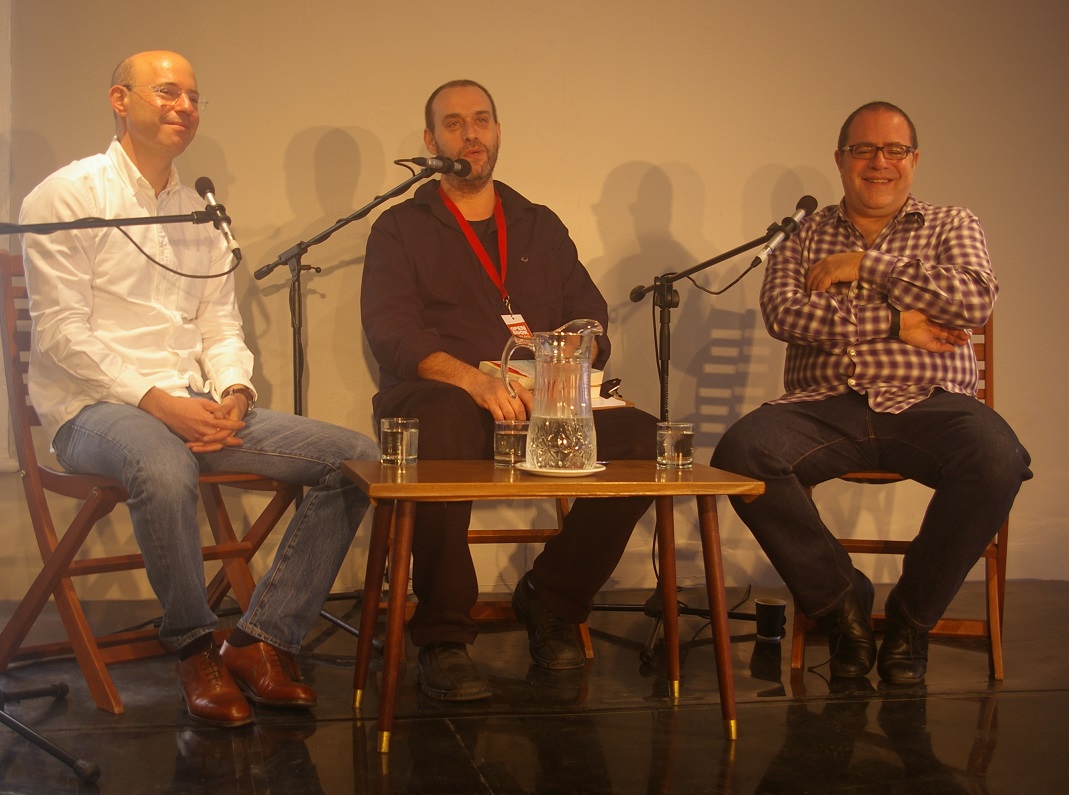
Niq Mhlongo, Chris Beukes, Malaika wa Azania and Natalie Denton
I cried twice. No matter how much I tried to control myself, the tears kept coming and I was grateful for the pack of tissues I had in my handbag. I should have started shedding tears at the beginning of the event, when the woman who is our national treasure, Sindiwe Magona, noticed that we were only a few people in the audience while the whole of South Africa should have been attending. But it was only when Sixolile Mbalo, the soft-spoken, beautiful author of Dear Bullet, Or A Letter to My Shooter (2014), pointed to herself with her most articulate hands and used the possessive pronoun “my” to refer to the man who raped, shot, and left her for dead, that the dam of anguish broke inside me. In my own personal reality I speak of “my friend”, “my brother”, “my husband”. To have to survive a reality where a rapist is internalised into “my rapist” is nearly unbearable to think of, and yet, as Ekow Duker, the third panellist of the Open Book Festival event presented by Rape Crisis, mentioned, “We get more upset when our soccer team loses than when a woman is raped.” That is the reality Mbalo lives, and courageously survives, every single day of her life. All of us should take note and salute her. Any moment, her fate could become that of “our friend”, “our sister”, or “our wife”.

“Women are ghost heroes in our struggle.” – Niq Mhlongo

This year’s Open Book unfolded over five days from 17 to 21 September in Cape Town. It was filled with insight and inspiration. Apart from the moment described above, laughter dominated. The second time I shed tears, they were also an expression of joy. Speaking about her touching Good Morning, Mr Mandela (2014), Zelda la Grange told Marianne Thamm that Madiba destroyed all her defences just by holding her hand when they met. La Grange’s life bears testimony to one of Thamm’s remarks: “Mandela made us better people; that’s what good leaders do.” The conversation between these two powerhouse women was undoubtedly a highlight of the festival. Judging by the faces and comments of people present at the event, most felt its magic.

“Let it all come out and let us talk about it.” – Mandla Langa

Sixolile Mbalo’s and Zelda la Grange’s life stories capture the immense span of the spectrum of South African everyday experience. And it is essential for our humanity to pay as much attention to the one story as to the other, even though it is in our nature to gravitate towards happiness and success.

“Memory is always a fiction we tell ourselves.” – Rachel Zadok

Continue reading: LitNet.

Jonny Steinberg, Mervyn Sloman and Mark Gevisser
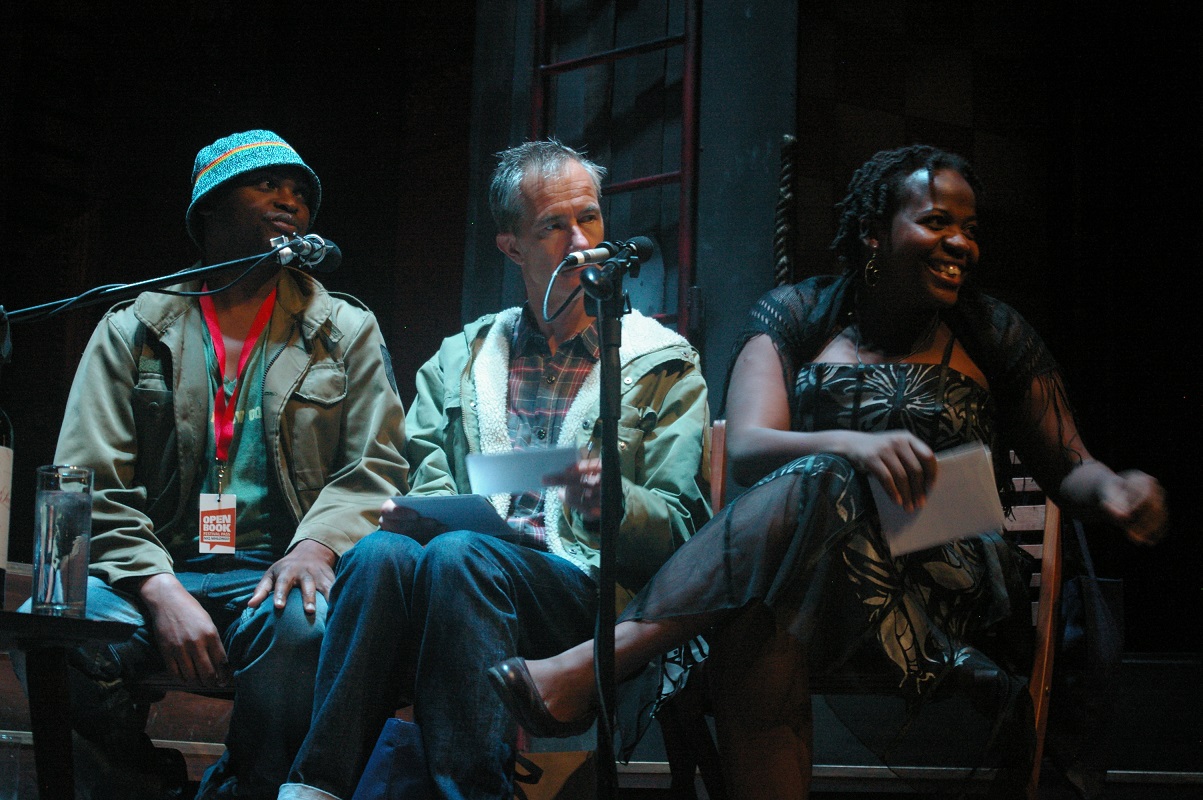
Niq Mhlongo, Geoff Dyer and Zukiswa Wanner
Raymon E Feist, Deon Meyer and Andrew Salomon
Zelda la Grange and Marianne Thamm

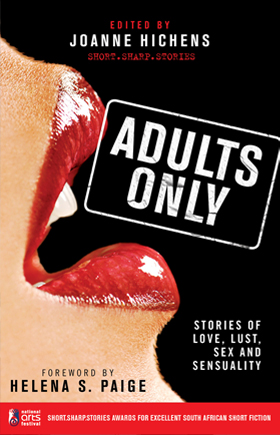
Review: Adults Only – Stories of Love, Lust, Sex and Sensuality edited by Joanne Hichens

adultsonlycoverThe stories in this anthology have been selected from some 150 entries submitted for the second annual Short.Sharp.Stories competition. As with all such collections, the quality of the twenty-two individual pieces varies. The authors range from first-time-published to award-winning practitioners of the genre. Additionally, in this particular case, every reader’s sexual preferences will strongly influence their reading of these diverse contributions. Sex in all its permutations is a highly personal experience, as is writing and reading about it. Hats off to the editor and all the authors for their daring explorations of the mine-fields of our sexualities.

As Aryan Kaganof’s narrator states, “there is no love that is not an echo”; he also understands that “real sex happens in the head”. Erotic stories are like lovers. They will either satisfy you or leave you wanting.

No doubt a few of the contributions will bring many readers out of their comfort zone and will have you reading through your fingers. Others will excite you. Some will delight with their humour or tenderness. There is a lot to be learned. Who would have thought that Woolies would emerge from the anthology as the preferred place of choice for sexy lingerie shopping? Or that the smell of semen reminds some of peeled potato? I didn’t even want to know what blunt knives could be used for. Every reader will find something to please or disturb them. No matter what, brace yourself: Adults Only is one hell of ride for most of its journey.

After reading the opening story, Alex Smith’s “The Big Toad”, I knew that I would never be able to look into my kitchen cupboards without apprehension, and perhaps a tiny bit of envy. I might have to get some Jungle Oats to liven up the scene inside my predictable cupboards. Arja Salafranca’s “Post-Dated Sex” made me look at post-it notes with fresh eyes. Her story approaches that beautiful space between lovers where words “dissolve” and become something “instinctive that moves against them.” Beauty is also the subject of Donvé Lee’s “The Mirror”. Lee is the author of An Intimate War (2010), one of the most erotic local novels of recent years. Her story shines with a similar intensity and rare honesty.

The competition’s winning entry, Nick Mulgrawe’s “Turning”, is a well-written and a worthy choice, but it did not move me as much as Ken Barris’s captivating “Louka in Autumn”, or Anthony Ehler’s shattering “Breaking the Rules”, or Alexander Matthews’s illuminating “Entropy”. Efemia Chela is a young writer to watch. Her “Perigee” is as bold and astute as her recently Caine Prize-shortlisted “Chicken”. She writes a lush and supple prose that is a pleasure in itself.

The language of sexuality is a very tricky thing to master. What will arouse one person, will do nothing for another. It’s so easy to fall into clichés and vulgarity. So it was quite refreshing to smile at phrases like “sex has always been at best pedestrian – Tim walks all over me” (in Christine Coate’s “The Cat’s Wife”, a tale of a bored wife seeking out adventures which will make her fly, literally and otherwise), or to admire the eloquence with which Justine Loots describes the sadness of an encounter between a prostitute and a young inexperienced man: “One of his wings, if he has wings at all, is torn at the edge. It won’t affect his flight much, you won’t even see it, but it’s there all the same.” The magic realist twist of Loots’s story “Uncaged” brings a wonderful dimension to the entire book. Strange beasts roam the world she creates; one can never be sure who is the prey and who the predator.

Not every use of the word “cunt” will have the same impact of Ian McEwan’s Atonement. And yet I was reminded of it in Aryan Kaganof’s powerful story “Time Out With My Destiny”. With every paragraph the first-person narrator lures you in, manages to surprise and capture something unique, and ends on a shattering note. A “wow story”, my husband said when I read it aloud to him.

The stories in Adults Only capture different aspects of our relationships: from tender intimacy to raw sex, and beyond, to abuse and rape. Wamuwi Mbao’s “The Ninth Wave” tells of that moment when wanting more from a relationship breaks the little that the other is prepared to give. Alan Waters’ debut story “A Threesome in the New South Africa” recounts a hilarious encounter between a middle-aged man, his younger girlfriend, and a Rastafarian of intimidating proportions. Not every longing is clearly identifiable. In Dudumalingani Mqombothi’s “The Streetwalkers”, the search for his lost father leads a man into the arms of a sex worker.

Adults Only is a fascinating read which showcases the diversity, audacity and vibrancy of South African fiction.

Adults Only: Stories of Love, Lust, Sex and Sensuality
Edited by Joanne Hichens
Mercury, 2014

An edited version of this review was published in the Cape Times on 12 September 2014, p. 10.

Our Literary Felines

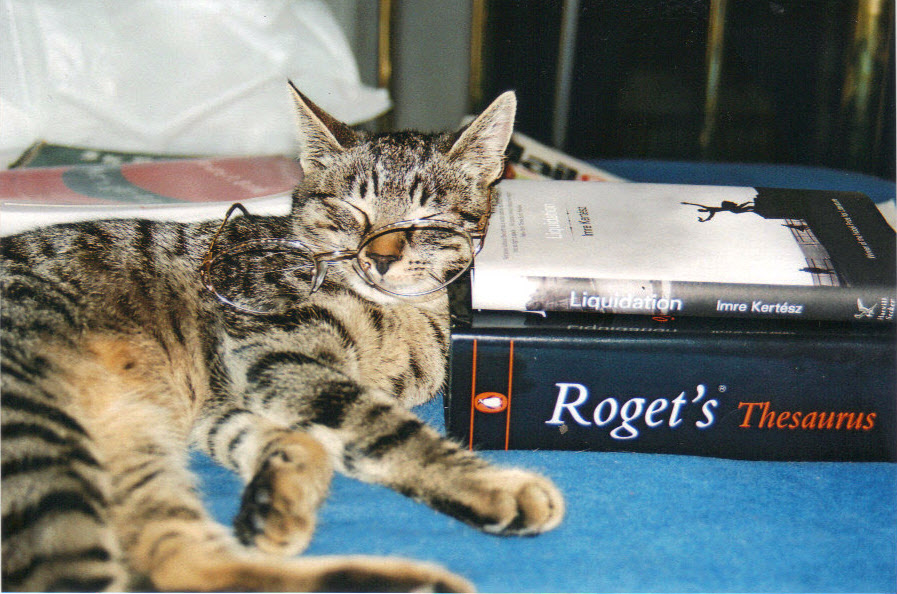
Mozart after finishing Imre Kertész's Liquidation

Mozart after finishing Imre Kertész’s Liquidation

Inspired by a chat over dim sum and pu-erh tea with Alex Smith and her recent Three Cats blog post, as well as an exchange of cat photographs on twitter with Katherine Stansfield whose four Cats seem as literary as our Feline Family, I decided to share a few stories and photographs here with you.
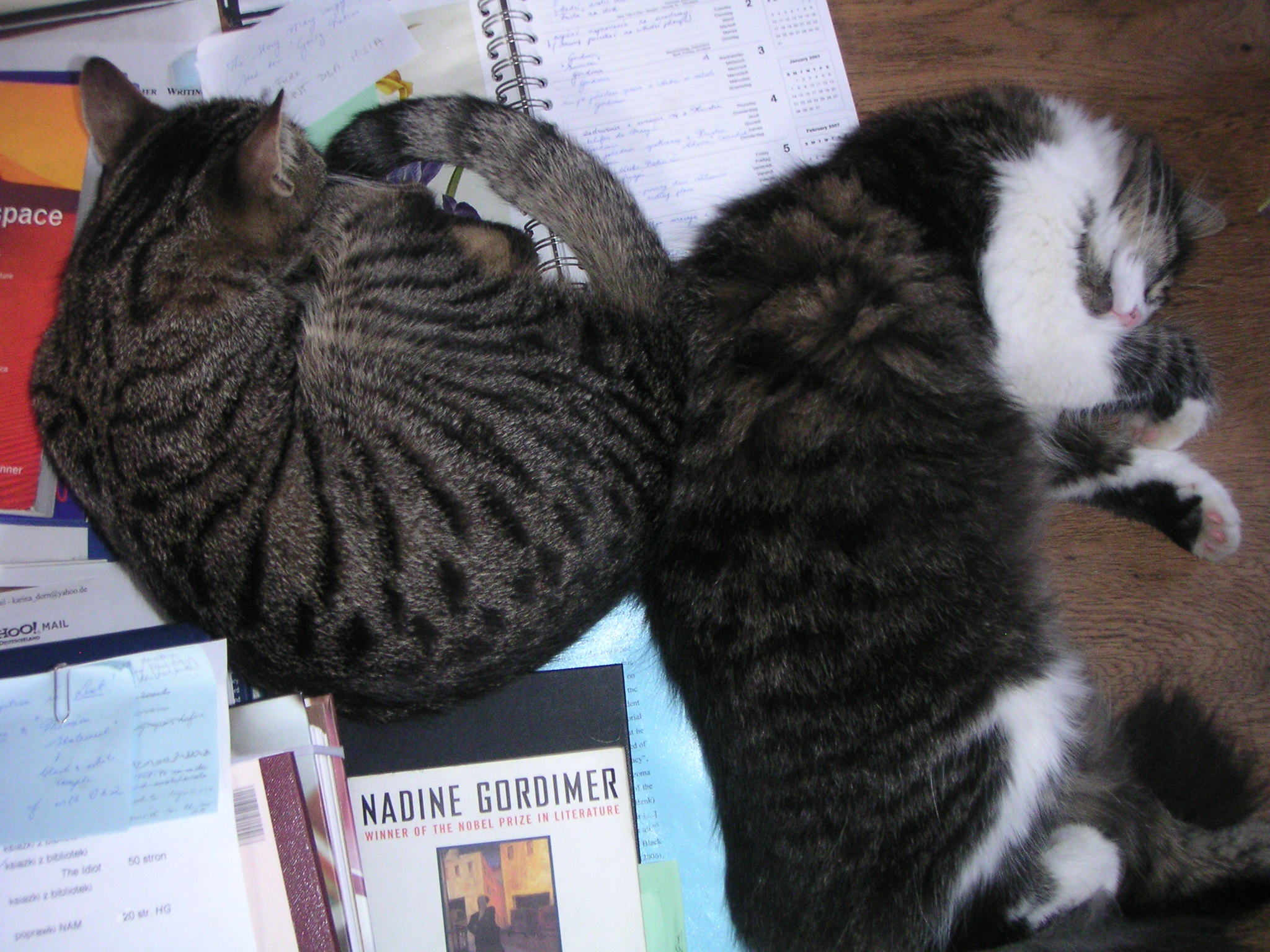
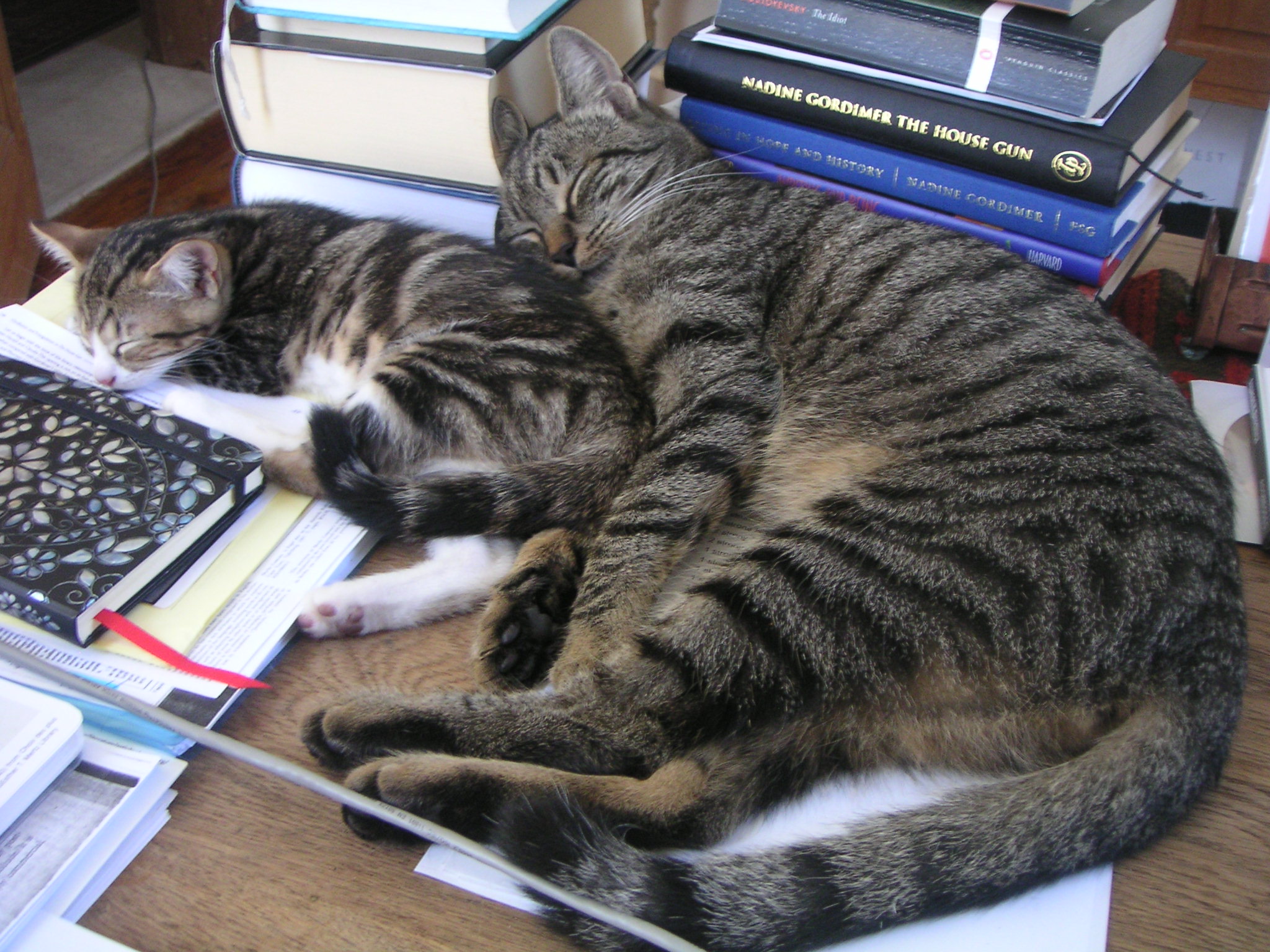
Anya and Mozart supervising the writing of my PhD thesis on Nadine Gordimer

Anya and Mozart supervising the writing of my PhD thesis on Nadine Gordimer


MINOLTA DIGITAL CAMERA
André and I don’t want to remember the ordinary boring life we led before Anya and Mozart (named after Anna Netrebko and Amadeus – they were born in the Mozart year) arrived on a KLM flight from Austria in 2006. It was quite a dramatic occasion, because their documents got lost along the way and their trip was postponed by 24 anxious hours. However, at last we received the news that they were safely on their way and we could pick them up from the airport. The plane landed, all the passengers – human and non-human – deboarded and we were told that we would get ‘our dog’ in a few minutes.
‘But we are expecting two cats,’ we protested with hearts in our throats.
The man glanced at the documents in his hands, ‘Yeah, right.’
Minutes passed, we remembered the lost documents and began to prepare ourselves for the Rottweiler travelling on Mozart’s pet passport while he and Anya were on their way to Australia for all we knew.
The airport official returned empty-handed, but assured us that ‘our dog’ was on his way.
‘You mean our TWO CATS!’ we shouted, but he was gone again.
At last, he returned with a cage containing two very vocal Kitties we recognised. Relief, relief!
We had read all the available cat books and prepared the house for their welcome, stressing about getting it all right, but Anya and Mozart were completely blasé about the entire trip to the other side of the world. The moment we arrived home, we let them out of the cage and stood around helplessly, watching for any signs of distress. They stretched, looked around, located the litter box, did their business, saw the food and the water, helped themselves, sniffed a bit around, and literally twenty minutes later were both stretched out on our bed, looking up as if to say, ‘So, when are you coming to bed?’

Our lives changed that day. They became a million times better!

Anya with one of her favourite novels, Jeanette Winterson's Lighthousekeeping

Anya with one of her favourite novels, Jeanette Winterson’s Lighthousekeeping


To lose Anya to a speeding car a few months later was shattering, for all three of us, worst for Mozart of course, but we all didn’t know how to deal with the loss. I still see her strolling through the house, waving her gorgeous bushy tale as if the world belonged to her. It did. We miss her terribly.
Mozart showing Salieri the ropes of supervising my PhD on Gordimer

Mozart showing Salieri the ropes of supervising my PhD on Gordimer


After the tragedy, friends recommended a kitten. That is how Antonia Salieri came into our lives in 2007. Born in a sewage pipe, she was a bit of a rough diamond at first, and so tiny that she constantly got lost under Mozart’s feet when he tried to play with her. Eventually, out of desperation, I presume, not knowing how to engage her otherwise, he danced on the scratching pole for her, bum and tail high in the air like a real pro. None of us will ever forget the performance, least of all the flabbergasted Salieri. Once she recovered from the shock, they settled into a co-habitation of mutual respect. Salieri quickly realised that the circumstances of her birth shouldn’t stand in her way of behaving like royalty and she earned herself the nickname Principessa from an Italian visitor to the Brink household. She only eats her food if served on the kitchen table (Royal Albert plates), takes up half of my half of the bed (she doesn’t care much for my back problems), and screams at me if I misunderstand ‘Catlise’, the most important language for any human to understand. Any cuddles happen only and entirely on her terms when she is ready for them.
As a kitten Salieri read Olga Tokarczuk

As a kitten Salieri read Olga Tokarczuk


Salieri pensive after reading the Sunday newspapers

Salieri pensive after reading the Sunday newspapers


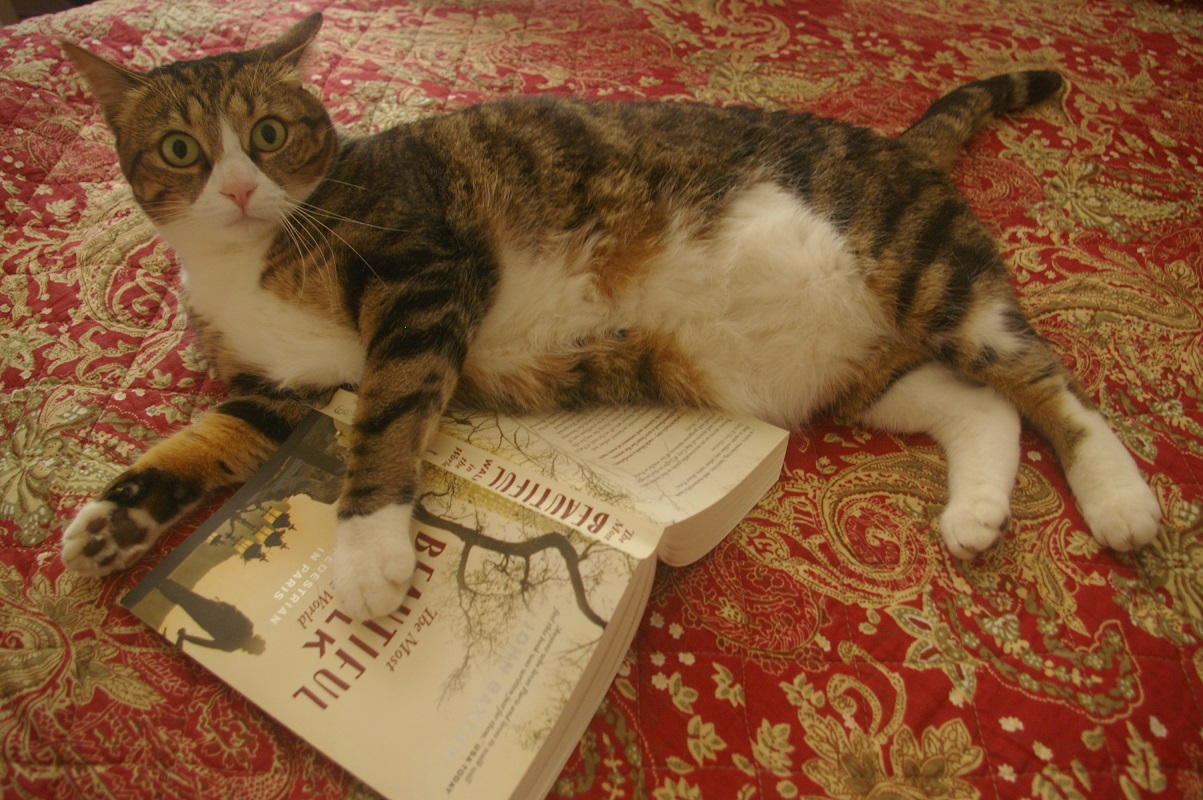
Salieri shocked how little she knew about Paris after reading The Most Beautiful Walk in the World by John Baxter

Salieri shocked how little she knew about Paris after reading The Most Beautiful Walk in the World by John Baxter


Salieri supervising André's translations of Ingrid Jonker's poetry for Black Butterflies

Salieri supervising André’s translations of Ingrid Jonker’s poetry for Black Butterflies

Salieri getting her teeth into Roget's Thesaurus

Salieri getting her teeth into Roget’s Thesaurus


Salieri trying to put some order into the chaos on André's desk

Salieri trying to put some order into the chaos on André’s desk


Mozart is our wanderer and partly adopted the neighbours as his other family. He is very wise, speaks Polish, German, English, Afrikaans, and Catlise fluently, understands many more languages and loves David Attenborough bird documentaries.
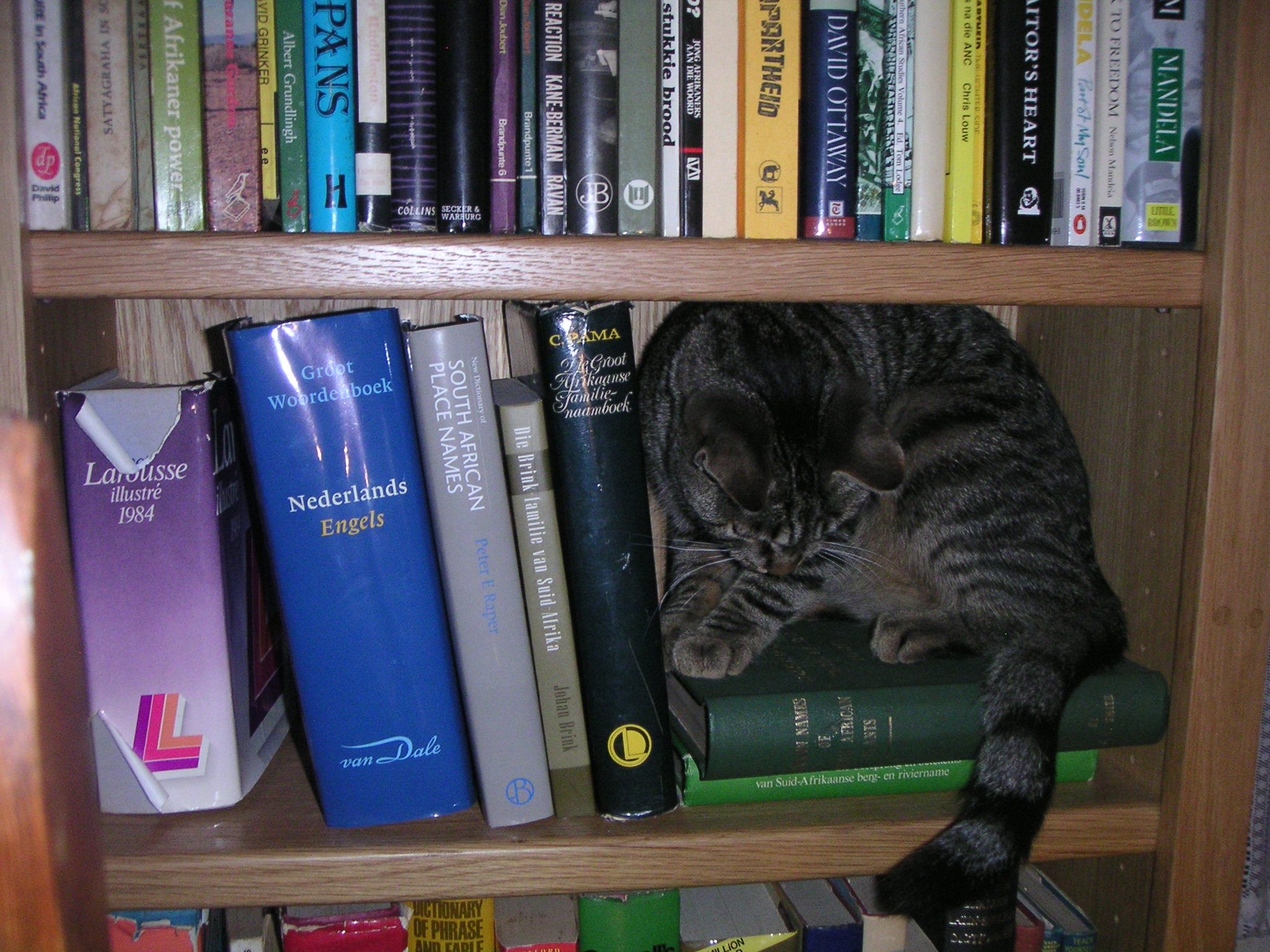
Mozart contemplating whether to read Granta magazine or Gordimer's Selected Stories next

Mozart contemplating whether to read Granta magazine or Gordimer’s Selected Stories next


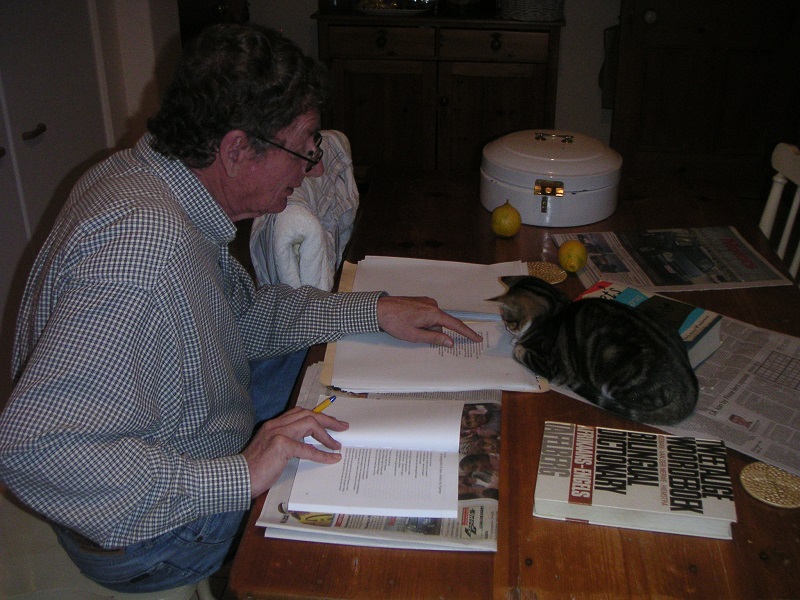
Mozart searching for a dictionary

Mozart searching for a dictionary


We never thought of another cat to join the household, but when Michela Glinka was placed in my hands with a red bow around her neck and we were told that she desperately needed a home, we had no choice. She arrived in 2008 with a tummy problem and kept us awake the whole first night. Between trying to somehow help her and changing our bed sheets for the third time, I was ready to give her back, but when we eventually all fell asleep in the morning and woke up together, I knew she was here to stay. She is now sleeping on my chaise longue in one of her nests.
Glinka in a nest

Glinka in a nest


Glinka5
Glinka is the ultimate nest-builder, fresh laundry is best, but any blankets or quilts will do. We also call her our birdie-cat because she chirps like a little bird. The moment I set foot out of the bed in the morning, she will be running through the house, chirping along the way to welcome me into the day. We make coffee together and then return to bed where she will sit on my chest (as close to my face as possible), have rusk crumbs, and read with me or go over to André to check whether his book is more interesting. Most of my writing happens with her in my lap or somewhere in the room.
Glinka with Lauren Beukes's Moxyland toy

Glinka with Lauren Beukes’s Moxyland toy

Glinka pondering a word she'd just looked up in a German-English dictionary

Glinka pondering a word she’d just looked up in a German-English dictionary


Glinka inspiring my writing

Glinka inspiring my writing

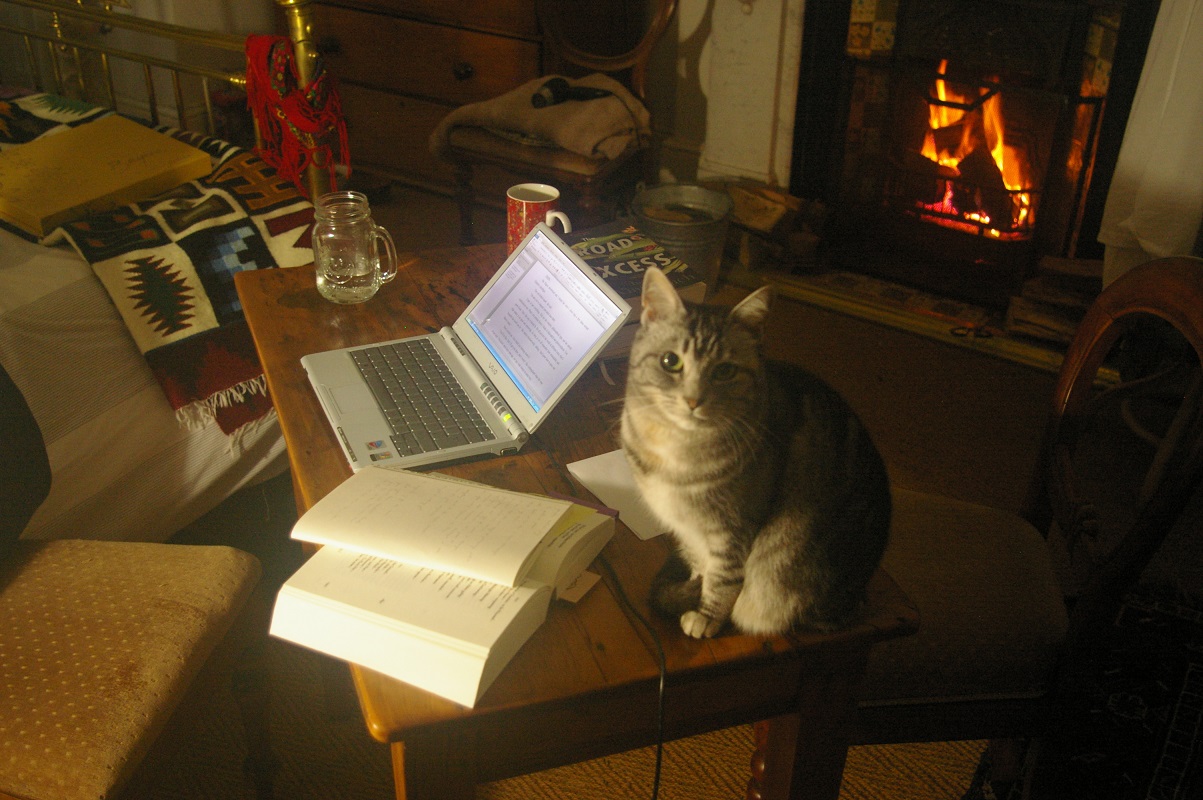
Glinka and I writing in winter close to the fireplace

Glinka and I writing in winter close to the fireplace


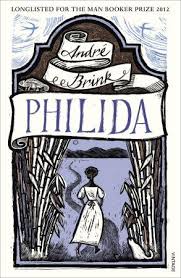
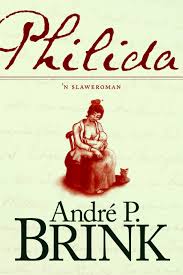
Glinka is most famous in the literary circles around the world as the cat who inspired Kleinkat in André’s Philida (2012), recently also published in Taiwan (I love the cats on the different covers).
Philida3Philida2Philida cover TaiwanFrom the acknowledgements of my Invisible Others: “My furry family, Glinka, Salieri and Mozart, true experts at life, keep trying to teach me how to make the most of it; I hope they will succeed one day.”

Worldwide Reading for Edward Snowden – Kalk Bay Books

Kalk Bay Books
Happy to participate in the following event:

PEN South Africa invites you to a Worldwide Reading for Edward Snowden

The international literature festival Berlin (ilb) has called on individuals, institutions, schools and media outlets to participate in a worldwide reading of texts about surveillance, in support of Edward Snowden, on Monday 8th September 2014. Pen South Africa will be participating in this event, and the reading will take place at Kalk Bay Books.
Readers include:

Rustum Kozain – Liesl Jobson – Ken Barris – Karina Szczurek – Karen Jayes – Justin Fox – Ingrid de Kok – Diane Awerbuck – Brent Meersman – Andrew Brown – AE Ballakisten

Monday the 8th is also International Literacy Day. Please join us in support of writers, freedom and civil rights.

WHEN: Monday 8th September at 6.30 for 7pm
WHERE: 124 Main Road, Kalk Bay

RSVP: email

events@kalkbaybooks.co.za
or call 021 788 2266

Invitation: PEN South Africa

Review: The Visitor by Katherine Stansfield

The VisitorThere are these magical moments in life when your call of longing is answered by the ideal book. Katherine Stansfield’s debut novel, The Visitor, was such a book for me. Despite having grown up in a picturesque mountain landscape, for most of my life I have felt that I belonged to the sea. In the last few weeks I have been thinking about the influence that sense of affinity with the sea has had on me as a person and a writer. Stansfield spent her childhood in Cornwall and lectures at the University of Wales which overlooks Cardigan Bay. The sea is in her blood and it is one of the main protagonists of her stunning novel.

Meticulously crafted, submerged in wisdom and yearning, The Visitor opens with a gem epigraph, a line by Ruth Bidgood: “When I have pictured a calm sea, there is your boat, waiting.” Set in a fictional fishing village in Cornwall towards the end of the nineteenth and the beginning of the twentieth century, the novel tells the story of Pearl, Jack and Nicholas: “The three of them live on the same street, three houses all in line and Pearl’s house in the middle. The three fathers go out in the lifeboat when the flare goes up, and everyone goes to chapel. Each family works together in pilchard season.”

Playing together as children, Pearl, Jack and Nicholas test the boundaries of the friendship that binds them. As young adults they begin to form new allegiances with one another and the community around them. When the pilchards stop coming, the lives of those dependent on the fish for their livelihood change irreversibly. Nicholas is a dreamer ready for adventure and distant shores. The steadfast Jack believes in the continuation of traditions. Pearl knows to whom her heart belongs, but some choices are not hers to make.

Years later, Pearl is forced to abandon her home. Once again everything around her transforms as her small village is flooded by tourists and modernity. At the same time she grapples with an infinitely more tragic loss as she tries to hold on to the precious memories of the love of her life: “What was remembered was true.” Haunted by a past which seems more real than anything else around her, Pearl waits for him to return and sneaks away to revisit the places where they’d experienced flashes of happiness together. On her wanderings she encounters cairns which remind her of all that is lost. She carries a cairn inside her, “weighed down by its stones”. Because of her precarious health, she is not allowed to swim, but the sea is the only thing which restores her to herself: “They were old friends. They had an understanding.”

A constant companion to the human drama unfolding at its shores, the sea continues with its own rhythms. Stansfield is also a poet. Her debut collection Playing House will be published in October. No wonder The Visitor’s prose shimmers with breath-taking beauty.

The Visitor
by Katherine Stansfield
Parthian, 2013

First published in the Cape Times, 29 August 2014, p. 32.

Open Book Festival 2014

Between 17 and 21 September the literary community in Cape Town will gather for the fourth Open Book Festival.
Open Book
In past years, apart from attending as a passionate reader, I have had the pleasure of interviewing some of my favourite authors at Open Book: Craig Higginson, Rachel Zadok, and Kgebetli Moele among them.

This year, I am in for another treat: I’ll be talking to Andrew Brown, Ekow Duker and Jonny Steinberg about the impact that the content of their books has on them (OFF THE PAGE, Friday 19 September, 4-5pm, Fugard Studio).

The day before, I’ll be chairing Open Book’s TRIBUTE TO NADINE GORDIMER with Imraan Coovadia, Billy Kahora and Margie Orford who will read from Nadine Gordimer’s work and share stories about her influence on their creative lives (Thursday, 18 September, 2-3pm, Fugard Theatre).

And last but not least, I’ll be the ‘little rat’ (=szczurek) next to two literary greats: Michiel Heyns and Damon Galgut. Our session – WRITING SEXUALITY – will be chaired by Karin Schimke (Wednesday, 17 September, 2-3pm, Fugard Studio).
Emma-van-der-Vliet-and-Patrick-DeWitt
For the full festival programme click here: Open Book 2014.
Imraan-Coovadia-and-Sarah-Lotz
Photographs: Open Book 2013.

My dreams are back

MINOLTA DIGITAL CAMERAI’m a dreamer. I dream with abandon, remembering up to four dreams a night, all vivid as if seen on a silver screen just moments before. Some of these dreams end up as my stories. Others I keep in my diary. As a child, I had a recurring dream about an island surrounded by dark waters. Many of my dreams are linked to the sea. In the last few weeks I’ve been through some rough waters. Under pressure, I stop eating, sleeping, and, worst of all, dreaming. The last dream I remember before last night is the one I wrote about in my Nadine Gordimer tribute. And now, over a month later, I’m surfacing and this morning I woke up remembering two dreams! One is for the diary. The other one for sharing.

But first a few memories. Many years ago I saw a movie which made a deep impression on my young mind; the most striking image from the movie involved women clad in crimson. Much later, at university in Austria, I read my first Margaret Atwood novel: Cat’s Eye. It triggered my fascination with Atwood’s work. I read a few other of her titles. Then, while doing research at the university library in Aberystwyth, Wales, I was passing a row of books when a red smudge on a book spine caught my eye: the crimson women. I think I read The Handmaid’s Tale in one sitting through the following night.

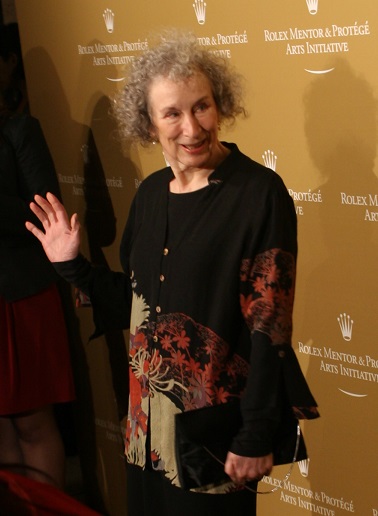
A few years ago, I had the remarkable honour of sitting at the same table as Margaret Atwood at a gala dinner in New York. We did not talk much, mostly because the Oscar-winning composer right next to me wanted to touch my hair, which was luckily all braided and pinned and meant for another. So sadly, I remember only one exchange with Atwood that night. We discussed peanut butter sandwiches. Really!

Fast-forward to last year. Venice. Another gala dinner, Atwood at the same table, for most of it right next to me. And this time I felt like a woman in one of her stories, battling with her voice. I stopped speaking all together for a week after that evening (acute laryngitis). Atwood took over the conversation and the erudite editor on my other side was just as entertaining. But I can’t say that I was much of an articulate presence.

Photo: Krystian Szczurek, New York 2011

Photo: Krystian Szczurek, New York 2011

And then a few days ago, I saw the wonderful news that Atwood’s latest short-story collection is to be published before the month is over. I’m eagerly awaiting the day it reaches South African bookshops. So, I suppose, given all of the above, it is no surprise that one of my dreams last night was about Margaret Atwood. In the dream, I was living in a small town. I found myself sitting next to Atwood on a park bench and she was telling me about attending a literary festival nearby. ‘This morning just after 5am, they came into my hotel room, saying that I needed to go with them to sign books, and they brought me here, and now I’m stuck, because nobody wants to take me back,’ she said, but she did not seem concerned at all, just perplexed, and a bit amused. Naturally, I offered to drive her to her hotel. And then I woke up, delighted to be dreaming properly again, and remembering how generously Atwood had signed my books in New York and Venice.

What would Dr Freud say?
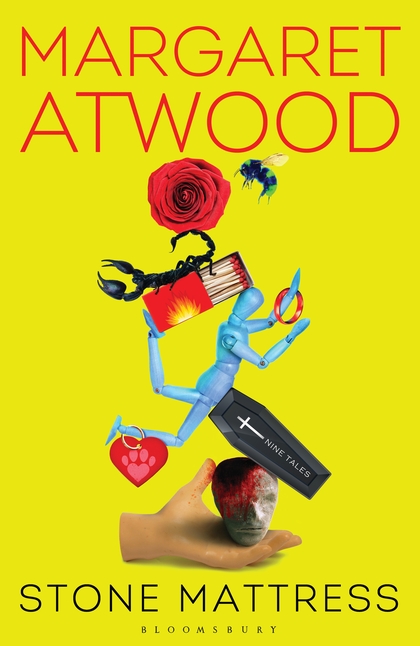
Dr Szczurek says: Get Stone Mattress!

Stone MattressAbout Stone Mattress:

“A recently widowed fantasy writer is guided through a stormy winter evening by the voice of her late husband. An elderly lady with Charles Bonnet’s syndrome comes to terms with the little people she keeps seeing, while a newly-formed populist group gathers to burn down her retirement residence. A woman born with a genetic abnormality is mistaken for a vampire. And a crime committed long-ago is revenged in the Arctic via a 1.9 billion year old stromatalite. In these nine tales, Margaret Atwood ventures into the shadowland earlier explored by fabulists and concoctors of dark yarns such as Robert Louis Stevenson, Daphne du Maurier and Arthur Conan Doyle – and also by herself, in her award-winning novel Alias Grace. In Stone Mattress, Margaret Atwood is at the top of her darkly humorous and seriously playful game.”

Over the years, I have reviewed a few of Atwood’s books:

The TentThe Tent (2006)

Margaret Atwood’s latest collection of writing The Tent is a visual and intellectual delight. Provocative and full of wisdom it provides plenty of food for thought, not always readily digestible. A little book with big ideas. Beautifully designed and illustrated by the author, it has the feel and look of a private notebook one would want to carry around in one’s breast pocket at all times. One feels tempted to add personal comments on the few blank pages in-between the many voices of Atwood’s narrators, living and sharing their thoughts full of anxieties and hopes with the readers in a world which is hostile and frightening.

From the drawing of the cover to the last page of the book one image persists: a tent full of words, surrounded by beastly creatures. When the narrator of the title piece in the collection tells us “you’re in a tent”, we just have to take the book and put it up on its covers’ edges to realise how deliciously suggestive the image is in its multiple meanings. “It’s vast and cold outside, very vast, very cold. It’s a howling wilderness…But you have a small candle in your tent. You can keep warm…The trouble is, your tent is made of paper. Paper won’t keep anything out. You know you must write on the walls, on the paper walls, on the inside of your tent.” With your writing you must describe the howling and the truth, you must write about the ones you love and the things you love and try to protect them, even though your “obsession with calligraphy” is not always appreciated and understood. And your tent is fragile and endangered by the howlers sniffing around outside, “but you keep on writing anyway because what else can you do?”

Xenophobia, violence, despotism, gender inequality, terrorism, crime, environmental crisis, tyranny, war – our global society is drenched in conflict, “a howling wilderness” indeed. If anybody had any doubt about the role of the intellectual in these difficult times, Margaret Atwood’s gem of a collection shows the path to take. The title piece is probably the most honest, humble as well as forceful, statement on the precarious situation of the writer and the importance of writing in recent years. In another piece, “Voice” the situation is again exemplified. The first-person narrator tells us she has been “given a voice”. No matter what glory and adoration it gives her, she knows one day it will begin to shrivel. Until then it is “attached like an invisible vampire to my throat.”

The whole book is like a little tent written against the evils of the world. Balancing on the border of fiction and non-fiction, Atwood’s collection with its generic mixture of fables, essays, dreams, monologues, dialogues, rewritings of myths and legends, satires, allegories and poems, is a subtle and razor-sharp analysis of the world around us. No preaching, just small precise revelations on the madness of our global society.

“Thylacine Ragout” explores the follies of genetics and the power of money to buy anything it wants. “Plots for Exotics” deals with our prejudices and xenophobia. Pieces such as “Heritage House” and the magnificent poem “Bring Back Mom: An Invocation” take up gender issues.

“And there you’ll be, in your cotton housecoat,
holding a wooden peg
between your teeth, as the washing flaps
on the clothesline you once briefly considered
hanging yourself with –”

“Eating the Birds” tells us of complicity, choice and unrighteous wanting of something that does not belong to us: “We’re ankle-deep in blood, and all because we ate the birds, we ate them a long time ago, when we still had the power to say no.” When in “Chicken Little Goes too Far” the chicken finds out that “the sky is falling”, he has to pay a high price for wanting to save the world.

Although some of the other pieces are more introspective, quiet, even funny, there is little comfort in the volume. However it is a nourishing piece of work that goes straight to the heart and makes one want to take up the pen and write on the blank pages in-between. For what else can you do?

Bertolt Brecht once said that thinking is something that follows problems and precedes action. This is precisely where Atwood’s little big book stands. In the last piece of the collection “But it Could Still” the narrator begins by saying: “Things look bad: I admit it. They look worse than they’ve looked for years, for centuries. They look the worst ever. Perils loom on all sides. But it could still turn out all right.” There are many stories, winter’s tales, that keep up the faith. “We want to huddle round them, as if around a small but cheerful fire.” And there are the tulips you planted before the winter frost “in the brown earth” where “already hundreds of small green shoots…intending to grow despite everything” were waiting. The narrator contemplates in the end: “What would you call them if they were in a story? Would they be happy endings, or happy beginnings? But they aren’t in a story, and neither are you. You tucked them back under the mulch and the dead leaves, however. It was the right thing to do on the darkest day of the year.”

Atwood’s Tent is full of thoughts on humanity. Like the small green shoots intending to grow despite everything, they will survive the dark cold winter and blossom proudly in spring. Outside of a story I would call them hope.

First published in the Sunday Independent, 4 June 2006.

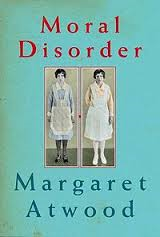
Moral DisorderMoral Disorder (2006)

Margaret Atwood, by now the author of over three dozen books, has always been a prolific writer. Last year, however, was a special treat for all the fans of her fiction. After the publication of The Penelopiad (one of a series of myth rewritings by internationally acclaimed authors) and The Tent (a collection of shorter miscellaneous pieces), the end of the year witnessed Atwood’s latest release, Moral Disorder. This intriguing book is yet another representative of a genre which is not exactly new, but is increasingly coming into its own on the international literary scene, and even more so on our local market. Moral Disorder could be termed a ‘short story novel’. It comprises a collection of interrelated short stories, which can be read separately as individual pieces in their own right, but which reveal the total scale of their meanings only within reference to each other, interacting in this way to form a whole which could be read as a novel.

In South African fiction, recent examples of this fascinating – at times also controversial (some of us will remember the debate surrounding the nomination of Ivan Vladislavić’s The Exploded View for the Sunday Times Fiction Award in 2005) – genre range from Mary Watson’s beautifully intricate Moss (2004) to Byron Loker’s freshly rewarding New Swell (2006). As Miki Flockemann pointed out in her review of Moss, it is not unexpected that this genre “has become a noticeable trend in recent South African writing on account of the simultaneous embrace of cohesion and fragmentation.” It fictionally embodies the instable and diverse nature of the reality around us.

The short story novel is not foreign to Canadian fiction either. Alice Munroe’s Runaway (2005) will ring a bell for many readers. Now, Atwood’s Moral Disorder, “a collection of eleven stories that is almost a novel…or a novel broken up into eleven stories”, as the inside cover suggests, embarks on a journey through time and space and reveals, in glimpses, the intertwined lives of its characters.

We are first introduced to the main protagonists, Nell and Tig, as an ageing couple in “The Bad News”. The bad news of the title arrives in the form of a newspaper headline Tig shows to Nell, who is not ready to receive it, “Not before breakfast…You know I can’t handle it this early in the day.” Nell knows that this sort of news – about explosions, oil spills, genocides, famines – will always be followed by others like it, and is unwilling to confront it unless it concerns them directly. Instead, she escapes into the distant past, remembering a holiday in France. The memory merges into a daydream, which makes her realise that bad news has always arrived at our doorstep and will always do so, until eventually it pounces and “you reach out in the night and there’s no more breathing.”

The second story, “The Art of Cooking and Serving”, takes us back in time to when Nell was eleven and her mother was expecting her second daughter. While Nell decides to knit a layette for her sibling, she is frightened of the “listless, bloated, version” of her mother, who by changing her own future also changes Nell’s “into something shadow-filled and uncertain.” After her sister is born, Nell suddenly finds herself taking over from her mother, baby-tending and doing the chores, until she rebels in order to lead the normal teenage life she witnesses other girls enjoying. We encounter her at that stage in “The Headless Horseman” and “My Last Duchess”.

In “The Other Place” Nell is a young adult on the run from herself and the world until she meets Tig, and later recalls: “then followed the cats and the dogs and children, and the baking, and even the frilly white window curtains, though they eventually vanished in their own turn”.

All stories are told in the first person, apart from the following four, “Monopoly”, the title story “Moral Disorder”, “White Horse”, and “The Entities”, which switch to the third person, allowing us a fuller perspective on the lives of the characters, and a different insight into Nell, who has been the storyteller until now.

The four third-person stories centre on the complex relationship between Nell and Tig, who brings into the equation two sons and Oona, his demanding first wife whom he is in the process of divorcing. We watch Nell navigate between the moods and wishes of the people in her life as well as trying to fulfil her own dreams and guard her own integrity in the process: “Nell felt intimidated by this marriage, and small and childish in comparison with it. It had a certain oversized and phosphorescent splendour about it, like a whale decaying on the beach. It made her seem pallid, at least to herself: pallid, banal, insipidly wholesome. She did not have nearly as much operatic and tenebrous and sanguinary melodrama to offer.”

Rich in memorable characters and evocative settings, Moral Disorder offers deeply moving reflections on all stages of life, including ageing and death, which feature strongly especially in the two last pieces: “The Labrador Fiasco” and “The Boys at the Lab”.

Atwood is one of the best storytellers alive. In all the stories of Moral Disorder the importance of literature in our lives as guide, companion, mirror, filters through, and because of the honesty and insight with which all of them are told, we find ourselves looking at our own lives reflected in them and, once again, begin to marvel at the miracle of it all.

First published in the Sunday Independent, 14 January 2007.

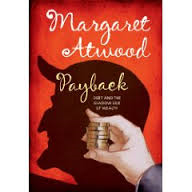
PaybackPayback: Debt and the Shadow Side of Wealth (2008)

In this time of financial crisis, reading an entire book about the concept of debt is not an enticing idea. This is the reason why as a devoted fan of Margaret Atwood’s work I’ve eagerly picked up her latest publication, Payback: Debt and the Shadow Side of Wealth, in the bookshop, and then, upon finding out what it was about, returned it to its shelf with a deep sense of mistrust, almost fear. I resisted the thought of hearing any more about debt, even if it was from one of my favourite writers.

Then a copy of the book arrived in the post for reviewing, and in the end, I couldn’t be more grateful for it. But my intuition about Payback was right. It is a scary book, although it does not begin as such. Payback comprises of five chapters, each focusing on a different aspect of the debt concept, and the first four are rather funny and light-hearted. It is only the last one that brings all the entertaining insights together in a devastating conclusion about us and our future.

As Atwood explains in the opening chapter “Ancient Balances”, Payback is not about such things as debt management, national debt, or shopaholics; it’s about debt as a human “imaginative construct”. Atwood goes on to expound that such inner foundation stones of humanness as instant gratification and fairness underlie this construct, presenting many fascinating experiments to illustrate her point. She also examines the moral and economic concepts of debt through a mythological and religious lens and traces them back to the idea of logos: without the possibility of keeping track of debt, it ceases to exist.

The second chapter “Debt and Sin” explores the idea of debt as a fashion: “We seem to be entering a period in which debt has passed through its most recent harmless and fashionable period, and is reverting to being sinful.” A lot of us have lost the ability of living within our means when it became acceptable to take the easier path. There was a time when going to a pawnshop was considered a terrible disgrace, a sin. Today, we all live on credit, however unaffordable it has become.

In spiritual terms, as Atwood shows, there is a close link between a pawnshop and redemption. She tells intriguing stories of St. Nicolas, the patron saint of thieves; the Sin Eater, who for a reward symbolically consumes a deceased person’s sins (spiritual debts) at the funeral; or the Devil and his careful bookkeeping of who owes him what.

The next chapter “Debt as Plot” builds on such stories and investigates many literary classics and their famous characters, especially Christopher Marlow’s Doctor Faustus and Charles Dickens’s Scrooge, offering a fresh insight into the art of storytelling and our perception of the primary mechanisms on which literary plots rely.

As its title suggests the next chapter, “The Shadow Side”, turns to the dodgy side of debt and traces the historical and present consequences of what actually happens when individuals or nations fail to settle their financial or ethical dues, i.e. when “big debts can make history and rearrange the landscape.” Atwood gives many terrifying examples of how the strategy of getting rid of debt by killing or expelling creditors has survived successfully throughout the ages. “The Shadow Side” also includes a sober, or rather satirical, look on tax: “There are two kinds of taxation systems: ones that are resented, and ones that are really resented.”

Atwood writes about the symbiotic relationship between the debtor and the creditor in the light of the Jungian theory of the Shadow, “our dark side, the repository of everything in us we’re ashamed of and would rather not acknowledge”. From there she moves to the concept of forgiveness and presents no other than Nelson Mandela and the TRC as her examples of how moral debt does not have to be evened out by revenge, but by the one thing which can undermine an eye-for-an-eye approach: forgiveness. If for nothing else, Payback is worth reading for this rather short section and Atwood’s fascinating thought experiment of what would have happened, had the president of the United States sent a message of forgiveness instead of revenge to the people responsible for 9/11.

“Payback”, the final chapter of the book by the same title takes us on a journey through time with a 21st-century version of Scrooge and the Spirits of Christmas. What Scrooge “Nouveau” experiences is scary, but Atwood does not wag her forefinger, she just wants us to wake up to the reality round us. As a human species we have incurred a debt to the planet that will also have to be settled, rather sooner than later, and if we want to be around to see the thereafter, we have to act now by paying back what we owe.

Payback includes a thorough bibliography, a good index and above all some valuable notes which can help readers think about realistic solutions to the many problems we face today.

First published in the Sunday Independent, 8 March 2009.

In Other WorldsIn Other Worlds: SF and the Human Imagination (2011)

Margaret Atwood opens her latest non-fiction offering with a clear declaration:

“In Other Worlds is not a catalogue of science fiction, a grand theory about it, or a literary history of it. It is not a treatise, it is not definitive, it is not exhaustive, it is not canonical. It is not the work of a practicing academic or an official guardian of a body of knowledge. Rather it is an exploration of my own lifelong relationship with a literary form, or forms, or subforms, both as reader and as writer.”

In short: In Other Worlds is a love song for a genre. Most importantly, precisely because it does not have any of the aspirations Atwood negates in the above statement, it will be appealing to many readers, of her own work and of science fiction (in all its manifestations).

The book is divided into four parts. The first includes the three Ellmann Lectures Atwood delivered at Emory in 2010. They constitute some general and theoretical deliberations on SF as well as on Atwood’s own full-length forays into what she calls “ustopia-writing”: The Handmaid’s Tale, Oryx and Crake, and The Year of the Flood. The second is a series of essays and reviews Atwood wrote on some classics of the genre, such as H. Rider Haggard’s She or Kazuo Ishiguro’s Never Let Me Go. The third is a tribute section for which Atwood selected some of her shorter ustopias. The final section, “Appendices”, features the open letter Atwood wrote to the Judson Independent School District which banned The Handmaid’s Tale (cautionary reading for our times in South Africa), and an article on Weird Tales covers of the 1930s, published recently in the US edition of Playboy.

It might seem like too much of a mixed bag, but the pieces are carefully chosen and well integrated into the whole. From the start, Atwood explains her understanding of the genre under discussion and the terminology she applies to its many subforms, introducing her own terms and clarifying where she differs from other practitioners. The most important to her is the umbrella term which she uses to refer to her own work: ustopia, a combination of utopia and dystopia – “the imagined perfect society and its opposite – because, in my view, each contains a latent version of the other.”

Atwood includes many stories about her “tangled personal history with SF, first as a child, then as an adolescent, then as a one-time student and academic, then as a reviewer and commentator, and then, finally, as a composer.” She also focuses on the literary and cultural context in which stories about alien invasions and possible futures have developed, offering a enticing overview of the field’s many fascinating aspects and paying homage to the path breakers like Swift or Verne. Atwood’s reading of well-known proponents of SF are highly enlightening and made me want to return to some of my favourites. But even if you are a LeGuin or Lem devotee, a staunch Trekkie, or a vampiramas addict, some of Atwood’s insights might add to your understanding and appreciation of the genre. And if you are one of those who’d rather stay away from SF altogether, even if it is offered by somebody of Atwood’s calibre, please remember that “in brilliant hands…the form can be brilliant”, in spite of its “downright sluttish reputation.”

In Other Worlds is also an astute analysis of SF’s function in our lives. As Atwood concludes one of her essays: “We are not only what we do, we are also what we imagine. Perhaps, by imagining mad scientists and then letting them do their worst within the boundaries of our fictions, we hope to keep the real ones sane.” There is little doubt that we are still very much on target towards one of Atwood’s own fictions: a brass cylinder with a rough outline of what humanity once was before eradicating itself. She ends the piece, “Time Capsule Found on the Dead Planet”, with the crushing line: “Pray for us, who once, too, thought we could fly.”

Informative, humorous and intriguing, In Other Worlds is dedicated Ursula K. LeGuin – a worthy tribute to the reigning queen of SF.

First published in ITCH e.10 (May 2012).

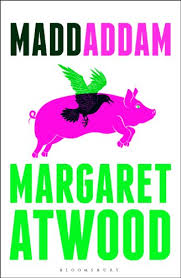
MaddAddamMaddAddam (2013)

The day the Nobel Laureate for Literature was announced in October was a great day for the short story, for women writers, for Canadian literature, and for the remarkable Alice Munro. Yet, my heart bled for another Canadian writer: Margaret Atwood. The ways of the Nobel committee are unfathomable, but given the choice between a brilliant Canadian woman short-story writer, and a brilliant Canadian woman short-story writer, novelist, essayist and poet all in one, it’s hard not to wonder what went through their minds.

Undoubtedly, there is a prejudice against so-called genre writing, even when it transcends such reductionist labels with the impeccable quality of its offerings, as do most works stemming from Atwood’s pen. Her The Handmaid’s Tale (1985) is a classic. Not that Atwood’s work can be lumped into any category. In the last decade, Atwood has published extensively, but the emphasis has been on the speculative fiction trilogy which began with the Booker-shortlisted Oryx and Crake (2003) and now concludes with MaddAddam. Perhaps the genre has torpedoed Atwood’s chances with the committee? If so, it is regrettable. But having said so, this is not to take anything away from the recognition of Munro’s work of which I am an avid admirer.

Also, I hope the above will testify to my respect for Atwood’s prolific writing and put my disappointment in her latest novel into context.

Oryx and Crake blew me away. Set in a not too distant future, it tells the story of Jimmy, the seemingly last human survivor of an apocalyptic plague unleashed on the world by his best friend Crake. In Jimmy’s care are the Crakers, a genetically engineered, green-eyed, blue-penis-swinging, eerily singing and purring humanoid species – Crake’s idea of an improvement on depraved humanity. The novel ends when Jimmy, injured and hallucinating, encounters three other human beings.

The follow-up, The Year of the Flood (2009), recounts the same story from another perspective and also leads up to the charged encounter. The three people Jimmy sees are Amanda, previously of the God’s Gardeners, an eco-sect founded by Adam One and led by the street-wise Zeb, and her malevolent kidnappers who have raped and tortured her. As it turns out, two others are also watching the confrontation: Ren, Amanda’s best friend, and Toby, their erstwhile teacher at the God’s Gardeners, who have likewise survived the pandemic. They are the protagonists of The Year of the Flood.

Having loved the ingenious predecessors, I reread them before turning to the trilogy’s highly anticipated conclusion. The joy I got out of the rereading turned out to be the best part of the whole experience. MaddAddam aptly wraps up some of the loose ends of the other novels, but it far from delivers on their considerable promise.

How is the handful of remaining humans going to build up a new life from the ruins of the post-pandemic world where genetically spliced plant and animal species sprawl and roam free, dangerous pig-human hybrids among them? What role will women, previously mass exploited and brutalised, play in this newly-fledged society? What is their interaction with the naïve, peace-loving Crakers going to be like? How will Jimmy feature in the mix, especially since three of his ex-girlfriends are among the survivors, and two of them have been inadvertently raped and impregnated by the Crakers who still see Jimmy as their creator’s prophet? What will they all make of Crake’s brilliantly insane plan for humankind and their own involvement in its execution?

The potential conflicts appear ripe for the picking. But MaddAddam only skirts these issues. Instead, the novel focuses on the backstories of Zeb and Adam One, and the enfolding relationship between Toby and Zeb. The former dominate large chunks of the narrative and unnecessarily demystify two of the most intriguing characters of the trilogy. The latter descends into the ludicrous stuff that soap operas are made of.

The mutations the main characters undergo in MaddAddam are baffling. Top-notch scientists, hackers and revolutionaries turn into bitchy fashionistas. The strictly vegetarian God’s Gardeners tuck into juicy steaks and crisp bacon. The tough, mysterious Zeb transforms into a chauvinistic jerk – “beneath vulgar”, in the words of his brother. Most discouraging, the once resilient and wise Toby begins acting like a lovesick teenager. Jimmy is comatose for nearly the entire time and when he finally regains consciousness, most of his conflicted, poignant nature stays behind in the coma.

The tension and the emotional intelligence of the first two novels are irreparably compromised in MaddAddam. But not all is lost. Moments of dark humour, the homage to the power of storytelling, some twists in the inter-species relations, and above all Atwood’s powerful prose, provide some satisfaction. But compared to the first two incisive instalments of the trilogy which both ended with a bang, MaddAddam is a mere whimper.

First published in the Cape Times, 15 November 2013.

Book mark: Love Tastes Like Strawberries by Rosamund Haden

Book mark_Loves Tastes Like StrawberriesLove Tastes Like Strawberries opens with an obituary of the painter Ivor Woodall. After his death, his partner Tony organises an exhibition of Ivor’s most recent portraits. All members of Ivor’s Friday life drawing classes receive special invitations to the opening. In all the addressees the invitations trigger uncomfortable memories of events from a distant and more recent past. Haden reveals their stories through the perspectives of several of the class participants. The web of intrigue tightens, forcing the characters to confront what haunts them. Alternating between present-day Cape Town, Rwanda of the time of the genocide, and timeless Greece, the novel portrays the precarious ties which bind people to one another across decades. Haden’s prose is smooth and lyrical, carrying the reader along. She explores seemingly insignificant incidents and gestures that can have far-reaching consequences for those involved, and conveys startling insights about loss, grief, and longing.

Love Tastes Like Strawberries
by Rosamund Haden
Kwela, 2014

An edited version of this book mark appeared in the Cape Times on 22 August 2014, p. 10.

Review
After her highly acclaimed debut The Tin Church a decade ago, Rosamund Haden returns with her second novel for adult audiences, Love Tastes Like Strawberries, which opens with an obituary. When the painter Ivor Woodall dies, his partner Tony Fox organises an exhibition of Woodall’s most recent portraits and extends a special invitation to the opening to all members of Woodall’s Friday life drawing classes.

As the invitations reach the individual artists whom Woodall had taught, each triggers uncomfortable memories of events from the distant or more recent past. The sisters Françoise and Dudu, Rwandan refugees, return to Cape Town to find their feet again after Dudu’s reckless act of stealing a car. It is Françoise’s portrait that features on the exhibition invites. Françoise is hoping to reunite with Timothy, a book seller and writer of obituaries. But Timothy seems to be missing. His friend Stella is also searching for him. She needs to reconcile with the events of a Greek summer holiday long past and the tragic death of her mother. When her mother drives over the edge of an abyss, Stella inherits her house and with it many haunting reminders of the holiday when they both fell under the spell of a promising young artist. Now in her early thirties Stella falls again, for Luke: “there’s something about him that’s so magnetic, so addictive. He should have a warning attached to him,” Jude, one of Luke’s many lovers, warns Stella. But Stella’s reasons for wanting to seduce Luke are complicated: she desires not only him, but also revenge. And Jude, perhaps the most talented of them all, has her own plan how to steal everyone’s show.

All of them have different reasons for attending Ivor Woodall’s classes. The meetings and ensuing parties gradually reveal the undercurrents of all the relationships Ivor’s students spin around their small circle until the web of intrigue and hidden agendas becomes too suffocating for some to bear and comes to a startling conclusion.

Alternating between present-day Cape Town, Rwanda of the time of the genocide, and timeless beaches of Greece, Love Tastes Like Strawberries explores the ties which bind people to one another across decades.

Haden’s prose is smooth and lyrical, it carries you along. Her characters are believable, even if theirs are very different to one’s own experiences. She explores the small, seemingly insignificant, incidents and gestures in life that can have far-reaching consequences for those implicated. There were times where I felt the narrative did not explore those moments deeply enough, and yet Haden manages to convey many unsettling insights about the way we deal with loss, grief, longing, and “foolishness that is painful”.

Review: Garden of Dreams by Melissa Siebert

garden-of-dreams-coverMelissa Siebert’s debut novel Garden of Dreams is the story of Eli de Villiers, a teenage wannabe rocker from Cape Town who travels to India with his mom Margo, a journalist. They explore the country on their way to Kathmandu, Nepal, where Eli is to visit his estranged father Anton, a world-renowned peacemaker. During their stay in Jaisalmer on the edge of the Thar Desert, Margo suddenly decides to abandon her son in the middle of the night to pursue a story on witchcraft allegations back home in Limpopo. She asks Badresh, the manager of the guesthouse where they are staying, to ensure that Eli is taken to the airport in Delhi to continue his journey north safely on his own. Margo’s staggeringly reckless decision (Eli is not even fourteen!) and blind trust in a complete stranger sends her son on a trip through the hell of child trafficking. He is kidnapped and taken to a brothel in the red-light district of Delhi, where he lands in the clutches of the vile Auntie Lakshmi, a lowlife criminal who develops a highly disturbing fascination with Eli. In the brothel Eli befriends some of the other children who are being drugged and raped for profit…

Continue reading: LitNet.