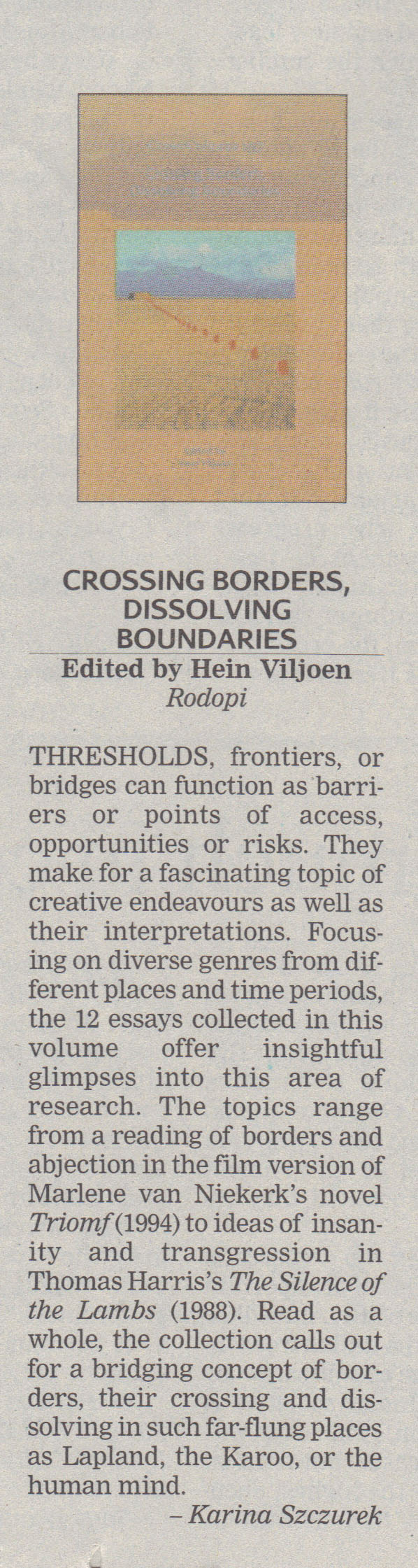
 Thresholds, borders, boundaries, frontiers, lines, bridges—they can function as barriers or points of access, and they can represent opportunities or risks. Inevitably accompanied by the concept of liminality, they are indispensable in our way of perceiving and categorising the world, and make for a fascinating topic of creative endeavours as well as their interpretations. Viljoen’s extensive and cogent introduction to Crossing Borders, Dissolving Boundaries does justice to this intriguing topic which yields a wide range of contributions. As always with such collections, the quality of the individual pieces varies, but on the whole the entire volume presents a highly insightful glimpse into this area of research.
The twelve essays included in the collection focus on diverse mediums—film, drama and other genres of literature—originating from different places and time periods. For example, John Gouws analyses Deneys Reitz’s autobiographical account of his experience of the Anglo-Boer War in Commando (1929), while Tony Ullyatt writes about the concepts of insanity and transgression in view of Thomas Harris’s thriller The Silence of the Lambs (1988). Crossing Borders, Dissolving Boundaries is the result of collaboration between the Grensprojek (Boundaries Project) at the Potchefstroom Campus of North-West University, South Africa, and a similar project of the Border Poetics Group of Tromsø University, Norway.
The first essay in the collection explores secularity and spirituality in Nadine Gordimer’s post-apartheid fiction. The title of Ileana Dimitriu’s contribution “Representing the Unpresentable: Between the Secular and the Spiritual in Gordimer’s Post-Apartheid Fiction” is misleading. Half the essay is a historical overview of critical responses to the enquiry into the boundary between the secular and the spiritual in literature, especially postcolonial literature. The other half focuses nearly exclusively on Gordimer’s novel None to Accompany Me (1994). Dimitriu rightly identifies the spiritual dimension of Gordimer’s more recent prose as an interesting “new way of interpreting her work, a spiritualizing rereading of it” (12), as most of her post-1994 (and earlier) writing lends itself to such an analysis. Dimitriu chooses None to Accompany Me as a “template” (13) for such a reading. For an established Gordimer scholar Dimitriu astonishes with a few uncharacteristically inaccurate statements about Gordimer’s work such as seeing Vera Stark’s “private transformation […] pushed into the foreground” as something new to Gordimer’s women characters, or attesting that Vera “casts aside many of the social burdens that weighed so heavily on, for example, Rosa Burger” (15) (in Burger’s Daughter, 1979). In fact, Vera is not new; she follows firmly in the footsteps of other typical Gordimer women characters like Rosa or Hillela from A Sport of Nature (1987). Simply put, the private has always been foregrounded in Gordimer’s work, pre- and post-1994.
In contrast, Heilna du Plooy’s contribution to Crossing Borders, Dissolving Boundaries is a text of precision and clarity which enriches one’s reading of the original text it explores, Ingrid Winterbach’s remarkable novel Die boek van toeval en toeverlaat (2006), translated as The Book of Happenstance (2008). Du Plooy demonstrates how a close reading of “the complexities of narrative eventfulness” can contribute to the creation of “an alternative system of meanings” (28). Events in the narrative are seen as crossing boundaries because of the new meanings they generate, refining and expanding worldviews (cf. 29 and 35). This highly fruitful approach singlehandedly unlocks the aesthetic power of Winterbach’s text. It is a wonderful experience when theoretical criticism of a work of art can reinforce one’s intuitive response to it.
Just as enlightened are Susan Meyer’s discussion of three carefully chosen Afrikaans texts which allow her to break down the dualistic approach in the thinking about the nature of borders between humans and their environment; Adéle Nel’s poignant reading of borders and abjection in the film version of Marlene van Niekerk’s novel Triomf (1994), of how these notions produce meaning and provide catharsis; Phil van Schalkwyk’s illuminating analysis of the rhetorical strategies Eben Venter employs in his novel Ek stamel ek sterwe (1996) to portray his “protagonist’s journey out of the confines of a rural existence towards death” (229) and of the book’s importance in Afrikaans literature in regard to addressing the topic of HIV and AIDS in the gay community; and Hein Viljoen’s engrossing essay on the “interstitial” in Antjie Krog’s poetry volume Lady Anne (1989), on how the interaction between Krog’s poetic persona and the historical figure of Lady Anne Barnard allows for a transcendence of linguistic and other boundaries (cf. 251).
Ellen Rees’s study of the dilemma biographical fiction faces with the conceptual boundaries between fact and fiction as illustrated by A.S. Byatt’s novel based on the life and death of Henrik Ibsen, The Biographer’s Tale (2000), can also be placed among these excellent essays despite its weak ending which stands in stark contrast to the rest of an otherwise brilliant piece. As if by not emphasising her strongest suggestion, that as an example of literary reception Byatt’s novel commits “ritual patricide” (177), in the conclusion of her essay, Rees shied away from her own findings.
Because of the domination by authors interested primarily in South African and Scandinavian studies, Crossing Borders, Dissolving Boundaries can also be viewed as a pertinent point of entry for comparison studies between these two, not obviously related, fields of research. To give only one example: even though one does not immediately associate Scandinavian countries with colonialism, the rather surprising parallels between the struggles of indigenous peoples of the region and the indigenous peoples of Southern Africa under colonialism resonate and inform the same problematic in two entirely different corners of the world with very different historical backgrounds.
Thus, contributions such as Anne Heith’s essay on the alternative knowledge generated by a new wave of Sámi and Tornedalian literary histories, or Johan Schimanski’s reading of Frank A. Jenssen’s Saltbingen (1981), translated as The Salt Bin (1988), which discusses the issue of “border aesthetics in a postcolonial context”, echo many issues that South African communities grapple with and their artists bring to light in their work. Alternative knowledge, its production and distribution, is a process of utmost importance for our globalised world of the twenty-first century where we are constantly threatened by uniformity. The same applies to xenophobia and othering. Confronting the colonial past, as does Janet Suzman’s play The Free State: A South African Response to Chekhov’s “The Cherry Orchard”, addressed in Crossing Borders, Dissolving Boundaries by Lida Krüger, is essential in the understanding of “boundaries between various binary oppositions such as ‘us’ vs ‘them’, ‘black’ vs ‘white’, or ‘colonized’ vs ‘colonizer’” (94).
Read as a whole, Crossing Borders, Dissolving Boundaries calls out for a bridging, interweaving application of the concept of borders, their crossing and dissolving in such far-flung places as Lapland, the Karoo, or the human mind.
Apart from a few unnecessary typos, all in all an excellent collection which truly offers a lot of scrumptious intellectual food for thought. Dr. Hannibal Lecter would approve, as he argues in Red Dragon (1981): “Any rational society would either kill me or give me my books” (qtd by Ullyatt 224).
Crossing Borders, Dissolving Boundaries
Cross/Cultures: Readings in Post/Colonial Literatures and Cultures in English 157
Edited by Hein Viljoen
Amsterdam and New York, NY: Rodopi, 2013
Review first published in Tydskrif vir letterkunde 51.1 (2014): pp. 178-180.





 Karina Magdalena