Tag Archives: André Brink

The Grandfather Clock

The Grandfather Clock

The clockmaker came out only at night. He arrived at the young widow’s house shortly after half-past eight. Books and remnants of a simple dinner lay across the table in the sitting room where the grandfather clock had been standing silent for a year. The woman pointed at the ancient instrument in the corner and folded her hands in front of her as if in prayer.

‘Sorry for your loss,’ he said.

‘Thank you.’

In the silence that followed, she could feel her heart galloping in her chest.

‘How long has it been now?’

‘A year, today.’

‘Ah. I’m sorry.’

They stood facing each other as time passed in slow motion.

‘So, what would you like me to do?’

She had summoned him earlier in the day, the explanation for the call vague. Something about an anniversary.

‘My husband had always taken care of it. It stopped when he died,’ she said.

‘So there’s nothing wrong with it? You just want me to get it going again?’

‘Yes.’ A prayer. ‘And please teach me how to keep it working.’

He nodded and opened his tool box, trying to concentrate on the task ahead instead of the woman beside him, tense like a coiled spring.

As the clockmaker set to work, she stepped back, watching from a distance. He asked about the key. She did not know what he meant, but eventually remembered the small black handle her husband had used to wind the clock. She was surprised how easy it was to keep the mechanism running.

‘It should be fine for a while,’ the man explained, turning the clock’s hands to the correct time, ‘but I’ll have to take it in for proper servicing soon.’

The clock chimed for the first time in a year. It took all her strength to keep her composure. Time stood still.


Before he left, she asked, ‘Tell me, do you think it’s true what they say, about your whole life flashing before you when you are about to die?’

‘I am not sure, dear,’ he said, reverting to the familiar address, not knowing how else to comfort the young woman.

He refused to take money from her. ‘Next time, when I service it properly,’ he said.

She thanked the clockmaker and gently closed the door after bidding him a good night. Alone, she leaned her head against the passage wall and cried.

The clock chimed nine. She counted the heartbeats and wiped the tears from her face with the back of her hand. She walked over to the grandfather clock. It towered above her in the silence of the night. Tick. Tock. Tick. Tock. The stories of a long-lost friend returning home. She listened to the soothing whispers of its hands telling her about the future. They reminded her of violin music announcing a new dawn.


“Your library is your soul”: Reflecting on Kate Atkinson’s A God in Ruins

A God in Ruins_Costa

Despite her substantial literary success, I did not know Kate Atkinson’s work before A God in Ruins was recommended to me by a friend whose taste I value. It won the Costa Novel Award in the beginning of this month, as did Atkinson’s previous novel, Life After Life (2014). The two are related, but can be read independently. I hope to turn to the sibling soon, as A God in Ruins is one of the most exquisite novels I have ever read, and the idea of Atkinson’s backlist reassures me greatly.

A God in Ruins is many things. It is the story of a British family set against the historical background of the past century. It is a novel about war and its aftershocks. It is a fine enquiry into human nature. But above all, it is a declaration of love for literature, its power and its manifold mysteries. And it is highly ambitious. What astounds about A God in Ruins is that it never falls short of these formidable ambitions. Such novels are rare. They take root in your mind and blossom in your soul. Even ferocious readers encounter a novel like this only once in a while.

The way it captures fiction’s ability to heal, to open up spaces in us we never even knew existed is striking. It is poetic in style as well as in its wisdom. For me personally, A God in Ruins was a magical key. It opened two doors in my life. Two doors connecting the past to my fragile present: one appeared while I was still reading, the other after I’d finished the novel. I stepped through the first, an imaginary one, during one of those serene nights when you are at peace with the world and yourself. It was around midnight. I was lost in the arms of a comfy easy chair; a soft caramel light illuminated the room. When I looked up from the book, I saw something so beautiful that I wanted to hold on to it forever. But I was scared to disturb the scene by searching for my camera, so I turned to the last blank page of A God in Ruins and drew a sketch of what was in front of me: a moment of flickering hope. It is also engraved in my heart.

The second door was real. It is the door to my late husband’s library. There are innumerable books in our house. We have roamed among them with the great pleasure that exploring books can bring only to two readers in love. When I finished A God in Ruins, I was crushed by the inability to share it with André. It was published a few weeks after his death. But I knew, had he been alive, I would have passed the novel to him the second I was finished with it that early Sunday morning, and I would have asked him to read it immediately so that we could discuss it in detail. Instead, I was all alone in an empty bed and all I could do was weep. What I have discovered about grief and loneliness is that it is not the lows which are unbearable, but the emptiness of the highs, when all you want to do is experience them with the person you love and there is no-one there to hold you…

Continue reading: LitNet

Chris Barnard 1939 – 2015

“And now Chris Barnard…” Breyten Breytenbach wrote for today’s Die Burger.

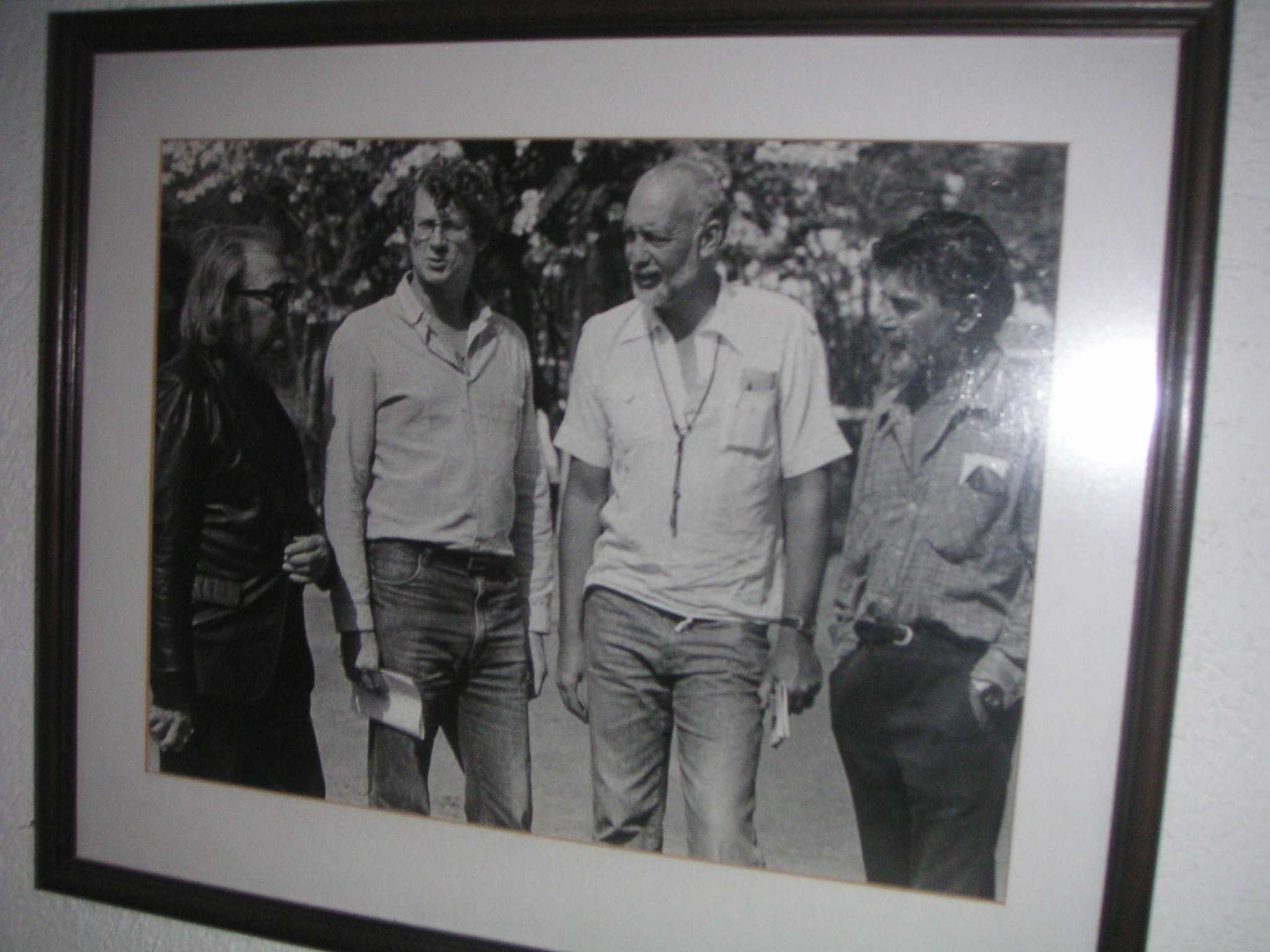
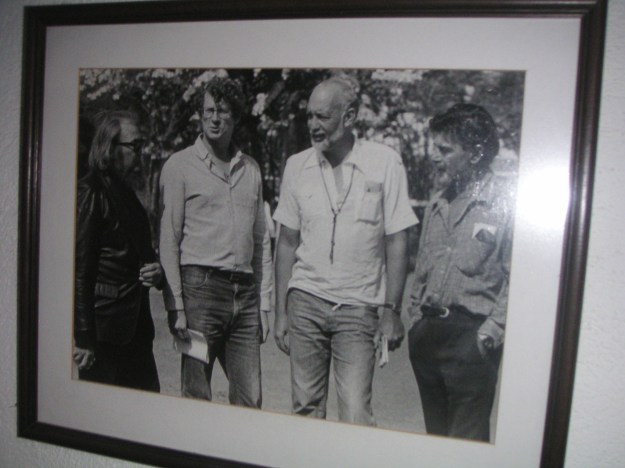
I did not know Chris and his wife Katinka well, but the few times I spent in their wonderful company are locked away in my heart as warm memories. They were both kind to me, open, welcoming. André loved them. We visited their home in Mpumalanga in 2007 where I took this shot of a photograph hanging in their house (Chris and André in the middle):
MINOLTA DIGITAL CAMERA
More recently, I remember a day when we sat together in the sun outside their house in Onrus, drinking what from that day on became my favourite South African bubbly: Krone Borealis. There were strawberries and laughter. The warmth of friendship.

My thoughts are with Katinka and her loved ones.

The opening passage of the chapter “Sestigers, Censors and Security Police” from André’s memoir, A Fork in the Road:

It was during the years leading up to my return to Paris in ’68 that censorship turned really bad. The situation was surprisingly complicated. Among the events that held me in South Africa, there was the emergence of a new generation of Afrikaans writers, the Sestigers (‘Sixtiers’); among those that prompted me to leave was the almost simultaneous crackdown of censorship. The complication lay in the fact that, in the South Africa of the Sixties, neither could be imagined without the other.

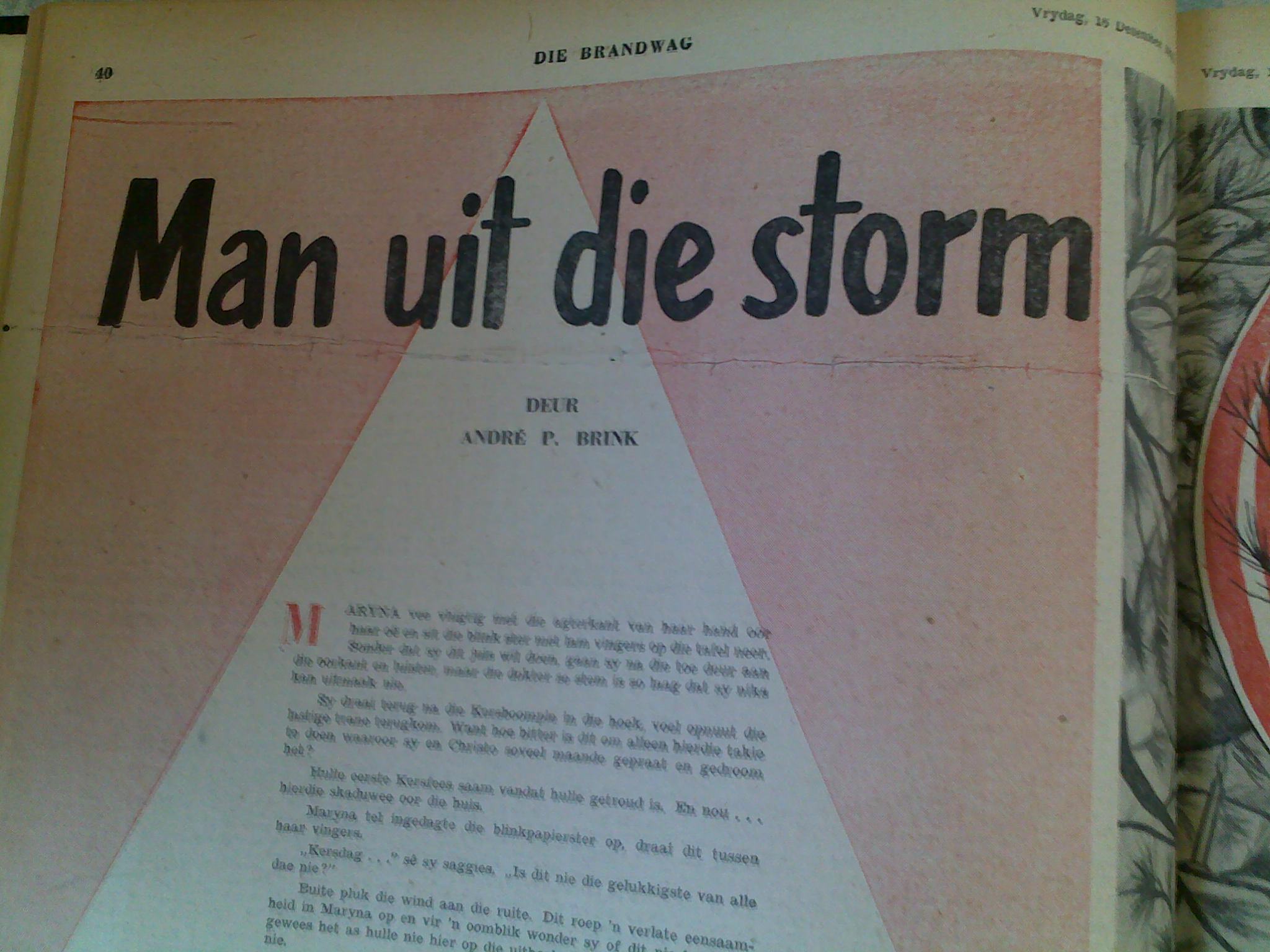
Within only a few months of my return in August, 1961, I received a letter from the young author Chris Barnard (no relation, I should make very clear, of the surgeon who a few years later became famous for succeeding with the world’s first heart transplant). Chris was then fiction editor of the magazine Die Brandwag, for which I had during my student years, and even during my stay in Paris, written potboiler short stories. He offered me an opportunity of emptying my drawers of old manuscripts. But much more importantly, he broached the subject of ‘a new generation’ of writers in Afrikaans. This was something that had much preoccupied me in Paris. I had even written an impassioned essay for the magazine Huisgenoot pleading for such a new wave of writing: taking my cue from the Dutch writers known as the Tagtigers (‘Eightiers’) of the previous century, who had swept away all the dead wood of conventional writing in Holland to establish a spectrum of bold and passionate prose and poetry that infused the Romantic movement in the Low Countries with the inspiration of Impressionism and Symbolism. In our context, of course, it was no longer a matter of Romanticism, but all the ripple effects of Modernism and Existentialism. My essay wasn’t published until several years later, as a kind of nostalgic backward glance, but from the correspondence with Chris it was soon evident that we were fired by the same kind of vision for a drastic overhaul of Afrikaans fiction.

Ever since the Thirties, when a group of young Afrikaans poets had boldly established radical new forms of individualism, our literature had been striving to break away from the more conventional expressions that had characterised it since the time of the First Language Movement in the late 19th century. Various spasms of renewal had followed, but these were invariably restricted to poetry. Fiction and drama still lagged depressingly behind; and by the time European literature was already experimenting with exciting new forms of writing, Afrikaans fiction was still largely stuck in 19th century Naturalism, echoing, at second or third hand, the surface features of the bleaker endeavours of the form, but without the passions of the great Russians, or the genius of a Hardy or a Hamsun, let alone an Undset, a Proust or a Musil. Our fiction, as the poet N. P. van Wyk Louw characterised it, was still locked in a local, cosy kind of realism dominated by locusts, drought and poor-whites.

Now came the discovery that a new generation of Afrikaans prose writers was waiting in the wings: we had widely different backgrounds and styles and interests, but one passion we shared – to bring Afrikaans literature, particularly fiction and drama, up to date with the rest of the world. Most of us, by that time, had spent shorter or longer periods abroad, mainly in Paris, and that experience emphasised the parochial closeness of the local cultural scene. Chris had not yet taken his gap year, but was preparing for it – in spite of the misgivings of his then wife. I can remember her arguing: ‘I’m really not eager to go to Europe. I’m scared that it may change my view of the world, and I’m so happy with the one I have right now.’ What made the comment memorable was that it exactly captured the attitude of all too many Afrikaners at the time.

Several authors had begun to move into prominence during the fifties. The early leading figure was Jan Rabie (born 1920) with his piercing brown eyes and defiant black goatee, strongly inspired by French writers like Henri Michaux and the Existentialists during his long stay in Paris, whose work was in no small measure one of the reasons why I ultimately decided to go to Paris myself – and one of the consolations about coming back in 1961, when he broke new ground with his passionate explorations of the Afrikaners’ early interaction with Africa. There was also Etienne Leroux (born 1922), a Mephistophelian figure always obscured behind dark glasses, soon to become the leading novelist of the generation, whose outrageous satires in the vein of the myth-mongering of his time provoked the religious and political establishment with his irreverence and wit. But he presented this establishment with a peculiar challenge: as the son of a respected cabinet minister in the Nationalist Government, he was not an easy target for ostracism or attack. Bartho Smit (born 1924), a dramatist, deceptively gentle in manner and appeareance. As a publisher, uncomfortably ensconced in the right-wing house of Afrikaanse Pers-Boekhandel, later Perskor, he became something of a mentor to most of the rest of us and was the moving spirit behind the quarterly journal Sestiger which, for the two years of its existence, became the mouthpiece of the whole group. After early work in a conventional, if charming, vein, Dolf van Niekerk (born 1923), a self-effacing loner, made an electrifying impression with his existentialist reimagining of early 20th century Afrikaner history. The other Sestigers were younger. Adam Small (born 1936) was the only coloured writer in the group, an affirmative presence with his angry and satirical poetry, his virulent rejection of apartheid, and his brilliant play, Kanna hy kô hystoe (Kanna Comes Home), which brought Afrikaans drama up to date with what had been happening in the rest of the world: an evocation of the lives of a coloured family who are forced to bear the brunt of the only one among them who manages to break away and lead a prosperous life in Canada, until the death of the materfamilias, Makiet, forces Kanna to return home. Abraham (Braam) de Vries, born in 1937, whose eyes, forever gleaming behind thick glasses, missed nothing, soon became adept at exposing the terror and magic that lurk below the surface of the everyday. And of course Chris Barnard (born 1939), a gentle giant, revealed an early interest in the taboos of apartheid before making a decisive break with realism in favour of symbolism, and an exploration of the absurd.

On the fringes of the Sestiger group the most important new writer was Breyten Breytenbach, who had settled in Paris in 1960, while I was still there, although we did not meet until 1964, when Ingrid and I were on our disastrous way to Spain. Breyten hit the world of Afrikaans letters like a force of nature, splashing a Black-Southeaster rain of surrealism, existentialism and Zen Buddhism across the still rather arid South African landscape. For many years, and in the minds of many people, the appellation of Sestiger applied pre-eminently to Breyten. Yet he persistently refused to be regarded as a member of the ‘movement’, both before and after his imprisonment from 1976 to 1983 on largely trumped-up charges of ‘terrorism’.

Others on the periphery of the core group of Sestigers included the master of Chekhovian impressionism, the short-story writer Hennie Aucamp; Elsa Joubert with her explorations of Africa and her persistent redefinitions of the Afrikaner world and heritage; and Karel Schoeman, who rather preciously cultivated the image of the enigmatic outsider, whose delicate prose explores the human condition within a South African context. In his best work he is a consummate novelist, but he resolutely steered a course separate from that of the Sestigers.

And then there was Ingrid. Who was a Sestiger in all but name, and who produced the major poetic work of the time in Afrikaans. Her prose alone, a handful of exquisitely wrought stories and sketches, should qualify her for inclusion in the group. So did her dramatic break with the ancien régime represented by her father, her uncompromising rejection of apartheid, and her embracing, under the influence of Uys Krige, of the free-verse forms of Lorca and his South American successors.

Last year, for Chris’s 75th birthday, André wrote the following tribute (published in Die Burger, if I remember correctly):

Dit was in die vroeë jare van die Sestigs, toe ek nog in Parys aan die studeer was, toe ek vir die eerste keer ’n brief van Chris Barnard uit Parys ontvang het. Daarmee het ’n korrespondensie aan die gang gekom wat tot vandag toe nog nie heeltemal sy einde bereik het nie, ofskoon die klimmende jare ons al op verskillende maniere probeer bykom of stilmaak het.

Op ’n tyd het Chris beplan om met sy destydse vrou, Annette, vir die eerste keer op Grahamstad by my en Estelle, my eie eerste paaltjiewagter, te kom kuier. ’n Nogal rampspoedige eerste kennismaking, want soos dit teen donkeraand geblyk het toe die Barnards hul bagasie uit die motor wou gaan haal waar ek die tasse al met die intrapslag uit die motor in die straat vlak voor die voordeur wou gaan aflaai en ons gesamentlik agtergekom het dat daar g’n teken meer was van ’n tas klein of groot nie. Waarskynlik het ons toe al pens en pootjies ingesleep geraak by die gesprek waarmee ons toe reeds begin het en waarby daar tot heden vandag toe nog nie tekens van ’n verslapping sigbaar is nie.

In die loop van daardie aand het Annette al wat flikker is, uitgehaal om dit aan die twee jong konstabels by die gestrande motor te vertoon, toegelig met histrioniese vermoëns wat vir my heelwat meer beïndruk het as vir Estelle: sy het verseg om in die swyende tweestryd tusen die twee vroue kans gesien om selfs maar ’n aks bes te gee. En Chris het ’n oorpyn ontwikkel wat vir niks wou skrik nie. Maar dit alles het minder as niks geweeg vergeleke met ’n lotsbestemming nie.

In die tussenjare was daar in die vriendskap al korter of langer hiate, om beter of swakker redes, van die soort wat jy maar in byna elke menslike verhouding teenkom; maar nooit – selfs nie in die maande wanneer dit tydelik tot stilstand gestotter het as een van die twee, of soms albei, deur ‘omstandighede buite ons beheer’ – voorlopig onkapabel was nie, was daar werklik enigiets gewigtigs in die weer nie. Chris was vir ’n ruk weg Parys toe, en daarna weer ek, en daarna is hy weer getroud, en toe weer ek, en toe weer ek, en toe weer ek, ensovoorts. Maar iets het tussen die twee van ons bly aanloop asof daar nooit enige onderbreking was nie. Op ’n onderwaterse vlak het ek en hy daardie gesprek tot vandag toe bly deurvoer. Nou is hy en Katinka saam, en ek en Karina, hy in Mpumalanga en ek in die Kaap. En mits die vlees geneë voel en die vermoë behou, behoort dit tot in lengte van dae so voort te gaan. Onder destyds se Sestigers is daar vandag nie danig veel meer oor nie, so ons sal maar aanhou tot waar die karrentjie sy staanplek kry.

Daar is min wat hierdie afgelope jare – nou waaragtig al meer as vyftig! – nie neerslag gekry het in ons korrespondensie nie. Soveel veugdes, soveel hartsere. Soveel huwelike, soveel egskeidings. Toe ek Ingrid destyds ontmoet het, was Chris een van die eerste vriende wat in ’n brief daarvan gehoor het; en ook hy wat heel eerste was om van die patetiese digpogings te siene gekry het wat ek vir Ingrid geskryf het. Oor die jare was ek jare lank een van sy eerste lesers, en omgekeerd (en vandag bly hy een van die bestes). Dit was – en is – wat ons probeer eerlik hou het teenoor mekaar. En dit is nie te versmaai nie.

Tussen hom en Bartho is die eerste gedagtes oor die moontlikhede vir vormgewing van Orgie gewissel. Met verloop van tyd het ek en hy elkeen, as ek nou reg tel, vier kinders verwek, en hande vol romans, verhale, draaiboeke en ander pennevrugte die lig laat sien. Oor en weer het ons gehelp om probleme uit te stryk, kritici uit te sorteer, idees te toets, mekaar op die skouers te klop, skoppe onder die gat te gee, of so na aan trane afvee te kom as wat ’n mens jou gevoeglik durf veroorloof het. Nie een van ons het verwag om so oud te word dat ons dertig van die agterkant af sou kon bekruip nie. En destyds was Sestig nog net ’n literêre begrip, g’n werklikheid of ’n simbool of ’n ding nie. Vandag is die wêreld ’n anderster plek. Maar op die een of ander manier probeer ons byhou. En ons kan nog altwee, deur die genade of een of ander moedswilligheid ons variasie probeer opsê van: Ek was toe Bart Nel, en ek is wragtag nog hy. En halleluja!

(Thank you, Izak de Vries, for proofreading the original text.)
Chris's books

Great, even life-changing – the books of 2015

Another great year of reading is coming to an end, although it did not start that way. I am grateful to the love that has returned my passion for reading to me when reading – when life – became unbearable.
books2015
Knowing how few books one can read in a lifetime (I won’t depress you with the estimate), I have become quite selective and wise about what I read. Thus, out of the sixty-three books I have read this year (until today, some not for the first time), almost all were good, thirty-one were great – among them were a few which were life-changing – and only two I did not finish. Of these two, one was brilliant, but I was reading it on 6 February and have not been able to return to it. The other one I had wonderful hopes for, but I was so disappointed and frustrated that after a hundred pages I decided not to waste more of my time on it. In the spirit of the festive season, the perpetrator shall remain unnamed.

The great ones I have finished, I would like to divide among four categories: relevant, delightful, exquisite, and life-changing (whereas some, of course, overlap).

There are old-time favourite authors on my list like Alexandra Fuller and Ivan Vladislavić, but also new discoveries like Pamela Power or Mark Winkler.

Relevant
Ingrid Jonker: A Biography by Louise Viljoen
Back to Angola: A Journey from War to Peace by Paul Morris
A Year of Magical Thinking by Joan Didion
J. M. Coetzee and The Life Of Writing: Face-To-Face With Time by David Attwell
Books That Matter by Marie Philip

Nor can we know ahead of the fact (and here lies the heart of the difference between grief as we imagine it and grief as it is) the unending absence that follows, the void, the very opposite of meaning, the relentless succession of moments during which we will confront the experience of meaninglessness itself.
(A Year of Magical Thinking by Joan Didion)

Delightful
The Unknown Unknown by Mark Forsyth
What Poets Need by Finuala Dowling
Ms Conception by Pamela Power
What I Didn’t See and Other Stories by Karen Joy Fowler
Death and the Penguin by Andrey Kurkov
The Chameleon House by Melissa de Villiers
Embers by Sándor Márai
Tribe by Rahla Xenopoulos
The Penguin Lessons by Tom Michell

I had a very efficient guano maker installed in my bath.
(The Penguin Lessons by Tom Michell)

Exquisite
The Long Dry by Cynan Jones
Leaving Before the Rains Come by Alexandra Fuller
101 Detectives by Ivan Vladislavić
To Kill a Mockingbird by Harper Lee
A God in Ruins by Kate Atkinson
The Dream House by Craig Higginson
The Alphabet of the Birds by SJ Naudé
We Are All Completely Besides Ourselves by Karen Joy Fowler
Sugar Man: The Life, Death and Resurrection of Sixto Rodriguez by Stephen ‘Sugar’ Segerman and Craig Bartholomew Strydom
the myth of this is that we’re all in this together by Nick Mulgrew
Wasted by Mark Winkler
Notes from the Dementia Ward by Finuala Dowling

We have to admit our massive love for people. If we don’t ever need to know its depth, we just feel the light on the surface.
(The Long Dry by Cynan Jones)

Life-changing
Flame in the Snow / Vlam in die Sneeu by André Brink and Ingrid Jonker
Killing Floor by Lee Child
Water: New Short Fiction from Africa
Mountains in the Sea: A Celebration of the Table Mountain National Park by John Yeld and Martine Barker
The Art of the Publisher by Roberto Calasso

I would like to single out two books I haven’t written about. Yet. Kate Atkinson’s A God in Ruins and Roberto Calasso’s The Art of the Publisher.
A God in Ruins
Atkinson’s novel is one of the most exquisite books I have read in my life. Its beauty and its declaration of love for the power of literature to capture eternity, to heal, to open up spaces in us we never even knew existed are staggering. Personally, I will always associate the novel with two seminal moments in my life. While reading it during one of those serene nights when you are at peace with yourself and the world, I saw something beautiful and drew a sketch of the scene at the back of the book. It is also engraved in my heart. And when I finished A God in Ruins, I was crushed by the inability to share it with André, but then something happened which gave me comfort and hope and the book will always be at the source of these feelings when it comes to reading. I hope to write about it before the year is over.
The Art of the Publisher
Calasso’s book speaks about everything I have ever known, felt, dreamt about or hoped for in publishing. I have known for years that one day I would become a publisher myself. The Art of the Publisher made me realise that the time has come to make that day become reality.

The heart has spaces – the love letters of André Brink and Ingrid Jonker

Drawing in Ingrid's letter of 15 October 1963
In the beginning there were the women of his past, a ghost among them. André Brink had never been afraid to love. After the life-defining relationship of his youth with Ingrid Jonker, her suicide, and four divorces, at the age of 69 he had the guts to say yes to a delicate possibility.

When we met in Austria towards the end of 2004 I was terribly young, on the verge of a divorce, broken by betrayals, and almost paralysed by mistrust. Continents and cultures apart, 42 years between us, the odds staked against us could not have been higher. Yet we somehow mustered enough courage to dare the impossible and turn it into reality. For ten years, the first thing we did every morning after waking up next to each other was to smile. No matter what. Of course it hadn’t been easy. Nothing worthwhile ever is. And coming to terms with our respective pasts was our greatest challenge.

André first introduced me to Ingrid in a letter on 23 December 2004:

She was a year or so older than me, and light-years older in terms of sexual experience. It was an incredible, hectic, heady, head-over-heels love of extremes, swinging wildly from ecstasy to the depths of misery; and it became just too exhausting and demanding. After two years (and several break-ups and new starts) she started a new love-affair, and then I did too (both of us, I think, grasping at possibilities of getting out of our own relationship which had become suffocating). And so it ended. She had one more mad love-affair, and committed suicide.

Coming to live with André in the South African spring of 2005, I very quickly realised that in order to know him – truly know him – I had to understand what had happened between him and Ingrid 40 years earlier. We both had to. No other woman in André’s life had left as indelible a mark on him as Ingrid. No other haunted me as much in the beginning of our relationship.

I am proud of countless things André and I have achieved together, but the one that made all else possible is the space we created in our relationship for sharing, for being painfully open with each other. André and I met at Vienna International Airport when I went to pick him up and accompany him on the train journey to Salzburg, where he was participating in a symposium I’d helped organise. On that trip we began a conversation which, literally, lasted ten years until I told him I loved him for the last time and closed his lips with a final kiss just before he died earlier this year. It was a stripping of minds and hearts. Time after time, we stood completely soul-naked in front of each other, risking everything, and eventually knowing that love would prevail, always, no matter how terrifyingly ugly the revealed truth – on both sides – was. It is the kind of knowledge which can lay any ghost to rest.

At the end of Everything I Know I Learned from TV: Philosophy for the Unrepentant Couch Potato, my favourite philosopher, Mark Rowlands, writes: “If I could repay you with a wish it would be that you find something in your life so important that without it you would not be the same person. If you’re lucky you’ll have it already.” The relationship with Ingrid was such a thing for André. He wrote in his memoir, A Fork in the Road (Harvill Secker, 2009): “On that memorable afternoon of 15 April, 1963, a group of us were gathered in the lounge of Jan Rabie’s rambling old house in Cape Town, when Ingrid walked in, barefoot and provocative, and the movement against censorship officially began, and the course of my life was changed.” Her influence permeated everything: his personal life, and, just as crucially, his writing. One only needs to look at André’s women characters, walking in Ingrid’s footprints across the pages of his novels, to comprehend what an impact their meeting had on his creativity. And they are only the most obvious example. But despite the evidence, for many years André was exceedingly reluctant to speak or write about Ingrid after her death.

At the time of our engagement in early 2006, together with Antjie Krog and Ingrid de Kok, André was working on the new translations of Ingrid Jonker’s poems which would result in the publication of Black Butterflies: Selected Poems (Human & Rousseau, 2007). It must have been during this period that he showed me his and Ingrid’s correspondence for the first time. He kept the letters in the same place as his diaries which he reread for the writing of the introduction to Black Butterflies, the first text of its kind after many years of silence. An intimate treasure and a chunk of literary history many had wondered about for decades, even back then the letters had an irresistible appeal for me. Although my grasp of the Afrikaans language and literature was shaky at this stage, I understood their importance as a key to André’s life story and to the creative and intellectual forces culminating in the literary movement of the Sestigers. We looked at them together, he told me their story, and allowed me to comment on the translations as well as on the introduction. The title for the collection followed from a suggestion I’d made. Being included felt like a form of exorcism.

I wrote in my own diary of the time: “Dear Ingrid, are you smiling at us after all?”

Continue reading: LitNet

How to Survive Christmas

It hit me the other day that Christmas this year is going to be bloody awful to survive. And yesterday, I was hit by another thing which almost made it unnecessary to survive anything else as it nearly killed me: a tome of André’s collected short stories. It fell on me from a high shelf while I was reaching for other books. I suppose a fitting end to someone like me who lives for books, but Lady Fate decided that it was not my time to go yet. So I still have some surviving to do next month…
tomes
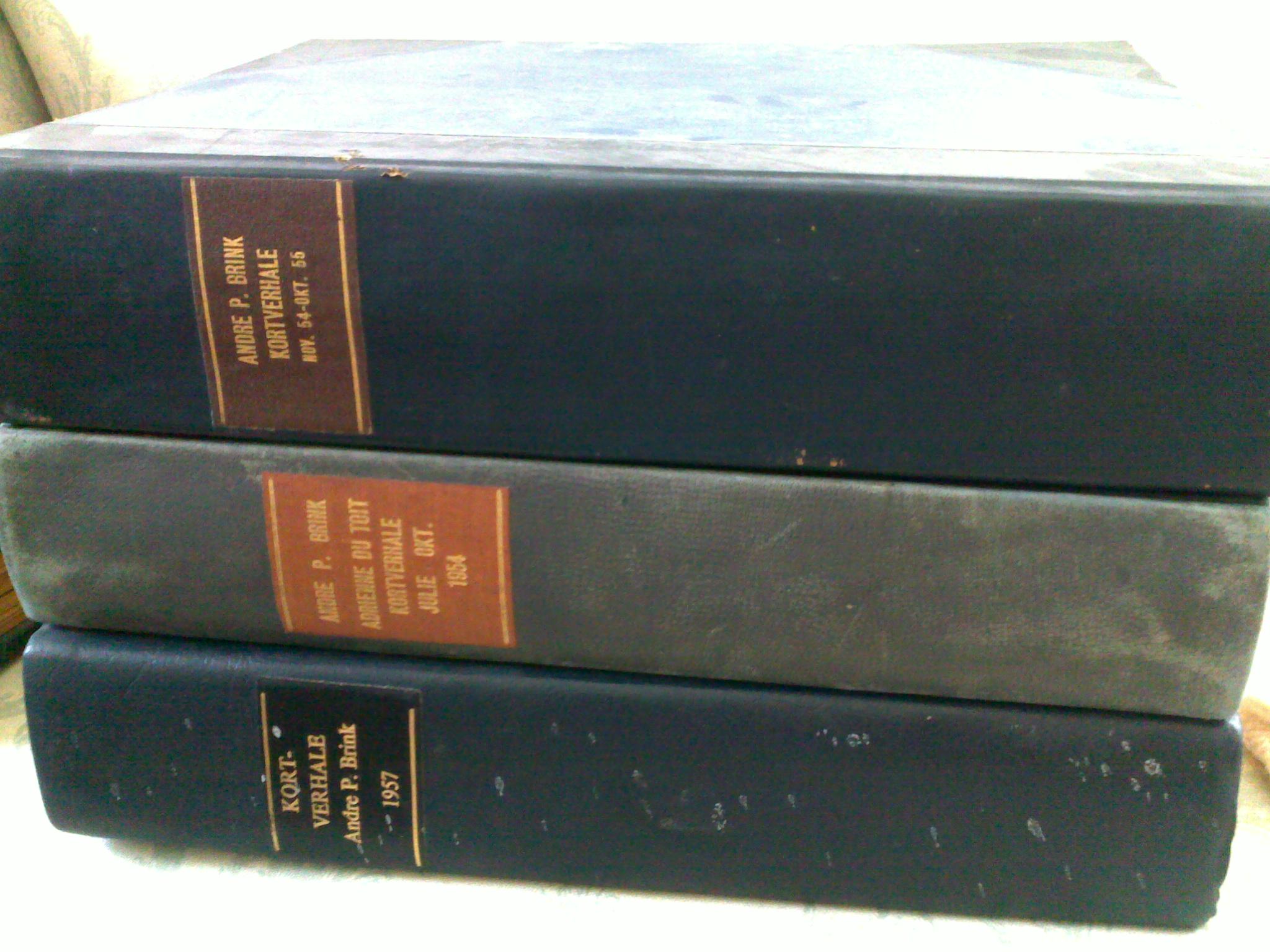
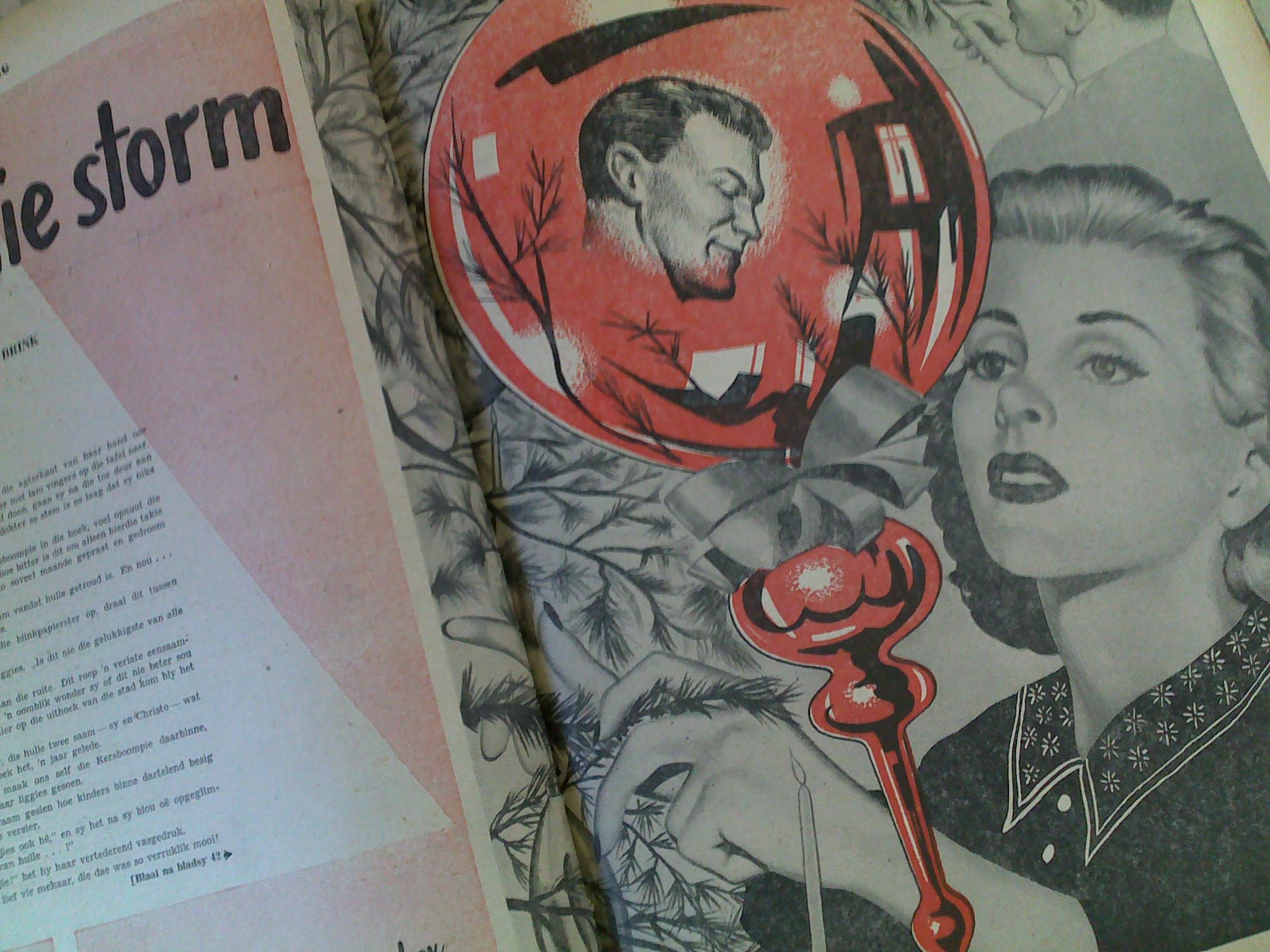
André always maintained that he was not a short story writer, but in fact he started off as one. Short stories are a fine way to “cut your teeth”, as a friend who visited today remarked when I told her about it. Indeed. Back in the day, it was also a way to earn some serious pocket money, and so to support himself in his student days André wrote short stories for magazines in the 1950s (he was barely twenty years old at the time – sigh! – some writers were born with a pen in their beautiful little chubby hands). He collected the individual magazine copies and had them bound into big leather tomes. I estimate there should be just over a hundred stories. Early André Brinks. How exciting is that! I knew about the collected tomes as they are stored in the little André Brink Library next to my study. But until recently I did not feel confident enough in my grasp of Afrikaans to attempt reading them. However, I do now!

When Christmas revealed itself as the nightmare that it is going to be this year, I started compiling a list of survival strategies. Since travelling is a bit of an issue, I can’t go to my family in Austria or Poland. And anyway, being away from home this year is simply impossible to imagine. So, Christmas in Cape Town it is going to be.

Karina’s How to Survive Christmas this Year List:

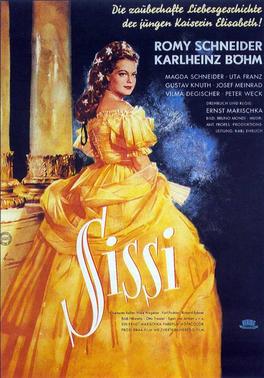
One: Watching all Sissi movies (for the hundredth time – hey, anything to survive!).
Sissi_film_poster
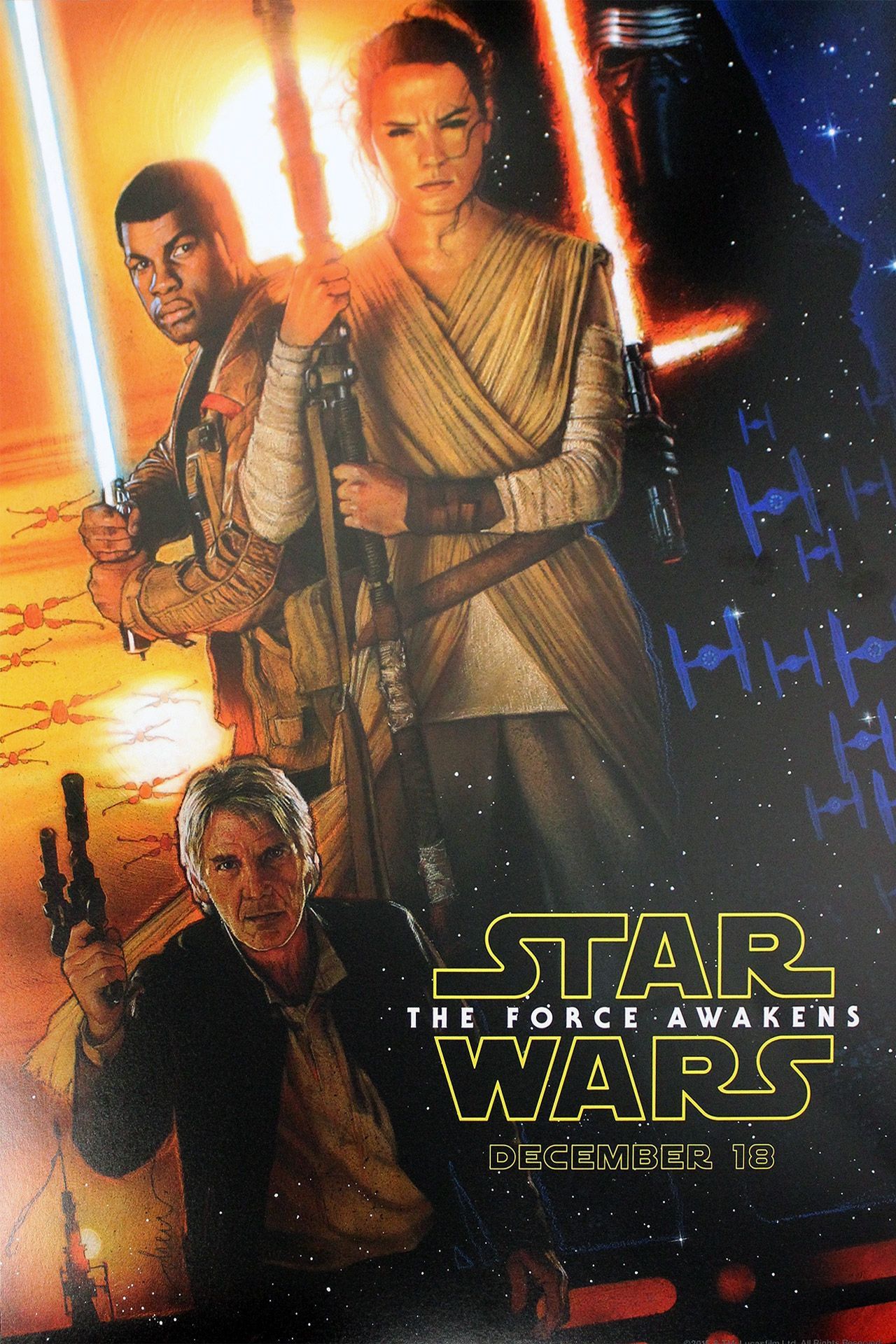
Two: Star Wars (whoever planned the release date for the latest Star Wars movie can pick up a really passionate kiss of gratitude from me, anytime – all yours, whoever you are!)
star_wars_poster_full_0_0
Three: Throwing the Christmas Party of the Year for my friends, divine Polish Christmas dishes and fireworks included.
Four hit me on the head: Reading all of André’s early short stories (some were written especially for Christmas!).
story1story2
Five was added this morning: I was invited and accepted to spend Christmas Eve and Christmas Day with my other family, the families of dear friends.

If I won’t be killed by falling books in December, I might be around for 2016! Pray for me.

The magic of Open Book 2015

Helen MacdonaldSo, who else has fallen in love with Helen Macdonald during Open Book 2015 in Cape Town? H is for Hawk has been on my radar for a while, but I’ve only decided to get the book when I heard about Macdonald’s generous endorsement of Stray: An Anthology of Animal Stories and Poems, edited by Diane Awerbuck and Helen Moffett (all royalties donated to TEARS Animal Rescue). How cool is that? Macdonald showed up at the Open Book Stray Readings and stole my heart reading the passage in which she first saw and fell for Mabel, the goshawk who helped her cope during her time of bereavement. At one of her other Open Book events, Macdonald spoke about how you can’t tame grief and how sometimes you have to do mad things in order to survive it.

This was my first Open Book since André’s death. Last year, we were still mourning Nadine Gordimer – together. We’d thought that we might celebrate the tenth anniversary of our first and only public interview (at Schloss Leopoldskron in Salzburg in 2004) with an event at the festival, but André was recovering from a knee operation and did not feel up to it. We did pay tribute to Nadine: with Margie Orford, Billy Kahora and Imraan Coovadia reading from her work and sharing stories about her influence on their lives and writing. André read from his own work at another event. We attended a few others, gathering memories which all returned to me this year when I was walking around The Fugard Theatre – alone.

At the opening ceremony, Mervyn Sloman said that every year Open Book is infused with magic. How true. “You’re a magician,” someone magical in my life said to me once. Perhaps I can conjure miracles when inspiration and desire strike, but I would like to think of myself as a magician of a different kind, one who can recognise the magic of the everyday. Even when suffocating in the clutches of grief.

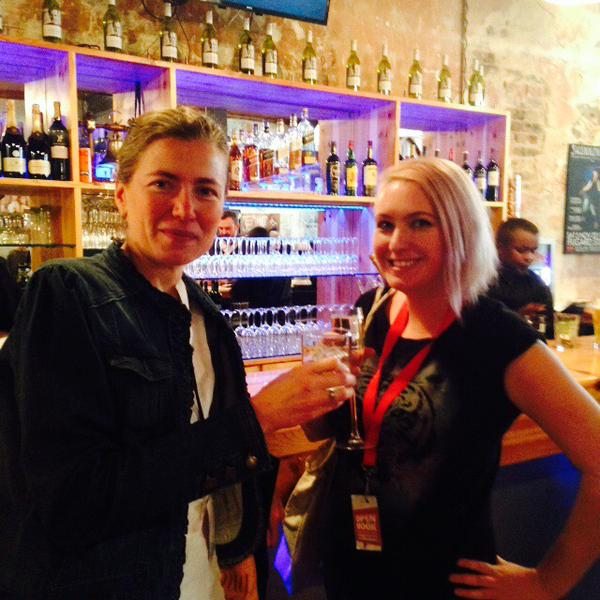
with SallyMagic was all over The Book Lounge and The Fugard Theatre during Open Book this year. In the stories I read preparing for the festival (discovering my love for the work of Karen Joy Fowler, Melissa de Villiers and Andrey Kurkov in the process); in the warmth of a friend’s grip around my arms at the opening ceremony; in Karen Joy Fowler’s humour; in the melody Petina Gappah sang during her interview with Lauren Beukes; in a walk in the sun between events; in Stephen Segerman’s and Craig Bartholomew Strydom’s devotion to the Sugar Man story; in Claire Robertson’s mesmerising reading voice; in seeing the first cover designs for the special edition of Flame in the Snow; in Elleke Boehmer’s, Henrietta Rose-Innes’s and Craig Higginson’s inspiring eloquence; in a dim sum lunch, a bubbly and a Glenfiddich shared with friends; in Beverly Rycroft’s moving honesty; in a friend’s sparkling eyes which could have been clouded by loss but weren’t; in the hospitality of Fugard’s Iris who with her colleagues took such great care of all of us; and, last but not least, in S.J. Naudé’s careful thoughts about our craft – the magic and beauty of it all.

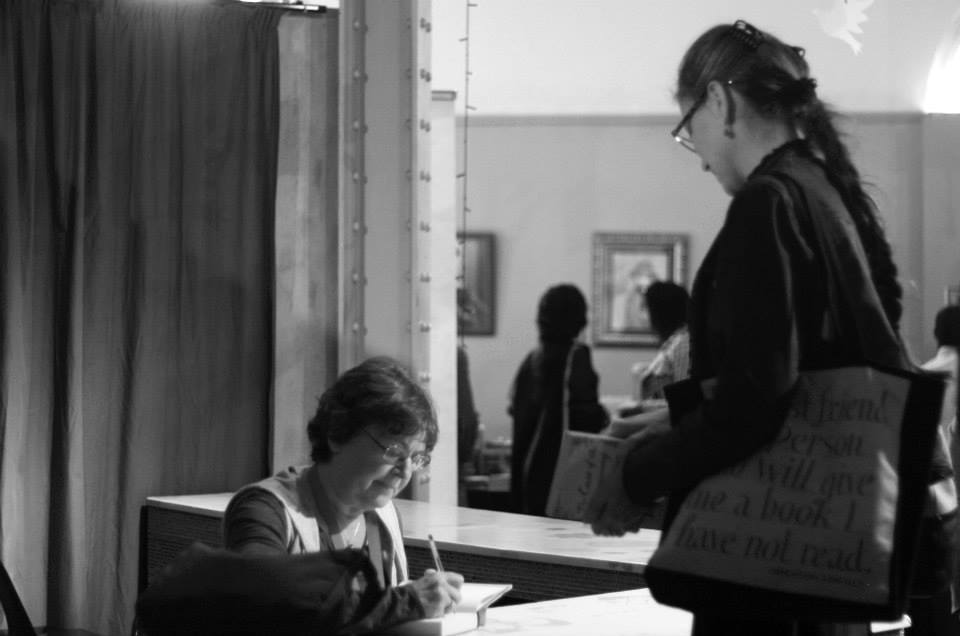
with KarenI loved chairing the three events I was asked to. I loved seeing old friends and meeting new ones. I loved interacting with writers whose work has meant so much to me over the years. I loved buying books and talking about literature with people who care. I loved being asked to sign my novel. I loved feeling that I was close to returning to my own creative writing. I loved every single memory from the past. I loved making new ones.

Thank you, Mervyn, Frankie and all the other magicians at The Book Lounge.

You can’t tame grief. Grief is this creature that moves into your home when death strikes. It lurks, ready to pounce at all times, especially when you least expect it. It never leaves again. You can’t tame it, but you can tame the way you react to it. And live. And experience joy again, in a story and in your life. And smile. And appreciate the magic. That moment.
with Andrey and Andrew

(Photos: Books Live and PEN SA)

Polish – Afrikaans magic

This morning I received the following message (in Afrikaans, nogal!):

“Koop vandag se Rapport! Groete Jerzy”

To which I automatically replied:

“Ek sal, baie dankie! K”

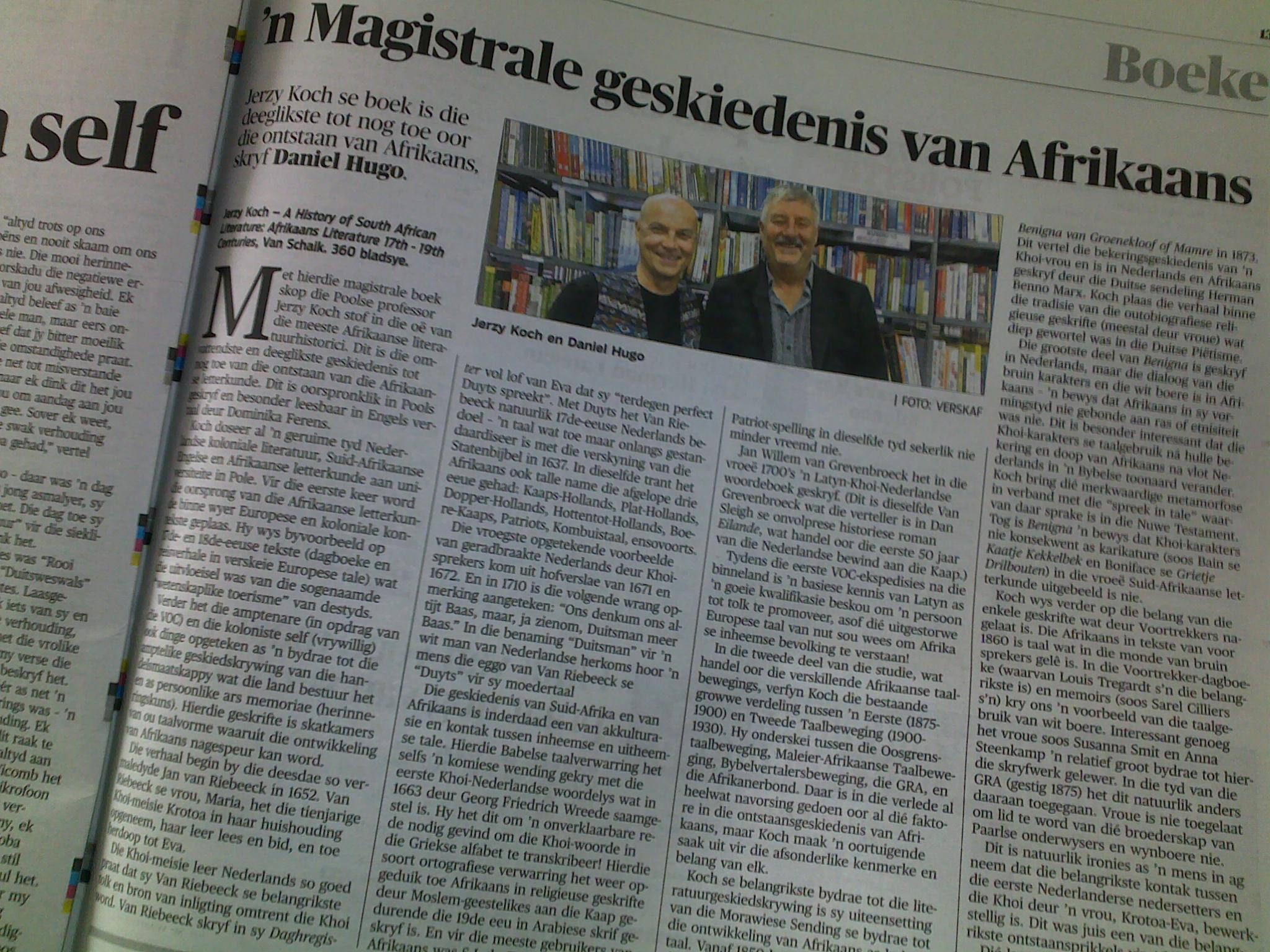
And I did. Inside, was an article about Jerzy Koch’s A History of South African Literature: Afrikaans Literature 17th – 19th Centuries (Van Schaik, 2015).
Jerzy Koch_Rapport
The article and our exchange reminded me of something I wrote for Die Burger in 2008.

Found in Translation: Two Poles in South Africa
(Die Burger 28 July 2008)

There is only a handful of people in his home country with whom the Pole Professor Jerzy Koch can easily converse in the language which over the last fifteen years has become his great linguistic passion – Afrikaans. His home in Wrocław in the South of Poland is perhaps the only place in the country where one will be welcomed with homemade bobotie and some biltong which always features on his shopping list whenever he visits South Africa.

When he is here, people are pleasantly surprised with his fluent and articulate Afrikaans and his incredibly diverse knowledge of local culture, literature and history. Koch’s work forms one of the strongest cultural and intellectual bridges between Poland and South Africa, and between the two languages, Polish and Afrikaans.

Suitably, his African adventure began with magic. Sometime in the 1980s, with his students of German, Koch was celebrating Andrzejki (St Andrew’s Day). According to Polish tradition, he poured some beeswax through the hole of a key into a bowl of cold water. The ensuing wax figurine, which was to foretell his future, was interpreted as having the shape of either a heart or of Africa. Not surprisingly, a few years later, Koch lost his heart to Africa when, after completing his doctorate at the Belgian Catholic University of Leuven, he participated in a conference in Potchefstroom in 1992.

In the introduction of his latest book, Hottentot Venus and Other Essays on South African Literature (published in Polish by Dialog, 2008), he recalls his fascination with South Africa of the early 1990s: “The fact that the transition in Poland was happening at the same time as the South African one made interest in South Africa, at least in my eyes, obvious.”

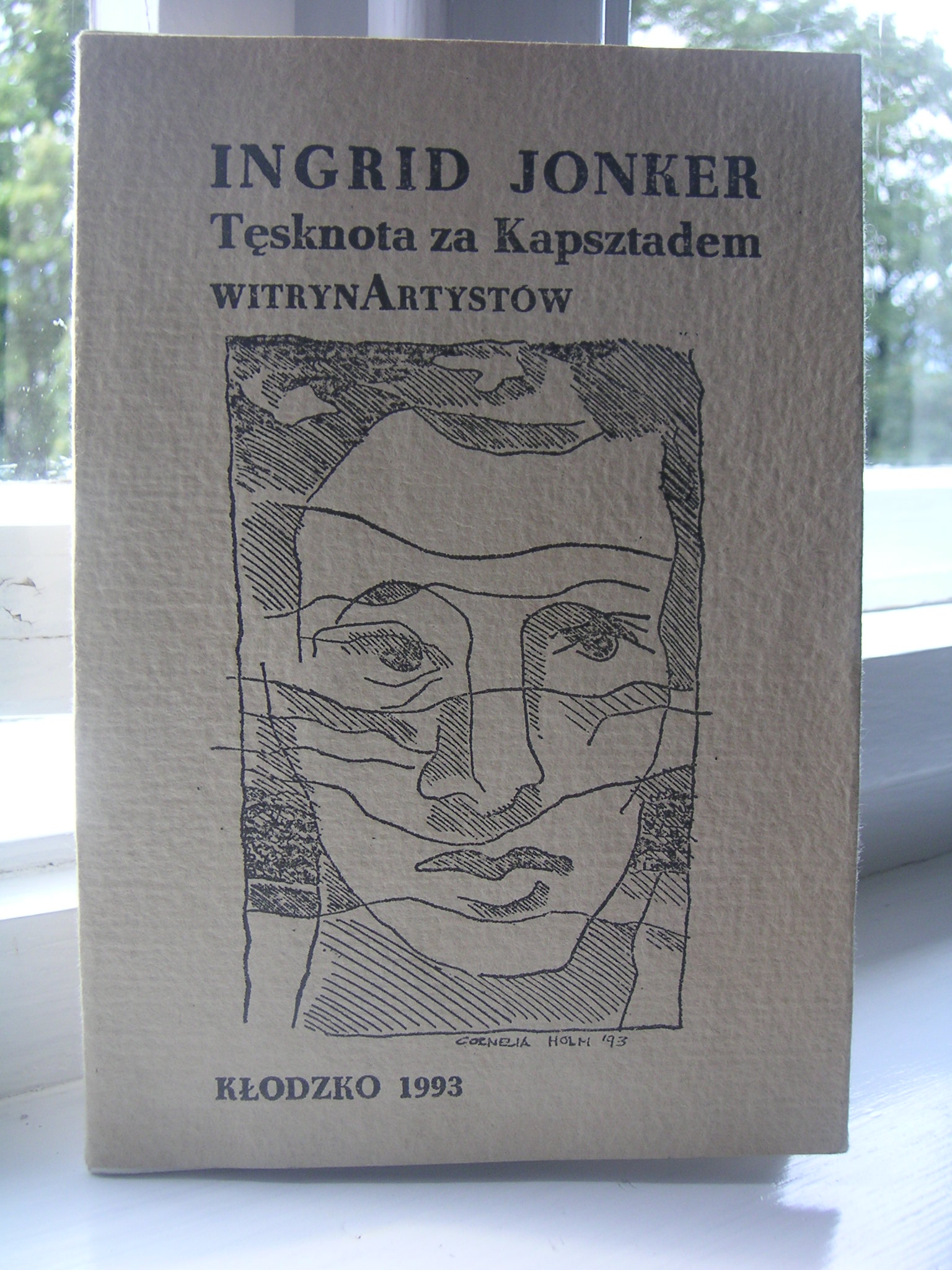
In 1993, our paths crossed for the first time in the most unusual manner and unbeknown to both of us at the time. After Daniel Hugo recited some of Ingrid Jonker’s verses to him at Three Anchor Bay, Koch translated a selection of Jonker’s poetry from Afrikaans into Polish. The volume was edited and published by WitrynArtystów, a small publishing house run by none other than my uncle, Bogusław Michnik. Jonker’s poetry collection was most likely the first book ever translated from Afrikaans into Polish. It is one of numerous translations from Dutch and Afrikaans for which Koch received the Martinus Nijhoffprijs in 1995.

Jerzy Koch is also the author of several monographs and numerous articles on South African literature in general, and Afrikaans literature in particular.
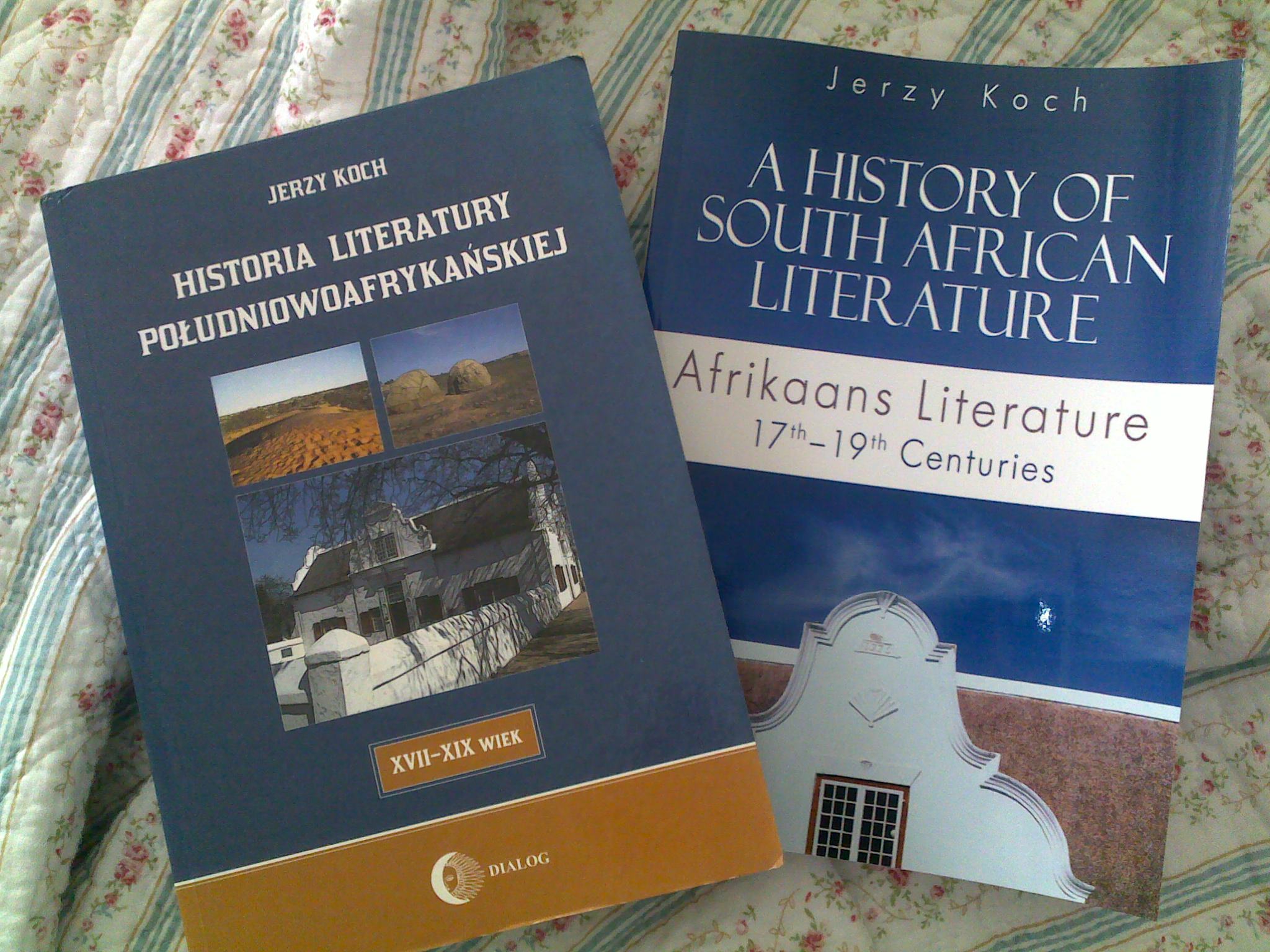
Jerzy Koch_booksHis previous book of local interest, History of South African Literature: Afrikaans Literature – 17th-19th Century, published in Polish in 2004, was the first study of its kind written by a non-South African for a non-South African audience. It is comprehensive, wonderfully illustrated history of Afrikaans literature which is an excellent point of entry for Polish students of South African studies at two Polish universities, University of Wrocław and the Adam Mickiewicz University in Poznań, where Koch introduced this particular field of inquiry. In translation, it might offer an inspirationally fresh look at literary history for Afrikaans speakers.

Koch is currently working on the sequel to this publication, a history of twenty-century Afrikaans literature and on the first Afrikaans-Polish dictionary, apparently the fourth ever bilingual dictionary that includes Afrikaans. He is also editor of the annual publication Werkwinkel: Journal of Low Countries and South African Studies. Its third issue on its way to us as I write.

Jerzy Koch, André and I in Stellenbosch in 2006.

Jerzy Koch, André and I in Stellenbosch in 2006.

In South Africa, he is presently a research fellow at the UFS in Bloemfontein and since 2005 a member of the Suid-Afrikaanse Akademie vir Wetenskap en Kuns, an honour rarely bestowed on a foreign scholar.

Easily recognised by his old-fashioned, long, curled moustache, Jerzy Koch was, fittingly, the first person I ever spoke Polish to in South Africa when we met at last in person in 2006 during one of his visits to the Cape. Ever since I came to live here myself in 2005 I have been absorbing Afrikaans. One day, Jerzy Koch and I will have a conversation in Afrikaans about Langenhoven. We share a passion for this country, its people and their cultural treasures, believing that it is of the utmost importance to forge understanding between peoples through explorations of the unknown with the help of the known. And a little bit of magic.

(When André and I first visited my uncle who published Tęsknota za Kapsztadem, he proudly presented the volume to us, not in the least aware of the connection between Ingrid Jonker and André. He was just proud of having published a South African author in translation. I remember I had tears in my eyes when he handed the book over to us and I paged through it, looking for a poem dedicated to André. I found one, pointed at the dedication and then at André, and said to my uncle in Polish: “It’s the same person, you know.” Tears flooded all our eyes. Magic. And Jerzy and I texting to each other in Afrikaans – that’s magic, too.)

One year later

Diary

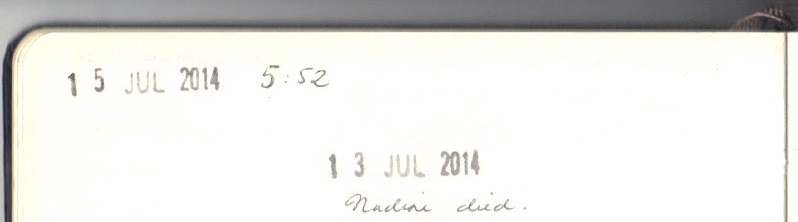
Diary, 15 JULY 2014, 05:52

13 JULY 2014
Nadine died.

I heard from Sally: ‘I’m not sure you have heard the sad news. Nadine Gordimer passed away.’ (14 July 2014, 15:08)

I replied immediately after reading: ‘Oh no! … In hospital today with André, he’s having a small knee op. Thanks for letting me know. How terribly sad …’ (14 July 2014, 15:28)

‘My thoughts are with you both.’ (Sally, 14 July 2014, 15:28)

‘We think of you in this difficult time. You’ll be in our prayers. Love, Arné & Christo’ (14 July 2014, 16:04)

‘Just heard about Nadine Gordimer – very sad in so many ways.’ (Edwin, 14 July 2014, 19:00)

I had a strange dream on the night of 13-14 July. I haven’t been remembering many dreams lately, but this one was very vivid & when I woke up yesterday it was with me. Yet, I dreaded thinking about it or writing it down because it seemed a bad omen & articulating it was scary on the day of André’s operation.
I was at the World Cup final party in Brazil that in my dream was also Poland. Everyone was celebrating. At some stage I said to Aunt Iwona that I hadn’t told Grandma Marysia about my visit because I did not want her to worry I was late, but that it was time for me to go next door and see her before she went to bed. On my way up the stairs I realised that I couldn’t visit her at all because she was dead.
I woke up feeling miserable that I came too late.

Since Nadine’s assistant wrote that Nadine could not attend Open Book because of ‘old age’ I have been thinking of writing to her to say thank you for everything. It is too late for that now, but perhaps she knew anyway.

We returned from the hospital in the early evening to requests from CNN, BBC, French press & radio for articles & interviews. André slept while I replied to all to say that he needs to recover first. Per wrote, said her family was with her & that she died in her sleep.

I posted my last interview with Nadine in the original English on my blog.

My heart is sore.

She has changed my life & I’ll forever treasure that. She has been such an inspiration, a true literary giant.

It was so good to come home with André last night to Chai-yo takeaways, a fire & our feline family.

When Sally’s message came yesterday I cried in the clinic waiting room. There was a man there waiting for his wife, reading Kaplan’s book. He asked whether I was okay & we talked about Kaplan & following one’s passions & recovering from injury & Dr Van der Merwe etc. I only said to him that a dear friend had died. He didn’t pry, but said that this was not the kind of news one wanted to hear on days when loved ones were in the hospital. True.

André & I woke up very early this morning & we had tea & rusks & spoke about Nadine. He is breathing gently in his sleep next to me now & he is in no pain. A new day is dawning and I’m so deeply grateful.

Andre Nadine obituary

(A few days after his operation André wrote an article about Nadine’s passing for Rapport. As far as I remember, it was the last, or one of the very last things he published.)

Philida van de Delta

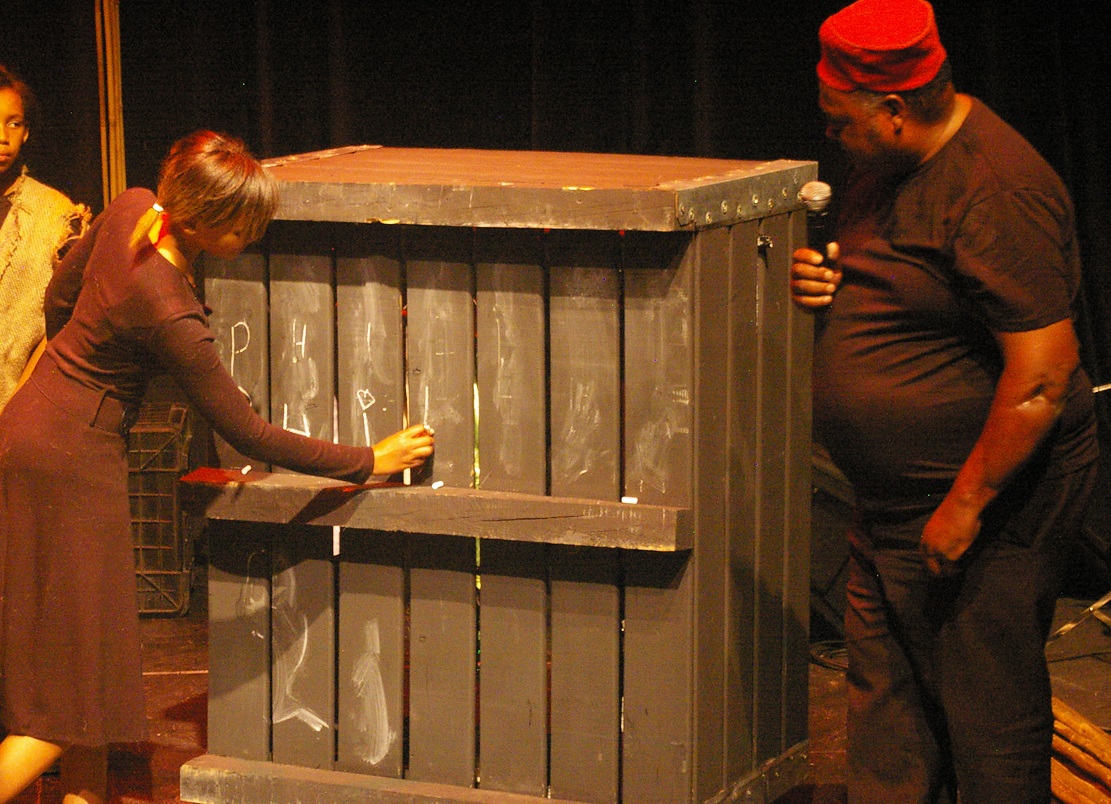
I remember the pages of the manuscripts spread all around our lounge floor: Afrikaans, English, several versions of each, all a complete muddle. André and I going around with scissors and Sellotape, piecing the different scenes together, then transferring the final ‘cut’ to the computer, editing, correcting, arguing, crying, laughing, and every inch of the way loving the story and the remarkable woman at its centre – those were the final stages of André’s last novel, Philida (2012), longlisted for the Man Booker later that year just in time for the publication.
Philida4

She arrived like all stories do, unexpected.

A phone call from a man who’d bought a farm near Franschhoek. An uncanny family connection. A museum opening. A barefoot girl with a heart full of courage. No wonder André fell in love with her. She walked straight into his imagination. And now she is stepping out of the pages of his book into the songs of her descendants.
Philida3
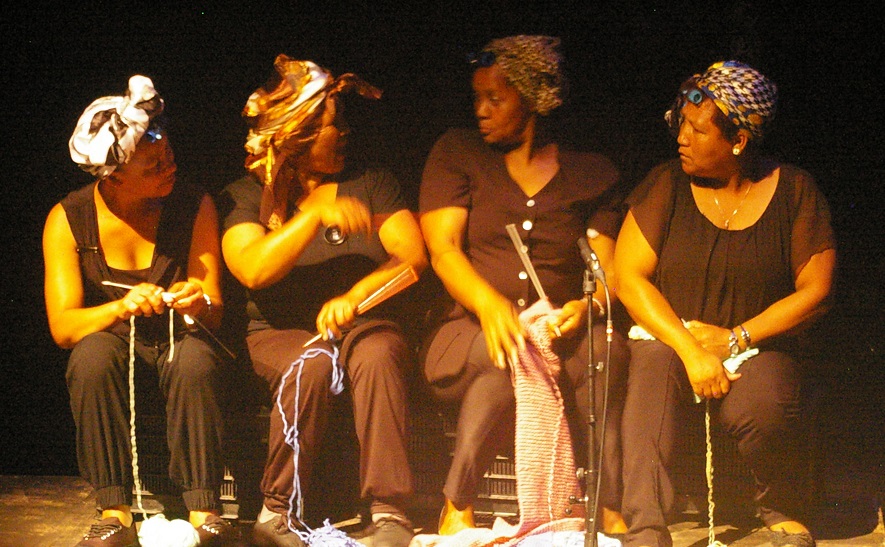
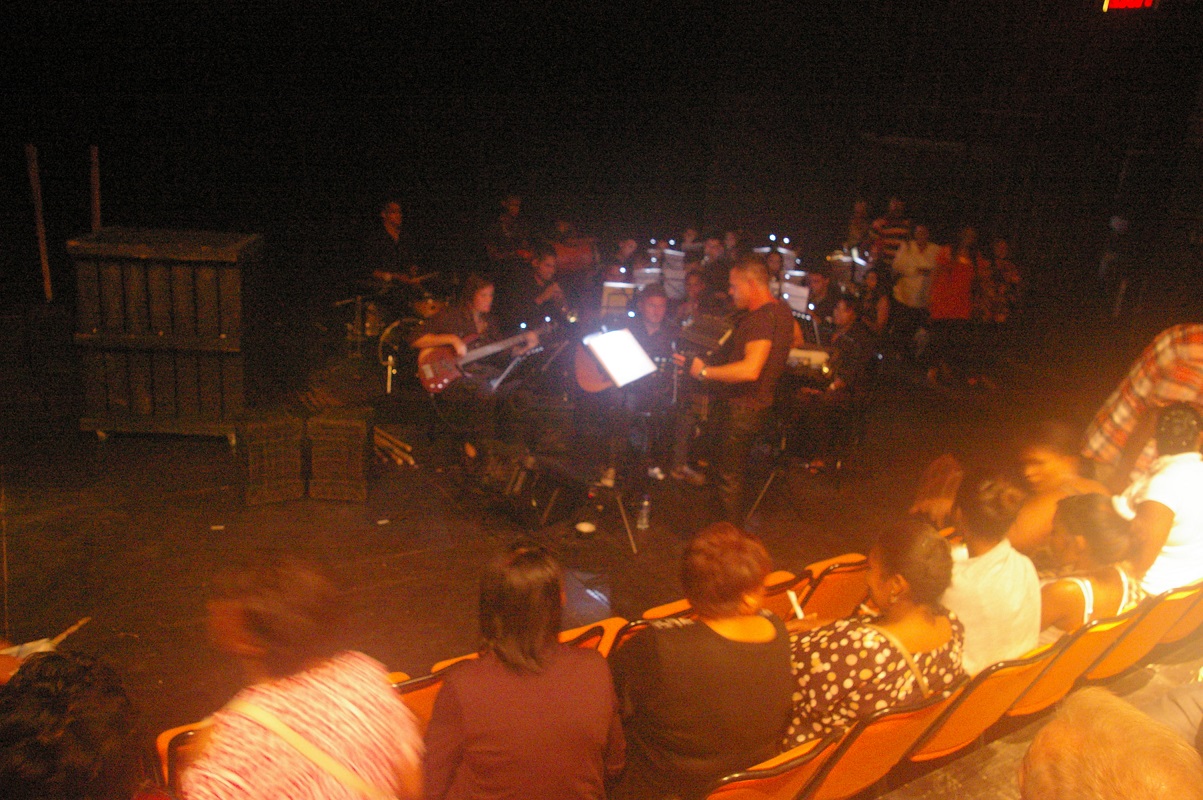
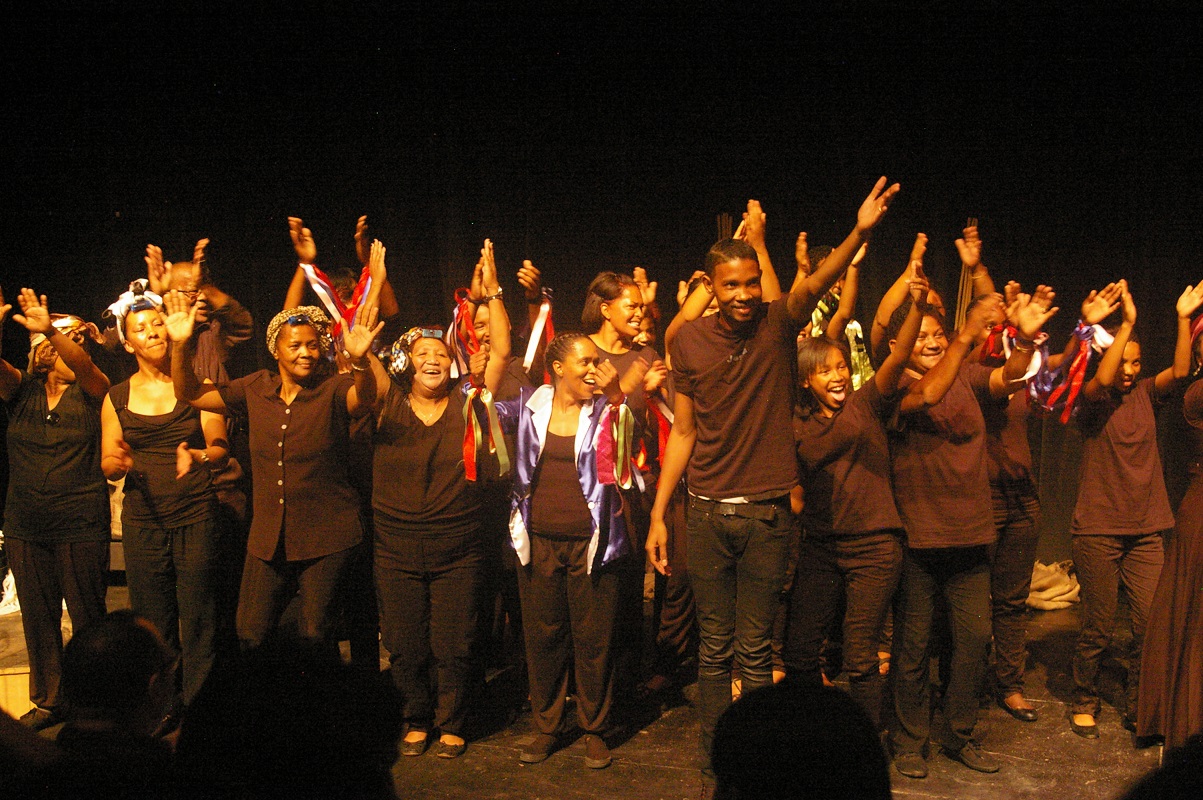
The people living, working and making music at Solms Delta have read Philida and turned her story into a musical.

I was invited to see the premier at the Baxter Theatre last night.
Philida1
Since André’s death, I have been unable to predict what will give me joy, what will hurt me. Everything is different now. What I believe will be difficult for me, turns out to be easy. At times, the easy stuff becomes impossible. Yesterday’s performance was utterly beautiful in all respects – simply stunning! Yet, it completely broke me. I wasn’t the only one who’d shed tears while following Philida’s moving story. I sat next to Tracey Randle, the wonderful historian who’d helped André do research for the book, and to Beverley Scott, mother of the late Alex van Heerden who, with his talent, charisma and enthusiasm, had brought music to the farm in the first place. We all cried, but I was the only one who had to leave, sobbing uncontrollably, just after the show.
Philida7
André and Alex should have been there last night, not only in the words and the music on stage, not only in our hearts…
Philida2
The beautiful young woman who sang Philida was the embodiment of André’s vision. He would have wept with all of us had he seen her come alive across space and time at the Baxter last night. The entire cast and the musicians were pure magic. They made my heart sing. The evening, though, broke it, too. And I was not prepared. I wish I could have said thank you or at least goodbye, but all I was capable of was finding refuge in the spare bedroom of my friends’ house which since early February has been on standby for such moments when being alone is not a viable option for me.
Philida5
I am humbled by the experience in all kinds of ways, and grateful. So many lives have been touched, changed, transformed for the better in all these years since we first heard Mark Solms’ message on our answering machine, that he wanted to meet, to tell us a story…
Philida9
Thank you.

PHILIDA VAN DE DELTA
at the 5th Annual Zabalaza Festival at the Baxter
Philida6
Company – Solms Delta
Writer – Members of Delta Soetstemme choir, facilitated by Amelda Brand
Director – Amelda Brand
Cast
Lyrics:
Delta Soetstemme choir, facilitated by Adriaan Brand, Leonore Bredekamp, Nick Turner, Amelda Brand and Jervis Pennington
Songs arrangement – Delta Langbroek band, musically facilitated by Adriaan Brand and Carlo Fabe
Language(s) – Afrikaans
Philida8
Performance Dates & Times:
22 March @ 18h00 – BAXTER FLIPSIDE THEATRE
27 March @ 16h00 – BAXTER Concert Hall