Tag Archives: André Brink

Nadine Gordimer (1923-2014)

An edited Afrikaans version of this article appeared as “Die miesies hy skryf” in By on 26 November 2011.

The madam he write

At eighty-eight Nadine Gordimer is throwing some more logs in the fire. Karina Magdalena Szczurek spoke with her about “certain kinds of attention”.

‘Do you know this author?’ I ask a waitress, pointing at Nadine Gordimer’s name on the cover of a book I am reading.

She shakes her head.

I pay for my lunch and walk from the restaurant to Parktown West, Johannesburg. A jacaranda petal falls on my head as I approach the angular white house which Nadine Gordimer has called her home for the past fifty years.

The first time I arrived here in 2004, I’d felt sick with worry for a week beforehand, duly warned about Gordimer’s reputation as an interviewee who suffers no fools. And this was my first interview, ever.

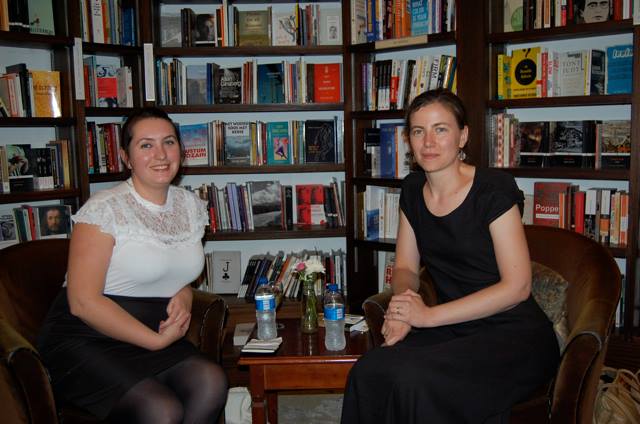
With Nadine during our first interview in 2004.

With Nadine during our first interview in 2004.

But when she realised that I wasn’t there to ask about her breakfast (the type of personal question she usually refuses to answer), she let down her guard. It was an invaluable experience.

My present visit is a déjà vu in this and other respects. I’m again first met by a staff member and inspected by an eager Weimaraner before being invited into the house. I walk through the kitchen, down a passage and past the narrow, light-filled study where Gordimer’s typewriter squats proudly on a small desk. She is waiting in the lounge. As I enter she folds a newspaper and puts her reading glasses aside.

It is the same room where we first met, but the furniture is arranged differently. She settles in an elegant rocking chair. I sit on a sofa opposite with a coffee table between us.

I have seen her look her age in badly taken photographs, but never in person. Today she looks radiant in a gracefully long white kaftan dress with a soft blue pattern. Her grey hair is stylishly arranged. Delicate earrings adorn her ears.

This time I am more at ease, but I still notice my hands trembling slightly as I set up the voice recorder. I can feel Gordimer’s lively brown eyes on me. A beauty at her age – she turned eighty-eight this month.

Few literary oeuvres can match Gordimer’s. Between the publication of her first story as a child in 1937 and today, the world has seen fourteen novels, ten short-story collections, and six volumes of essays. In 2010, her stories and essays were collected in two large tomes: Life Times: Stories 1952-2007 and Telling Times: Writing and Living 1950-2008.

When in the beginning of 2006 Ampie Coetzee spoke to Gordimer at a literary breakfast organised by Die Burger Book Club in Cape Town, she told him that her memory no longer allowed her to think in novel-terms.

The collection of stories Beethoven Was One-Sixteenth Black was published a year later.

Now she’s finished writing another novel after all. I remind her of what she’d said at the breakfast.

She smiles. ‘I don’t know what was wrong with me then.’

Since 2001, when her husband Reinhold Cassirer died, all her books carry his life dates and the dates of their relationship on their front pages. The dedication moves me every time.

Throughout her writing life Gordimer has stuck to a strict routine, devoting the first part of the day to her work only: ‘I still feel in the morning when I get up now, I’ve got to be at my desk.’

André Brink recalls how many years ago, before he knew better, he tried to phone her before lunch. A staff member informed him that Gordimer was not available.

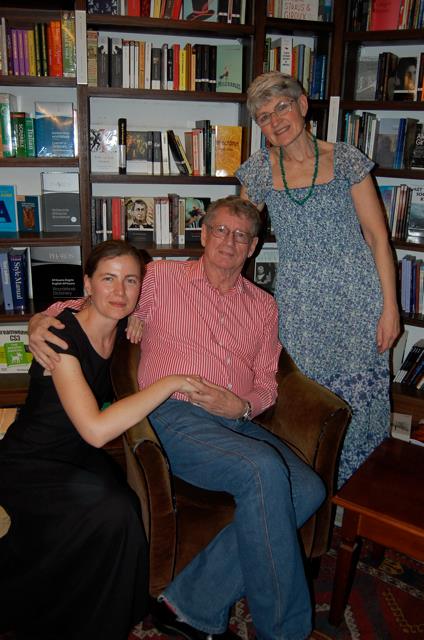
At André's 70th birthday in Johannesburg.

At André’s 70th birthday in Johannesburg.

‘The madam he write,’ he was told firmly, and he had to try again in the afternoon.

The statement is extremely telling, even if it was not intended as such.

Gordimer grew up into a position of privilege in apartheid South Africa. And yet, while many others went with the flow, she devoted her life to fighting injustice. Even though she is most uncomfortable about the designation, for decades she was considered the ‘voice’ and ‘conscience’ of South Africa in the world.

I first encountered her work at university. The story “The Moment Before the Gun Went Off” (1991) pricked my interest in South African literature, and eventually brought me here for research, then for life.

It tells the story of an Afrikaner farmer on trial for shooting one of his farm workers. The racial and political circumstances condemn him, but the last line of the story overturns all our expectations: “The young black was not the farmer’s boy; he was his son.”

Gordimer has often been accused of portraying Afrikaners unfairly in her work. Asked about it, she reminds me that when the time to protest came there was no prejudice. ‘We did it together!’

She is also quick to point out how Uys Krige was the first person who published anything of hers: ‘He encouraged me tremendously, gave me the most helpful criticism and was a very dear friend.’

She reads Afrikaans writers in translation, and regrets that she lost the Afrikaans she learned at school, or that she never learned any of the other indigenous African languages. ‘As I say, it’s terrible; I’m a very poor linguist.’

Gordimer’s work is not everyone’s cup of tea, mostly considered too political or / and too challenging. But both judgements rest more on hearsay than an engagement with her actual work.

Occasional stylistic density prevents a more leisurely read, but allowed to sink in, her thought-provoking stories can be inspiring, revelatory, and life-changing.

Many see her 1994 novel None to Accompany Me as a purely political reflection of the transition period in South Africa’s recent history. Rereading it now, I am stunned by the accuracy with which she prophecies the dangers facing the fledgling democracy. But for me personally, the novel is one of the most profound portrayals of a woman’s journey to selfhood.

This again brings to mind the statement with which André Brink’s morning phone call was fended off, and another quality which has defined Gordimer’s career – her ambivalence towards feminism. ‘All writers are androgynous beings,’ she states repeatedly.

She caused an uproar when she withdrew The House Gun (1998) from the shortlist of the prestigious Orange Prize for Fiction, reserved for women only.

‘I have been indeed and still am sometimes tackled, because I withdrew…and then I made this rather rude, I suppose,’ she reconsiders, ‘frank remark that we don’t write with our genitals.’

One of her stories, “A Journey”, was reprinted in the South African October edition of Playboy.

‘How do you feel about being published in the magazine?’

There is no issue for her. She does however make one crucial distinction. ‘I would hate to be published anywhere which was racist,’ she says. ‘I would refuse.’

Her parents were Jewish, but she is a self-declared atheist. She recently caused, in her own words, ‘great offence in America’ with her story “Second Coming” (2011) in which the son of God walks across a desolate, post-apocalyptic landscape. The possibility of life’s or humanity’s re-creation is rendered impossible, because as the last one-sentence paragraph tells us: “The sea is dead.”

‘What was the Americans’ problem with it?’ I’m curious.

‘Well, it’s not for me, sitting here in South Africa, this little unbeliever in any religion to say that Jesus is coming…using this as the ultimate example it should be, for people who revere Jesus and the idea of a second coming, that he should find the world destroyed. It’s a story about the environment.’

Gordimer’s Get a Life (2005) was probably the first green novel in South Africa. She is one of a handful of local writers who now consistently champion the environment in their work.

* * *

While she gets some tea, I glance around me. On three sides of the room shelves brim with books and CDs. A vase of strelitzias and a few sculptures of different origins catch my eye. A walking stick rests against the other side of the sofa. The room opens on a large patio and a magnificent garden in full bloom. The cushioned bay window looks like an ideal place for reading. It makes me think of something she’s just said:

‘I have recently reread Anna Karenina and War and Peace, and I have reread the whole of Marcel Proust and now I can read French sufficiently to read it in French. And there are so many others. When I look at my bookshelf, I say, my God I must read that again before I die.’

Bodo, the dog, appears at the same time as the tea tray. Marie biscuits are on offer.

‘How do you like your tea, weakish?’ she asks.

‘Strongish’

‘Oh good!’

Bodo is allowed one cookie while she pours the tea. As she lifts the heavy pot her fragile hands betray her age for the first time.

I cannot help but think of the three thieves who forced their way into her home in 2006 and brutally removed her wedding ring from her finger.

‘Did the attack have any lasting effects on you?’

‘You know, I hesitate to answer this because it sounds as if I’m saying that I am brave. I’m not… The only thing of consequence, practical consequence, is that I now have these wires around the house… But I’m not brave…I choose to go on living here…my reality is here.’

With Sontag at Wits in 2004.

With Sontag at Wits in 2004.

She has been accused of lacking courage to criticise the ANC. But following her late friend, the American intellectual Susan Sontag, Gordimer believes that ‘to be a moral human being, is to be obliged to pay certain kinds of attention.’

Very often she is the first to pay attention and fight with any means available to her for the causes she believes in.

Recently, together with André Brink, she drew up a petition against the planned legislation curtailing freedom of speech in South Africa and introducing ‘apartheid-type censorship all over again.’ The petition was not only signed by just about every writer in the country, but also many international writers whom Gordimer approached at the time during a visit in Sweden.

‘Let’s keep [the protest] going. Throw another log in the fire!’ she says.

The presidency was not impressed.

‘President Zuma didn’t have the courtesy to send us, representing so many others, an acknowledgement.’

In a recent HARDtalk interview she told Stephen Sackur that real loyalty to the ANC means the right to criticize the party, of which she is a member. She spoke of the disappointment she felt about the values that were being betrayed by the ANC. I prod her for more particulars.

‘First of all the fact that power is used in a very personal way.’

She is also deeply disappointed about the government’s handling of education.

‘The schooling is so bad.’ She is shocked at the discrepancy in entry requirements for university students from different backgrounds.

‘We can’t keep our black comrades out of universities. My God, who would want to? But what is the point of them coming in if they can’t cope. It’s humiliating for them…’
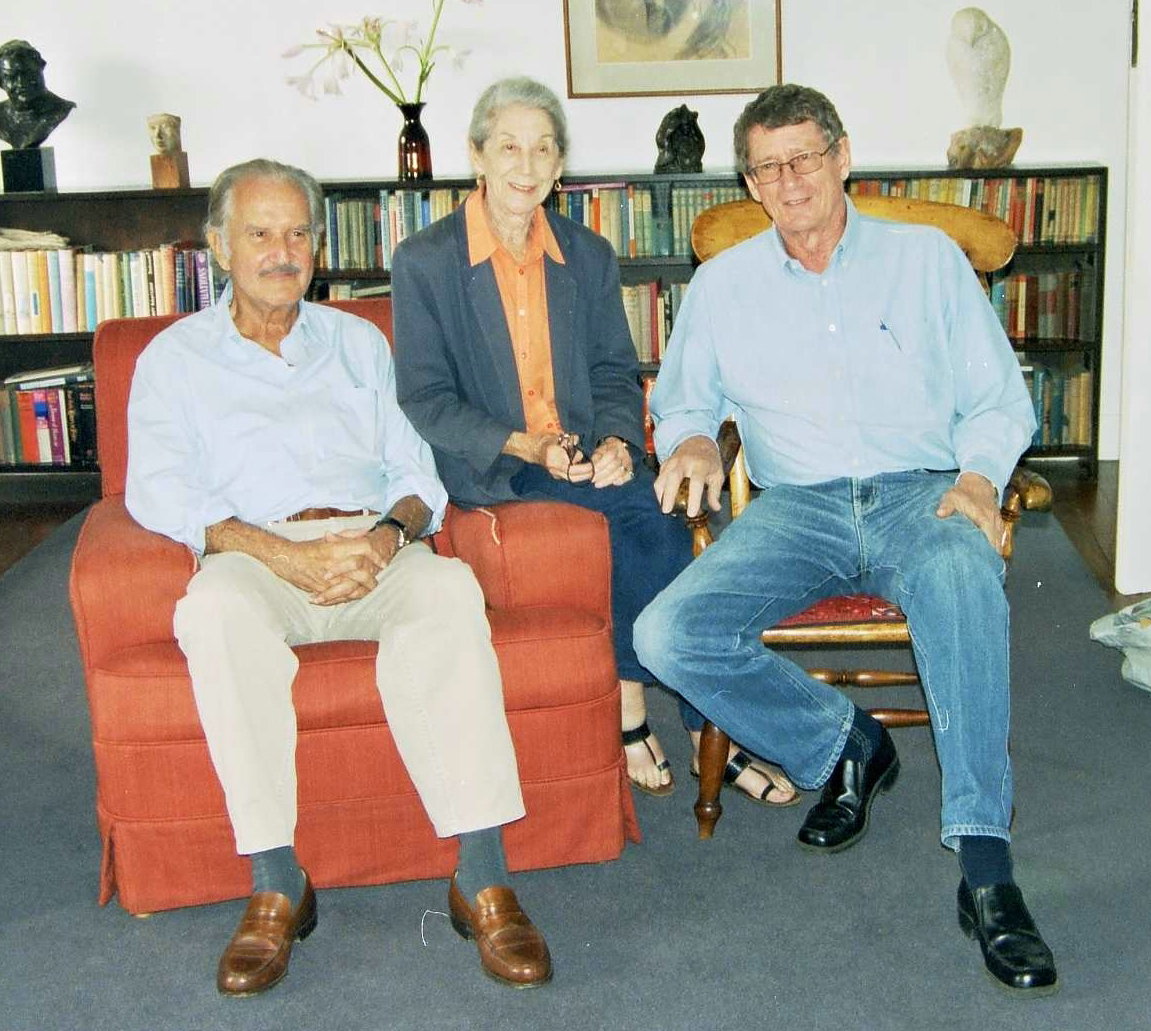
With Carlos Fuentes and André at home in 2006.

With Carlos Fuentes and André at home in 2006.

On the way to O.R. Tambo I ask the shuttle driver whether he knows the author Nadine Gordimer. I also ask a few SAA attendants. No recognition.

While awaiting my flight, I pose the same question to the middle-aged gentleman next to me. He is the only person to respond positively to my question. Does it matter that he is white and at least two decades older than the other people I’ve approached?

I am confident most Poles would at least have heard the name of the Polish Nobel Laureate Wisława Szymborska at school.

* * *

Still in Gordimer’s lounge, I dare ask a personal question.

‘What makes you really happy?’

A short silence; my heart stops.

‘André would say chocolate,’ I volunteer out of desperation.

‘Well, that’s an evasive answer… I’m also very fond of black chocolate, but of course that’s a taste happiness.’

Another pause.

‘I have been unbelievably lucky by having forty-eight years with the love of my life, and I have that to treasure. Sometimes it is painful to do so, but other times…it’s there, I had it.’

So far so good: Best of 2014 book giveaway

Best of 2014_1
For me, one of the best tests for a good read is whether I find myself wanting to share it with others. The bookshops I visit will testify to the fact that I often return to the same title over and over again when searching for presents. I don’t know how many copies of the original versions and their translations into other languages I have bought in the last few years of, among others, Mark Rowlands’ The Philosopher and the Wolf, or Carsten Jensen’s We, the Drowned, or Alastair Bruce’s Wall of Days, or Siri Hustvedt’s What I Loved. The authors of these books must have enjoyed at least a bottle of really nice wine or bought a book or two by other authors from the royalties my book-shopping sprees have generated for them. And it makes me happy to think that this might have been the case. Cheers!

The last six months have been particularly plentiful in good reads. I’ve been lucky. There is nothing worse than finishing a great book and encountering a dozen duds before discovering the next good one (especially if you are like me and finish most of the books you’ve started). But 2014 is turning out to be a really satisfying reading year. Of the books I’ve read until now there are twelve that I have either already bought for or at least wholeheartedly recommended to others.

The twelve titles in no particular order:

Ash WednesdayAsh Wednesday by Ethan Hawke (2002)
My dear friend Isabella and I have been fans of Ethan Hawke, the actor, since high school. I will never forget how we saw Great Expectations with him and Gwyneth Paltrow at a student cinema in Łódź – the screen was made out of three bed sheets and we sat on ordinary kitchen chairs in the audience… When we found out that Hawke was a novelist, too, I bought Isabella his debut novel as a present, and ever since then I have been meaning to read one of his books myself, but somehow never got around to it. But then earlier this year, I accidently saw Reality Bites again and thought of Isabella and decided to make up for lost time. Ash Wednesday was a real treat: Jimmy and Christy are in love, pregnant, and want to get married, but nothing is simple when you are young and life with all its choices looms large around the corner. On a road trip across America they confront their secret dreams and hidden fears, risking everything for what they believe in. Ash Wednesday is written in a crisp prose that carries you across the page like a good old Chevy Nova across an alluring landscape. It has turned me into a fan of Ethan Hawke, the novelist.

The Last Man in Russia by Oliver Bullough (2013)
I was asked to write a short review of this book for the Cape Times. The book broke my heart because it resonated so much with my memories of my native Poland. It saddens me that the one characteristic that Russians and Poles are (in)famous for in the world is their heavy drinking. Alcoholism is a plague which has taken a heavy toll on both countries. I believe that things are changing in Poland, at least that is what my family and friends assure me of, but it will take at least a generation or two for the new ways of life to have real impact on society and to begin to heal the wounds. Bullough explores the historic trauma at the root of the pandemic with incisive insight. Anybody interested in understanding that part of the world will be wise to read The Last Man in Russia. It not only throws light on the past of the region but also its current situation.

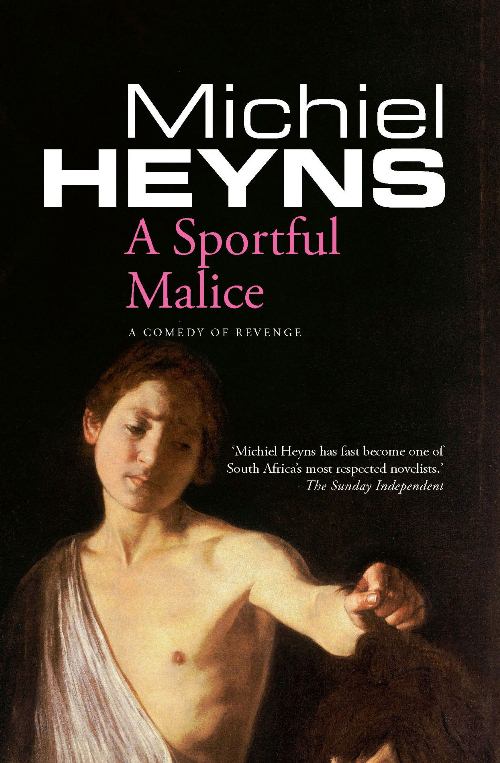
A Sportful MaliceA Sportful Malice by Michiel Heyns (2014)
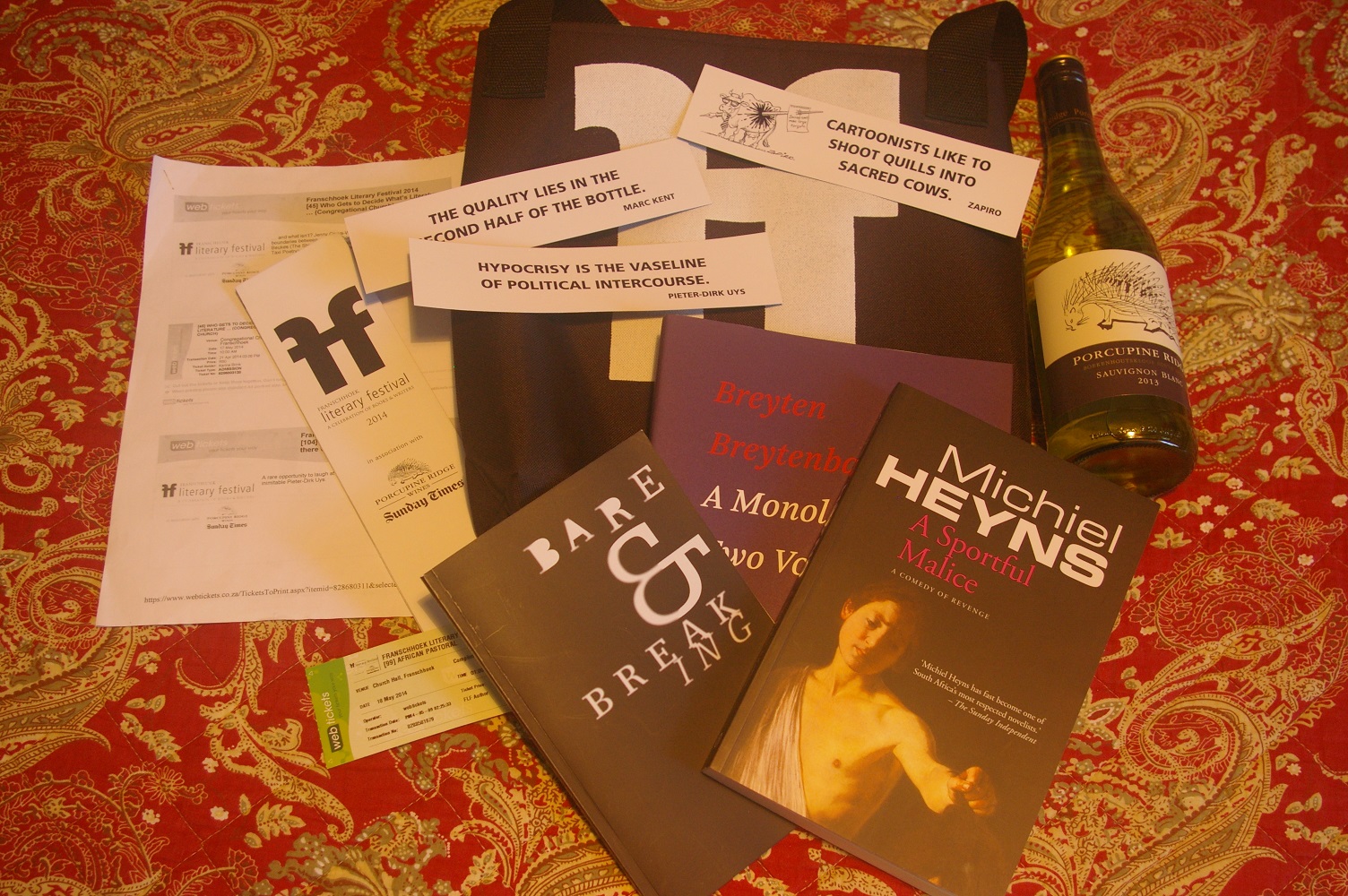
I brought this book back from the FLF. It is the funniest novel I have read in the last few years. I take books with me wherever I go and I found myself reading this one in a few public places where I got a lot of curious stares from strangers because I couldn’t stop laughing while reading. Every page brings a smile to one’s face, and some of the humour is truly and deliciously dark. A Sportful Malice takes the reader to Tuscany via London Stansted on a nightmare Ryanair flight which turns out to be the least worrisome aspect of Michael Marccuci’s trip. Micheal is a gay South African literary scholar. One of his many Facebook contacts offers him a house for rent in a small Tuscan village where Michael plans to finish the book he is currently working on. On his trip, Michael encounters the obnoxious Cedric, a clumsily inexperienced but not unwilling Wouter, his eccentric (to say the least!) landlord and his wife, and the irresistible Paolo. But nobody and nothing is as it seems. Full of himself, Michael is too blind to realise that he is not entirely in charge of his fate. The novel is told in a series of Michael’s letters to his lover back home. As always, Heyns’ prose is pure pleasure, and the humour of A Sportful Malice is sheer delight.

Arctic Summer by Damon Galgut (2014)
I had the honour of reviewing Galgut’s latest for the Cape Times. I read an advance proofs copy but have bought the strikingly pink hardcover edition for a young friend who is discovering and exploring his sexuality. A lot has changed in our society since the days of E.M. Foster, but despite our amazing constitution, there is still so much hatred and bigotry around that it makes one desperate. It is such a precious gift to find that other person who shares your dreams and longings. What sex or gender that person is shouldn’t concern anybody else but the people doing the searching and the finding.

The Maze Runner by James Dashner (2009)
While reading up on the touching and wise film The First Time, I accidently stumbled upon the trailer for The Maze Runner. It intrigued me and when I realised that it was based on a novel I decided to read the book before the movie came out later this year. It didn’t disappoint. Fast-paced, the novel itself is like a maze. You have no clue where you are going to end up turning the next corner. And the ending just makes you want to read more. I was relieved to discover it’s the first in a series. I’m a sucker for stories about friendship (one of those got me hooked on the writer whose book is next on my list here!) and I liked the portrayal of the dynamics between the characters in The Maze Runner. The thrilling action all around was a bonus.

Die DreiThe Three by Sarah Lotz (2014)
I’m supposed to review this novel so the proper review is pending. For now, I would just like to confess that I am a Stephen King virgin. I remember Isabella devouring King novels but I’ve never really felt that they were something for me. I have seen some of the films based on the novels, enjoyed Carrie and Misery very much, and my favourite TV series at the moment, Haven, is based on one of King’s short stories, “The Colorado Kid”, and yet I haven’t felt tempted to turn to the books. I did buy a King novel for my brother on his 30th birthday (the novel was published the same year as he was born). But still, no King for me. Until now that is. After reading Lotz’s The Three – brilliant, riveting – and seeing King’s endorsement on the back cover, I have decided to give the man a chance since he has shown some really good taste there. I bought The Shining yesterday. Incidentally, it was published in the month and year of my birth. And JohaN from Protea Bookshop informed me that the sequel is out. Fortunately, unlike other readers, I won’t have to wait 37 years for it!

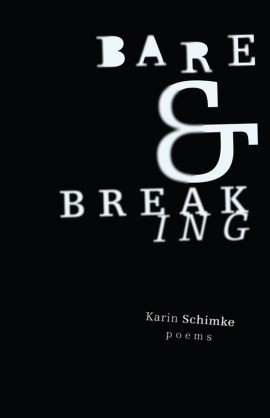
Bare and BreakingBare & Breaking by Karin Schimke (2012)
Schimke’s collection also came back home with me from Franschhoek. I haven’t felt so excited about a volume of poetry since Tracey K. Smith’s Pulitzer-winning Life on Mars (2011). I read Smith’s collection a few weeks before the prize announcement (which made me jump up and down with joy) and was simply bowled over by the power and wisdom of her words. Schimke’s volume has similar qualities, but it exhibits an intimacy and eroticism that I haven’t encountered in contemporary poetry for a long time. She writes skin and desire, allowing the reader to get lost in both. In simple images she captures the miracles of a couple’s everyday life, how those little wonders remain hidden from others but never cease to amaze those who experience them. The violence of desire explodes on the page and splits you open. Bare & Breaking echoes those moments when you face the inevitable, when loss threatens your sanity, when you can’t help longing for all the wrong reasons. And when you get to the last poem in the volume you will be struck by the quiet after the storm. Poetry can be so satisfying!

And speaking about ‘quiet’, next on the list is:

Quiet by Susan Cain (2012)
The book made me properly understand something about myself that I have always known only intuitively. It probably is such a bestseller because it resonates with a lot of people. Life has become somehow simpler for me since reading Quiet. It helped me crystallise certain ideas on how to stay in tune with my inner qualities. In the words of Ruben, the protagonist of André’s The Rights of Desire, “I don’t like shouting.”

The Blazing World by Siri Hustvedt (2014)
Hustvedt is one of only a handful of writers who have never disappointed me. A friend introduced me to her work and I have read every single title she has published. Every time I open one of them, I know I will be challenged, enriched and entertained. I bought a copy of The Blazing World for a friend even before I read my own, because I knew that one couldn’t go wrong with a novel by Hustvedt. I am waiting for the translations into German and Polish so that I can share the book with friends and family abroad. I reviewed The Blazing World for the Cape Times.

Road of ExcessThe Road of Excess by Ingrid Winterbach (2014)
Translated from Afrikaans, The Road of Excess was a wonderful companion read to The Blazing World. They are both set in the art world and deal with the insecurities of creativity and fame. Aaron Adendorff is a renowned painter recovering from cancer. After more than two decades of prosperous collaboration, it seems that the owner of the gallery where Aaron usually exhibits is threatening to drop him. Inexplicably though, he sends two new darlings of the art world Aaron’s way and asks him to assist them. All this time, Aaron is getting the weirdest messages from his brother, a recovering alcoholic, intent on confronting some uncomfortable truths about their family past. To make matters even more disturbing, Aaron’s home is invaded by the unforgettable Bubbles Bothma, a neighbour from hell, who is threatening to save Aaron from all his demons, if she doesn’t accidently get him killed first. A profound and funny read which lingers in one’s mind long after the last page is turned. I have now read all of Winterbach’s novels available in English and am hoping that my Afrikaans will be good enough one day to enjoy the ones which remain untranslated. Her work is extremely versatile, engaging, and her supple prose shines through even in translation.

Breyten Breytenbach, A Monologue in Two Voices by Sandra Saayman (2014)
My short review of this title is being processed for publication, but I can say here that this book simply as an object offers the reader a gratifying aesthetic experience. It is beautifully and carefully produced, includes a variety of reproductions of Breytenbach’s artworks, and encourages the reader/viewer to perceive them in context.

Bloody LiesBloody Lies: Citizens Reopen the Inge Lotz Murder Case by Thomas and Calvin Mollett (2014)
My review of this bold book should be published in the near future, so I won’t repeat myself here. I can just urge anybody interested in the history of the case to read Bloody Lies and to look at the Molletts’ website: Truth 4 Inge. If you are following the Oscar Pistorius trail, this book might also be for you. Bloody Lies is a highly informative, page-turning read.

I would like to invite other readers here to tell me which books have made such an impact on you in the first half of this year that you wanted to share them with others. At the same time, please let me know which of the titles I’ve mentioned above you would be interested in reading yourself. From your comments, I’ll draw one name at the end of July 2014 and send you the book you have chosen from my list of twelve titles. I will include my own Invisible Others in the parcel.

Happy reading & sharing everyone!

Four stories from Touch longlisted for TWENTY IN 20

TouchI am delighted to announce that the following four short stories from Touch: Stories of Contact by South African Writers have been included on the 50-titles strong longlist for the TWENTY IN 20 project which aims to publish an anthology of the best twenty South African short stories written in English during the past two decades of democracy:

“File Under: Touch (Avoidance of, Writers); Love (Avoidance of, Writers). (1000 words)” by Imraan Coovadia
“Threesome” by Emma van der Vliet
“Salt” by Susan Mann
“The Crossing” by Damon Galgut

Other Touch authors are also on the list, but with different stories:

Byron Loker with “New Swell” from his debut collection by the same title (2006)
Ivan Vladislavić with “The WHITES ONLY Bench” from Propaganda by Monuments and Other Stories (1996) and “The Loss Library” from The Loss Library and Other Unfinished Stories (2011)
Zoë Wicomb with “Disgrace” from The One That Got Away (2008)
Mary Watson with “Jungfrau” from Moss (2004)
Henrietta Rose-Innes with “Homing” from the collection by the same title (2010) and “Poison” from African Pens: New Writing from Southern Africa (2007)
Alistair Morgan with “Icebergs” from The Paris Review (2007)
Liesl Jobson with “You Pay for the View – Twenty Tips for Super Pics” from Ride the Tortoise (2013)
Nadine Gordimer with “Loot” from the collection Loot and Other Stories (2003)

About Touch: Stories of Contact (2009):

For this unique and impressive anthology, some of South Africa’s top storytellers were invited to interpret the theme of touch. The result is a scintillating collection of twenty-two stories about all kinds of human interaction. There are tales of love lost, and of discovering intimacy. Some describe encounters with strangers, others examine family relationships. Most deal touch in a physical sense; one or two explore the idea of ‘keeping in touch’.
Touch: Stories of Contact brings us work from such established luminaries as André Brink, Nadine Gordimer, Damon Galgut and Ivan Vladislavić, and exciting new voices such as Alistair Morgan and Julia Smuts Louw. Whether poignant or humorous, fictional or autobiographical, these innovative tales remind us of the preciousness of touch and are a testimony to the creative talents of South Africa’s writers.
All the authors have agreed to donate their royalties to the Treatment Action Campaign. Every copy sold therefore contributes to the fight against HIV and AIDS.

Touch Contributors: Emma van der Vliet, Michiel Heyns, Elleke Boehmer, Susan Mann, Willemien Brümmer, Julia Louw, Anne Landsman, Byron Loker, Maureen Isaacson, Ivan Vladislavić, Zoë Wicomb, Imraan Coovadia, Jonny Steinberg, Mary Watson, Henrietta Rose-Innes, Alex Smith, André Brink, Damon Galgut, Alistair Morgan, Liesl Jobson, Nadine Gordimer, Lauren Beukes.

(From the short stories I know, I am also thrilled to see “Where Will He Leave His Shoes” by Karen Jayes, “The Pigeon Fancier” by Sarah Lotz, “Porcupine” by Jane Bennett, “A Visit to Dr Mamba” by Andrew Salomon, among others, on the list – these are the kind of stories you will never forgot after reading.)

Fresh from Franschhoek: FLF 2014

Nadia and I at the FLF, photo by Jennifer Platt

Nadia and I at the FLF, photo by Jennifer Platt

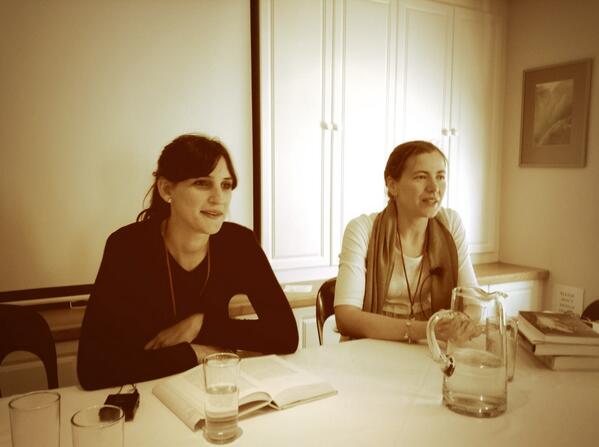
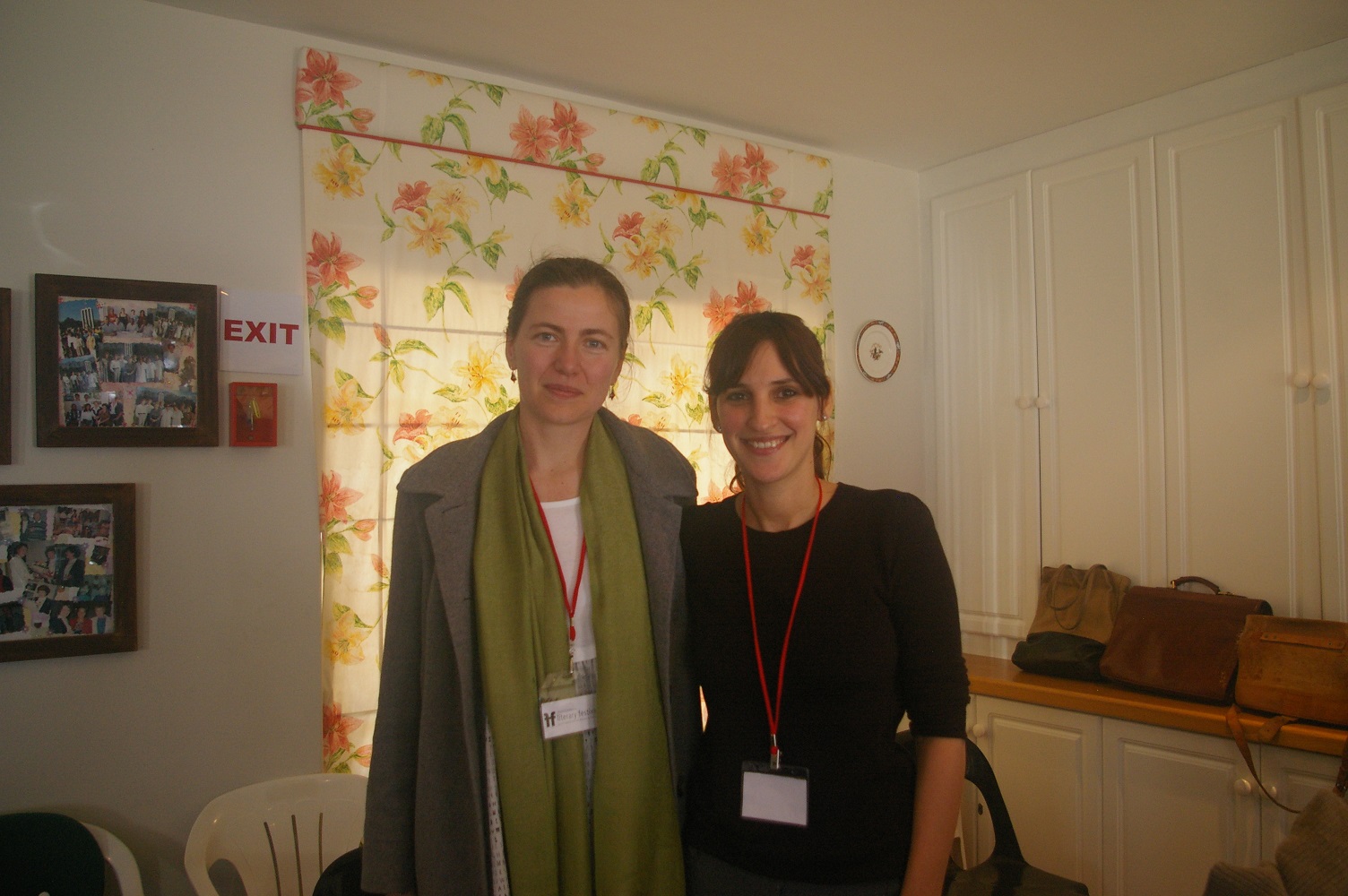
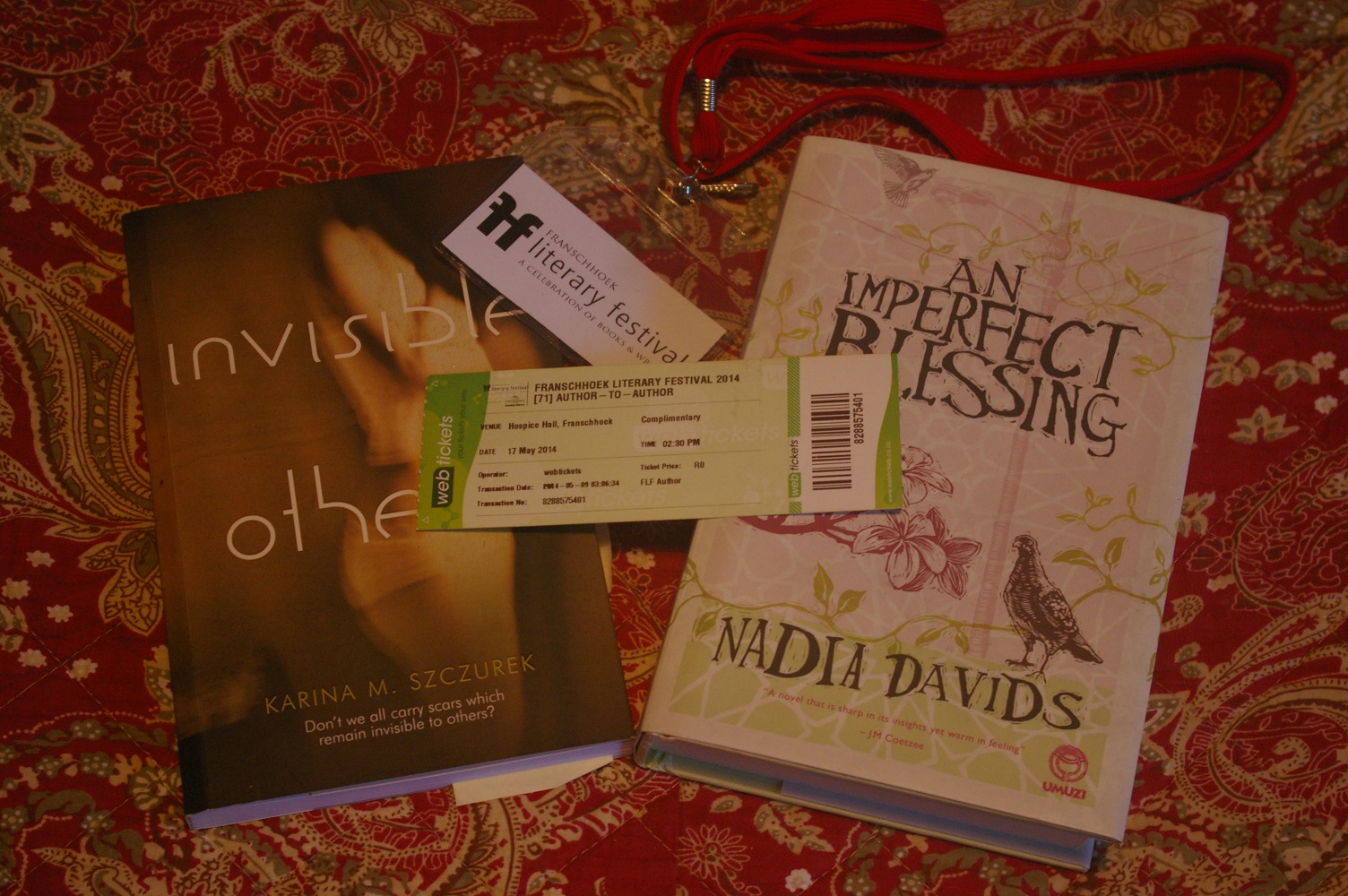
Another FLF has come and gone. It was my first one as a participating author. My event with Nadia Davids was a real joy. Nadia is wonderfully articulate, kind, a pleasure to talk to, and more beautiful in real life than in any photograph. We discovered that on top of everything else we have in common, she left South Africa the year I first arrived here. We seem to be leading these uncanny parallel lives. I hope there will be many more points of contact. We read from our novels, spoke about writing place and history, being first-time novelists, the genres we write in, and our lives as writers and critics.
With Nadia
(Jennifer Platt from the Sunday Times twitted live from our event.)

The guest of honour at the FLF this year displayed her eloquence with light, shade and colour, bathing Franschhoek in its autumn glory. This is my favourite time of the year, and the beauty of autumn days like these past two fills me with a sense of wonder like nothing else. (There was this one autumn day in 1990 when my mother was hanging up laundry in our garden in Church Street in Warwick, NY, and I was just there, watching her, surrounded by the reds and browns and yellows of dying leaves, basking in the early morning light, the sun on my back, and silence between us when I thought, This is where love comes from, from the beauty of this world, it is nourished and sustained by it. Despite its craziness, the weekend reminded me of that day.)

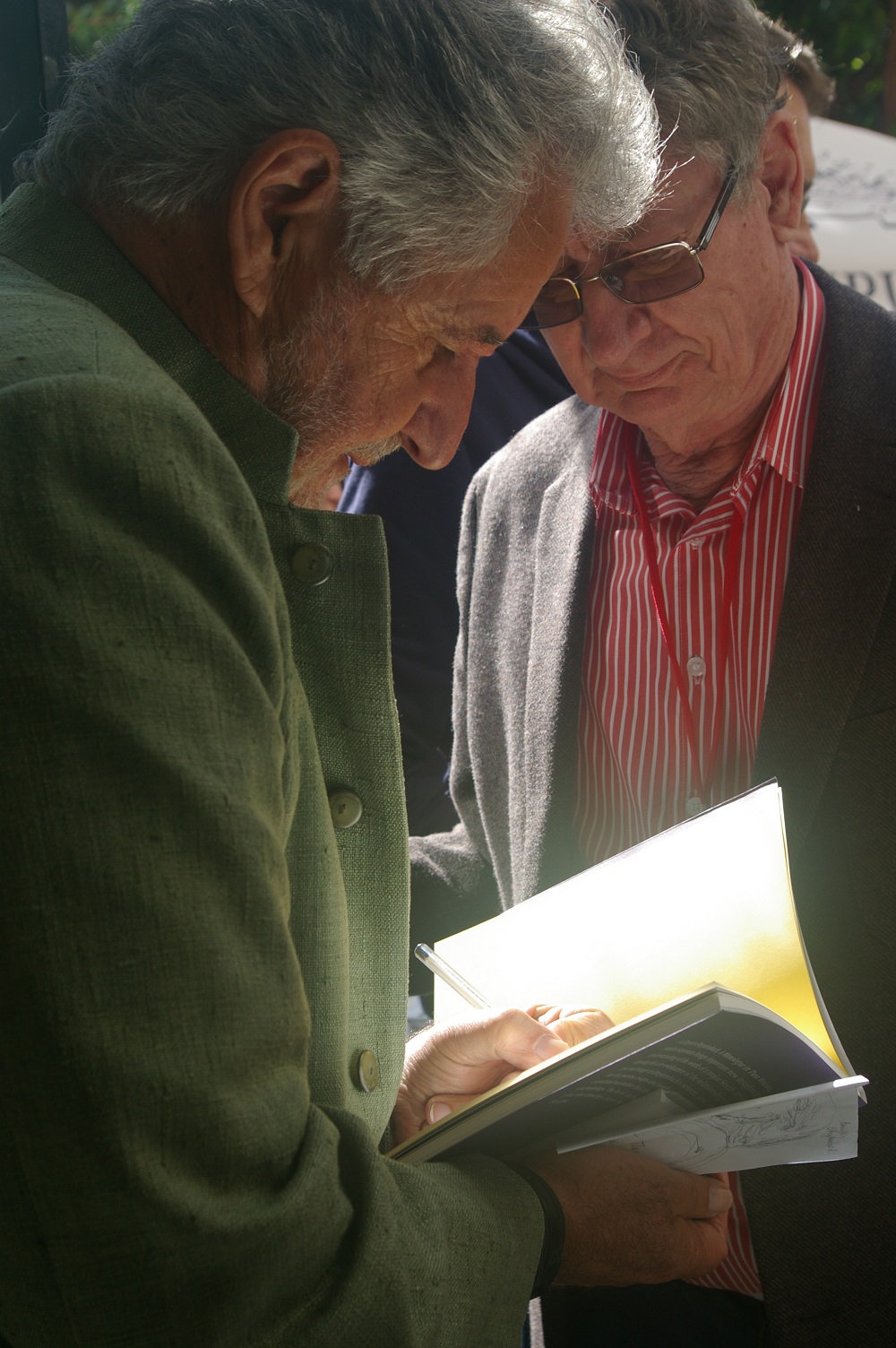
André with Breyten Breytenbach at the FLF

André with Breyten Breytenbach at the FLF

Franschhoek had all its other treats ready for us. Books and book lovers everywhere. The programme offered tons of stimulating encounters. The food and the wines were divine, as always. Gable Manor, the guest house we stayed in, was charming and cosy. In the words of Kgebetli Moele, the author of Untitled, who left a comment in the guest book the day before us: “Perfection!”
All that was missing was the time and space to enjoy it all, but festivals are by nature hectic creatures, especially if one is participating, leaving you dazed and exhausted for days afterwards. There is something about a festival that often puts me on edge. It’s not the participating on stage or being part of an audience, but rather the in-between of awkwardness when these boundaries are blurred.

I attended four sessions and a show during the weekend. The highlight was the show: Pieter Dirk-Uys’s AND THEN THERE WAS MADIBA! I have heard him speak at FLF and other events before, seen him numerous times on TV, and have cooked with Evita for years now, but I had never attended one of his live performances. Now I know that by not making it to one earlier, for years I have been depriving myself of laughter and insight. I will not be so stupid in the future. Dirk-Uys as Madiba or Zuma or Verwoerd was a sight to behold. He was priceless as Winnie. And underneath all the laughter and fun was a profound message of hope and being all together in this beautiful mess we call the New South Africa. There is always hope for a nation capable of laughing at its follies.

The sessions I attended were truly inspiring, worth every cent:

WHO GETS TO DECIDE WHAT’S LITERATURE
Jenny Crwys-Williams talking to Karin Schimke, Lauren Beukes and Imraan Coovadia about the interactions between authors, critics and readers. I found the following comments interesting:

Lauren said that nowadays authors have to be more social and put themselves out there. As Jenny pointed out, Lauren is highly successful in exploiting social media for book-promotion and is one of the few young South African writers who can write full-time because of commercial success. Lauren said that as a social person she counts herself lucky to be able to engage in the world of social media and enjoy it. She also said that she was fortunate in finding an agent who understood her vision. Lauren helps to promote other local writers by hosting The Spark on her blog. When she started with it, the idea was to have a white and a black writer alternatingly, which has proven impossible. It seems that black writers were not responding as readily to her requests as white writers (I had a similar experience when compiling Touch: Stories of Contact for which I was subsequently criticised, but I did approach many more black writers than ended up in the anthology; for various reasons some chose not to participate in the project; both Lauren and Imraan donated their fantastic stories for which I am still very grateful). She also praised her South African editor, Helen Moffett, who allows her to perform all kinds of acrobatic stunts in the air because she knows who is on the ground waiting to catch her if anything goes wrong. (As part of the trio Helena S. Paige behind the Girl series, Helen is not only a successful novelist, but also a sensual poet and a nurturer of South African literary talent.)

FLF books1Karin conceded that as a journalist she understands that she should be participating in the world of social media, but admitted to finding it exhausting. She made a wonderfully vivid comparison between twitter and being at a crowded cocktail party where all one longs for is a breath of fresh air, but getting to the door proves to be nearly impossible. (I cannot say how grateful I was for that image – I am too frightened to even enter that room – I am the one outside in a quiet corner, sipping the champagne, and reading a book). Karin did not get out of her way to market her book of poetry Bare & Breaking when it was published in 2012. Like most writers, she would love to be able to write in her chosen genre fulltime, but has to make a living otherwise. She has no illusions about being able to live off writing poetry in South Africa, but that is not what it is all about for her. As a writer, one has to understand one’s motives for writing, she said.

Imraan spoke about the difficulty of talking about the reading experience which is deeply personal and not always easily shareable. I loved his comment about the fact that a change in taste is proof of a “living mind”. He also mentioned that for him there are different ways of being a writer in the world. He referred to Damon Galgut who is shy and simply gets on with his writing without unnecessarily putting himself out there. He also said something very interesting: Why spend so much time on publicity if the reason you write is to get rich? Instead, one could invest the time in becoming a billionaire by other, more straightforward ways. For him, writing is about the “book and you”.

(After the session I bought a copy of Karin’s Bare & Breaking. Some time ago, I published a review of four Modjaji poetry titles, three of which I found outstanding, one less so. The positive comments I made about the three books went largely unnoticed. For my comments about the fourth one I got lynched. The heated reaction of the publisher and friends of the author to my negative remarks about the fourth volume sadly put me off further Modjaji titles. This is how I missed out on Karin’s book until now. But some of her comments about the volume and her own approach to writing made me curious enough to ignore my decision to keep away from Modjaji titles. On Saturday evening, I read some of Karin’s poems in the luxurious bath of our room with a view at Gable Manor and the moment I got out, I made my husband read them. We were both bowled over by her “sound-shades”. I look forward to discovering the rest of the volume.)

Here is one gem:

“Morning Work” by Karin Schimke

We are cocked and angled
together like an African chair,
groin-hinged and eye-locked,
small-talking the sun up.
At the join we are genderless
until – out of two flat triangles –
something flowers at us,
blooms bright as though
our eyes are suns
and it must find light.
We give it light, and we laugh,
and then bury it, lids shut,
so it can seed again.

THE CONSIDERED CANON
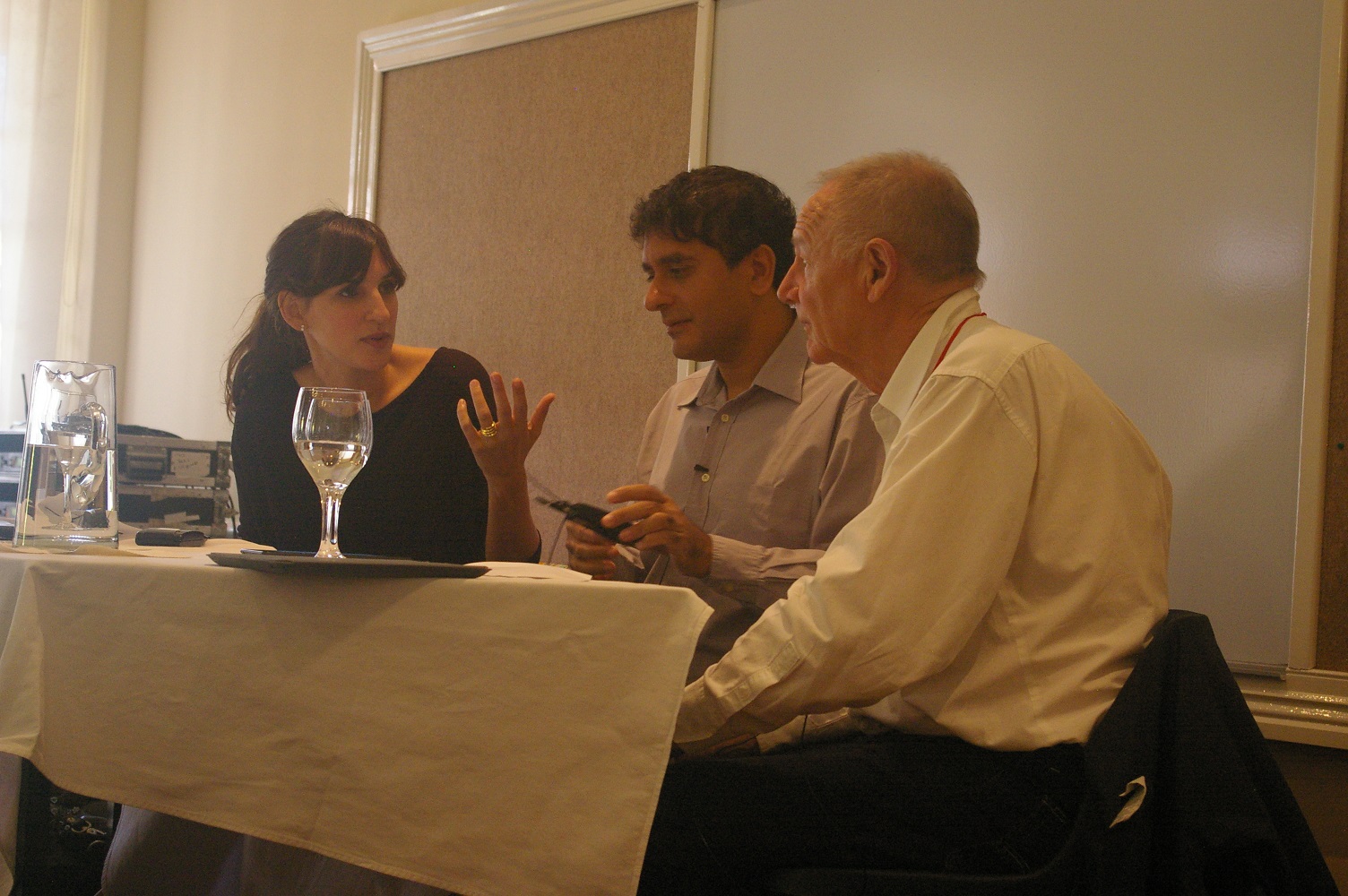
Imraan Coovadia spoke to Nadia Davids and Michiel Heyns about the Western and the South African literary canons. All three are novelists, reviewers and academics.

FLF books 2Nadia said something very moving about academics having the “privilege of learning to read deeply”. She sees the text as a social document that operates in the world, not only as something read for pleasure. During our talk the day before, I asked her whether her own novel, An Imperfect Blessing, was an attempt to write a people into history who had been underrepresented until recently, and she said yes, admitting that it was done with the full awareness of the pitfall of representation. That was her reason for including minute details of everyday Muslim family life in her story of specific historical moments (time round forced removals from District Six, the state of emergency in1986 and the year 1993, just before the first democratic elections). Michiel mentioned that while reading Nadia’s novel he was aware of her having read Jane Austen. What a compliment for any writer!

Nadia, Imraan and Michiel at the FLF

Nadia, Imraan and Michiel at the FLF

Imraan, who is an excellent book reviewer with the kind of gutsy eloquence which I lack, quoted from the curious Wikipedia entry about South African literature which made most of the audience shudder. Hope was expressed that people engaged in writing these entries will amend it to reflect less biased views. Imraan asked the panellists to name their own personal South African canons. The Story of an African Farm was there for both Nadia and Michiel. Michiel mentioned Bosman, Paton, J.M. Coetzee (Age of Iron and Disgrace); Nadia added Woza Albert!, The Island, Gordimer and Brink. Outside of South Africa, Nadia made a special mention of Anna Karenina, and Michiel of Middlemarch. Harold Bloom’s conservative take on the Western canon was discussed. Imraan found that according to Google the most mentioned South African books are Long Walk to Freedom, Cry, the Beloved Country, Country of My Skull, Heart of Redness, Ways of Dying, Spud, The Smell of Apples, The Power of One, and Master Harold and the Boys. He added Burger’s Daughter to the list himself, because “it should have been there.” I agree wholeheartedly.

Michiel Heyns is one of my favourite local book reviewers. (For five years, I’d had the honour of reviewing books alongside Imraan and Michiel for the Sunday Independent under the editorial guidance of Maureen Isaacson.) I always say that when I grow up I want to write reviews like his. I also had the privilege of working with him on Encounters with André Brink. Michiel is one of the few South African authors who see the entire world as their fictional playground, daring to write about topics other than local. I applaud him for that! Exciting news is that Michiel’s latest novel, A Sportful Malice, has been published last week. Talking about the Western canon, or any canon for that matter: the title derives from Shakespeare. Definitely something to look forward to! During the discussion, Michiel mentioned merit in relation to Nadia’s reference to the text as a social document. He spoke about literature and the canon as a “moral guide”, of showing you “how to live your life”. A test for any text is whether you are prepared to reread it, he said. I also think of it in terms of whether you want to share it with other people. The moment I find myself buying the same title over and over again for my friends, I know I have encountered a good book.

AFRICAN PASTORAL
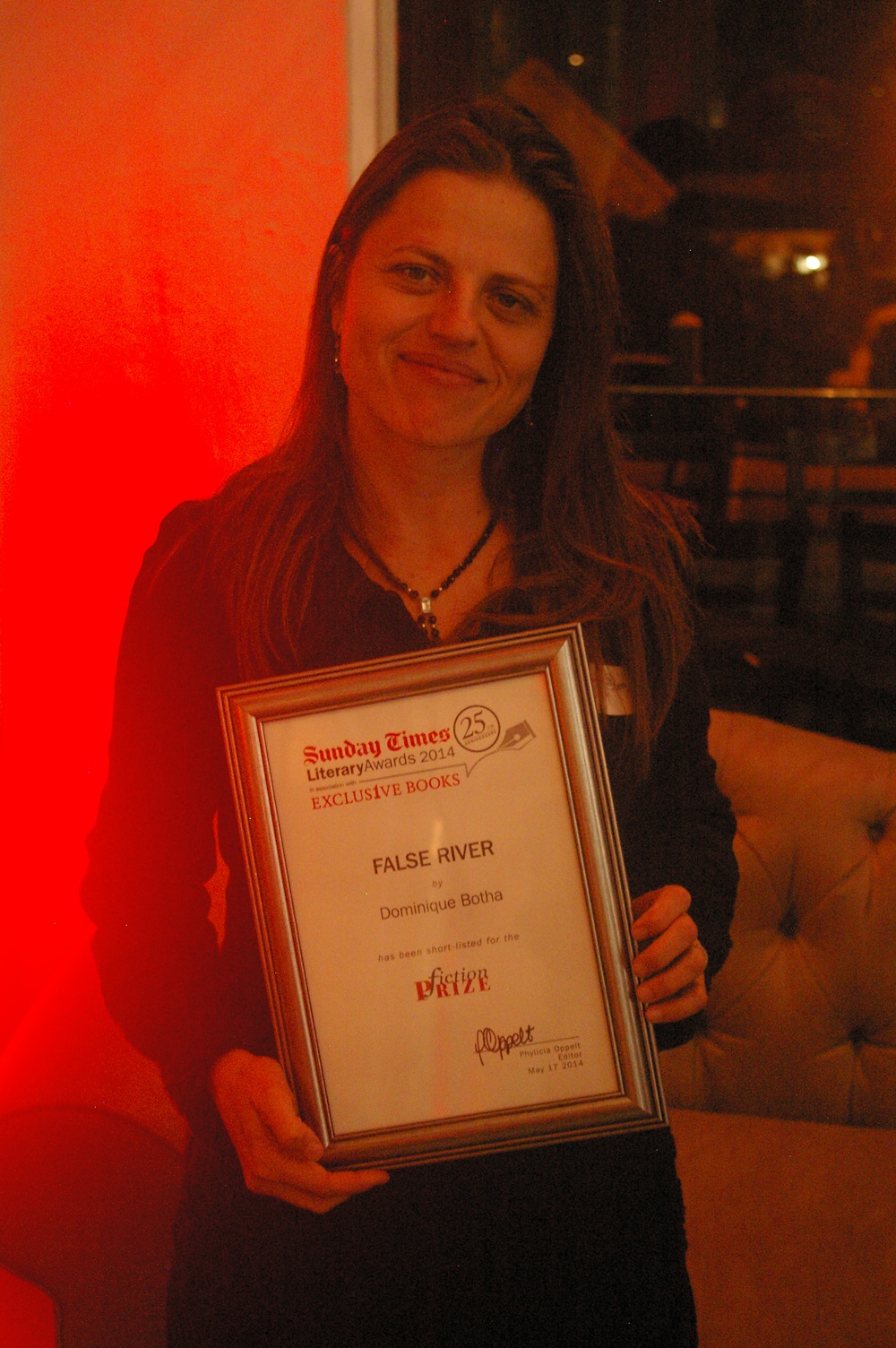
DominiqueHarry Garuba talking to Dominique Botha, Claire Robertson, and André Brink about their latest novels, False River, The Spiral House, and Philida, respectively.

Claire and Dominique are first-time novelists. Like André, Dominique writes in both languages, Afrikaans and English. She recommended to everyone in the audience to write in Afrikaans if they could, as she was thrilled with the kind of enthusiasm and reception she encountered on the Afrikaans literary scene. Her novel is based on her family story and she has kept the names of her family members in the book: “It’s my take on something that may or may not have happened,” she said. She is of the opinion that “it is much better to write truth and call it fiction than to write fiction and call it truth”. (During questions from the audience, I asked about her decision to keep the real names for a fictionalised story. She said the names were beautiful and that changing them would not have removed the problematic aspect of the situation. The people involved would still know that they are being written about, only the larger public not. I’m not entirely convinced. In cases like this, I always try to imagine what it would be like for me: I would feel uncomfortable about my own brother writing a fictionalised version of me and using my name for it in a novel. It simply would feel that it wasn’t me. Why my name then? If he was writing a memoir or biography, and attempting to reconstruct memories in the process without intentionally fictionalising them, I would have no issue with him telling anything about the family past we share and using my name. In a novel based on fact, on the other hand, I feel that a name change signifies that fiction is part of the parcel, that the people are no longer the ones you knew in real life but partly imagined characters who might reflect on real people but are their own creatures. This is particularly true for me when one writes about people who are still alive and who owe their own versions of a story. I don’t want to pretend to have final answers to this complicated process, not even for my own work, but I think it is an aspect of writing that should be treated with utmost care.)

Claire, who had the rare experience in South Africa of having her book go beyond the first impression within a very short period of time, spoke about the idea of a farm novel which not only connects us to the land but to something much larger. After she’d finished her novel, it revealed to her that what she had been writing about is the “urge to perform acts of rescue”. While writing, whether as a novelist or a journalist, she looks for “tragic flaws”, not “wickedness”, in people, whether it is in the men of the Enlightenment or the architects of apartheid.

Tellingly, I forgot to note who during the discussion said that memory is a “very personal and unreliable thing”.

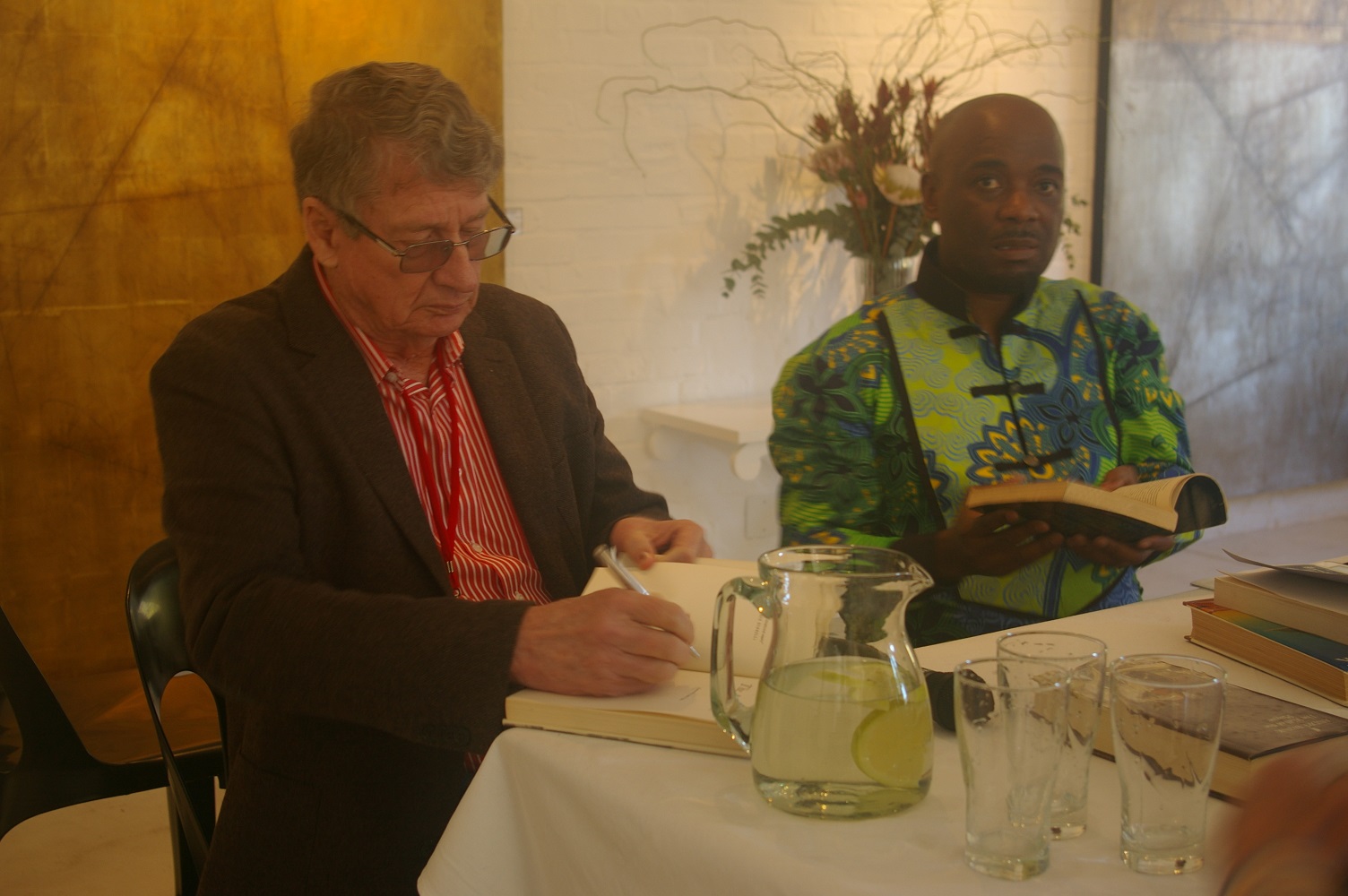
Victor and André

Victor and André

For André, whose novel Philida was born on and delves into the history of the nearby wine farm Solms-Delta, the act of writing begins when fact ends and imagination takes over. Through writing the story of Philida, he felt “enmeshed in my own life”. Philida could voice things which were difficult to communicate otherwise.
In the fourth event I attended (LITERARY DOYEN) Victor Dlamini, an insightful and patient interviewer (and one of my favourite photographers), spoke to André about his career, belonging, and Philida.

A note of thank you: Thank you Liz for all your kind words about my novel (you made my day!). Thank you to all for a weekend of literary delights!

Books sold (that I know of): 1 (thank you Nols – very kind of you! I hope you will enjoy it)
Books bought: 3
(I’m clearly not in it for the money.)

27 April 1994: Two Decades Later

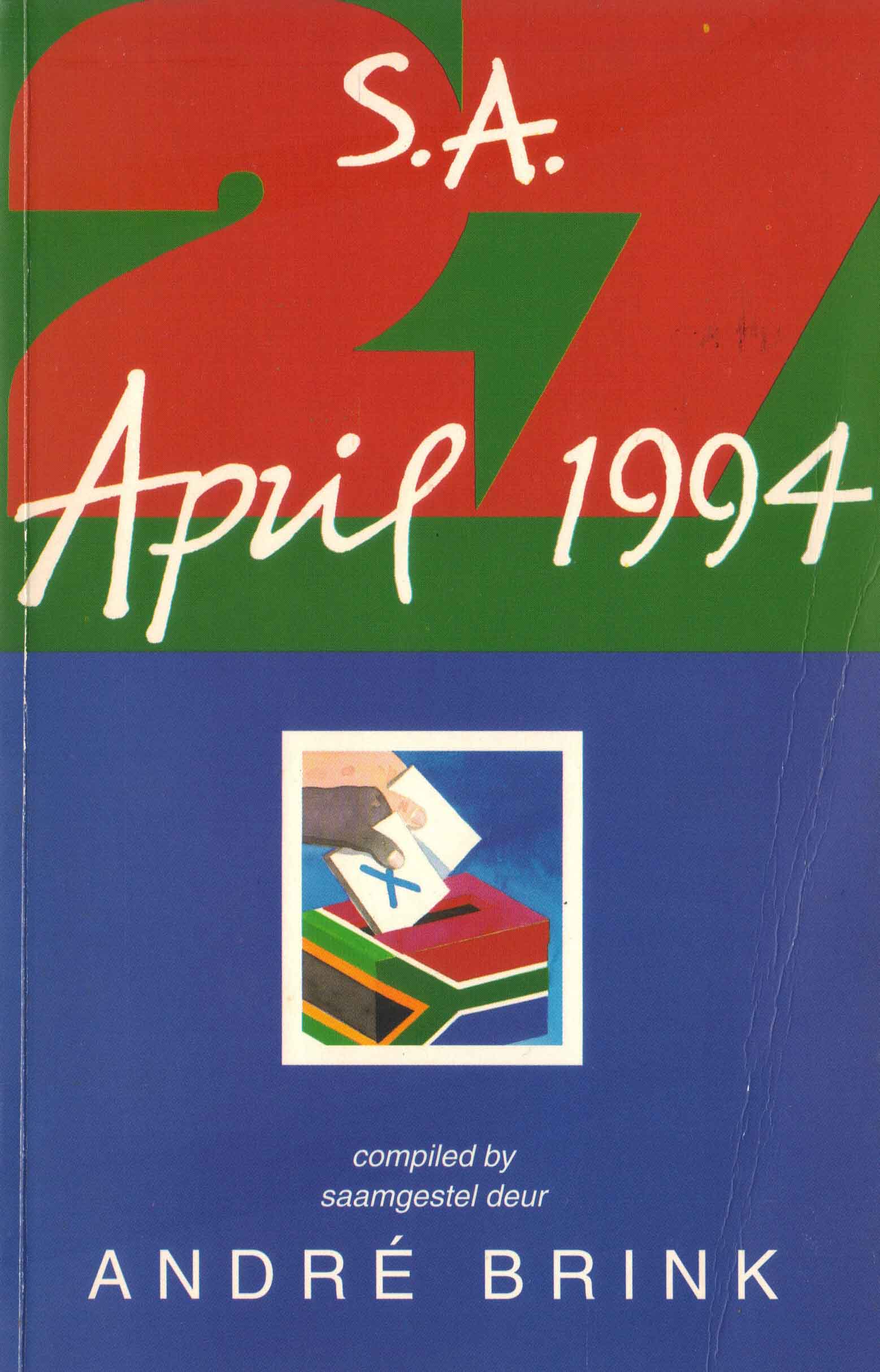
27 April 1994SA 27 APRIL 1994: AN AUTHORS’ DIARY * ‘N SKRYWERSDAGBOEK (Queillerie, 1994)
Edited by André Brink

“…here was an opportunity for writers to test their word against, arguably, the most remarkable moment in their history.” André Brink in “To the Reader”, p. 8.

“Later, sun low, tide running out in me, I bus into the township shack of my dear love, my need of her never so strong.
[…]
She reads me, smiles, her eyes soft in the room’s dusk, her hands beckoning me to come.
‘It’s done,’ she whispers, ‘we have walked the last mile!’
Later still, I help her to the bed. We are careful with each other as though we hold a fine glass, and my heart sings.
Yes, against all odds, my heart sings.” Tatamkulu Afrika in “Against All Odds, My Heart Sings”, p. 13.

“Mens se hart is bly: niemand gaan hierdie stukkies toekoms wat die mense vashou weer kan wegneem nie. Byna wil ek sê: hierdie land se politici verdien wragtig nie so ‘n wonderlike bevolking nie.” Breyten Breytenbach in “Joernaal van ‘n wending”, p. 25.

“The day has been captured for me by the men and women who couldn’t read or write, but underwrote it, at last, with their kind of signature. May it be the seal on the end of illiteracy, of the pain of imposed ignorance, of the deprivation of the fullness of life.” Nadine Gordimer in “April 27: The First Time”, p. 52.

“We all know that it won’t be a smooth road ahead.” Jenny Hobbs in “The Day We Minded Our Peace in Queues”, p. 60.

“An Organisation must be disciplined, purposeful, and idealistic in a good sense. It must also be diverse, in that it must encompass others, beyond its own affiliates. It must be committed and dedicated to one goal and one goal only: to change the miserable conditions of people to enable them to live full and rich lives; it must inspire them to realise their full intellectual potential.” Mazisi Kunene, p. 73.

“My greatest victory and achievement as an individual is to know that my children and grandchildren and their age groups in my community move with grace and dignity as full-fledged citizens of South Africa, and with full rights to determine the future of our country.” Ellen Kuzwayo in “The First Democratic Elections in South Africa”, p. 80.

“Peace is like an undying light / Shining and glowing from within / Within each one of us” Gcina Mhlophe in “Peace Is Within”, p. 85.

“Perhaps it [Table Mountain] was reaffirming its old lesson on faith: on election day. That the future is there for us: we need to have faith in it, and in ourselves. And so I ended my day unemotionally, but deeply affirmed.” Njabulo S Ndebele in “Elections, Mountains, and One Voter”, p. 95.

“I picked up the pencil that was well chewed and attached to the makeshift desk by a length of string and put my cross, quickly, trying not to agonise about it yet again.” Mike Nicol in “Voting at the Camel Rock Café”, p. 98.

“Wanner iemand my vra wat dink ek van ons toekoms, dan antwoord ek ons mag die toekoms nie ken nie: so bly elke dag ‘n avontuur.” Jan Rabie, p. 108.

“So, Mammie en Derri, cheers! Ek leef – kyk, ek leef – in ‘n nuwe Suid-Afrika!” Adam Small in “Feniks: ‘n brief, kamma, aan my ouers (wat al dood is)”, p. 123.

“It was after three hours walking, at 7 am, that I cast my two votes at the Dwarsrivier polling station. It was quite clear that I was the very first person to vote there. No doubt the IEC staff manning the station had been expecting something extraordinary all along, but not for the first voter suddenly to appear, as I had done, out of the mountains behind the school-hall that served as the polling station.” Stephen Watson in “Voting With My Feet”, p. 162.

“Want vir die heel eerste keer in my lewe was ek ‘n vry Suid-Afrikaan.” Melvin Whitebooi in “Au revoir”, p. 171.

Contirbutors: Tatamkulu Afrika, Hennie Aucamp, Chris Barnard, Breyten Breytenbach, Kerneels Breytenbach, André Brink, Achmat Dangor, Abraham H de Vries, Arthur Goldstuck, Jeanne Goosen, Nadine Gordimer, Rachelle Greeff, Jenny Hobbs, Peter Horn, Daniel Hugo, Elsa Joubert, Antjie Krog, Mazisi Kunene, Ellen Kuzwayo, Dalene Matthee, Mzwakhe Mbuli, Gcina Mhlophe, Petra Müller, Njabulo S Ndebele, Mike Nicol, Welma Odendaal, Abraham Phillips, Marguerite Poland, Jan Rabie, Albie Sachs, Riana Scheepers, Gus Silber, Adam Small, Berta Smit, Peter Snyders, Klaas Steytler, Alexander Strachan, Pieter Dirk-Uys, Madeleine van Biljon, Marita van der Vyver, Marlene van Niekerk, Lettie Viljoen (Ingrid Winterbach), Stephen Watson, George Weideman, Melvin Whitebooi

10 Questions

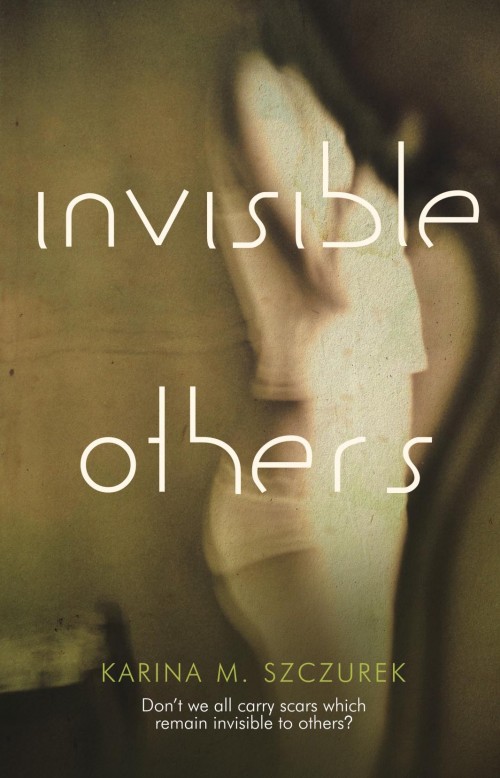
Invisible Others1. What question are you asked the most frequently?
How does one pronounce ‘Szczurek’? People usually remember me as the one with that weird name and hardly ever get it right. But I don’t mind. I know they mean me.

2. What is the question you dread being asked about Invisible Others?
It wouldn’t be very wise to give it away here… Officially, I don’t dread any questions about the novel.

3. Invisible Others is your first novel and at first you wanted to publish it under a pseudonym. Why?
People engaged in criticism often misinterpret their own role in the literary community. I wanted to avoid having to deal with those kinds of frauds, but I realised that a pseudonym wasn’t the answer.

4. Do you think being André Brink’s wife can count against you as a novelist?
Perhaps, but it will count against me with people who base their judgements on matters which have nothing to do with the real me or the real André, and definitely not with my work, so I can’t really take that attitude seriously.

5. You write about sex without the shackles of Calvinism. Are Polish women more open to talk about sex than South African women?
Not at all. My open approach to sexuality has nothing to do with my being Polish. Sexuality is such an essential part of who we all are; it is important to me to write about it as a lived, not only an imagined (and thus often distorted), experience.

6. In Invisible Others you describe Paris in a sensual and cinematically evocative way. Why are you so drawn to this city?
The story demanded being set in Paris. My role was to try to do justice to the city which has been written about so widely. I focused on the spaces which have personal meaning for me, like the Polish Bookshop.

7. You and your family fled Poland when you were still young. In what way has this shaped the Karina you are today?
In every way. A migratory background marks people the way gender, class and race do – it influences everything you do in life. We fled the then-communist Poland in 1987 when I was ten years old and settled in Austria where my parents still live. They wanted a life of freedom and opportunities for us. They certainly succeeded!

8. What is your favourite thing about South Africa?
Multiculturalism – it is what made me feel at home here the moment I stepped off my first flight to Cape Town a decade ago.

9. And your least favourite thing?
Fear.

10. You and your husband André are both masterful tellers of love stories. Will you ever write about your own romance in fictional form?
If we ever did, our love story would not need the veil of fiction to be told. In a way we are telling it already, in bits and pieces of our non-fiction writing.

First published in Afrikaans in Beeld.

Liesl Jobson on the Book Lounge launch of Invisible Others

With Sally, photo by Liesl Jobson

With Sally, photo by Liesl Jobson

With my Mom and André, photo by Liesl Jobson

With my Mom and André, photo by Liesl Jobson

“At the launch of Karina Szczurek’s debut novel, Invisible Others, at The Book Lounge last week, this most welcome addition to the South African literary canon received high praise from those in the know. ‘It is a beautifully written novel,’ said an Mervyn Sloman, ‘in a spare style that is simultaneously lavish – it must be the French connection!’ Sloman said the characters are fully drawn with the author sustaining a ‘wonderful novelistic tease’ that keeps one turning the page. ‘This book is an absolute gift to us!’ he said.

Szczurek was joined in conversation by the talented YA novelist, Sally Partridge, who confirmed Sloman’s assessment of Invisible Others as ‘beautiful’. She introduced Szczurek as an author who wore many hats – an academic, editor, essayist, poet and an award-winning playwright. She said the book is an intense study on the nature of damaging relationships and asked Szczurek why she chose to write about this topic….’

Continue reading…
Report by Liesl Jobson

For more photographs click here.

First steps

Invisible Others is making her first steps in the world. These are some of the questions I have been asked about the novel during the launch last Tuesday (interviewed by S.A. Partridge) and during the Woordfees event (interviewed by Ingrid Winterbach) on Thursday. A rough reconstruction of my replies follows.

How does it feel to hold the novel in your hands?
It still doesn’t feel real. I think it will take a few weeks to sink in, to properly realise that something that has lived on in my head for so many years is finally out there, contained in an object that has turned out to be so beautiful. I am grateful for all people involved in the production process of the physical book, especially Hanli Deysel and Danél Hanekom, whose ideas, designs, guidance and the willingness to cooperate were exceptional. It isn’t a given that an author is included in the decision-making pertaining to this part of a book publication.

How did the novel begin?
As a short story, and with a single image. For a long time I’d thought of myself a short story writer, but I was curious whether I could write in the longer form. To test myself, I went to a writer’s retreat in Calvinia and began writing my first novel there. In the course of my stay in Calvinia I realised that I could do it, but the story I was writing (a more typical first novel about growing up) was too autobiographical, too close to the bone, and I was not prepared to share it with an audience, at least not yet. So the manuscript ended up in my drawer. I then picked up an unfinished short story I was working on at the time. It began escalating into something longer and eventually resulted in Invisible Others. But it all started with an image of a woman and a man having a picnic in a park I knew in Paris. That scene is still in the novel. I knew that they were somehow trying to reach out to one another, but it was not easy for them to connect. The novel became an exploration of the reasons behind this difficulty.

Will there be another novel, or are you returning to the short form?
I am working on a YA novel, and I have a half-finished speculative fiction novel waiting on the backburner. But I love short stories and will continue writing them. I am intrigued by the challenge of the short story, of having to make every word and gesture count. Sometimes I feel that everything I write is about gestures, tiny imperceptible things like a glance or a twitch of a finger can change the course of a story. Capturing these moments in fiction fascinates me.

How does an academic background inform your writing?
I am aware of trends, patterns, some theory which is a good and a bad thing. As a writer, I would like to build on existing developments, but not be trapped by them. Having a very individual and specific migratory background, and yet being thoroughly shaped by my knowledge of local literature, I believe I can contribute something different to the scene. At the same time, very often being aware of what is happening can be limiting and discouraging.

Carolina's park

Carolina’s park

You write about Paris with a clear sense of place. Do you know it well?
I wrote about a deeply personal side of Paris – the spaces I know and love in the city, like the Polish Bookshop or some of the restaurants and parks mentioned in the novel. But I don’t want to claim that I know Paris well. It is a city which constantly eludes me no matter how eager I am to grasp it.
I was also very much aware of the fact that Paris is one of the most written about places on the planet, and that I did not want to compete with such a significant body of work. Trying to do justice to the setting, I concentrated on a few familiar, intimate spaces. I worked from memory, but also took photographs, drew little maps, made many notes, and used Google Maps for verification. But there was a moment where imagination took over and the descriptions in the novel do not always correspond 1:1 with reality. Also, I discovered that during the time it took me to write the book some places I used as settings had changed: a restaurant I mentioned disappeared completely; the bookshop changed its layout and expanded. In that sense, the Paris of the novel is at times a purely imagined space.

Both Cara and Konrad find refuge in Paris – why Paris as a runaway place?
For Cara, the reason why she chooses Paris becomes obvious as the novel progresses. For Konrad, it is a place that is essential to his research. From the first, Paris was always part of the story. The story chose it. On the one hand, I persisted with the setting because I liked the idea of it being an unusual place for a contemporary English-speaking South African to emigrate to. It used to be much more obvious for Afrikaans speakers to travel to Paris in the 50s, 60s and beyond. A whole generation of Afrikaans writers were shaped by their Parisian encounters. On the other hand, I did not want to write another novel about an exiled South African returning to the country of their birth. Cara and Konrad do not emigrate because of socio-political or historical circumstances, but for purely personal reasons. I wanted to write about a different migratory experience which reflects a different aspect of the reality of our globalised world – one where people migrate and choose to stay or even move on, but do not return to their country of origin. In that sense, I wanted the novel to defy expectations.

What about other research?
My characters know a lot more than I do about art, history, typesetting or geography. They have different passions and fears from mine. I wanted to make things which originated in my head come to life for others. I had to read up enough on all these subjects in order to make them believable.

And national identity?
There are two ways in which I wanted to engage with issues of identity in the novel: as an everyday experience without necessarily political or historical connotations; and an academic pursuit where these connotations matter strongly, but are nearly entirely confined to the research Konrad does, they do not spill over into his own lived experience. But on the whole, I wanted to remain on a rather superficial level while handling these issues by concentrating on the nostalgia for one’s country of origin in daily life which manifests itself in preferences for certain food, music, art, reading, drinks, proverbs, or customs. It was important for me to show that despite these obvious and natural longings, like so many people in today’s world, Konrad and Cara can make a home for themselves away from the places of their birth.

In the novel, you come across as an authority on art. What is the role of visual art in your life?
To be honest, I know very little about visual art apart from my own responses to some artists’ work. I have a deep love for beauty and objects. There is something about the timelessness and reliability of an object which fascinates me. I surround myself with objects which have meaning for me, some of these are art pieces – hardly ever of any general value, but always of enormous personal value to me. One of the reasons I fell head over heels in love with The Book of Happenstance (by Ingrid Winterbach) is the portrayal of the relationship the main character has with her collection of shells. It is one of the most, if not the most, accurate description of what I often feel for objects which matter to me, and what their loss means to me.
I am a huge fan of Siri Hustvedt’s work as a novelist and as an observer. Her books on art and looking at art are inspiring and moving. The theory is just as important as the response, and the clarity of her presentation of both is astounding.

Which artists, if any, inspired the art in Invisible Others?
These might seem like completely incompatible influences, but for Lucas’s work I thought of Francis Bacon, Egon Schiele and Tamara de Lempicka; for Dagmar’s work I thought of William Kentridge and Renée le Roux. But no specific real image inspired any of the imagined paintings which appear in the novel. It was more like the combined mood of these oeuvres that I tried to capture in the art featured in Invisible Others.

Invisible Others is a timeless story where technology takes a backseat – was this a conscious decision?
Very much so. It also reflects my own life and attitude towards social media, media in general, and the internet. I love the opportunities technology and media offer, but I have also become very cautious in using them. The internet provides us with enormous advantages; it can enrich our lives, but it can also be a dangerous tool with a sting. The exposure to media nearly destroys Cara’s life. She consciously tries to hide from it all. Konrad is weary of the pitfalls of the internet and yet can’t resist its temptations. To his credit, instead of speculating, he tries to keep an open mind and find out what he needs to know from the only person who can tell him the truth about what happened.

Why the attraction of love triangles and dysfunctional relationships?
When we are honest with ourselves, most of us will have to admit that there are many things – essential things – in our relationships with others which we cannot articulate – such as our fears, desires or passions. I have always been fascinated by this inability to communicate between people, and personally, I have worked all my life in my relationships to conquer it. But often instead of communicating, we end up falling into triangular relationships – not necessarily with other people, a hobby or work can be such an escapist third party – to satisfy what cannot be brought to light in the relationships which truly matter to us. We are mostly suckers for suffering. We need to suffer to feel alive. There aren’t many people out there who are happy without drama, who can appreciate the simple, good things in life.

Do invisible others doom relationships before they even happen?
They do. For better or worse, we carry around the memories and ghosts of people who have shaped and influenced our lives and very often we are either unaware of their presence or not courageous enough to admit to it or face it. These invisible others can interfere with our present relationships if we allow them to haunt us. Finding a way to see and understand these spaces and figures makes relationships possible, or not, if we fail. This is where fiction comes in for me: writing is often an attempt at trying to penetrate those spaces.

What drives Cara into the affair?
A powerful attraction. She falls for the wrong man and persists in the relationship. It seems to me that we often stay in relationships because we believe that we have already sacrificed so much for them, we simply have to make them work, even if the only sensible thing to do is to cut one’s losses and walk away.

Why should the reader identify with her?
I hope readers will travel a journey with Cara similar to my own. When she appeared to me in that picnic image in the park, she started off as a puzzle, a mystery, one I did not particularly warm to, but one who intrigued me. I wanted to understand her, to see what made her tick, and almost inevitably I started caring for her in the attempt. Cara defied me. She showed me that sometimes people do terrible things not because they are terrible people, but because they can’t help themselves. One can appreciate or forgive a lot as long as one understands the reasons. This is part of what Siri Hustvedt refers to as “a call for empathy” and the reason why I chose the passage from one of her essays which explains this phrase for the epigraph of Invisible Others.

The ending of the novel was puzzling – can you comment?
The ending somehow surprised me as well. It has everything to do with the fact of how Cara took over her own story, how she did not allow me to leave her entirely in the lurch (as I was keen to in the beginning). It is an open ending. It is wonderful for me to see how some of my readers are beginning to interpret it. Deep in my heart I can feel what happened to Cara, but I still want readers to decide for themselves.

In the novel, Cara turns to reading for solace or guidance. What would you like readers to take away from this novel?
I suppose a bit of both, but mainly solace – I don’t feel that I have the right to guide anybody. But if readers find a moment of truth or revelations in the novel which penetrates their own invisible others and inspires them to explore, communicate, understand these spaces, the magic of fiction would have happened, and that would be more than I would dare to hope for.

You are married to one of the most important contemporary South African writers with an overwhelming oeuvre to his name. Isn’t it a bit intimidating?
Not at all. In the beginning, when I started getting to know André I was a bit scared of his creative process. I know that for many it can be a process of solitude and exclusion and I did not know how I would fit into, or around, it. But then I discovered how open to sharing André was, how generous and supportive, and I relaxed completely. Our studies are at the opposite ends of a passage in our house. There is a lot of communicating going on between them, and invitations to tea.
André’s body of work is enormous, and I am its greatest fan. It doesn’t intimidate me because I have no intentions of competing with it – that would be ridiculous. My writing is very different, the stories I want to tell are my own. I am grateful for all of André’s support and expertise, but I also know that it works both ways. I offer the same to him. There is no room for intimidation in our personal and literary relationship.