Category Archives: Memories

A tribute to Nadine Gordimer

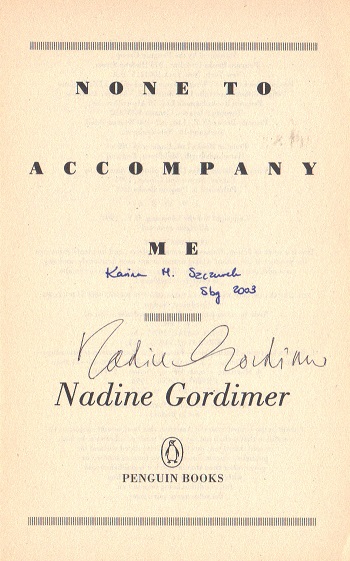
Signature “And then took up her way, breath scrolling out, a signature before her.” The last sentence of Nadine Gordimer’s None to Accompany Me (1994), my favourite of all her novels, still takes my breath away. It is a “biting ebony-blue” winter night when Vera Stark, the narrative’s protagonist, steps into the garden of her new home. Everything is “stripped” outside, bare and clear.

The night Nadine Gordimer died I dreamt of wanting to visit my grandmother. I was walking up the staircase to her flat when I realised that I could no longer see her because she had been dead for several years. I woke up unsettled. The dream was so vivid that it scared me on the morning of the day when my husband André was to undergo surgery. It also made me think about all the precious people in my life.

Continue reading: A tribute to Nadine Gordimer – LitNet

Nadine Gordimer (1923-2014)

An edited Afrikaans version of this article appeared as “Die miesies hy skryf” in By on 26 November 2011.

The madam he write

At eighty-eight Nadine Gordimer is throwing some more logs in the fire. Karina Magdalena Szczurek spoke with her about “certain kinds of attention”.

‘Do you know this author?’ I ask a waitress, pointing at Nadine Gordimer’s name on the cover of a book I am reading.

She shakes her head.

I pay for my lunch and walk from the restaurant to Parktown West, Johannesburg. A jacaranda petal falls on my head as I approach the angular white house which Nadine Gordimer has called her home for the past fifty years.

The first time I arrived here in 2004, I’d felt sick with worry for a week beforehand, duly warned about Gordimer’s reputation as an interviewee who suffers no fools. And this was my first interview, ever.

With Nadine during our first interview in 2004.

With Nadine during our first interview in 2004.

But when she realised that I wasn’t there to ask about her breakfast (the type of personal question she usually refuses to answer), she let down her guard. It was an invaluable experience.

My present visit is a déjà vu in this and other respects. I’m again first met by a staff member and inspected by an eager Weimaraner before being invited into the house. I walk through the kitchen, down a passage and past the narrow, light-filled study where Gordimer’s typewriter squats proudly on a small desk. She is waiting in the lounge. As I enter she folds a newspaper and puts her reading glasses aside.

It is the same room where we first met, but the furniture is arranged differently. She settles in an elegant rocking chair. I sit on a sofa opposite with a coffee table between us.

I have seen her look her age in badly taken photographs, but never in person. Today she looks radiant in a gracefully long white kaftan dress with a soft blue pattern. Her grey hair is stylishly arranged. Delicate earrings adorn her ears.

This time I am more at ease, but I still notice my hands trembling slightly as I set up the voice recorder. I can feel Gordimer’s lively brown eyes on me. A beauty at her age – she turned eighty-eight this month.

Few literary oeuvres can match Gordimer’s. Between the publication of her first story as a child in 1937 and today, the world has seen fourteen novels, ten short-story collections, and six volumes of essays. In 2010, her stories and essays were collected in two large tomes: Life Times: Stories 1952-2007 and Telling Times: Writing and Living 1950-2008.

When in the beginning of 2006 Ampie Coetzee spoke to Gordimer at a literary breakfast organised by Die Burger Book Club in Cape Town, she told him that her memory no longer allowed her to think in novel-terms.

The collection of stories Beethoven Was One-Sixteenth Black was published a year later.

Now she’s finished writing another novel after all. I remind her of what she’d said at the breakfast.

She smiles. ‘I don’t know what was wrong with me then.’

Since 2001, when her husband Reinhold Cassirer died, all her books carry his life dates and the dates of their relationship on their front pages. The dedication moves me every time.

Throughout her writing life Gordimer has stuck to a strict routine, devoting the first part of the day to her work only: ‘I still feel in the morning when I get up now, I’ve got to be at my desk.’

André Brink recalls how many years ago, before he knew better, he tried to phone her before lunch. A staff member informed him that Gordimer was not available.

At André's 70th birthday in Johannesburg.

At André’s 70th birthday in Johannesburg.

‘The madam he write,’ he was told firmly, and he had to try again in the afternoon.

The statement is extremely telling, even if it was not intended as such.

Gordimer grew up into a position of privilege in apartheid South Africa. And yet, while many others went with the flow, she devoted her life to fighting injustice. Even though she is most uncomfortable about the designation, for decades she was considered the ‘voice’ and ‘conscience’ of South Africa in the world.

I first encountered her work at university. The story “The Moment Before the Gun Went Off” (1991) pricked my interest in South African literature, and eventually brought me here for research, then for life.

It tells the story of an Afrikaner farmer on trial for shooting one of his farm workers. The racial and political circumstances condemn him, but the last line of the story overturns all our expectations: “The young black was not the farmer’s boy; he was his son.”

Gordimer has often been accused of portraying Afrikaners unfairly in her work. Asked about it, she reminds me that when the time to protest came there was no prejudice. ‘We did it together!’

She is also quick to point out how Uys Krige was the first person who published anything of hers: ‘He encouraged me tremendously, gave me the most helpful criticism and was a very dear friend.’

She reads Afrikaans writers in translation, and regrets that she lost the Afrikaans she learned at school, or that she never learned any of the other indigenous African languages. ‘As I say, it’s terrible; I’m a very poor linguist.’

Gordimer’s work is not everyone’s cup of tea, mostly considered too political or / and too challenging. But both judgements rest more on hearsay than an engagement with her actual work.

Occasional stylistic density prevents a more leisurely read, but allowed to sink in, her thought-provoking stories can be inspiring, revelatory, and life-changing.

Many see her 1994 novel None to Accompany Me as a purely political reflection of the transition period in South Africa’s recent history. Rereading it now, I am stunned by the accuracy with which she prophecies the dangers facing the fledgling democracy. But for me personally, the novel is one of the most profound portrayals of a woman’s journey to selfhood.

This again brings to mind the statement with which André Brink’s morning phone call was fended off, and another quality which has defined Gordimer’s career – her ambivalence towards feminism. ‘All writers are androgynous beings,’ she states repeatedly.

She caused an uproar when she withdrew The House Gun (1998) from the shortlist of the prestigious Orange Prize for Fiction, reserved for women only.

‘I have been indeed and still am sometimes tackled, because I withdrew…and then I made this rather rude, I suppose,’ she reconsiders, ‘frank remark that we don’t write with our genitals.’

One of her stories, “A Journey”, was reprinted in the South African October edition of Playboy.

‘How do you feel about being published in the magazine?’

There is no issue for her. She does however make one crucial distinction. ‘I would hate to be published anywhere which was racist,’ she says. ‘I would refuse.’

Her parents were Jewish, but she is a self-declared atheist. She recently caused, in her own words, ‘great offence in America’ with her story “Second Coming” (2011) in which the son of God walks across a desolate, post-apocalyptic landscape. The possibility of life’s or humanity’s re-creation is rendered impossible, because as the last one-sentence paragraph tells us: “The sea is dead.”

‘What was the Americans’ problem with it?’ I’m curious.

‘Well, it’s not for me, sitting here in South Africa, this little unbeliever in any religion to say that Jesus is coming…using this as the ultimate example it should be, for people who revere Jesus and the idea of a second coming, that he should find the world destroyed. It’s a story about the environment.’

Gordimer’s Get a Life (2005) was probably the first green novel in South Africa. She is one of a handful of local writers who now consistently champion the environment in their work.

* * *

While she gets some tea, I glance around me. On three sides of the room shelves brim with books and CDs. A vase of strelitzias and a few sculptures of different origins catch my eye. A walking stick rests against the other side of the sofa. The room opens on a large patio and a magnificent garden in full bloom. The cushioned bay window looks like an ideal place for reading. It makes me think of something she’s just said:

‘I have recently reread Anna Karenina and War and Peace, and I have reread the whole of Marcel Proust and now I can read French sufficiently to read it in French. And there are so many others. When I look at my bookshelf, I say, my God I must read that again before I die.’

Bodo, the dog, appears at the same time as the tea tray. Marie biscuits are on offer.

‘How do you like your tea, weakish?’ she asks.

‘Strongish’

‘Oh good!’

Bodo is allowed one cookie while she pours the tea. As she lifts the heavy pot her fragile hands betray her age for the first time.

I cannot help but think of the three thieves who forced their way into her home in 2006 and brutally removed her wedding ring from her finger.

‘Did the attack have any lasting effects on you?’

‘You know, I hesitate to answer this because it sounds as if I’m saying that I am brave. I’m not… The only thing of consequence, practical consequence, is that I now have these wires around the house… But I’m not brave…I choose to go on living here…my reality is here.’

With Sontag at Wits in 2004.

With Sontag at Wits in 2004.

She has been accused of lacking courage to criticise the ANC. But following her late friend, the American intellectual Susan Sontag, Gordimer believes that ‘to be a moral human being, is to be obliged to pay certain kinds of attention.’

Very often she is the first to pay attention and fight with any means available to her for the causes she believes in.

Recently, together with André Brink, she drew up a petition against the planned legislation curtailing freedom of speech in South Africa and introducing ‘apartheid-type censorship all over again.’ The petition was not only signed by just about every writer in the country, but also many international writers whom Gordimer approached at the time during a visit in Sweden.

‘Let’s keep [the protest] going. Throw another log in the fire!’ she says.

The presidency was not impressed.

‘President Zuma didn’t have the courtesy to send us, representing so many others, an acknowledgement.’

In a recent HARDtalk interview she told Stephen Sackur that real loyalty to the ANC means the right to criticize the party, of which she is a member. She spoke of the disappointment she felt about the values that were being betrayed by the ANC. I prod her for more particulars.

‘First of all the fact that power is used in a very personal way.’

She is also deeply disappointed about the government’s handling of education.

‘The schooling is so bad.’ She is shocked at the discrepancy in entry requirements for university students from different backgrounds.

‘We can’t keep our black comrades out of universities. My God, who would want to? But what is the point of them coming in if they can’t cope. It’s humiliating for them…’

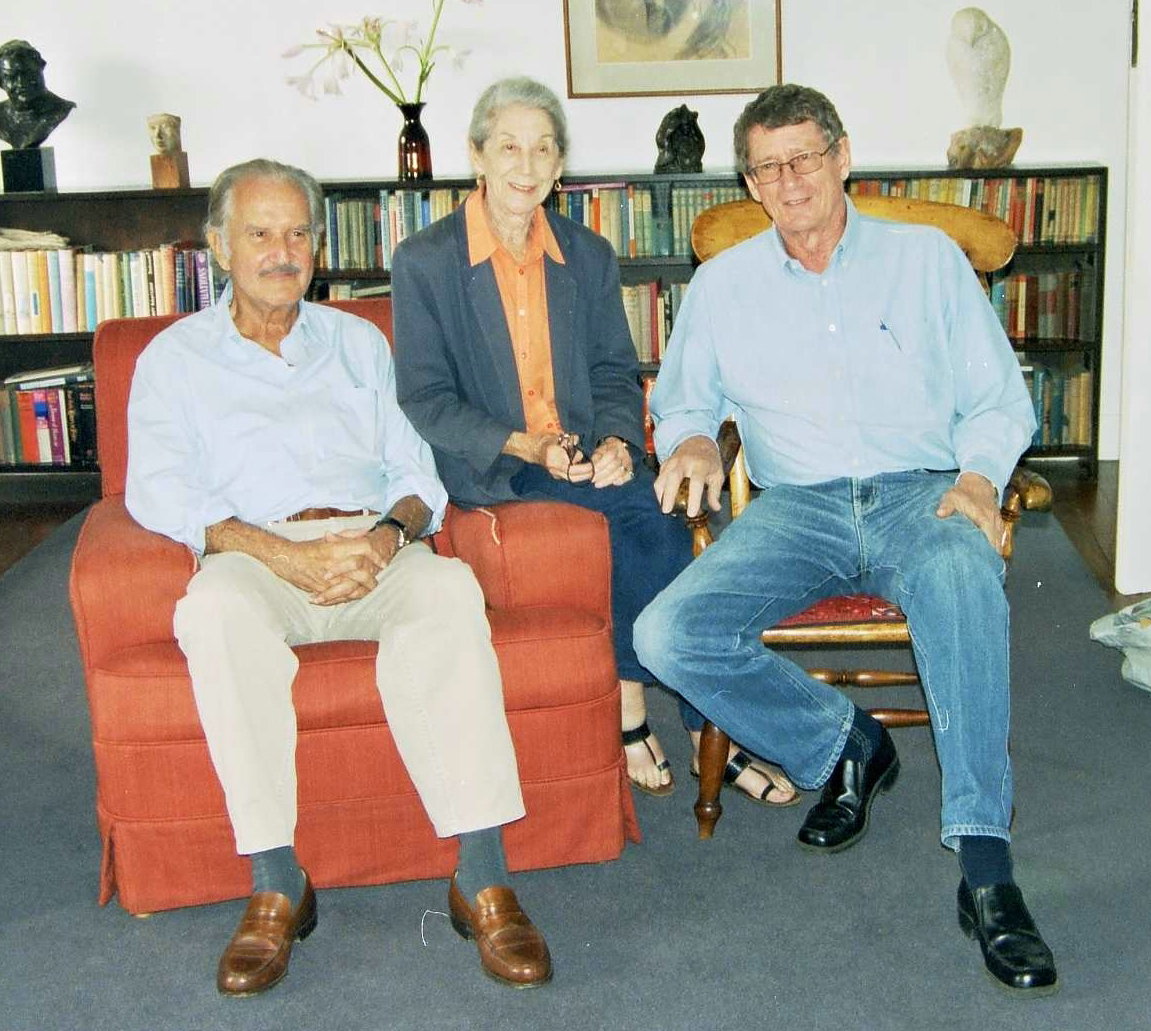
With Carlos Fuentes and André at home in 2006.

With Carlos Fuentes and André at home in 2006.

On the way to O.R. Tambo I ask the shuttle driver whether he knows the author Nadine Gordimer. I also ask a few SAA attendants. No recognition.

While awaiting my flight, I pose the same question to the middle-aged gentleman next to me. He is the only person to respond positively to my question. Does it matter that he is white and at least two decades older than the other people I’ve approached?

I am confident most Poles would at least have heard the name of the Polish Nobel Laureate Wisława Szymborska at school.

* * *

Still in Gordimer’s lounge, I dare ask a personal question.

‘What makes you really happy?’

A short silence; my heart stops.

‘André would say chocolate,’ I volunteer out of desperation.

‘Well, that’s an evasive answer… I’m also very fond of black chocolate, but of course that’s a taste happiness.’

Another pause.

‘I have been unbelievably lucky by having forty-eight years with the love of my life, and I have that to treasure. Sometimes it is painful to do so, but other times…it’s there, I had it.’
Power to inspire

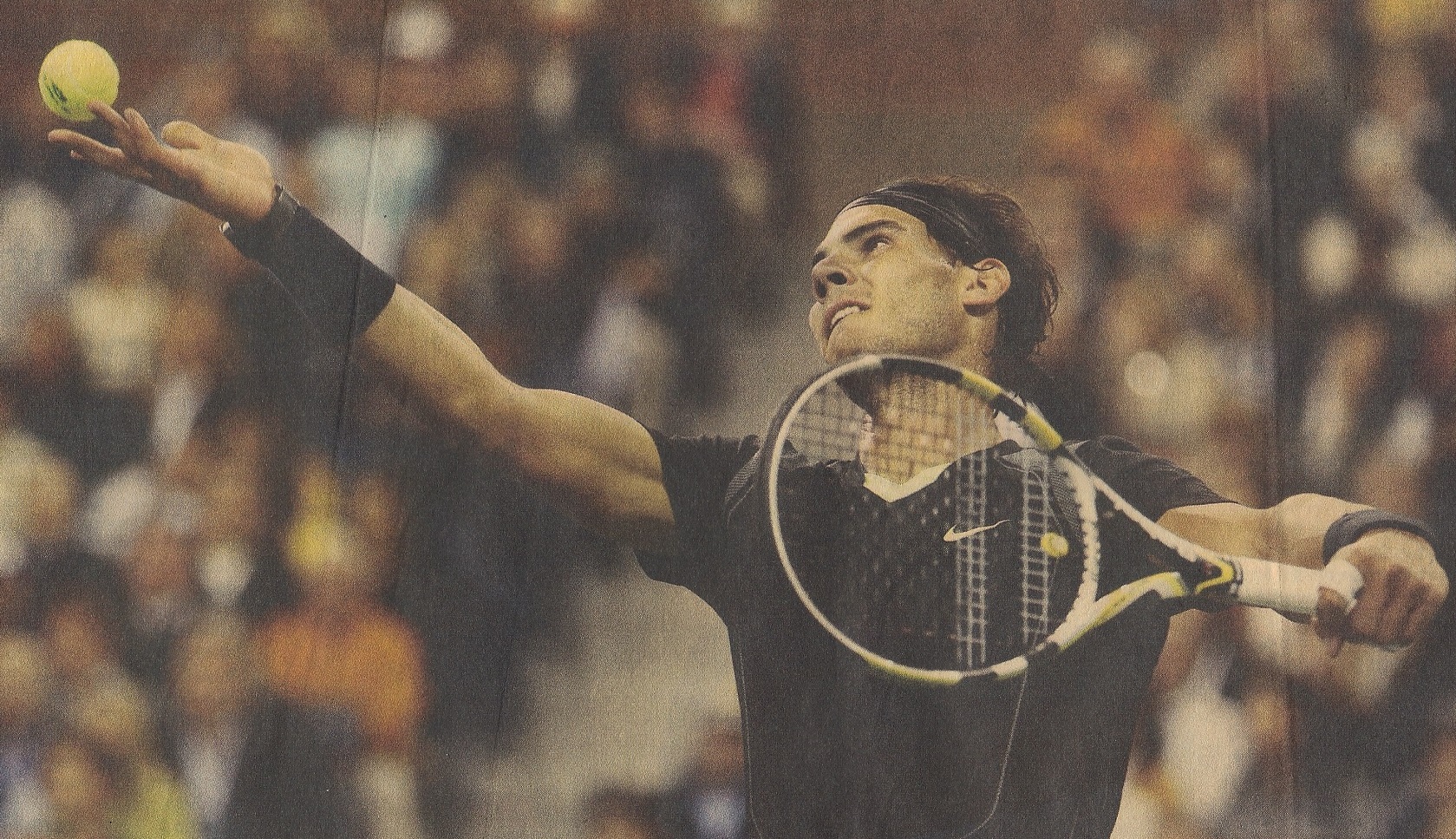
Rafael Nadal at the 2010 US Open, photo by Kevin Lamarque for Reuters

Rafael Nadal at the 2010 US Open, photo by Kevin Lamarque for Reuters

Every time Rafael Nadal steps on a court he is prepared to suffer, and then to suffer some more. By his own admission, he never plays without pain. He seldom gives up, no matter how bad it becomes. His tenacity was nowhere more evident than in the final of the Australian Open earlier this year when he faced Stanislas Wawrinka and could hardly move. He had no right to win that third set, and yet he did. During injury timeout he sobbed his eyes out. The armour of his many strange habits melted away in the furnace of his suffering. Across the world, Rafa fans watched with lumps in their throats. The encounter was painful to all involved, perhaps most to Stan the Man himself who will probably always wonder whether it was a spasm or his skill that won him that title. As is his habit, Nadal congratulated his opponent, his team, thanked everyone, did not make excuses, and bowed out graciously to allow another man to bask in the glory of the moment.

I suppose Wawrinka deserved it anyway for the way he nearly beat Novak Djokovic the year before, and the way he finally managed to beat him in the semi-final before facing Nadal. There is some poetic justice in that. But how much sweeter the victory could have been if, like the nineteen-year-old Juan Martín del Potro, he had beaten the world Number One and Two in top form on his way to his maiden Grand Slam title? The unbelievable final between Del Potro and Federer at the US Open of 2009 is locked away in my memory as one of the greatest matches I’ve witnessed since becoming a tennis fan. I felt just as exhausted from cheering as Del Potro must have been after that beautiful win.

Yesterday, when Nadal lost his first set in the Roland Garros quarter-final to his compatriot David Ferrer, I did not panic. A commentator once remarked that unlike most other tennis players, Nadal, like a sports car, has a sixth gear. It is something to watch when his play shifts into it. Even when he is playing badly and nearly losing and his opponent dares to begin dreaming of victory, there will often be one game, one point, when a stroke of genius ignites that sparks of Nadal’s sixth gear and he will pull a victory out of that fire. Nadal wasn’t anywhere near defeat last night, and there wasn’t much wrong that Ferrer did in the third set, but Nadal becomes unstoppable when he is in that zone. (It is the reason why a fan wrote in one of those endless comment chains on the ATP homepage before the Australian final this year that Nadal is a lion who eats wawrinkas for breakfast. When he isn’t stiff with pain, that is.)

Ferrer is the only player I don’t mind Nadal losing to. Seeing Ferrer triumph at Monte Carlo did not hurt. When Nadal was out with injury for most of 2012 and many doubted whether he would ever play again, during a post-match interview Ferrer was asked whether with Nadal out of the game he was now the King of Clay? His answer – I’m no king, I’m David – says everything about this man who on court between points reminds me of a farmer pacing his kitchen floor, waiting for the storm to pass so that he can inspect the damage to his crops. People say that he has no weapons in his arsenal to beat the Big Four. Perseverance might not be an Isner serve or a Wawrinka backhand, but those haven’t won Ferrer over twenty ATP titles. I would love to witness him adding a Grand Slam championship to that trophy cabinet before he finally hangs up his racket and turns his attention to something just as fulfilling, potato farming or wine making.

Until a few years ago, I hated watching tennis. I had a few false starts with the sport. I thought of it as an elitist pastime for Ferrari-driving snobs and rich bored housewives. When I was a child in Poland of the early 1980s, one of the girls in our street had a tennis racket (her father worked across the border in Eastern Germany), and sometimes she would let us use it. We stood in a queue and passed the racket on to one another; everyone was allowed to bounce the ball once against the side of a building. Not exactly the most exciting introduction to tennis. When I was about thirteen, Liz, a school friend in Warwick, N.Y., tried to teach me to play but she chose a day during a humid heat wave and I could barely move or see in the sun. Then, when I was slightly older, my two male cousins who played quite regularly wanted to play a trick on me and let me hit the ball against them for a few hours. My right arm was in a sling for a week afterwards. I even had to eat with my left, it was so sore. And I always remember my paternal grandfather obsessively glued to the screen whenever tennis was broadcast on TV. He watched night and day and was not amused when we interrupted.

But then I met André. There are three hobbies my husband introduced me to: he asked me to listen to Anna Netrebko and Rolando Villazón and I was forever hooked on opera; he showed me the All Blacks in action and something which I’d always considered brutal and ugly became poetry; and he asked me to watch Roger Federer play against Nadal – the contrasting styles and their rivalry inspired my passion for tennis. Like André, I was a Nadal fan from the start. (Unlike André, I don’t think that his biceps are the most beautiful part of a body I’ve ever seen in a man. I like the way Nadal’s right hand moves through the air though; in slow motion and stills, there is a grace and subtlety to the way his fingers align that clashes with the sheer brutal physicality on his other movements.) We could admire the precision and beauty of Federer’s tennis, but it was the force and ingenuity of Nadal’s racket that won us over. In the meantime, Federer has also grown on us. There is no doubt in my mind that apart from the niggling head-to-head record with Nadal, Federer is the Greatest of All Times. Should Nadal add a few dozen weeks at Number One and a Slam or two to his illustrious achievements, I will reconsider. At the same time, I am not giving up on Federer to still add to his just yet, not before Wimbledon or the next Olympics anyway.

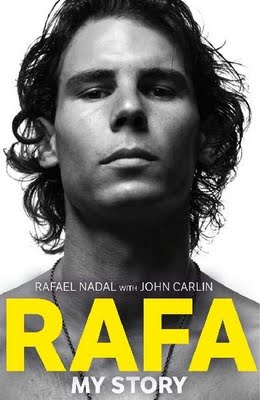
RafaI loved reading Nadal’s autobiography Rafa: My Story, co-written with the wonderful John Carlin whose Playing the Enemy is one of the best books every written on South Africa and rugby. Rafa is also a great read, at times as tense as a Wimbledon final, but mostly an insightful analysis of the fabric of Nadal’s achievements. What moved me most in the book were the descriptions of the tightly woven ties of the Nadal family. I was reading Rafa during my parents’ divorce proceeding, so I understood immediately why it was no coincidence that in 2009 Nadal’s knees gave in at the time when his own parents were separating. Every time he plays and both his parents watch on from the player’s box, sometimes sitting next to each other and chatting away or cheering, I envy him. No achievement of mine could bring my parents back into the same room. The entire Court Philippe Chatrier would not be big enough to accommodate their pain.

Nadal is an inspiration in every sense of the word. I will never play tennis myself, but whenever I am struggling to find the will to go on with my own work, I think of him and write the next word. I think of all the other tennis encounters I’ve witnessed, watching tournaments with André over the years, and take courage from them. Who can forget those last few games of the longest match ever played between John Isner and Nicolas Mahut at Wimbledon? Or that marathon Australian final between Djokovic and Nadal and the latter’s ‘good morning everyone’ during the trophy ceremony. Or Gilles Simon’s and Gael Monfils’ five-setter thriller in Australia, when from the third set onwards one was cramping so much he could hardly stand and the other’s blistered hand was dripping blood, and yet the moment the ball was in play, they fought for every single point as if it was their last. There are no losers in such matches. My everyday battles might seem insignificant in comparison but they are no less real. Watching tennis in such moments gives me strength to face my own weaknesses. And it was Nadal’s on-court magic that brought me to the sport. When he was out with injuries in 2009 and 2012, I continued watching and cheering, but something was missing. A healthy and competing Nadal at the top of his game makes my own work easier and more worthwhile. True greatness always has the power to inspire beyond its own discipline.

Fresh from Franschhoek: FLF 2014

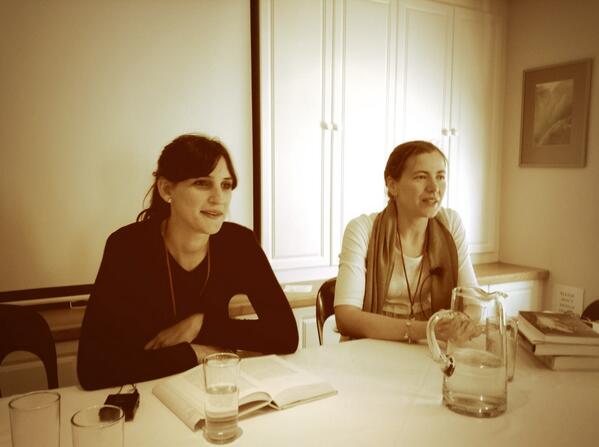
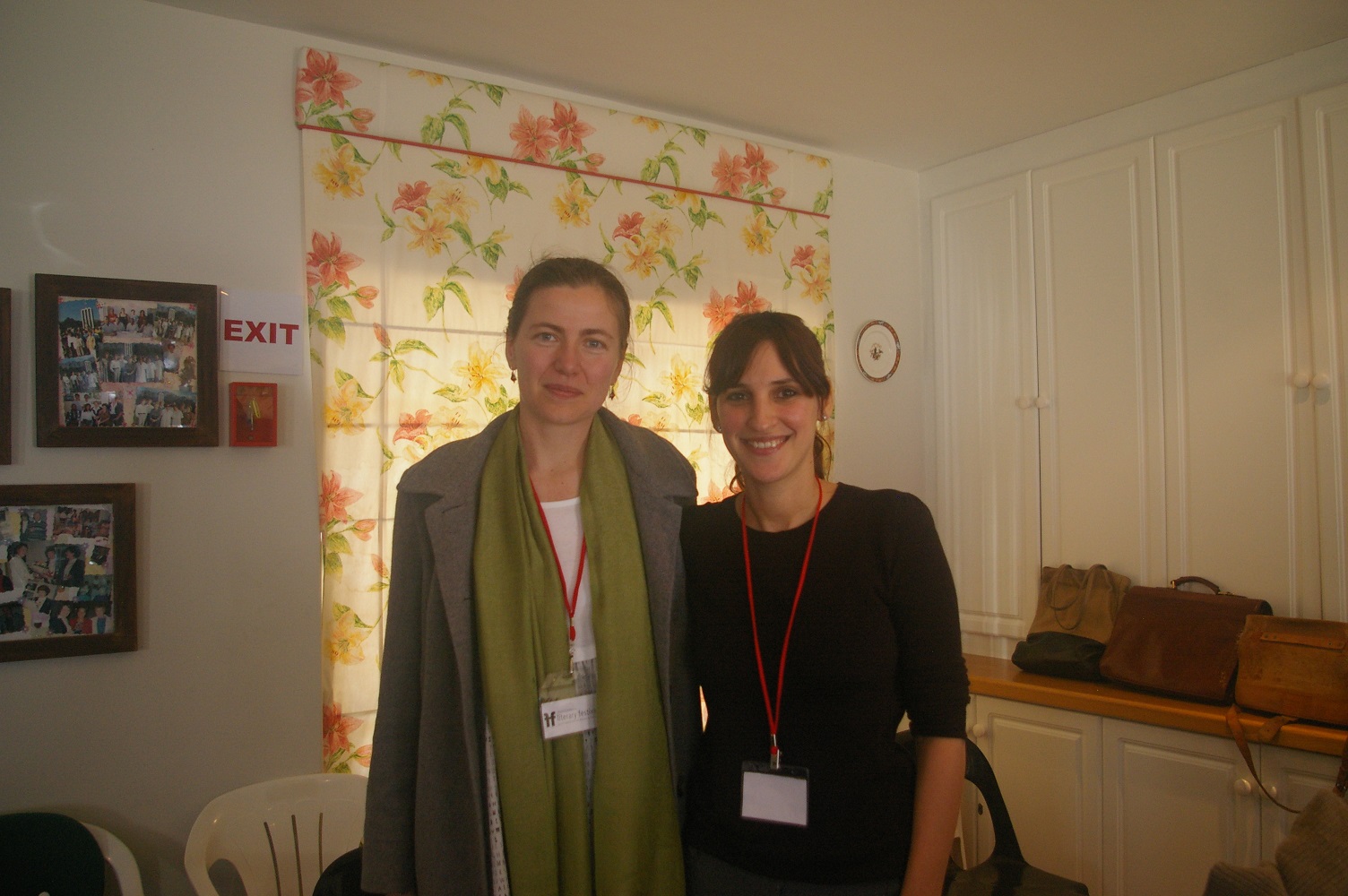
Nadia and I at the FLF, photo by Jennifer Platt

Nadia and I at the FLF, photo by Jennifer Platt

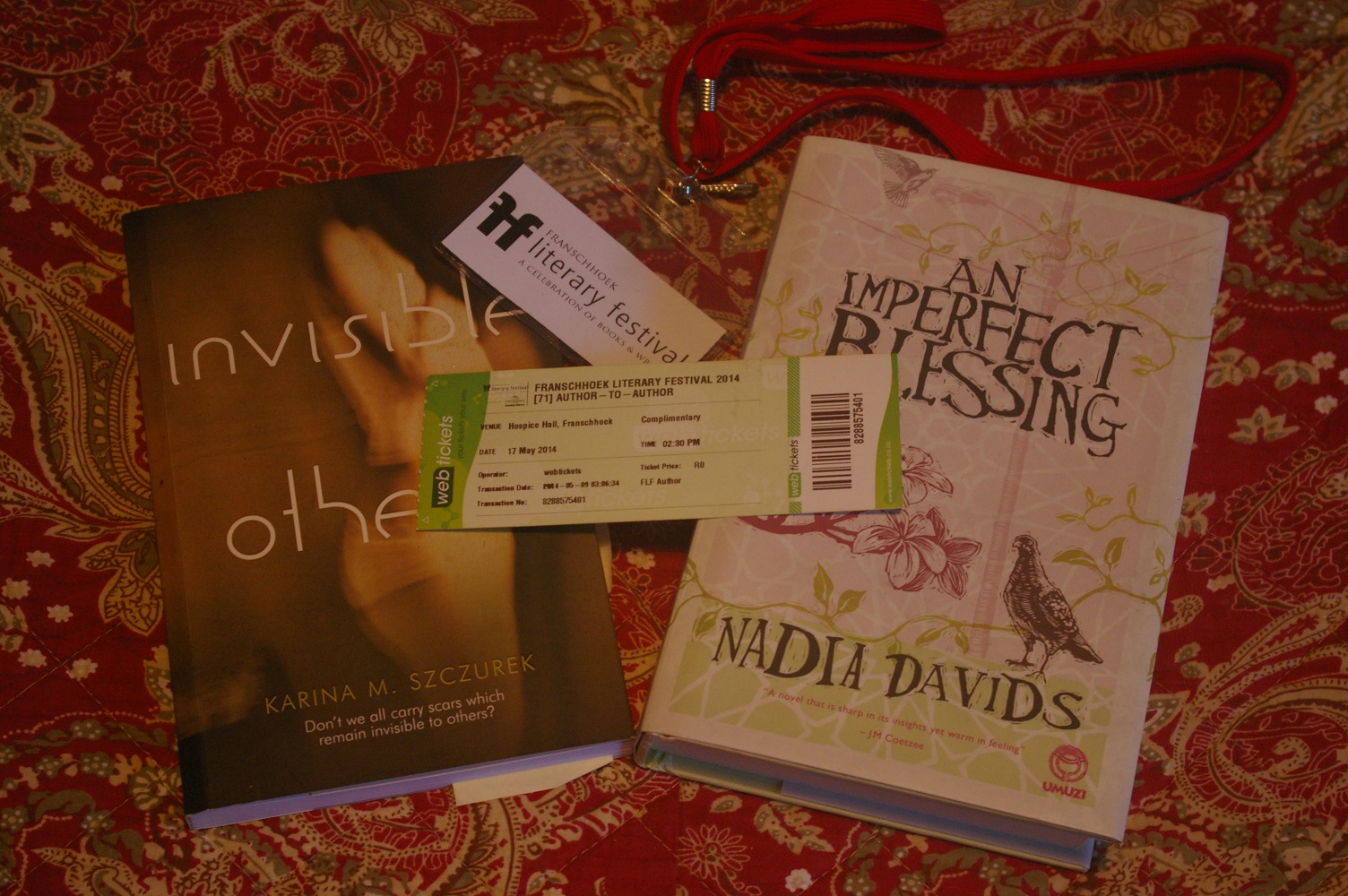
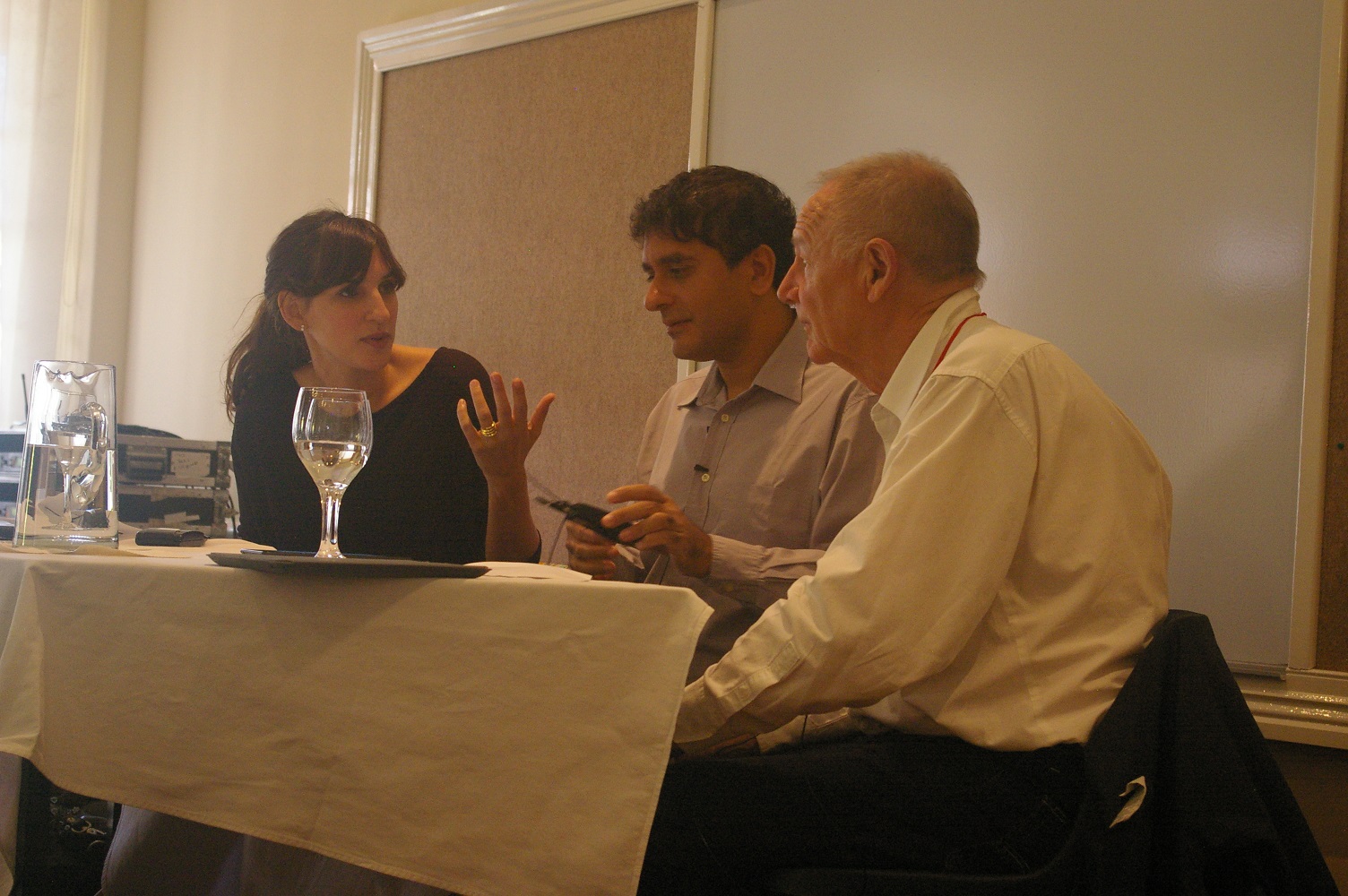
Another FLF has come and gone. It was my first one as a participating author. My event with Nadia Davids was a real joy. Nadia is wonderfully articulate, kind, a pleasure to talk to, and more beautiful in real life than in any photograph. We discovered that on top of everything else we have in common, she left South Africa the year I first arrived here. We seem to be leading these uncanny parallel lives. I hope there will be many more points of contact. We read from our novels, spoke about writing place and history, being first-time novelists, the genres we write in, and our lives as writers and critics.
With Nadia
(Jennifer Platt from the Sunday Times twitted live from our event.)

The guest of honour at the FLF this year displayed her eloquence with light, shade and colour, bathing Franschhoek in its autumn glory. This is my favourite time of the year, and the beauty of autumn days like these past two fills me with a sense of wonder like nothing else. (There was this one autumn day in 1990 when my mother was hanging up laundry in our garden in Church Street in Warwick, NY, and I was just there, watching her, surrounded by the reds and browns and yellows of dying leaves, basking in the early morning light, the sun on my back, and silence between us when I thought, This is where love comes from, from the beauty of this world, it is nourished and sustained by it. Despite its craziness, the weekend reminded me of that day.)

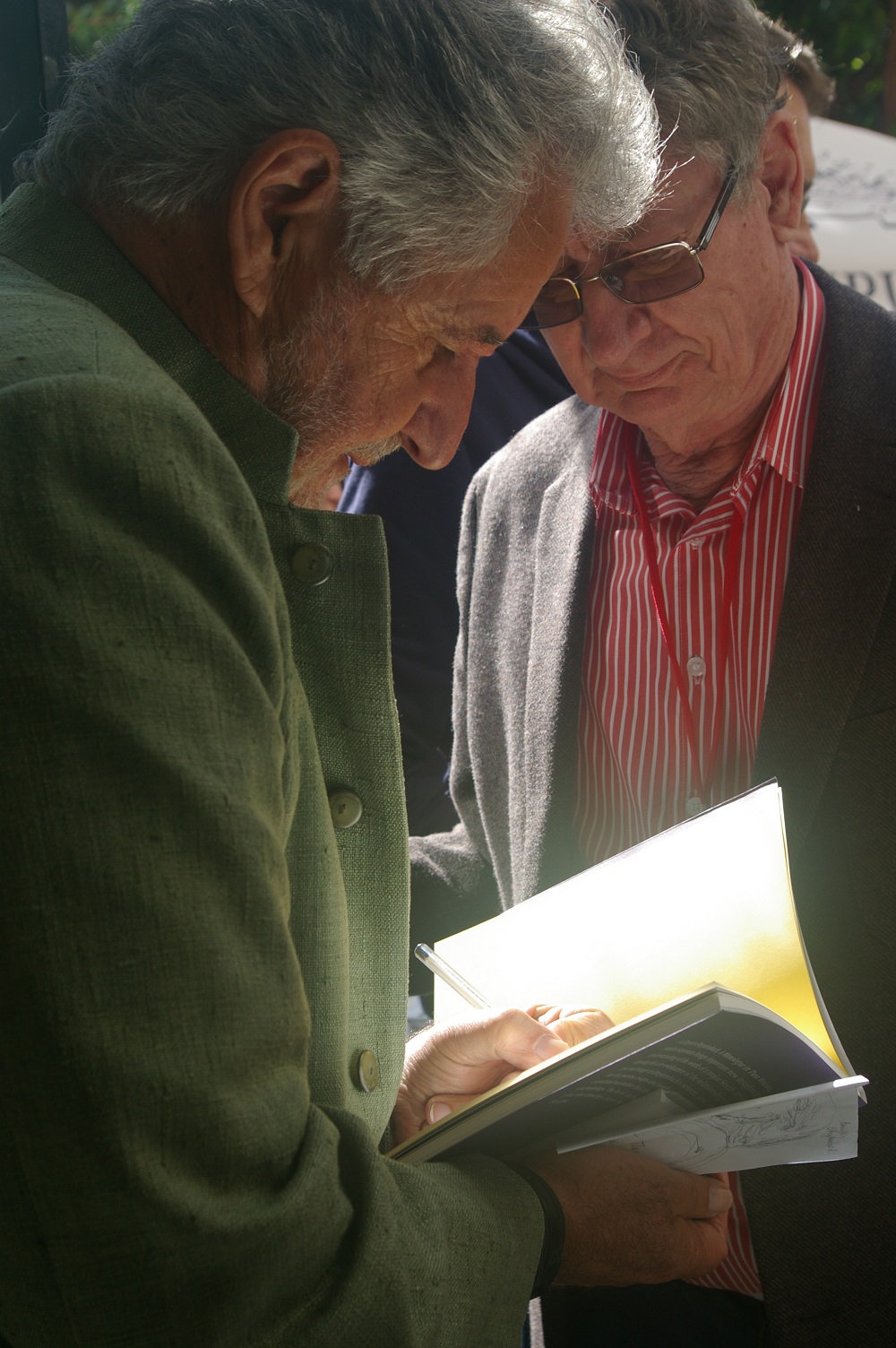
André with Breyten Breytenbach at the FLF

André with Breyten Breytenbach at the FLF

Franschhoek had all its other treats ready for us. Books and book lovers everywhere. The programme offered tons of stimulating encounters. The food and the wines were divine, as always. Gable Manor, the guest house we stayed in, was charming and cosy. In the words of Kgebetli Moele, the author of Untitled, who left a comment in the guest book the day before us: “Perfection!”
All that was missing was the time and space to enjoy it all, but festivals are by nature hectic creatures, especially if one is participating, leaving you dazed and exhausted for days afterwards. There is something about a festival that often puts me on edge. It’s not the participating on stage or being part of an audience, but rather the in-between of awkwardness when these boundaries are blurred.

I attended four sessions and a show during the weekend. The highlight was the show: Pieter Dirk-Uys’s AND THEN THERE WAS MADIBA! I have heard him speak at FLF and other events before, seen him numerous times on TV, and have cooked with Evita for years now, but I had never attended one of his live performances. Now I know that by not making it to one earlier, for years I have been depriving myself of laughter and insight. I will not be so stupid in the future. Dirk-Uys as Madiba or Zuma or Verwoerd was a sight to behold. He was priceless as Winnie. And underneath all the laughter and fun was a profound message of hope and being all together in this beautiful mess we call the New South Africa. There is always hope for a nation capable of laughing at its follies.

The sessions I attended were truly inspiring, worth every cent:

WHO GETS TO DECIDE WHAT’S LITERATURE
Jenny Crwys-Williams talking to Karin Schimke, Lauren Beukes and Imraan Coovadia about the interactions between authors, critics and readers. I found the following comments interesting:

Lauren said that nowadays authors have to be more social and put themselves out there. As Jenny pointed out, Lauren is highly successful in exploiting social media for book-promotion and is one of the few young South African writers who can write full-time because of commercial success. Lauren said that as a social person she counts herself lucky to be able to engage in the world of social media and enjoy it. She also said that she was fortunate in finding an agent who understood her vision. Lauren helps to promote other local writers by hosting The Spark on her blog. When she started with it, the idea was to have a white and a black writer alternatingly, which has proven impossible. It seems that black writers were not responding as readily to her requests as white writers (I had a similar experience when compiling Touch: Stories of Contact for which I was subsequently criticised, but I did approach many more black writers than ended up in the anthology; for various reasons some chose not to participate in the project; both Lauren and Imraan donated their fantastic stories for which I am still very grateful). She also praised her South African editor, Helen Moffett, who allows her to perform all kinds of acrobatic stunts in the air because she knows who is on the ground waiting to catch her if anything goes wrong. (As part of the trio Helena S. Paige behind the Girl series, Helen is not only a successful novelist, but also a sensual poet and a nurturer of South African literary talent.)

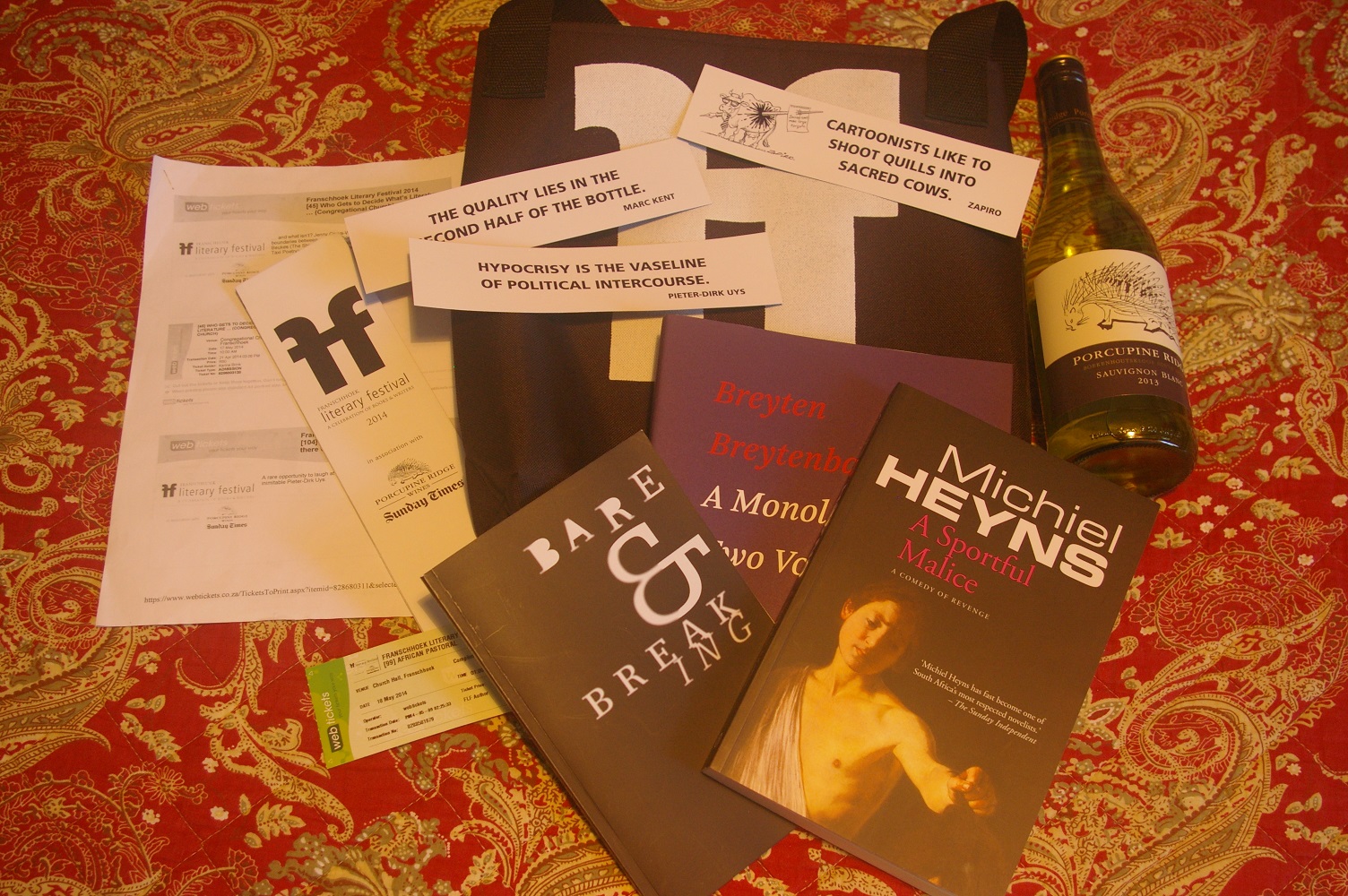
FLF books1Karin conceded that as a journalist she understands that she should be participating in the world of social media, but admitted to finding it exhausting. She made a wonderfully vivid comparison between twitter and being at a crowded cocktail party where all one longs for is a breath of fresh air, but getting to the door proves to be nearly impossible. (I cannot say how grateful I was for that image – I am too frightened to even enter that room – I am the one outside in a quiet corner, sipping the champagne, and reading a book). Karin did not get out of her way to market her book of poetry Bare & Breaking when it was published in 2012. Like most writers, she would love to be able to write in her chosen genre fulltime, but has to make a living otherwise. She has no illusions about being able to live off writing poetry in South Africa, but that is not what it is all about for her. As a writer, one has to understand one’s motives for writing, she said.

Imraan spoke about the difficulty of talking about the reading experience which is deeply personal and not always easily shareable. I loved his comment about the fact that a change in taste is proof of a “living mind”. He also mentioned that for him there are different ways of being a writer in the world. He referred to Damon Galgut who is shy and simply gets on with his writing without unnecessarily putting himself out there. He also said something very interesting: Why spend so much time on publicity if the reason you write is to get rich? Instead, one could invest the time in becoming a billionaire by other, more straightforward ways. For him, writing is about the “book and you”.

(After the session I bought a copy of Karin’s Bare & Breaking. Some time ago, I published a review of four Modjaji poetry titles, three of which I found outstanding, one less so. The positive comments I made about the three books went largely unnoticed. For my comments about the fourth one I got lynched. The heated reaction of the publisher and friends of the author to my negative remarks about the fourth volume sadly put me off further Modjaji titles. This is how I missed out on Karin’s book until now. But some of her comments about the volume and her own approach to writing made me curious enough to ignore my decision to keep away from Modjaji titles. On Saturday evening, I read some of Karin’s poems in the luxurious bath of our room with a view at Gable Manor and the moment I got out, I made my husband read them. We were both bowled over by her “sound-shades”. I look forward to discovering the rest of the volume.)

Here is one gem:

“Morning Work” by Karin Schimke

We are cocked and angled
together like an African chair,
groin-hinged and eye-locked,
small-talking the sun up.
At the join we are genderless
until – out of two flat triangles –
something flowers at us,
blooms bright as though
our eyes are suns
and it must find light.
We give it light, and we laugh,
and then bury it, lids shut,
so it can seed again.

THE CONSIDERED CANON
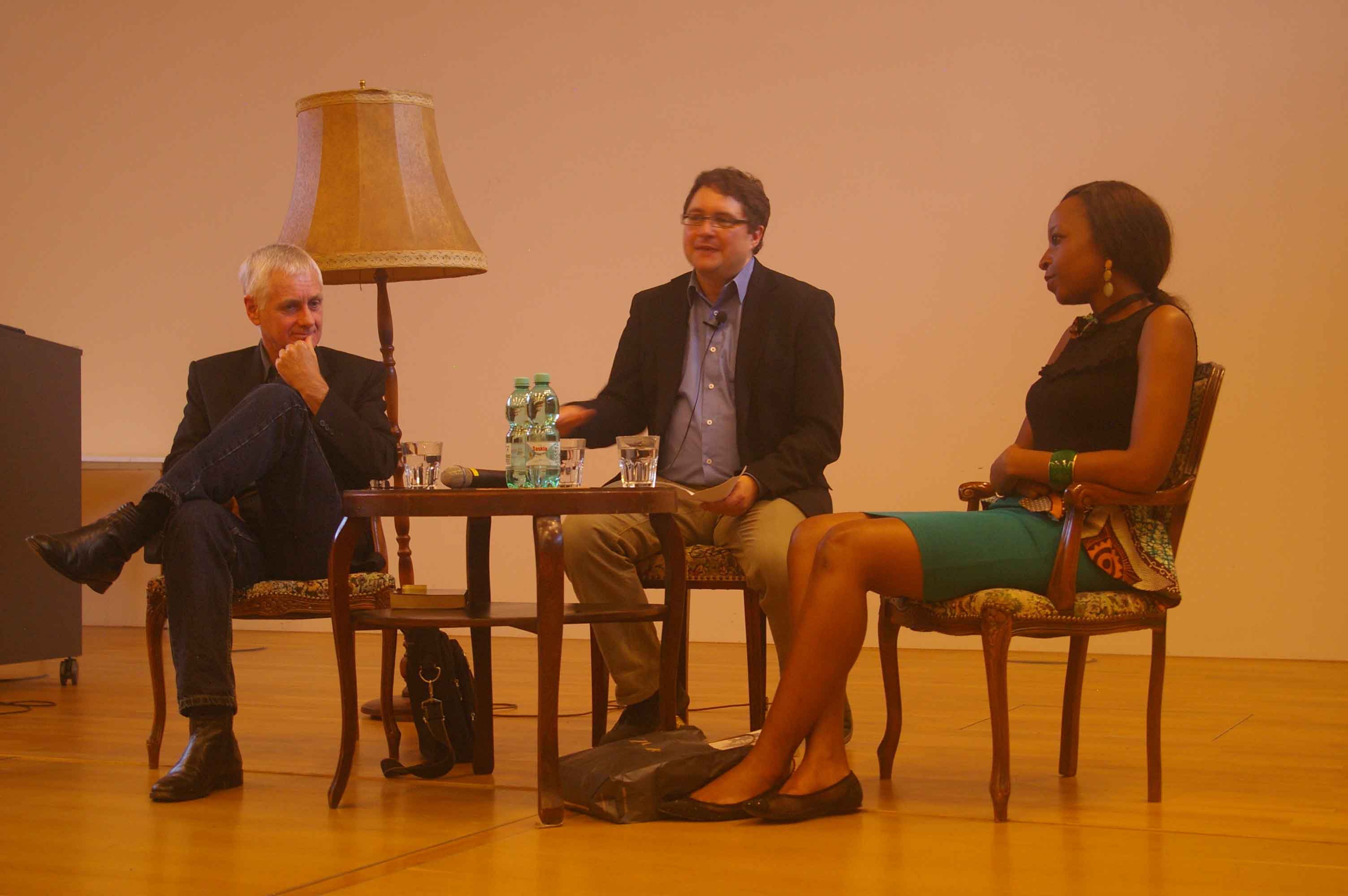
Imraan Coovadia spoke to Nadia Davids and Michiel Heyns about the Western and the South African literary canons. All three are novelists, reviewers and academics.

FLF books 2Nadia said something very moving about academics having the “privilege of learning to read deeply”. She sees the text as a social document that operates in the world, not only as something read for pleasure. During our talk the day before, I asked her whether her own novel, An Imperfect Blessing, was an attempt to write a people into history who had been underrepresented until recently, and she said yes, admitting that it was done with the full awareness of the pitfall of representation. That was her reason for including minute details of everyday Muslim family life in her story of specific historical moments (time round forced removals from District Six, the state of emergency in1986 and the year 1993, just before the first democratic elections). Michiel mentioned that while reading Nadia’s novel he was aware of her having read Jane Austen. What a compliment for any writer!

Nadia, Imraan and Michiel at the FLF

Nadia, Imraan and Michiel at the FLF

Imraan, who is an excellent book reviewer with the kind of gutsy eloquence which I lack, quoted from the curious Wikipedia entry about South African literature which made most of the audience shudder. Hope was expressed that people engaged in writing these entries will amend it to reflect less biased views. Imraan asked the panellists to name their own personal South African canons. The Story of an African Farm was there for both Nadia and Michiel. Michiel mentioned Bosman, Paton, J.M. Coetzee (Age of Iron and Disgrace); Nadia added Woza Albert!, The Island, Gordimer and Brink. Outside of South Africa, Nadia made a special mention of Anna Karenina, and Michiel of Middlemarch. Harold Bloom’s conservative take on the Western canon was discussed. Imraan found that according to Google the most mentioned South African books are Long Walk to Freedom, Cry, the Beloved Country, Country of My Skull, Heart of Redness, Ways of Dying, Spud, The Smell of Apples, The Power of One, and Master Harold and the Boys. He added Burger’s Daughter to the list himself, because “it should have been there.” I agree wholeheartedly.

Michiel Heyns is one of my favourite local book reviewers. (For five years, I’d had the honour of reviewing books alongside Imraan and Michiel for the Sunday Independent under the editorial guidance of Maureen Isaacson.) I always say that when I grow up I want to write reviews like his. I also had the privilege of working with him on Encounters with André Brink. Michiel is one of the few South African authors who see the entire world as their fictional playground, daring to write about topics other than local. I applaud him for that! Exciting news is that Michiel’s latest novel, A Sportful Malice, has been published last week. Talking about the Western canon, or any canon for that matter: the title derives from Shakespeare. Definitely something to look forward to! During the discussion, Michiel mentioned merit in relation to Nadia’s reference to the text as a social document. He spoke about literature and the canon as a “moral guide”, of showing you “how to live your life”. A test for any text is whether you are prepared to reread it, he said. I also think of it in terms of whether you want to share it with other people. The moment I find myself buying the same title over and over again for my friends, I know I have encountered a good book.

AFRICAN PASTORAL
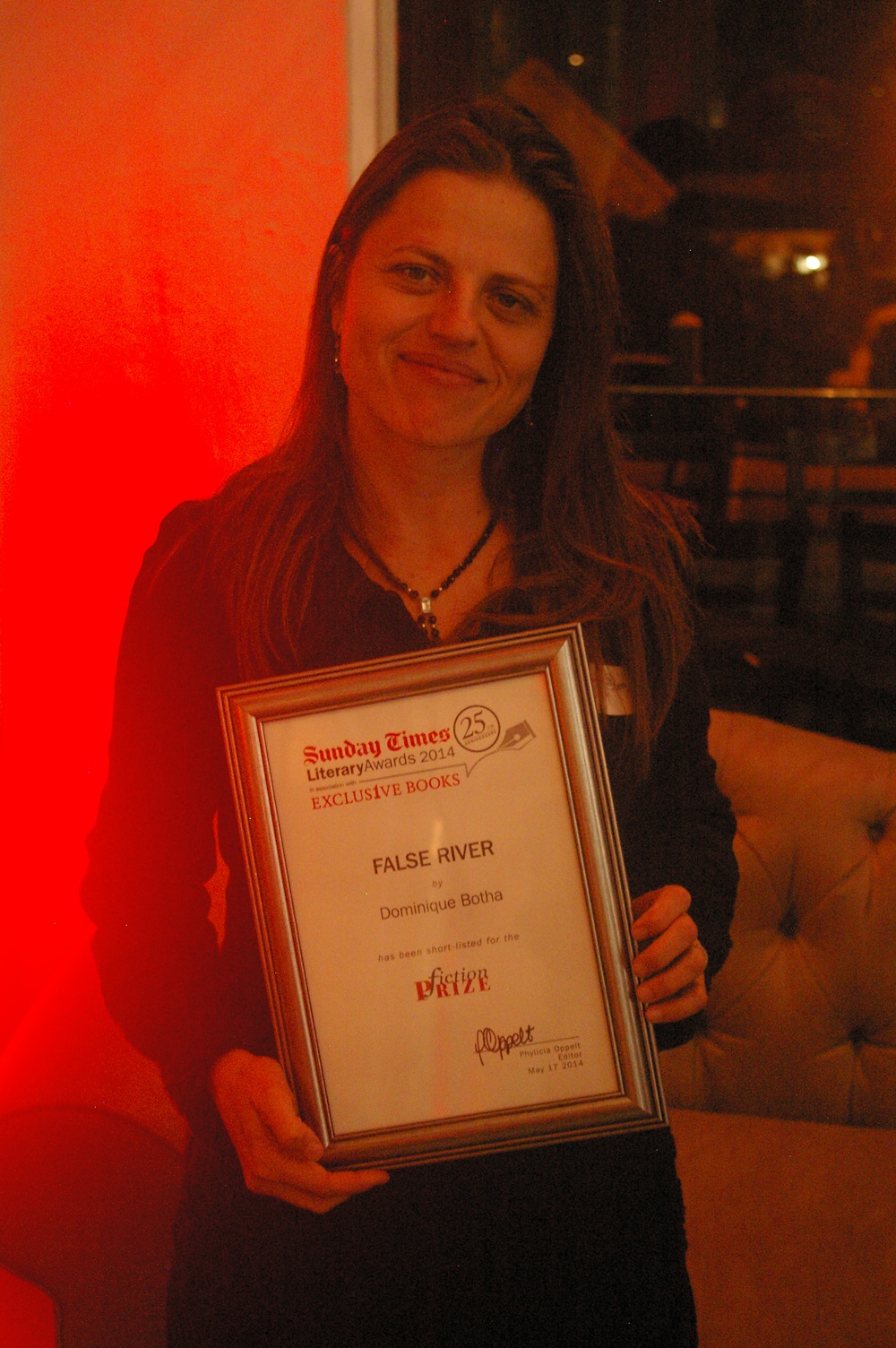
DominiqueHarry Garuba talking to Dominique Botha, Claire Robertson, and André Brink about their latest novels, False River, The Spiral House, and Philida, respectively.

Claire and Dominique are first-time novelists. Like André, Dominique writes in both languages, Afrikaans and English. She recommended to everyone in the audience to write in Afrikaans if they could, as she was thrilled with the kind of enthusiasm and reception she encountered on the Afrikaans literary scene. Her novel is based on her family story and she has kept the names of her family members in the book: “It’s my take on something that may or may not have happened,” she said. She is of the opinion that “it is much better to write truth and call it fiction than to write fiction and call it truth”. (During questions from the audience, I asked about her decision to keep the real names for a fictionalised story. She said the names were beautiful and that changing them would not have removed the problematic aspect of the situation. The people involved would still know that they are being written about, only the larger public not. I’m not entirely convinced. In cases like this, I always try to imagine what it would be like for me: I would feel uncomfortable about my own brother writing a fictionalised version of me and using my name for it in a novel. It simply would feel that it wasn’t me. Why my name then? If he was writing a memoir or biography, and attempting to reconstruct memories in the process without intentionally fictionalising them, I would have no issue with him telling anything about the family past we share and using my name. In a novel based on fact, on the other hand, I feel that a name change signifies that fiction is part of the parcel, that the people are no longer the ones you knew in real life but partly imagined characters who might reflect on real people but are their own creatures. This is particularly true for me when one writes about people who are still alive and who owe their own versions of a story. I don’t want to pretend to have final answers to this complicated process, not even for my own work, but I think it is an aspect of writing that should be treated with utmost care.)

Claire, who had the rare experience in South Africa of having her book go beyond the first impression within a very short period of time, spoke about the idea of a farm novel which not only connects us to the land but to something much larger. After she’d finished her novel, it revealed to her that what she had been writing about is the “urge to perform acts of rescue”. While writing, whether as a novelist or a journalist, she looks for “tragic flaws”, not “wickedness”, in people, whether it is in the men of the Enlightenment or the architects of apartheid.

Tellingly, I forgot to note who during the discussion said that memory is a “very personal and unreliable thing”.

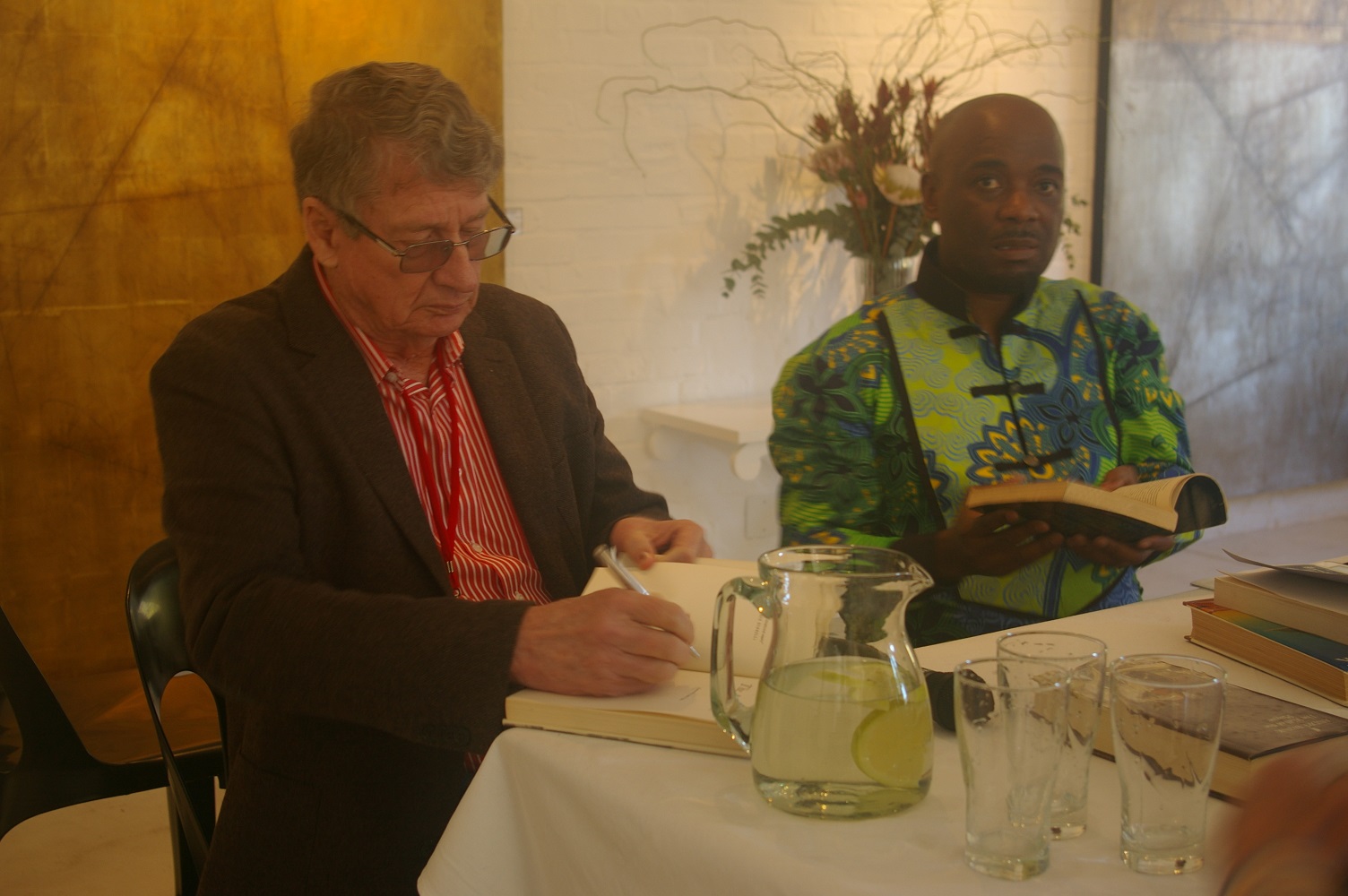
Victor and André

Victor and André

For André, whose novel Philida was born on and delves into the history of the nearby wine farm Solms-Delta, the act of writing begins when fact ends and imagination takes over. Through writing the story of Philida, he felt “enmeshed in my own life”. Philida could voice things which were difficult to communicate otherwise.
In the fourth event I attended (LITERARY DOYEN) Victor Dlamini, an insightful and patient interviewer (and one of my favourite photographers), spoke to André about his career, belonging, and Philida.

A note of thank you: Thank you Liz for all your kind words about my novel (you made my day!). Thank you to all for a weekend of literary delights!

Books sold (that I know of): 1 (thank you Nols – very kind of you! I hope you will enjoy it)
Books bought: 3
(I’m clearly not in it for the money.)

Of Treks, Wars and Stars

HeirToTheEmpireI still don’t really understand how it happened, but when I was about seven or eight years old and still living in the then Communist Poland, our school went to see Star Wars: Return of the Jedi in the cinema. The film made an enormous impression on me, at that stage not necessarily a good one. I was too young to digest the violence, especially when perpetrated against the cuddly, cute Ewoks. The scene where one of the Ewoks realises that their friend is not moving and will not get up again haunted my childhood dreams for many months to come. Despite this heartache and trauma, there was something about the Star Wars Universe that captured my imagination. When a few years later, I had the opportunity to see the entire original Star Wars trilogy, I was hooked for life. I cannot count how many times I have watched these movies, and how many more times I still will. I don’t seem to ever tire of them. I have also read some of the accompanying books, of which Timothy Zahn’s Thrawn Trilogy is my absolute favourite.

I am not a huge fan of the recent Star Wars film trilogy, although I love the way it portrays Anakin’s path to the Dark Side. And, obviously, I am counting the days until the first film in the latest Disney trilogy is released next year. I hope I can go and see it with Krystian, my brother, who is just as much a fan as I am. The fact that the original actor trio: Carrie Fisher (whom I also adore as an author), Harrison Ford, and Mark Hamill are going to be starring in the trilogy is fantastic. I have followed their careers with great interest for many years (I saw another all-time favourite for the first time – The ‘Burbs – just because Carrie Fisher starred in it).

Fisher Ford HamillTo see them reunited on a film project makes my heart sing. When I was thirteen and had a terrible crush on Luke Skywalker, I promised myself that one day when I am old enough, I am going to travel to Hollywood, declare my love to him, and we will live happily ever after, travelling through the Universe and defending it from all Evil (at that stage, I didn’t differentiate much between an actor and his role…). Then I grew up (and found out that Mark Hamill was one of the few people in Hollywood who actually seemed happily married and not looking to go on quests to rescue the Universe with some crazy Jedi wannabe).

imagesR77R8SAFAt some stage, while I was still at high school, my friend Thomas suggested that as a Star Wars fan I might enjoy watching Star Trek which he did religiously. I had accidently seen a few scenes from the series when zapping through TV channels but hadn’t found anything appealing in them. But then, Thomas asked me to just watch one full episode before passing final judgement. To humour him, I agreed, and that very afternoon settled down after to school to watch. I am not sure that I recall that first episode I saw correctly, but I know it blew my mind. That is how I became a Trekkie. Since them, I have also seen everything that there was to watch connected with the franchise, including the first seasons of Star Trek from the 60s. I was amazed how watchable they still were. A year or so ago, one of our channels available in South Africa repeated all the Star Trek feature films. I’ve always enjoy seeing those, too. What I like about them most is their subtle or not so subtle commentary on contemporary socio-political developments. J.J. Abrams’ latest Star Trek: Into Darkness’s take on ‘the hunt for a dangerous war criminal’ is not exactly subtle but brilliant nevertheless. It just shows you that real baddies are not always easy to identify.

Whether trekking or warring, these movies/series make one think beyond their special effects (no matter how spectacular), and that is what I treasure about them most. That, and the humour, the values, and the friendships they portray (Spock and Kirk, or Data and Geordie, or Luke and Han).

wishfuldrinkingI like the fact that the first Star Wars movie was born the same year I was.

My brother and I greet each other like Vulcans.

Once I tried wearing my hair like Princess Leia but my friend Jeremy pointed out that it rather looked like Chewie’s.

I drink Earl Grey tea when I write, a habit inspired by Jean-Luc Picard. Too bad I can’t order it from a replicator. Well, at least not yet…

I like reaching for the stars.

\\//_

May the Force be with you!

And a belated happy birthday to George Lucas!

A haven for diaries

Diaries
What pleasure to open a daily newspaper to two pages devoted only to writing and reading! Especially in times when less and less space is spared for such ‘archaic’ occupations. The Cape Times‘ book page(s) appear(s) every Friday. Yesterday, a full spread was filled with reviews, book marks, information about upcoming literary events, and a heart-warming article by Katie Grant about The Great Diary Project.

I began keeping a diary in 1989. The first one was a Mickey Mouse journal with a lock. I got it from one of my Dad’s (he used to be a coach) cyclists and his girlfriend for my 12th birthday. There was also a matching fountain pen which my brother still feels sorry about accidently destroying a few years later. I started the diary on 29 January, a day after my birthday, and wrote about the party, the cake my Mom baked (the entry includes a surprisingly accurate sketch of the leftovers), and a line about how strange it was to be a twelve-year-old girl.

Since then I have filled many other diaries, all of which I have with me in my study in Cape Town. I read some of the entries today and can’t stop smiling and blushing – that kiss on a park bench near my high school, that longing and the confusion, that first break-up with all the door slamming and high drama, or all that sand in my hair after a night on the beach with R and my Mom’s loaded silence when I slipped back into our guesthouse room in the early morning hours – it’s all there, not necessarily only in words, somehow dormant and forgotten, and yet immediately brought back to life the moment I begin reading… The smell of the Baltic Sea during that rainy summer. I would never have been able to remember most of it. But the diaries hold all my former selves and remind me why I still feel that Wednesdays are special, why I love getting handwritten letters, why that particular shade of blue, or why chocolate flavour.

To think what treasures the collection of The Great Diary Project holds…

Invisible Others at Clarke’s Bookshop

IO at Clarkes2Not surprisingly, since Protea Book House is my publisher, I sighted the first copies of Invisible Others on a bookshop shelve at the Rondebosch branch of Protea Bookshop where the novel was also launched a few days ago. The Book Lounge also launched it, so no surprise to see it there either. But when I saw Invisible Others prominently displayed at Clarke’s Bookshop in Long Street where I had no launch and where I do not know a single soul, that gave me a real thrill. It felt like the novel had truly made it into the world and from then on embarked on a life as an independent creature. May that journey be full of wonder and joy!

To order Invisible Others from Clarke’s Bookshop click here: How to order.

Invisible Others at Clarke's Bookshop, photos by Roma Szczurek

Invisible Others at Clarke’s Bookshop, photos by Roma Szczurek

A literary ‘rainbow nation’ in Regensburg

University of Regensburg

University of Regensburg

At the beginning of April, I attended a literary conference in Regensburg, Germany. Organised by Prof. Jochen Petzold, the conference intended to shed light on some of the developments in recent South African literature. Two days, various themes, and an intimate crowd of eager participants amounted to a very stimulating experience which reconfirmed for me the decision not to forsaken academia all together just yet. The papers covered a wide range of topics, from youth literature to writing on HIV/AIDS, with the farm novel and Indian Ocean literature thrown into the mix.

UK Quartet Books edition

UK Quartet Books edition

The conference kicked off with a paper by Chris Warnes which put a smile on my face because Warnes spoke about ideas being more productive than theory. Taking popular fiction seriously, Warnes explained how romances, crime novels, and thrillers can tell us more about present-day South Africa than ‘serious’ writing. The next speaker, Michael Cawood Green, read an excerpt from his upcoming novel. Full of scrumptious ideas, it gave one more food for thought than most theoretical writing ever can. A few years ago, I had the pleasure of reviewing Green’s fascinating novel For the Sake of Silence (2008). It remains one of my all-time favourite books, and I am deligthed now to own a signed hardback copy given to me by the author.

We continued with papers on Achmat Dangor‘s Bitter Fruit, trauma and memory, and young adult literature. I shared the slot with Sandra Stadler who has done some ground-breaking work on the YA genre in South Africa. Her thesis is something to look forward to.

Focusing on Nadine Gordimer’s The House Gun, Ivan Vladislavić’s Portrait with Keys, Stephen Watson’s A City Imagined , Antjie Krog’s Body Bereft, and the theoretical backbone done on the city in South African literature by such scholars as Achille Mbembe, Sarah Nuttall and Michael Titlestad, I spoke about how among urban spaces, Johannesburg and Cape Town dominate the literary topography of the country, and how the latter is fast on its way to becoming South Africa’s capital of crime fiction with internationally best-selling authors like Deon Meyer, Margie Orford, Roger Smith, Sarah Lotz or Mike Nicol, making Cape Town the preferred settings of their literary crimes.

Mike Nicol and Angela Makholwa

Mike Nicol and Angela Makholwa


That evening, two crime specialists, Angela Makholwa and Mike Nicol, read to us from their latest work, and together with our host, Jochen Petzold, spoke about their experience of the crime genre in South Africa and abroad.
Mike Nicol, Jochen Petzold, and Angela Makholwa

Mike Nicol, Jochen Petzold, and Angela Makholwa

The next day began with two papers on the HIV pandemic as reflected in literature and culture. The farm novel dominated the next slot on the programme. It seems nowadays that no conference on South African literature can do without a vivid discussion on the elusive ending of J.M. Coetzee’s Disgrace. There are usually as many interpretations as people in the room, and so this time. The novel continues to haunt literary scholars.

Speaking about Aziz Hassim’s Revenge of Kali, Felicity Hand quoted a sentence from the novel which stuck in my head: “Only a corpse knows the loneliness of the grave.” The conference ended with three papers focused on Afrikaans literature. Cilliers van der Berg spoke about Afrikaans literature as a “minor discourse”, Adéle Nel about the “sense of ending” in some contemporary novels, and Willie Burger about the difficulties of categorisation that diversity brings with it.

I left Regensburg full of new ideas, a long list of titles to read, and a feeling of being part of a vibrant, exciting, and bold literary culture in South Africa.

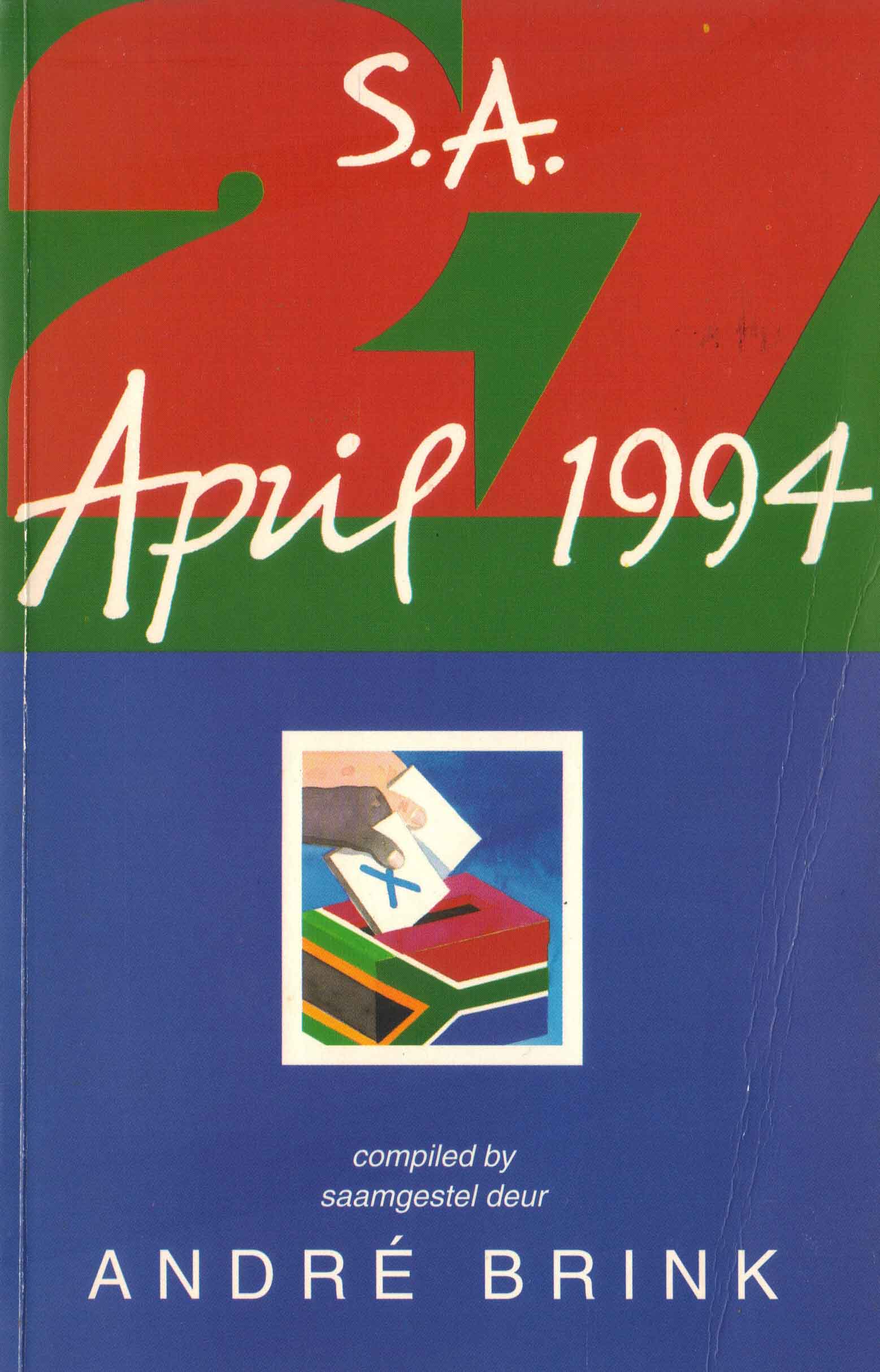
27 April 1994: Two Decades Later

27 April 1994SA 27 APRIL 1994: AN AUTHORS’ DIARY * ‘N SKRYWERSDAGBOEK (Queillerie, 1994)
Edited by André Brink

“…here was an opportunity for writers to test their word against, arguably, the most remarkable moment in their history.” André Brink in “To the Reader”, p. 8.

“Later, sun low, tide running out in me, I bus into the township shack of my dear love, my need of her never so strong.
[…]
She reads me, smiles, her eyes soft in the room’s dusk, her hands beckoning me to come.
‘It’s done,’ she whispers, ‘we have walked the last mile!’
Later still, I help her to the bed. We are careful with each other as though we hold a fine glass, and my heart sings.
Yes, against all odds, my heart sings.” Tatamkulu Afrika in “Against All Odds, My Heart Sings”, p. 13.

“Mens se hart is bly: niemand gaan hierdie stukkies toekoms wat die mense vashou weer kan wegneem nie. Byna wil ek sê: hierdie land se politici verdien wragtig nie so ‘n wonderlike bevolking nie.” Breyten Breytenbach in “Joernaal van ‘n wending”, p. 25.

“The day has been captured for me by the men and women who couldn’t read or write, but underwrote it, at last, with their kind of signature. May it be the seal on the end of illiteracy, of the pain of imposed ignorance, of the deprivation of the fullness of life.” Nadine Gordimer in “April 27: The First Time”, p. 52.

“We all know that it won’t be a smooth road ahead.” Jenny Hobbs in “The Day We Minded Our Peace in Queues”, p. 60.

“An Organisation must be disciplined, purposeful, and idealistic in a good sense. It must also be diverse, in that it must encompass others, beyond its own affiliates. It must be committed and dedicated to one goal and one goal only: to change the miserable conditions of people to enable them to live full and rich lives; it must inspire them to realise their full intellectual potential.” Mazisi Kunene, p. 73.

“My greatest victory and achievement as an individual is to know that my children and grandchildren and their age groups in my community move with grace and dignity as full-fledged citizens of South Africa, and with full rights to determine the future of our country.” Ellen Kuzwayo in “The First Democratic Elections in South Africa”, p. 80.

“Peace is like an undying light / Shining and glowing from within / Within each one of us” Gcina Mhlophe in “Peace Is Within”, p. 85.

“Perhaps it [Table Mountain] was reaffirming its old lesson on faith: on election day. That the future is there for us: we need to have faith in it, and in ourselves. And so I ended my day unemotionally, but deeply affirmed.” Njabulo S Ndebele in “Elections, Mountains, and One Voter”, p. 95.

“I picked up the pencil that was well chewed and attached to the makeshift desk by a length of string and put my cross, quickly, trying not to agonise about it yet again.” Mike Nicol in “Voting at the Camel Rock Café”, p. 98.

“Wanner iemand my vra wat dink ek van ons toekoms, dan antwoord ek ons mag die toekoms nie ken nie: so bly elke dag ‘n avontuur.” Jan Rabie, p. 108.

“So, Mammie en Derri, cheers! Ek leef – kyk, ek leef – in ‘n nuwe Suid-Afrika!” Adam Small in “Feniks: ‘n brief, kamma, aan my ouers (wat al dood is)”, p. 123.

“It was after three hours walking, at 7 am, that I cast my two votes at the Dwarsrivier polling station. It was quite clear that I was the very first person to vote there. No doubt the IEC staff manning the station had been expecting something extraordinary all along, but not for the first voter suddenly to appear, as I had done, out of the mountains behind the school-hall that served as the polling station.” Stephen Watson in “Voting With My Feet”, p. 162.

“Want vir die heel eerste keer in my lewe was ek ‘n vry Suid-Afrikaan.” Melvin Whitebooi in “Au revoir”, p. 171.

Contirbutors: Tatamkulu Afrika, Hennie Aucamp, Chris Barnard, Breyten Breytenbach, Kerneels Breytenbach, André Brink, Achmat Dangor, Abraham H de Vries, Arthur Goldstuck, Jeanne Goosen, Nadine Gordimer, Rachelle Greeff, Jenny Hobbs, Peter Horn, Daniel Hugo, Elsa Joubert, Antjie Krog, Mazisi Kunene, Ellen Kuzwayo, Dalene Matthee, Mzwakhe Mbuli, Gcina Mhlophe, Petra Müller, Njabulo S Ndebele, Mike Nicol, Welma Odendaal, Abraham Phillips, Marguerite Poland, Jan Rabie, Albie Sachs, Riana Scheepers, Gus Silber, Adam Small, Berta Smit, Peter Snyders, Klaas Steytler, Alexander Strachan, Pieter Dirk-Uys, Madeleine van Biljon, Marita van der Vyver, Marlene van Niekerk, Lettie Viljoen (Ingrid Winterbach), Stephen Watson, George Weideman, Melvin Whitebooi